It's 2 PM on a Friday before a holiday weekend. Your flagship IPA is flying off shelves, distributors are calling for more cases, and the packaging line just stopped. The filler's rotary valve seized—a $400 part that nobody stocked because "it never fails." Four hours later, the line restarts, but you've lost 3,200 cases of product, missed two truck departures, and your largest distributor is questioning whether you can handle their volume.
Brewery packaging lines operate at the intersection of precision engineering and biological unpredictability. Unlike discrete manufacturing, you're packaging a living product with narrow quality windows. A 30-minute delay isn't just lost production—it's potentially compromised beer sitting in the filler, oxygen pickup degrading flavor, and temperature excursions affecting carbonation. Your packaging line SLA must account for these unique constraints.
This guide establishes a framework for designing Service Level Agreements that match packaging line reliability to brewery production demands. Breweries implementing structured SLA-driven maintenance achieve 85-95% Overall Equipment Effectiveness (OEE) while reducing unplanned downtime by 60-75%. Ready to engineer reliability into your packaging operation? Sign up free to start building your packaging line SLA.
What if your packaging line uptime was guaranteed by design—not hoped for by luck?
Understanding Packaging Line Dynamics
A brewery packaging line is only as reliable as its weakest component. Understanding how each element contributes to—or detracts from—overall line efficiency is the foundation of effective SLA design.
→
→
Filler/Crowner
500 BPM
Bottleneck
→
→
→
→
BPM = Bottles Per Minute | Line speed governed by bottleneck station
Critical Equipment Reliability Profiles
Typical MTBF
2,400 hours
Avg Repair Time
2.5 hours
Common Failures
Valve seals, fill tubes, timing belts
Typical MTBF
1,800 hours
Avg Repair Time
45 minutes
Common Failures
Label jams, sensor drift, glue system
Typical MTBF
3,200 hours
Avg Repair Time
1.5 hours
Common Failures
Pneumatic cylinders, photo-eyes, chain wear
Typical MTBF
4,800 hours
Avg Repair Time
30 minutes
Common Failures
Belt tracking, motor bearings, gearbox
The True Cost of Packaging Line Downtime
Before designing SLAs, you need to quantify what downtime actually costs. Most breweries dramatically underestimate true downtime costs by focusing only on lost production—ignoring quality impacts, labor inefficiency, and customer relationship damage.
Lost output (500 BPM × 60 min = 30,000 bottles/hour)
At $0.15 margin/bottle = $4,500/hour
6 operators idle during downtime @ $25/hr = $150/hour
Overtime to recover schedule = $225/hour (1.5x)
Beer in filler during stoppage (potential dump) = $800-2,000
Restart quality checks and adjustments = 15-30 min lost
Missed shipping windows = $500-2,000 expediting
Distributor penalties/chargebacks = Variable
Estimated Total Downtime Cost
$5,000 - $7,500 per hour
Designing Your Packaging Line SLA
An effective SLA translates reliability goals into measurable commitments with clear accountability. Your SLA should define what performance levels are acceptable, how they're measured, and what happens when targets are missed.
SLA Tier Structure
Availability
≥98%
Performance
≥97%
Quality
≥99.5%
Response Time
≤15 min
Best for: High-volume flagships, seasonal peaks, contract brewing
Availability
≥95%
Performance
≥92%
Quality
≥99%
Response Time
≤30 min
Best for: Standard production runs, core portfolio SKUs
Availability
≥90%
Performance
≥88%
Quality
≥98%
Response Time
≤60 min
Best for: Limited releases, experimental batches, low-volume SKUs
OEE Component Breakdown
Availability
×
Performance
×
Quality
=
OEE
95%
×
92%
×
99%
=
86.5%
Availability
Run Time ÷ Planned Production Time
Losses: Breakdowns, changeovers, material shortages, operator absence
Performance
Actual Output ÷ Theoretical Output (at rated speed)
Losses: Reduced speed, minor stops, jams, sensor faults
Quality
Good Units ÷ Total Units Produced
Losses: Rejects, rework, underfills, mislabels, damaged packages
Cutting Downtime with Foresight — A Food & Beverage Manufacturing Lifecycle with Automation
Predictive maintenance transforms SLA achievement from reactive firefighting to proactive prevention. IoT sensors continuously monitor equipment health, AI analytics identify failure patterns, and work order automation ensures issues are addressed before they cause line stops.
IoT Sensor Deployment for Packaging Lines
Filler Zone
Vibration Sensors
Rotary bearings, drive motors, carousel alignment
Pressure Transducers
Fill bowl pressure, CO2 counter-pressure, valve actuation
Temperature Probes
Product temperature, bowl jacket, motor windings
Flow Meters
Fill volume consistency, CIP flow rates
Labeler Zone
Vision Systems
Label placement, skew detection, missing labels
Tension Sensors
Web tension, label feed consistency
Temperature Monitors
Glue system temperature, hot melt applicators
Conveyor System
Current Monitors
Motor load, detecting belt drag or mechanical binding
Speed Sensors
Line synchronization, accumulation table status
Proximity Sensors
Bottle presence, jam detection, queue levels
AI-Powered Risk Scoring
AI analytics aggregate sensor data into actionable risk scores, enabling maintenance teams to prioritize interventions based on failure probability and business impact.
Schedule This Week
Schedule Within 48hrs
Immediate Action
Next PM Cycle
Schedule This Week
Schedule Within 48hrs
Monitor Only
Next PM Cycle
Schedule This Week
Work Order Automation Flow
01
Anomaly Detection
Filler bearing vibration exceeds learned baseline by 35%
02
Risk Assessment
AI calculates 78% failure probability within 5 days — High risk score assigned
03
Work Order Generation
System creates WO with bearing specs, historical data, and OEM manuals attached
04
Smart Scheduling
WO scheduled during next planned changeover — zero additional downtime
05
Mobile Execution
Technician receives notification, scans barcode/QR, completes repair with photo documentation
06
Audit Trail Complete
All data logged for compliance—FDA, FSMA, and customer audit requirements satisfied
Food & Beverage Manufacturing Compliance Requirements
Brewery packaging operations must satisfy regulatory requirements that go beyond equipment reliability. Your CMMS must capture the documentation that auditors expect—automatically, without adding burden to operators.
FDA
FDA 21 CFR Part 117
Preventive controls for human food including equipment maintenance and sanitation
Required: Maintenance logs, sanitation records, corrective action documentation
FSMA
Food Safety Modernization Act
Hazard analysis and risk-based preventive controls
Required: Equipment verification records, monitoring documentation, audit trail
SQF
Safe Quality Food Certification
Equipment maintenance programs with documented schedules
Required: PM schedules, completion records, calibration logs
TTB
Alcohol and Tobacco Tax and Trade Bureau
Production records, equipment calibration for fill volumes
Required: Filler calibration records, volume verification documentation
Oxmaint CMMS generates audit-ready reports automatically from daily maintenance activities. When auditors arrive, documentation is complete, organized, and instantly accessible—not scattered across clipboards and filing cabinets. Get started free with automated compliance documentation.
Food & Beverage Manufacturing CMMS Best Practices
Implementing maintenance software food & beverage manufacturing operations requires attention to industry-specific requirements. These best practices maximize value while ensuring food safety and regulatory compliance.
01
Separate Food-Contact Equipment
Tag and categorize equipment that contacts product separately from utilities and infrastructure. Food-contact equipment requires different PM frequencies, lubricant specifications, and documentation requirements.
02
Integrate Sanitation and Maintenance
CIP (Clean-in-Place) cycles and sanitation events should be tracked alongside maintenance. Some maintenance tasks must follow sanitation; others must precede it. Your CMMS should enforce these sequences.
03
Specify Food-Grade Materials
Work orders should automatically specify NSF H1 lubricants, food-safe gaskets, and compliant replacement parts. Technicians shouldn't have to remember which lubricant goes where—the system should tell them.
04
Enable Mobile Inspections
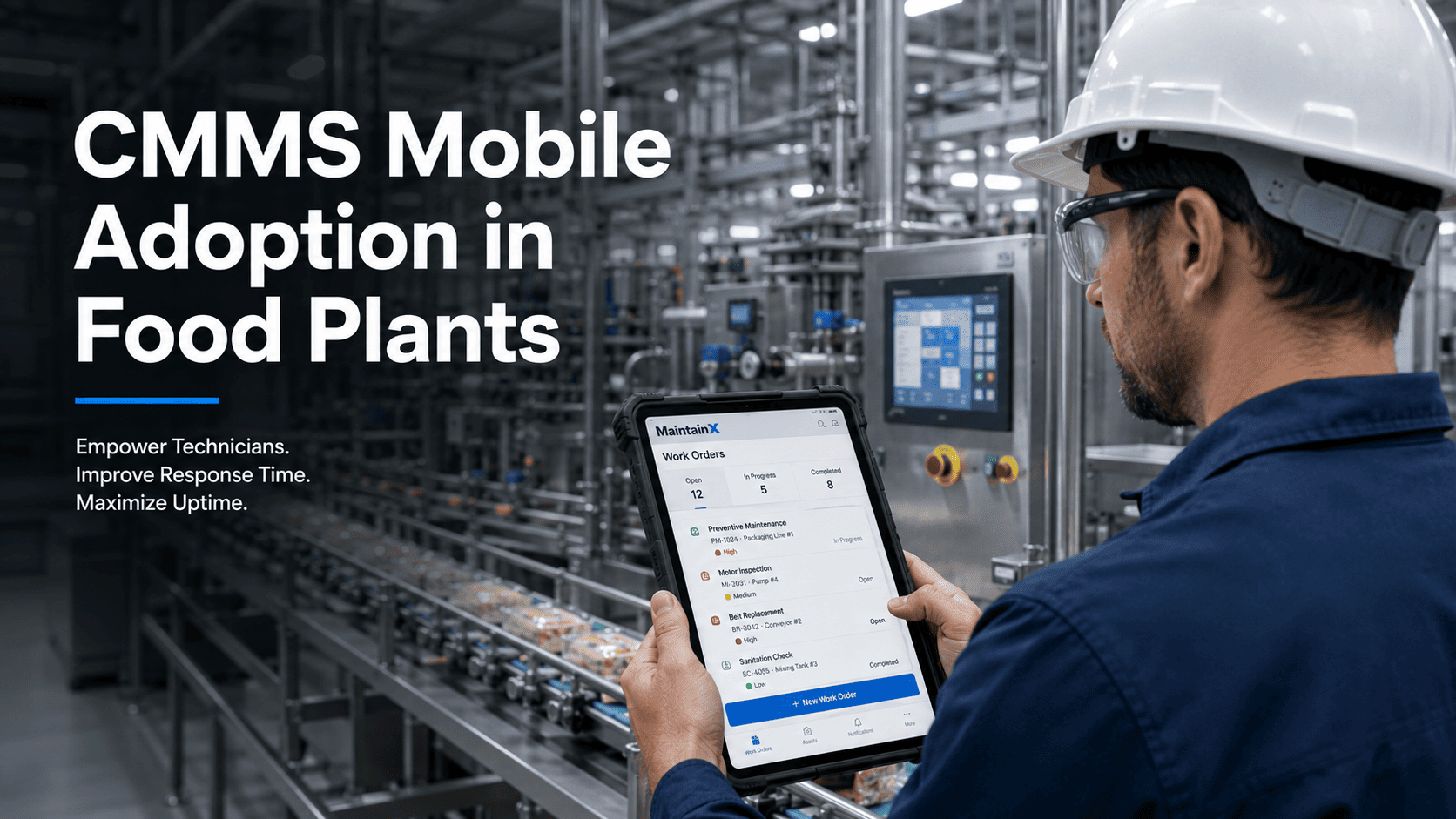
Operators conducting pre-shift inspections should use mobile devices with guided checklists. Digital capture ensures nothing is missed, photos document conditions, and data feeds directly into the CMMS.
05
Track Allergen Changeovers
For breweries producing flavored or specialty products, allergen changeover protocols must be documented in the maintenance system. Each changeover becomes a trackable work order with verification steps.
06
Connect to Production Scheduling
Maintenance windows should align with production schedules. The CMMS should know when lines are scheduled for changeovers, cleaning, or downtime—and automatically schedule maintenance during those windows.
Multi-Site Rollout Considerations
Growing brewery groups with multiple production facilities need SLA frameworks that scale. Standardization enables meaningful cross-site benchmarking while accommodating legitimate local differences.
- OEE calculation methodology
- Equipment criticality classifications
- Failure code taxonomies
- Work order categories and priorities
- Compliance documentation requirements
- KPI definitions and targets
- Equipment-specific PM intervals
- Local vendor and parts sources
- Shift schedules and maintenance windows
- Site-specific equipment configurations
- Regional regulatory requirements
- Legacy system integrations
Measuring SLA Performance
Your SLA is only meaningful if you measure and report on it regularly. These metrics should be reviewed weekly by operations leadership and monthly by executive management.
Target: 85% (Gold SLA)
On Target
Target: ≤30 min
On Target
Target: ≤2.0 hrs
Needs Attention
Target: ≥95%
Needs Attention
Build reliability into your packaging line by design. Start with the tools that make SLA achievement measurable and manageable.
Frequently Asked Questions
What OEE target is realistic for a craft brewery packaging line?
World-class OEE for beverage packaging is typically 85%+, but craft breweries with frequent changeovers and smaller batch sizes often achieve 70-80% as a realistic target. Focus on incremental improvement rather than arbitrary benchmarks. A brewery currently at 60% OEE should target 70% before aiming for 85%. The key is consistent measurement and continuous improvement.
How do we handle SLA metrics during planned changeovers?
Planned changeovers should be excluded from availability calculations but tracked separately as "planned downtime." Your SLA should define standard changeover times by SKU transition type. Changeovers exceeding the standard become an improvement opportunity. Some breweries include changeover efficiency as a separate SLA metric alongside OEE.
What IoT sensors provide the best ROI for packaging line monitoring?
Start with vibration monitoring on the filler—it's your bottleneck and most expensive equipment. Add pressure monitoring for CO2 and product bowl. Temperature monitoring on critical motors and the filler bowl provides early warning of failures. Vision systems for label verification improve quality metrics. Most breweries see positive ROI within 6 months from prevented failures on the filler alone.
Try free to assess sensor opportunities for your line.
How do we balance PM scheduling with production demands?
Integrate your CMMS with production scheduling. Identify natural maintenance windows—changeovers, CIP cycles, shift changes, weekends—and schedule PMs to coincide. For critical equipment, consider condition-based maintenance that extends intervals when equipment is healthy rather than interrupting production for calendar-based PMs. Reserve 15-20% of scheduled maintenance capacity for unplanned work.
What documentation do FDA auditors typically request for packaging equipment?
Auditors commonly request preventive maintenance schedules and completion records, equipment calibration logs (especially for fillers), sanitation and CIP records, corrective action documentation for equipment failures, training records for maintenance personnel, and change control documentation for equipment modifications. Oxmaint CMMS generates all these reports automatically from daily operations data.
How do we get operators to adopt mobile inspections?
Start with pre-shift inspections that operators already perform—digitize existing checklists rather than adding new tasks. Make mobile devices available at the line (tablets or rugged smartphones). Keep checklists short and focused. Show operators how their input drives maintenance response. Celebrate catches that prevented failures. Resistance typically indicates the inspection process adds burden without visible value—address that perception first.