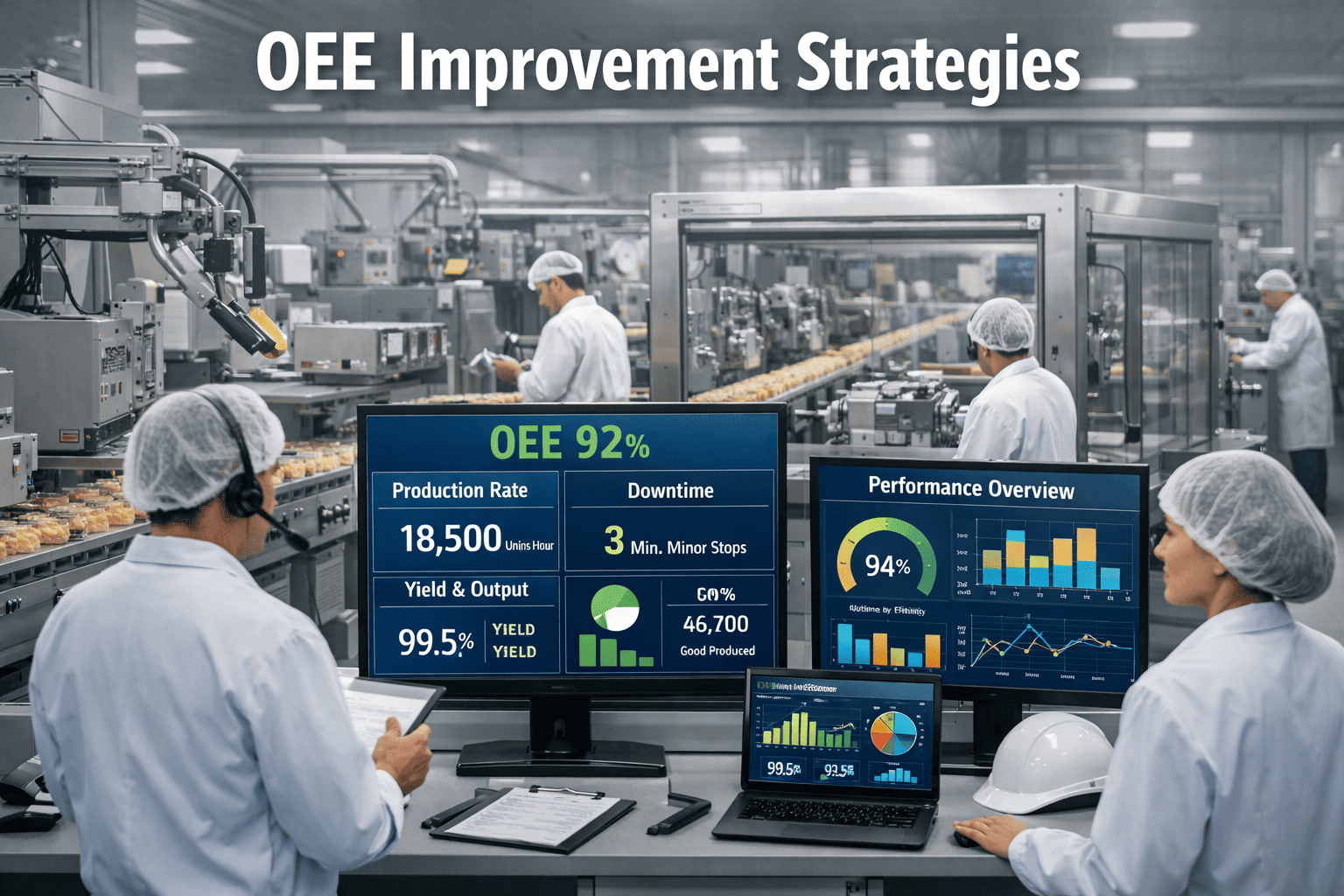
A snack food manufacturer ran their flagship packaging line at 67% OEE for three years, assuming that was simply "how the equipment performed." When a new operations manager analyzed the data, she discovered that 18% of capacity was lost to unplanned maintenance stops, 9% to extended changeovers, and 6% to minor stoppages nobody tracked. Within eight months of implementing maintenance analytics by Signing Up to Oxmaint and targeted improvements, OEE climbed to 82%—the equivalent of gaining an entire extra shift of production weekly without buying new equipment.
Production line efficiency determines whether food processing facilities meet customer demands profitably or struggle with capacity constraints and margin pressure. Every percentage point of efficiency improvement translates directly to throughput gains—often worth millions annually on high-volume lines. Yet many facilities operate well below their equipment's potential because they lack visibility into where losses occur and which maintenance practices drive performance. This guide examines the factors that influence production efficiency and the maintenance strategies that maximize throughput. Book a demo to see how Oxmaint's Maintenance Analytics help food processors optimize line performance.
Operations Optimization / Efficiency
Production Line Efficiency in Food Processing
Understanding and improving the factors that drive throughput, quality, and profitability on processing lines.
World-Class OEE
85%+
Availability × Performance × Quality
Typical Food Industry
60-70%
Significant improvement opportunity
Hidden Capacity
15-25%
Recoverable through optimization
The Six Big Losses Affecting Production Efficiency
OEE methodology identifies six categories of loss that reduce production efficiency. Understanding where your losses occur guides improvement priorities.
Availability Losses
1
Equipment Failures
Unplanned stops due to breakdowns—the most visible and often most costly loss category.
2
Setup & Adjustments
Changeovers, startups, and adjustments that consume production time.
Performance Losses
3
Minor Stoppages
Brief interruptions—jams, sensor trips, material feed issues—often untracked but significant.
4
Reduced Speed
Running below design speed due to equipment issues, product characteristics, or operator caution.
Quality Losses
5
Startup Rejects
Product scrapped during warmup, stabilization, and initial production runs.
6
Production Rejects
Defective product during steady-state operation—rework, scrap, and downgrades.
Identify Your Hidden Losses
Oxmaint's Maintenance Analytics tracks downtime, identifies patterns, and reveals where your production capacity is being lost.
Maintenance Practices That Drive Efficiency
Equipment reliability is the foundation of production efficiency. These maintenance practices directly impact line performance. Implement these practices with Oxmaint by Signing Up.
Scheduled maintenance prevents breakdowns that stop production unexpectedly. Effective PM programs achieve 95%+ completion rates with tasks timed to minimize production impact.
Impact:
25-50% reduction in unplanned stops
Condition-based maintenance catches problems before failure, enabling planned repairs rather than emergency stops.
Impact:
70-90% of failures predicted
Operators perform basic care—cleaning, inspection, lubrication—catching issues early and freeing technicians for complex work.
Impact:
Faster problem detection
Every breakdown is an opportunity to prevent future failures. Systematic RCA identifies why failures occur and what changes will prevent recurrence.
Impact:
Eliminates repeat failures
Critical spares on hand minimize repair time. Stock parts that frequently fail or have long lead times.
Impact:
50-80% faster repairs
Technician expertise directly affects repair speed and quality. Cross-training builds flexibility for complex issues.
Impact:
Reduced MTTR
Understanding OEE Components
OEE breaks efficiency into three measurable factors. Improving each component contributes to overall line performance.
Run Time ÷ Planned Production Time
Measures the percentage of scheduled time the equipment is available for production. Reduced by breakdowns, changeovers, and adjustments.
Target: 90%+
Improve by: Preventive maintenance, SMED changeovers, reliability engineering
Actual Output ÷ Theoretical Output
Measures how close to design speed the equipment runs when operating. Reduced by minor stoppages and running below rated speed.
Target: 95%+
Improve by: Minor stoppage tracking, speed optimization, operator training
Good Units ÷ Total Units Produced
Measures the percentage of production that meets specifications. Reduced by startup rejects and in-process defects.
Target: 99%+
Improve by: Process control, equipment precision, startup procedures
Example Calculation
90% Availability × 95% Performance × 99% Quality = 84.6% OEE
Track Your OEE Automatically
Oxmaint calculates OEE from your maintenance and production data—showing trends, losses, and improvement opportunities.
Quick Efficiency Wins
Start improving production efficiency this week with these practical actions. Schedule a consultation for customized recommendations.
This Week
Start Tracking Downtime
Log every stop with reason codes. You can't improve what you don't measure.
This Week
Identify Top 3 Problem Assets
Which equipment causes the most stops? Focus improvement efforts here.
This Month
Review PM Completion
Are scheduled PMs getting done? Low completion rates predict future failures.
This Month
Analyze Changeover Time
Time your changeovers. Most have 30-50% reduction potential with SMED.
This Quarter
Implement Operator Rounds
Daily operator inspections catch problems before they cause stops.
This Quarter
Calculate OEE Baseline
Establish your current OEE to measure improvement progress.
Key Performance Metrics
Track these metrics to monitor efficiency improvement progress and identify areas needing attention.
OEE (Overall Equipment Effectiveness)
Target: 85%+ world-class
MTBF (Mean Time Between Failures)
Target: Increasing trend
MTTR (Mean Time To Repair)
Target: Decreasing trend
PM Completion Rate
Target: 95%+ on schedule
Planned vs Reactive Ratio
Target: 80%+ planned work
First Pass Yield
Target: 99%+ good product
Frequently Asked Questions
What's a realistic OEE improvement target?
Most food processing facilities can improve OEE by 10-15 percentage points within 12-18 months with focused effort. Facilities starting below 60% often see larger gains.
Start tracking with Oxmaint by Sign Up to establish your baseline and measure progress.
Should we track OEE on every line?
Start with your constraint—the line that limits overall plant output. Improving efficiency elsewhere doesn't help if you're bottlenecked elsewhere. Once you've optimized the constraint, move focus to the next limiting factor.
How do we reduce changeover time?
Apply SMED (Single-Minute Exchange of Die) principles: separate internal tasks (must be done stopped) from external tasks (can be done running), convert internal to external where possible, and streamline remaining internal tasks. Most changeovers have 30-50% reduction potential.
Book a consultation for SMED guidance.
What causes minor stoppages and how do we reduce them?
Minor stoppages result from jams, sensor trips, material issues, and operator interventions. They're often untracked but can consume 5-15% of capacity. Start by making them visible—count every stop. Then address the most frequent causes through equipment adjustments, material improvements, or procedure changes.
Unlock Your Hidden Production Capacity
Join food manufacturers using Oxmaint to improve OEE, reduce downtime, and maximize throughput from existing equipment.