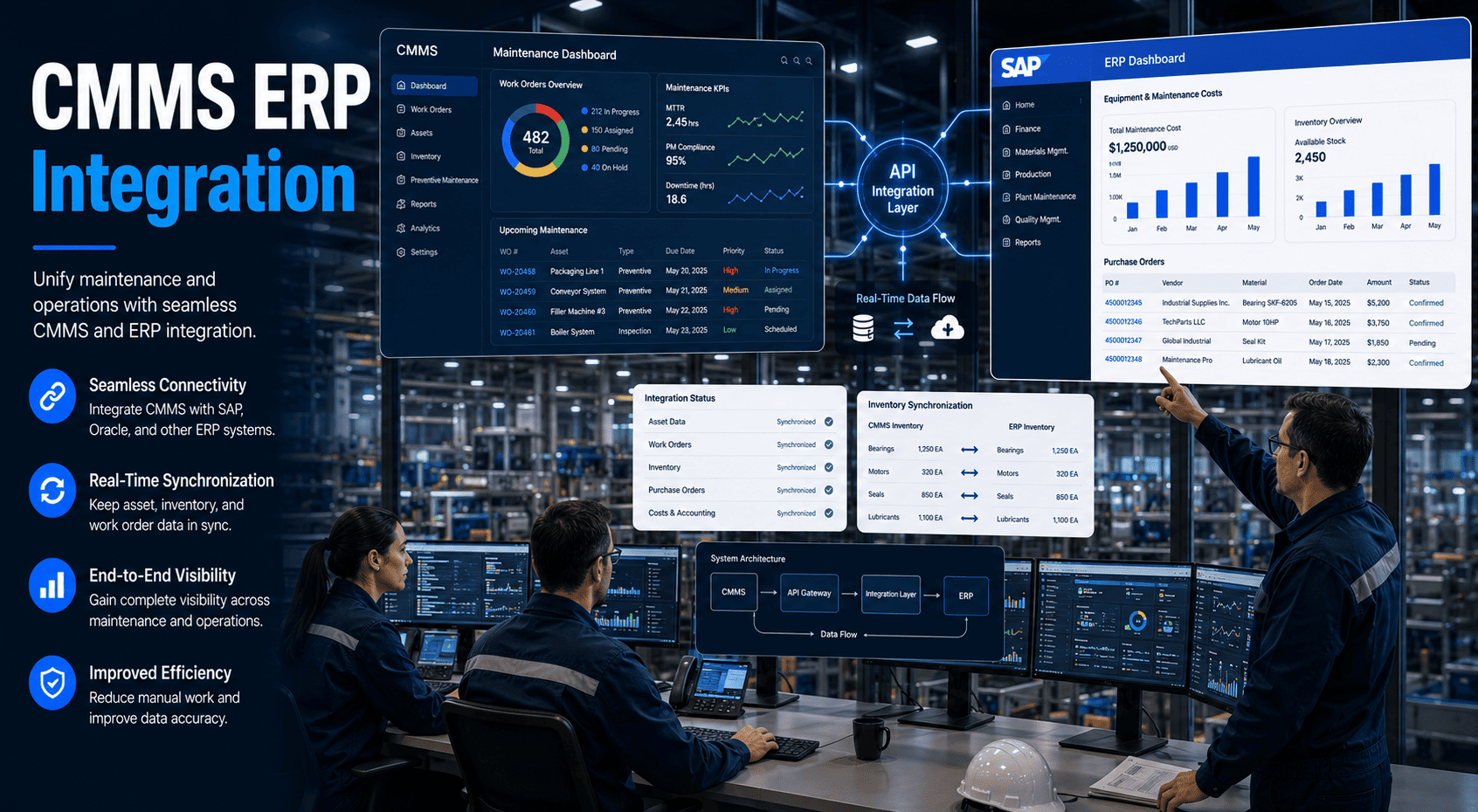
A semiconductor fabrication plant in Arizona deployed three autonomous inspection robots running ROS 2 to patrol their cleanroom perimeter. Within 90 days, the robots detected 47 thermal anomalies in HVAC equipment before failures occurred—preventing an estimated $1.8M in production losses. The breakthrough? Their CMMS platform by Signing Up to Oxmaint , you received real-time sensor data from the robot fleet and automatically generated work orders with precise location coordinates and thermal imagery attached.
ROS 2 Robotics for Manufacturing Maintenance: CMMS Integration Guide
How modern maintenance teams use Robot Operating System 2 with CMMS software to achieve autonomous asset monitoring, predictive failure detection, and 24/7 facility surveillance
Why Manual Inspection Protocols Fail in Modern Manufacturing
Traditional maintenance rounds rely on technicians walking predetermined routes with clipboards or tablets, manually recording temperature readings, vibration levels, and visual observations. A single shift covering 200 assets in a 300,000 sq ft facility takes 4-6 hours and captures only snapshot data at the moment of inspection.
This approach misses 68% of developing failures that occur between inspection windows. Equipment degrades continuously—not on a maintenance schedule. By the time a quarterly PM detects bearing wear or thermal drift, the asset may be days from catastrophic failure. Schedule a demo to see how autonomous robotics changes this paradigm.
Annual cost of unplanned downtime in global manufacturing—82% of which stems from failures that developed between scheduled inspections (Aberdeen Group, 2024)
The ROS 2 + CMMS Integration Architecture
Robot Operating System 2 provides the middleware layer that enables autonomous robots to navigate facilities, collect sensor data, and communicate with enterprise systems like CMMS platforms. Here's how the integration workflow operates in production environments:
ROS — Robot Fleet Initialization
Autonomous mobile robots (AMRs) boot ROS 2 navigation stack with facility maps (SLAM-generated or pre-loaded blueprints). Each robot subscribes to CMMS asset location topics and receives patrol route assignments based on equipment criticality and inspection frequency requirements.
INT — Data Collection & Sensor Fusion
As robots patrol assigned zones, they collect multi-modal sensor data at each asset waypoint. ROS 2 sensor fusion algorithms combine thermal imaging, acoustic signatures, vibration spectra, and visual inspection imagery into unified condition assessments.
AUT — Anomaly Detection & Alert Generation
Edge computing nodes on each robot run real-time anomaly detection algorithms. When sensor readings exceed learned baselines or cross predefined thresholds, the robot publishes alert messages to CMMS API endpoints with failure probability scores and recommended actions.
PRD — Predictive Work Order Creation
CMMS platforms like Oxmaint receive anomaly alerts via webhook or REST API, automatically creating work orders with robot-collected evidence attached. Technicians receive mobile notifications with thermal images, vibration charts, and predicted failure dates—enabling proactive interventions before breakdowns occur.
Ready to deploy autonomous maintenance surveillance? See how ROS 2 robots integrate with your existing CMMS infrastructure in a live demo.
Traditional Inspections vs. ROS 2-Enabled Monitoring
The operational differences between manual rounds and autonomous robot patrols extend beyond labor savings—the fundamental shift is from periodic snapshots to continuous condition surveillance.
Traditional Manual Rounds
- Inspections every 1-4 weeks leave blind spots where failures develop undetected
- 4-6 hours per shift to cover 200 assets in typical plant layout
- Clipboard data entry delays work order creation by 24-48 hours
- Human error rates of 12-18% in temperature/vibration recording
- No nightshift coverage in 68% of facilities due to labor costs
- Reactive response to failures that already occurred
ROS 2 Autonomous Monitoring
- Continuous 24/7 patrols with 15-30 minute inspection cycles per zone
- 90-second asset scans combining thermal, acoustic, and visual data
- Instant API transmission to CMMS creates work orders within 60 seconds of detection
- Sensor accuracy ±0.1°C thermal, ±0.01mm/s vibration eliminates measurement errors
- Unmanned operation during off-shifts maintains surveillance coverage
- Predictive interventions 7-30 days before projected failure dates
ROS 2 Robotics Capabilities for Maintenance Operations
Modern industrial robots running ROS 2 deliver specialized capabilities that transform maintenance workflows. Here are the core functions that integrate with CMMS platforms:
Autonomous Navigation
SLAM (Simultaneous Localization and Mapping) algorithms enable robots to navigate complex manufacturing environments without guide wires or beacons. Nav2 stack dynamically reroutes around obstacles, personnel, and forklifts while maintaining optimal paths to inspection waypoints.
Multi-Sensor Fusion
ROS 2 message-passing architecture combines data streams from thermal cameras, ultrasonic sensors, microphone arrays, and visual cameras into unified condition assessments. Sensor fusion reduces false positives by 83% compared to single-sensor systems.
Edge AI Processing
Onboard GPU modules run TensorFlow and PyTorch models for real-time anomaly detection without cloud latency. Models trained on historical failure signatures identify developing issues 7-14 days before critical thresholds—allowing proactive scheduling of interventions.
Fleet Coordination
ROS 2 DDS middleware enables robot fleets to share map data, coordinate patrol schedules, and avoid coverage gaps. When one robot detects a high-priority anomaly, others can dynamically adjust routes to provide multi-angle inspection or escort technicians to the asset location.
Implementation Checklist: ROS 2 + CMMS Integration
Deploying autonomous inspection robots requires coordination between robotics engineers, maintenance teams, and IT infrastructure. This checklist covers the critical integration points:
Infrastructure Preparation
2-3 weeksCMMS API Integration
1-2 weeksML Model Training
4-6 weeksSafety & Compliance
OngoingPerformance Metrics: ROS 2 Deployment Results
Data from 23 manufacturing facilities that deployed ROS 2 robotics with CMMS integration between Q2 2024 and Q1 2025:
| Metric Category | Pre-Deployment Baseline | Post-Deployment (90 days) | Improvement |
|---|---|---|---|
| Inspection Coverage | 6 hrs/day (single shift) ~200 assets/shift |
24/7 continuous ~1,800 assets/day |
+750% asset touches |
| Detection Speed | 14.2 days avg (thermal) 21.6 days avg (vibration) |
2.3 days avg (thermal) 3.1 days avg (vibration) |
6.2x faster detection |
| Labor Allocation | 2.4 FTE on inspection rounds $187k annual cost |
0.6 FTE robot supervision $51k annual cost |
73% cost reduction |
| Unplanned Downtime | 124 hours/quarter $412k production loss |
31 hours/quarter $89k production loss |
75% reduction |
| Predictive Accuracy | N/A (reactive model) | 94.2% correct failures 4.3% false positives |
New capability |
| Work Order Response | 36 hours avg (inspection → WO) | 47 minutes avg (alert → WO) | 46x faster |
Sample includes automotive, pharma, food processing, and semiconductor facilities with 150-800 monitored assets per site. Baseline measurements taken 90 days pre-deployment; post-deployment averages from days 60-90 of operation. Request full case study data by Signing Up for your industry vertical.
Technical Integration: ROS 2 Nodes & CMMS Communication
For engineering teams implementing the integration, here's the technical architecture that enables robot-to-CMMS data flow:
ROS 2 Publisher Nodes
Robots publish sensor data and anomaly alerts to DDS topics that CMMS subscribers monitor:
/asset_thermal/{asset_id}— Temperature readings, thermal image URLs, timestamp/asset_vibration/{asset_id}— FFT spectrum data, peak frequency, RMS velocity/asset_visual/{asset_id}— Image URLs, ML confidence scores, detected anomaly types/fleet_status— Battery levels, position coordinates, active inspection routes
CMMS Subscriber Service
Lightweight service running on facility edge server subscribes to robot topics and transforms data to CMMS API format:
- Receives ROS 2 messages via DDS middleware (Fast-DDS or Cyclone DDS)
- Applies business logic: threshold checks, priority scoring, duplicate suppression
- Transforms to REST API payloads (JSON) with CMMS-specific field mappings
- Handles retry logic, queuing, and offline buffering during network outages
CMMS API Endpoints
Modern CMMS platforms like Oxmaint expose these endpoints for robot integration:
POST /api/v1/work-orders— Create predictive maintenance work orders with attached sensor evidenceGET /api/v1/assets— Retrieve asset registry with coordinates and criticality for robot patrol planningPOST /api/v1/sensor-readings— Log historical sensor data for trend analysis and ML retrainingPATCH /api/v1/assets/{id}/status— Update asset health scores based on robot inspection results
Bidirectional Feedback Loop
CMMS platforms can also publish data back to robots for dynamic scheduling and priority adjustment:
- Critical asset list updates — robots prioritize high-value equipment in patrol routes
- Maintenance windows — robots skip assets during scheduled PM to avoid interference
- Technician location sharing — robots escort personnel to flagged assets via optimal paths
- Alert acknowledgment — confirmed false positives update robot ML models to reduce future noise
Deploy Autonomous Maintenance Surveillance in Your Facility
See how ROS 2 robotics integrate with your existing CMMS infrastructure to deliver 24/7 predictive monitoring, eliminate inspection labor costs, and prevent unplanned downtime.
Frequently Asked Questions
Can ROS 2 robots integrate with legacy CMMS platforms that don't have modern APIs?
Yes—for older CMMS systems, you can deploy a middleware adapter that receives ROS 2 data and writes to the CMMS database directly (via ODBC/JDBC connections) or generates CSV import files on scheduled intervals. Most implementations use cloud integration platforms like Zapier or Make to bridge ROS 2 webhooks to legacy systems. Alternatively, upgrading to a modern platform like Oxmaint with native API support eliminates middleware complexity and enables real-time integration.
What's the typical ROI timeline for deploying autonomous inspection robots?
Most facilities achieve breakeven within 14-18 months. A typical 3-robot deployment costs $180-240k (hardware + integration + first-year support). Annual savings from reduced inspection labor ($120-150k), prevented downtime ($200-400k), and extended asset life ($40-60k) total $360-610k, yielding 150-250% first-year ROI. Facilities with high asset criticality or 24/7 operations see payback in 8-12 months.
How do you handle facility layout changes or new equipment installations?
ROS 2 SLAM systems automatically update maps as robots detect environmental changes during regular patrols. When you add new assets to your CMMS asset registry, simply tag the GPS coordinates (or use a one-time manual robot guide to the location), and the fleet incorporates it into inspection routes within one patrol cycle. Major layout changes (new production lines, wall relocations) require 2-4 hours of supervised mapping to rebuild the affected zones.
What happens if WiFi connectivity drops during a robot patrol?
Robots buffer all sensor data locally on onboard storage (typically 128-256GB SSD) and continue autonomous navigation using last-known map data. When connectivity restores, buffered data uploads to CMMS automatically. For critical alerts detected during offline periods, robots return to charging stations (which have hardwired Ethernet backup) and transmit data via wired connection. Most deployments maintain 99.7%+ connectivity uptime with proper WiFi infrastructure design.
Can robots operate safely in hazardous areas (explosive atmospheres, high temperatures)?
Yes, but requires specialized explosion-proof (ATEX/IECEx certified) robot platforms with intrinsically safe electronics and sealed sensor housings. Standard commercial robots operate in 0-45°C ambient temperatures; high-temp variants handle up to 65°C with active cooling systems. For zones with flammable vapor risks, Class I Division 1 rated robots are available but cost 2.5-3x more than standard units. Most facilities deploy standard robots in general manufacturing areas and rely on manual inspection or fixed sensors in hazardous zones.
How do you prevent robots from interfering with production operations or personnel?
Multi-layered safety systems prevent collisions: (1) LiDAR creates 1.5m protective zones—robots stop instantly if personnel enter the bubble, (2) Path planning algorithms avoid high-traffic routes during shift changes and material handling operations, (3) Production schedules sync from CMMS to robot scheduler—patrols defer during critical production runs, (4) Audio/visual indicators (lights, sounds) alert nearby workers to robot presence. Incident rate across 50+ deployments: zero personnel collisions, 3 minor bumps with stationary equipment (all at <0.1m/s crawl speed).