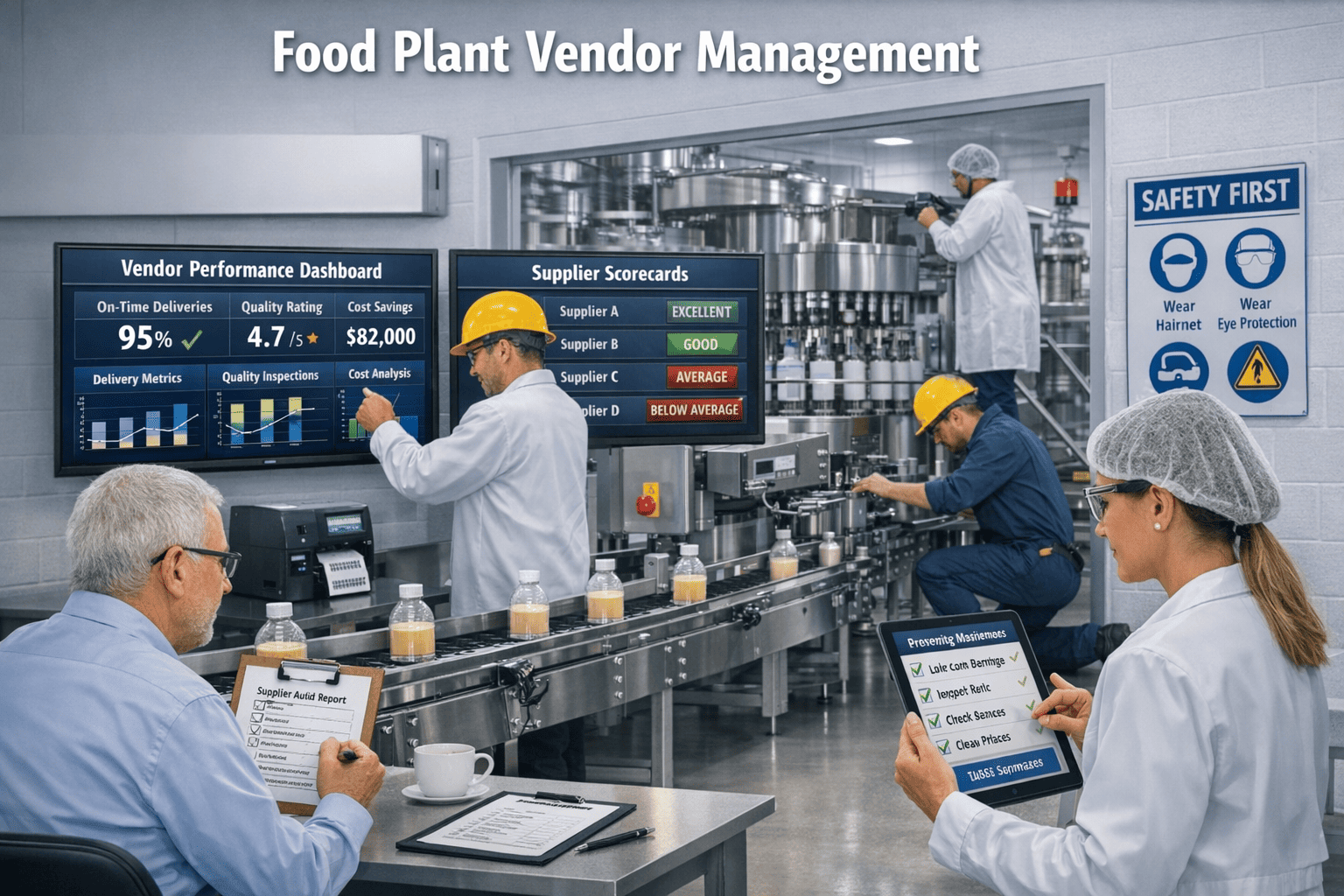
Vendor-managed maintenance for food plants is no longer an optional efficiency upgrade — it is a strategic imperative for procurement directors and plant managers navigating rising equipment complexity, tighter compliance mandates, and shrinking in-house technical headcounts. Choosing between OEM service contracts and third-party maintenance providers is one of the highest-stakes procurement decisions in food manufacturing today. Get it wrong and you absorb unplanned downtime, hidden cost overruns, and regulatory exposure. Get it right and your plant runs cleaner, leaner, and more predictably than competitors. Sign Up Free to see how OxMaint helps food plants take control of vendor maintenance.
Take Control of Your Vendor Maintenance Contracts
OxMaint's CMMS platform centralizes vendor PM schedules, SLA tracking, and cost reporting across every line in your food plant — from fillers to CIP systems.
What Is Vendor-Managed Maintenance in Food Manufacturing?
Vendor-managed maintenance is a structured model where equipment upkeep, preventive servicing, and repair work are delegated to external service providers under formal maintenance contracts. In food plants, this spans OEM service agreements for thermal processing systems, third-party multi-vendor programs managing entire production lines, and hybrid arrangements where specialists handle calibration and overhaul work.
For procurement directors in the US, UK, Canada, Germany, and the UAE, vendor-managed maintenance is not simply outsourcing — it is a governance discipline that requires rigorous SLA definition, performance monitoring, cost benchmarking, and integration with a CMMS platform to be effective. Without that infrastructure, vendor relationships drift into reactive patterns that cost more while delivering less accountability.
Why Food Plants Are Accelerating Vendor Outsourcing
Equipment is increasingly proprietary and software-driven — modern filling lines and X-ray inspection systems contain embedded diagnostics that require OEM-certified technicians to service safely. Regulatory requirements under FSMA, BRC Global Standard, and IFS Food demand documented maintenance histories that are difficult to sustain without specialist vendor systems.
Labor markets in Canada and the UAE are compounding the pressure. Skilled maintenance technicians are increasingly scarce and expensive to retain. Vendor-managed maintenance programs offer a practical path to maintaining technical depth without building large in-house teams — provided the contracts are structured with appropriate performance accountability.
OEM Service Contracts vs. Third-Party Maintenance: The Core Decision
The choice between OEM service agreements and third-party maintenance providers is not binary — most mature food plants use both. Understanding the structural differences is essential for procurement directors building a defensible vendor strategy. Book a Demo to see how OxMaint maps vendor types to your asset register automatically.
OEM Service Contracts
OEM agreements provide certified technicians trained on specific equipment models, guarantee original parts, maintain warranty validity, and cover firmware updates. For high-precision systems in Germany and the UK, OEM servicing is frequently mandated by insurers and certification bodies. The trade-off: OEM rates run 30–60% above third-party options, requiring careful escalation clause management in multi-year contracts.
Third-Party Maintenance Services
Third-party providers offer multi-brand expertise, competitive pricing, and faster response times — a major advantage for food plants across the US and Canada operating multi-site portfolios. They consolidate servicing across heterogeneous equipment fleets. For UAE and Germany operations, third-party providers must demonstrate equivalent record-keeping rigor before procurement approval.
Vendor Comparison Framework: OEM vs. Third-Party vs. Hybrid
No single vendor model suits every equipment category. A structured comparison across key procurement criteria helps plant directors allocate vendor types to the right asset classes and risk profiles.
| Evaluation Criteria | OEM Service Contract | Third-Party Maintenance | Hybrid Model |
|---|---|---|---|
| Cost per Service Event | High (premium certified rates) | Low to Medium | Medium (optimized by asset) |
| Parts Authenticity | Guaranteed OEM parts | OEM or aftermarket options | OEM for critical; aftermarket for secondary |
| Warranty Protection | Fully preserved | May void manufacturer warranty | OEM track preserves warranty |
| Multi-Brand Coverage | Single brand only | Broad multi-brand capability | Blended coverage |
| Response Speed | Variable (OEM scheduling) | Often faster (local networks) | Flexible SLA allocation |
| Regulatory Documentation | Excellent (OEM audit trails) | Varies by provider | Platform-managed compliance |
| CMMS Integration | Limited (OEM proprietary) | API-compatible leaders | CMMS as central data hub |
| Best Fit Asset Class | Critical, proprietary systems | High-volume, standard equipment | Mixed-criticality portfolios |
Defining Effective SLAs for Food Plant Maintenance Contracts
A service level agreement is only as effective as the metrics it enforces. Many procurement directors inherit vendor contracts with vague response time commitments and no consequence mechanisms. Building SLAs that genuinely govern vendor performance requires specificity across five dimensions.
Response Time by Equipment Criticality
Set separate response tiers: P1 critical assets (filler, pasteurizer, CIP) warrant a 2-hour on-site response; P3 packaging issues may allow 48 hours. Criticality tiers must be built into your CMMS so escalations trigger automatically — not manually.
Preventive Maintenance Completion Rate
Target 95%+ PM completion across all vendor-managed assets. For UK and Germany plants under IFS or BRC certification, PM completion rates are directly auditable — gaps generate non-conformances with real commercial consequences.
First-Time Fix Rate (FTFR)
Track the proportion of reactive calls resolved without a return visit. Low FTFR signals parts shortages or technician skill gaps. Monitor by vendor and equipment category to identify underperformers before contract renewal decisions.
Mean Time to Resolution (MTTR)
Define MTTR targets by equipment class and require monthly trend reports from vendors. For high-throughput US and Canadian food lines, every hour of MTTR translates directly to lost production volume and measurable waste losses.
Documentation Delivery Standards
Every service event must produce a structured record: technician details, work performed, parts with lot numbers, and handover status — delivered within 24 hours into your CMMS platform. Non-negotiable for FSMA and HACCP compliance.
How AI Vision Enhances Vendor-Managed Maintenance in Food Plants
AI Vision — computer vision and machine learning applied to inspection data — gives food plant leadership a continuous, objective view of equipment condition between vendor visits. For procurement directors in the US, UK, Canada, Germany, and UAE managing distributed vendor relationships, it creates an independent audit layer that no maintenance contract alone can provide.
AI analyzes inspection photos to detect conveyor wear, seal degradation, and corrosion before they escalate. This creates a tamper-proof audit trail vendors cannot alter — giving plant directors hard evidence for disputes and warranty claims.
AI reviews vendor-submitted photo evidence to confirm PM tasks were actually completed — filters replaced, cleaning done to standard, reassembly correct. It closes the gap between what vendors report and what was physically performed.
Machine learning flags early deterioration signals — thermal anomalies, vibration patterns, surface accumulation — and triggers work orders before vendor PM schedules are due, reducing reactive call frequency across Canada and UAE sites.
AI correlates visual condition trends with vendor service history to produce objective performance scorecards — giving procurement teams data-driven evidence for SLA enforcement, renegotiation, or vendor replacement decisions.
CMMS Integration: The Operating System for Vendor Management
A CMMS platform is the operational backbone of any mature vendor-managed maintenance program. Without a centralized system managing vendor PM schedules, work order generation, documentation, and cost tracking, procurement directors are dependent on vendor-supplied data — a structural conflict of interest that reliably produces optimistic reporting.
A purpose-built CMMS vendor management tool gives plant teams full visibility into every open and completed vendor task across all equipment and contracted providers. For food plants in Germany and the UK managing concurrent OEM and third-party contracts, CMMS consolidation is the difference between coherent governance and administrative chaos.
Automated Vendor PM Scheduling
CMMS auto-generates vendor work orders based on run hours, calendar frequency, or condition triggers — notifying vendors automatically and removing the administrative burden from plant maintenance coordinators.
Real-Time SLA Compliance Tracking
Every open vendor work order is tracked against SLA commitments in real time. Overdue responses trigger automatic escalation notifications — ensuring SLA breaches surface immediately, not at quarterly reviews.
Vendor Cost Tracking and Budget Variance
CMMS captures all vendor invoicing against individual work orders, enabling cost-per-asset analysis. For US and Canadian plants managing multiple contracts, this visibility identifies cost overrun patterns before they breach annual budgets.
Audit-Ready Documentation Repository
All vendor service records, parts certifications, and technician qualifications are stored centrally and linked to equipment records — retrievable in seconds for food safety audits across UAE and German manufacturing markets.
Vendor Performance Management: From Reporting to Accountability
Measuring vendor performance is only the first step. The practices that distinguish high-performing food plant maintenance programs are the ones that convert data into structured accountability and contractual consequences. Without that loop, dashboards become reporting theater rather than governance tools.
Quarterly Vendor Business Reviews
Present CMMS-generated KPI scorecards (MTTR, FTFR, PM completion, cost variance) in formal quarterly reviews. Require vendors to submit root cause analysis for SLA breaches and corrective action plans with measurable commitments — building a documented performance history for renewal decisions.
Penalty and Incentive Structures
Tie financial mechanisms to performance: SLA breaches attract invoice credits; consistently high FTFR earns preferred renewal pricing. This aligns vendor commercial interests with your plant's operational outcomes — the foundation of a genuinely productive maintenance partnership.
Vendor Consolidation Strategy
Consolidating to fewer capable providers reduces administrative overhead, improves site familiarity, and creates stronger procurement leverage — particularly for UK and Canadian plants negotiating multi-year agreements with volume-based cost commitments.
Contingency and Dual-Sourcing Plans
Pre-qualify and periodically assess backup vendors even when primary vendors are meeting all SLAs. Germany and UAE plants increasingly require this as standard procurement governance — shortening emergency response timelines when primary relationships fail.
Benefits and ROI of Structured Vendor Maintenance Programs
The financial and operational return from a structured vendor-managed maintenance program is measurable across cost reduction, audit performance, and asset longevity. For procurement directors building the business case for CMMS platform investment, the evidence is compelling. Book a Demo to see the ROI model OxMaint uses with food plant clients across the US, UK, and Canada.
Structured vendor PM programs shift the planned-to-reactive ratio toward 70:30 — cutting emergency labor rates, unplanned parts costs, and production losses in food manufacturing environments.
Plants with CMMS-managed vendor documentation achieve stronger BRC, SQF, and FSMA audit outcomes — maintenance records available instantly, PM completion verifiable at work order level, technician certifications searchable.
Consistent OEM-aligned PM execution extends operational life of high-value processing equipment — deferring capital replacement cycles and improving long-term asset ROI across thermal and aseptic filling systems.
Two to three years of CMMS-documented vendor performance data transforms contract renewal negotiations — enabling procurement teams to benchmark competing bids against verified history, not vendor sales narratives.
Common Challenges and Practical Solutions
Vendors Bypassing CMMS Entry
Technicians completing work without CMMS records creates invisible maintenance history and compliance gaps. Fix: make CMMS record submission a payment condition — invoices are not processed until work orders are closed with full documentation. Critical for UK and Germany audit environments.
OEM Parts Pricing Opacity
Time-and-materials OEM contracts frequently generate parts cost surprises on aging equipment. Fix: negotiate fixed-price schedules for high-consumption components at contract initiation and require written advance approval for any single parts purchase above a defined threshold.
Inconsistent Technician Competency
High vendor technician turnover quietly degrades service quality. Fix: require named technician documentation with certification records in your CMMS, and define a minimum experience threshold — mandatory approval before substitutions on critical equipment.
Warranty Invalidation Risk
Third-party work on in-warranty equipment can void OEM coverage. Fix: maintain a warranty register in your CMMS that automatically routes in-warranty asset work orders to OEM-contracted providers — keeping third-party vendors on out-of-warranty equipment only.
Best Practices for Food Plant Vendor Maintenance Programs
Segment Your Asset Register by Vendor Strategy
Classify every major asset into OEM-mandated, preferred third-party, or hybrid categories. This gives procurement teams a structured allocation framework instead of making vendor decisions reactively — especially valuable for large multi-site operations across the US and Canada.
Synchronize Vendor PM with Production Schedules
Vendor tasks scheduled without production visibility create costly conflicts. Connect your CMMS scheduling with production planning so PM windows align with sanitation stops and changeovers — not live production runs where downtime is most expensive.
Build Knowledge Transfer Into Contracts
Require structured knowledge transfer sessions from vendors for complex systems, and capture that knowledge in CMMS equipment records. This reduces dangerous vendor dependency during critical production periods — a growing requirement for UAE and German plant certifications.
Run Annual Contract Benchmarking Exercises
Use CMMS cost data to generate cost-per-service-event comparisons annually and issue targeted RFIs for your highest-spend equipment categories. This keeps incumbent vendors commercially competitive and gives procurement teams objective market data for renewals.
The Strategic Case for Vendor Maintenance Program Investment
Vendor-managed maintenance for food plants is a strategic investment in plant reliability, food safety compliance, and asset value. The food plants achieving the strongest cost performance are those with the clearest SLAs, the most disciplined CMMS-based governance, and rigorous performance accountability — not simply the cheapest contracts.
Procurement and plant directors across the US, UK, Canada, Germany, and UAE who build that infrastructure — combining the right vendor mix with AI-powered condition monitoring and centralized CMMS management — position their plants to outperform on reliability, out-score on audits, and out-compete on production cost per unit. Book a Demo to explore how OxMaint's CMMS vendor management tools work for food plant environments.
Ready to Build a Best-in-Class Vendor Maintenance Program?
OxMaint gives food plant procurement and operations teams the CMMS infrastructure to manage OEM contracts, third-party vendors, SLA compliance, and maintenance costs from a single platform — audit-ready, always.
Frequently Asked Questions
What is vendor-managed maintenance in food manufacturing?
Vendor-managed maintenance is a structured program where external service providers — OEMs or third-party specialists — take primary responsibility for equipment preventive maintenance, calibration, and repair under formal service agreements. The plant retains governance through SLAs, CMMS tracking, and performance reviews rather than performing all maintenance with in-house labor.
When should a food plant use an OEM service contract vs. a third-party provider?
OEM contracts are recommended for proprietary, software-driven, or warranty-active equipment where certified technicians and original parts are required. Third-party providers suit standard mechanical equipment, high-volume routine PM tasks, and multi-brand fleets where cost efficiency and flexibility matter more. Most food plants use both models strategically across different asset categories.
What SLA metrics should food plant maintenance contracts include?
Effective food plant vendor SLAs should define response time commitments by criticality tier, PM completion rate targets (95%+), first-time fix rate benchmarks, MTTR thresholds by equipment class, and documentation delivery standards. Each metric should have a defined measurement method, reporting frequency, and consequence mechanism for breach.
How does a CMMS improve vendor maintenance management in food plants?
A CMMS centralizes vendor PM scheduling, work order tracking, SLA compliance monitoring, cost capture, and documentation storage in a single platform. This eliminates dependence on vendor-reported data, provides real-time SLA visibility, and creates the audit-ready maintenance history required for BRC, SQF, and FSMA compliance programs.
Can third-party maintenance providers work alongside OEM contracts in the same food plant?
Yes — the hybrid model is most common in food plants with diverse equipment fleets. A CMMS warranty register and automated work order routing ensure in-warranty assets are always serviced by OEM providers, while third-party vendors are deployed on out-of-warranty equipment where cost-efficiency applies without warranty risk.
How does AI Vision improve vendor maintenance outcomes in food plants?
AI Vision creates a continuous, objective inspection layer between scheduled vendor visits — detecting deterioration, verifying PM task completion via photo analysis, and generating predictive alerts before failures occur. It provides independent condition data that cannot be influenced by vendor reporting, creating an objective basis for performance accountability, contract disputes, and warranty claims.