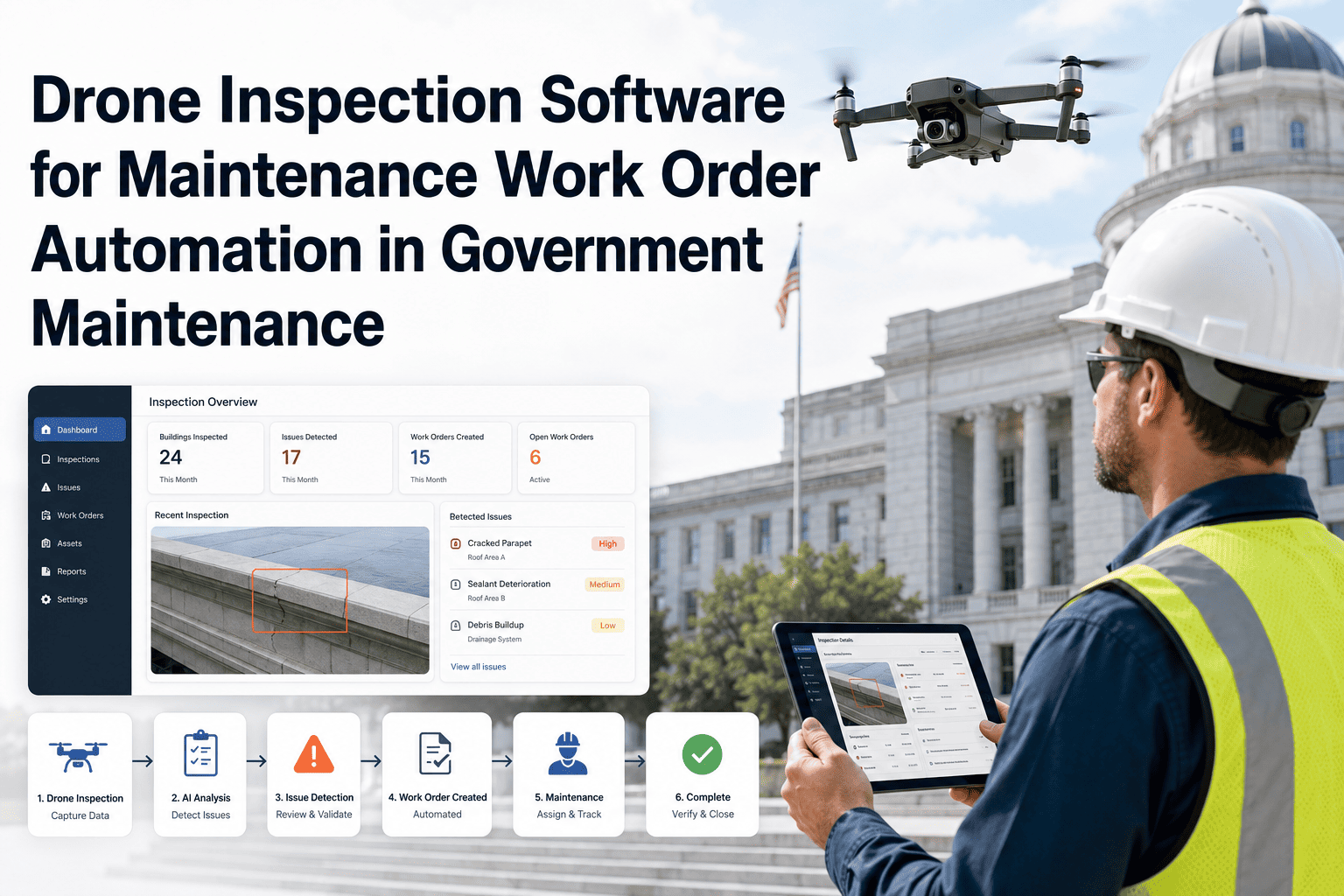
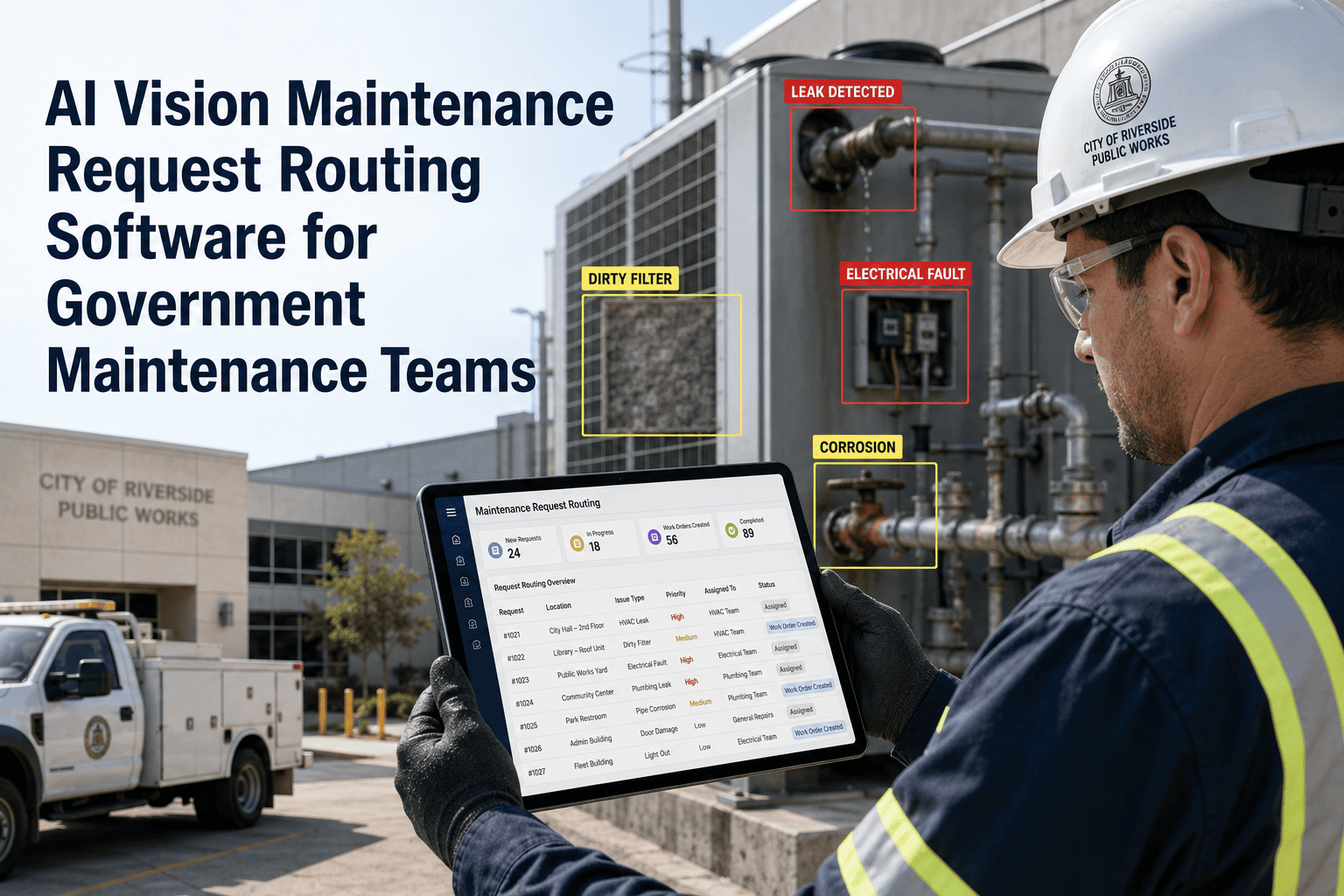
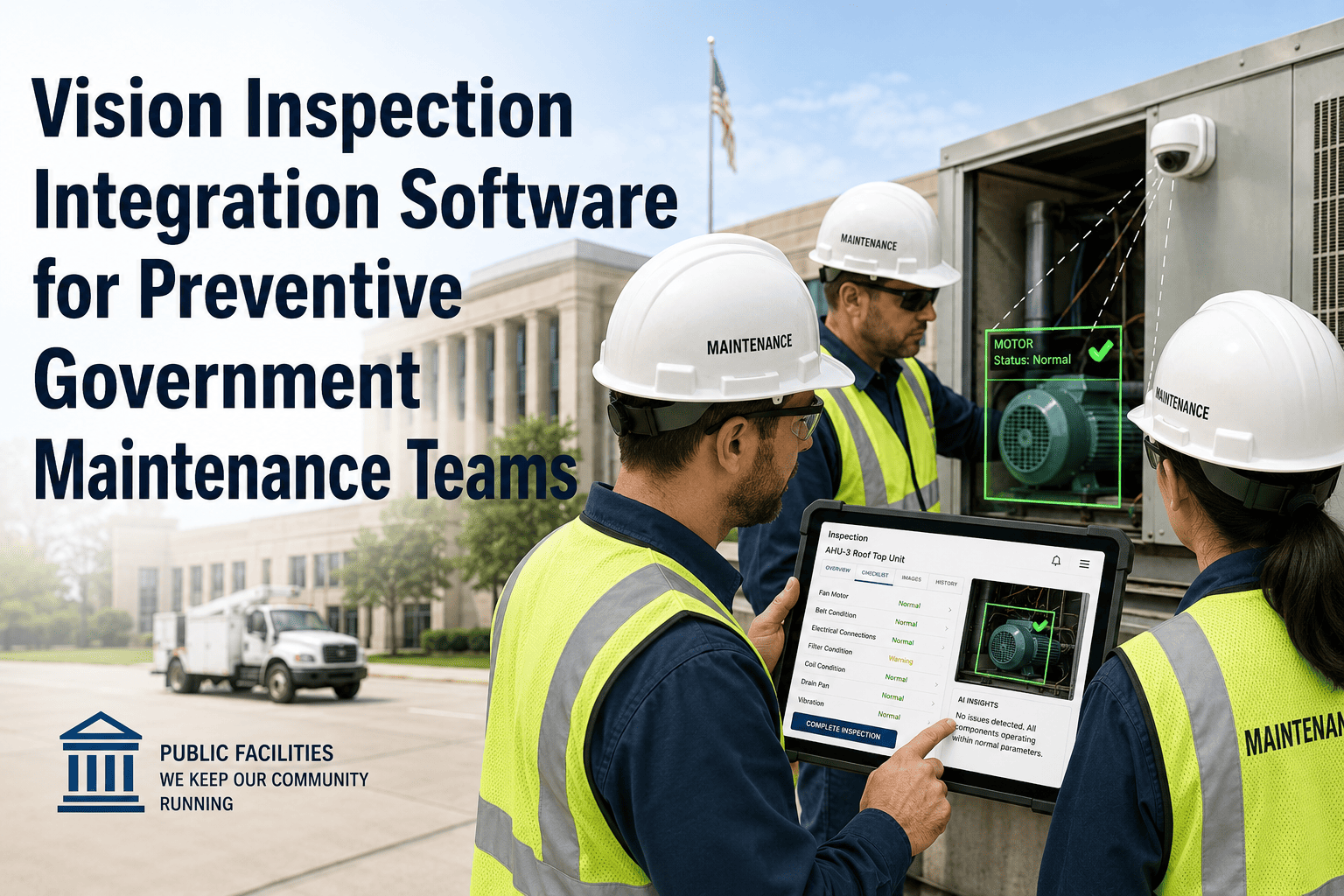
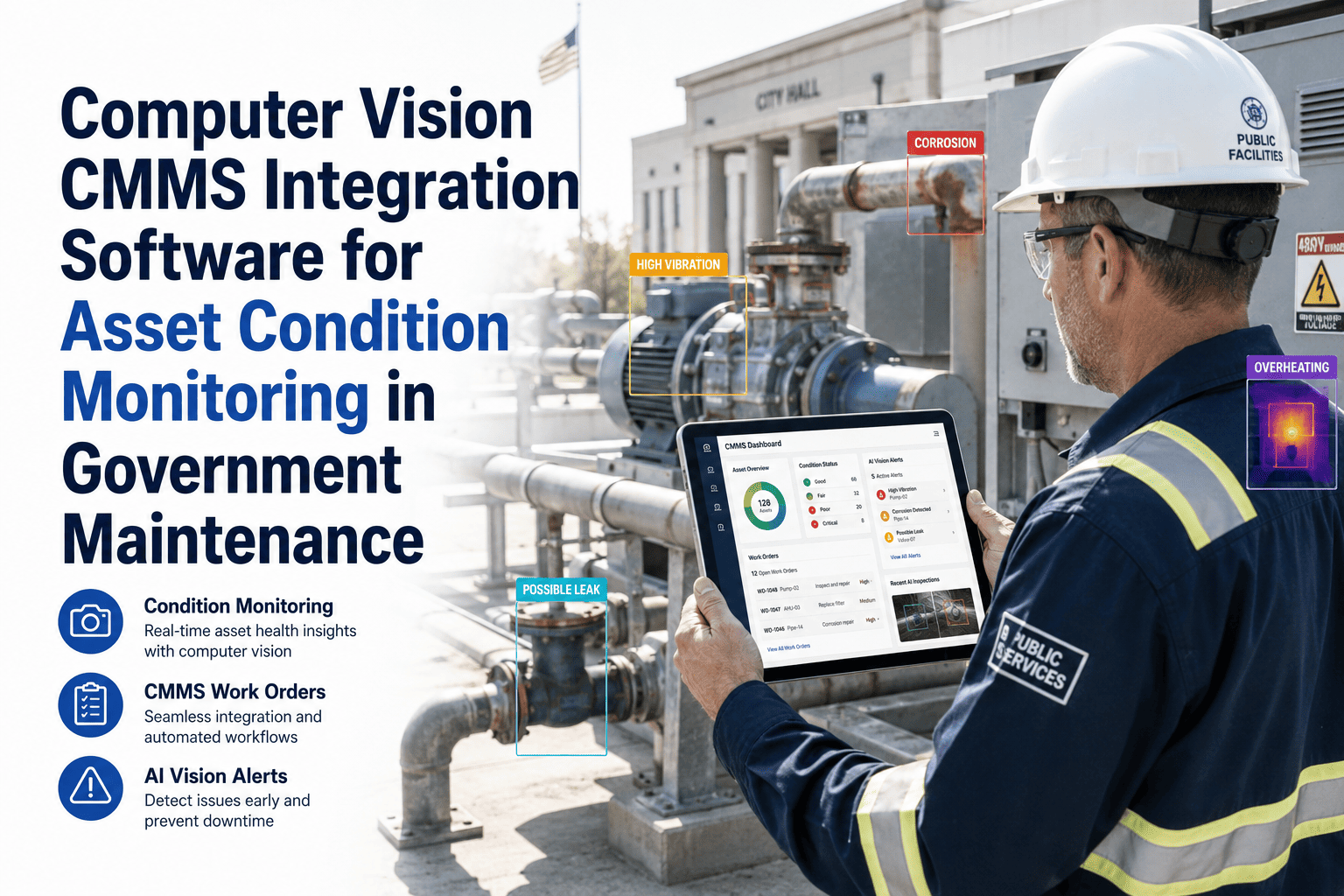
Government maintenance teams that rely on contractors for specialised asset servicing face a consistent documentation problem: contractor service reports arrive with varying levels of detail, inconsistent photo evidence, and no structured link to the CMMS work order or asset record they relate to. When a regulator or internal auditor queries the condition of a critical asset three years after a contracted service, the evidence trail is often a PDF in a shared folder and a phone call to a contractor who may no longer hold the contract. Book a demo with OxMaint to see how AI vision integration standardises contractor service report quality and links every image, finding, and sign-off directly to your government CMMS asset record. Integrating AI vision with contractor service workflows changes this permanently — creating a single structured evidence chain from contractor camera to government asset record, regardless of which contractor delivers the work.
Government / Public Works · Contractor Management · AI Vision
AI Vision Integration with Contractor Service Reports for Government Maintenance Teams
Standardise contractor evidence, eliminate report inconsistency, and create audit-ready asset records from every contracted maintenance visit — automatically.
The Contractor Report Problem in Government Maintenance
67%
of contractor service reports reviewed in public-sector audits are missing required photographic evidence
3–5 days
average delay between completed contracted work and submission of usable documentation to the asset owner
41%
of government maintenance teams cannot link a contractor's submitted photos to a specific asset in their CMMS
Why It Happens
Root Causes of Poor Contractor Service Documentation
Inconsistent contractor reporting is not primarily a contractor quality problem — it is a process design problem. Without a structured capture tool that enforces documentation requirements at the point of work, report quality is left entirely to the contractor's own procedures.
01
No Standardised Capture Tool
Contractors use their own forms, apps, or paper records. The government team receives outputs in different formats with different levels of detail — some with photos, some without, some with asset references, some with none.
02
Photo-Asset Linkage Is Manual
Even when contractors submit photos, matching those images to the correct asset in the government CMMS requires manual work by the asset management team. Errors and omissions are common — particularly across multi-asset service visits.
03
Findings Not Classified or Prioritised
Contractor reports describe what was observed, but without standardised severity classification, the government team must re-evaluate each finding to determine whether a follow-up work order is needed and at what priority.
04
No Approval Integration
Contractor service reports are received as documents, not as structured records inside the approval workflow. Signoff happens outside the CMMS — meaning the approved service record is never formally linked to the asset history in the system of record.
Integration Model
How AI Vision Standardises Contractor Service Reports
Step 1
Contractor Access via OxMaint Mobile
Contractor technician is granted scoped access to the OxMaint mobile app for the specific work order. The app loads the required inspection checklist, asset data, and mandatory photo checkpoint list for that service.
Step 2
AI-Guided Capture at Each Checkpoint
At each inspection point, the contractor captures images through the OxMaint camera interface. AI vision classifies the image, assigns a condition score, and flags any deviations from expected asset condition immediately.
Step 3
Auto-Generated Structured Report
OxMaint automatically compiles a structured service report from the captured data — images, condition scores, checkpoint completion status, findings, and timestamps — linked to the asset record and work order.
Step 4
Government Team Review & Approval
The government asset manager reviews the structured report inside OxMaint, approves or queries specific findings, and closes the work order — all within the same platform. The asset record is updated automatically on closure.
Comparison
Unstructured vs. AI Vision-Integrated Contractor Reporting
| Dimension |
Unstructured Contractor Report |
AI Vision-Integrated Report (OxMaint) |
| Report Format |
Variable — PDF, email, paper, or contractor's own app output |
Standardised — structured record in CMMS with consistent fields |
| Photo Evidence |
Optional — contractor's discretion on what to photograph and submit |
Mandatory — AI-enforced checkpoint photos cannot be skipped |
| Asset Linkage |
Manual matching required by government team |
Automatic — every image tagged with asset ID, location, timestamp |
| Condition Classification |
Descriptive text — subjective and non-comparable |
AI severity score 1–5 — consistent across all contractors and visits |
| Follow-up Work Orders |
Manually created by government team after reviewing report |
Auto-generated from findings above severity threshold |
| Approval Process |
Email or paper sign-off — outside the CMMS |
Digital approval chain inside OxMaint — timestamped and linked to asset |
| Audit Readiness |
Evidence reconstruction required — hours to days per audit |
Instant export from asset record — complete service history in seconds |
See How OxMaint Controls Contractor Report Quality
Government asset managers use OxMaint to enforce documentation standards across all contractors — regardless of the contractor's own systems or processes. Book a demo to see how it works for your contractor network.
OxMaint Features
Contractor Service Report Capabilities in OxMaint
Scoped Contractor Access
Contractors access only the specific work order they are assigned to — no visibility into other assets, permits, or team communications. Access is revoked automatically on work order closure.
Mandatory Photo Checkpoints
Government teams define which inspection points require photographic evidence. Contractors cannot mark a checkpoint complete without a valid AI-classified image attached.
Real-Time Condition Scoring
AI scores each image at capture. Government supervisors see live condition data as the contractor works — not after the report is submitted. Critical findings trigger immediate alerts.
Auto Work Order Creation
Findings above severity threshold automatically generate corrective work orders in OxMaint — assigned to the appropriate internal team with the contractor evidence already attached.
Contractor Performance Tracking
OxMaint tracks report quality, checkpoint compliance rates, and finding accuracy across all contractors over time — giving procurement teams objective data for contract renewal decisions.
Asset History Integration
Every approved contractor service report becomes a permanent entry in the asset's maintenance history — visible alongside internal work orders, inspections, and previous contracted services on the asset timeline.
"
The biggest compliance exposure in contracted government maintenance is not the work quality — it is the paper trail. When a contracted service is performed correctly but documented poorly, you have no proof of compliance when the auditor arrives. Government teams that give contractors a structured digital capture tool — with mandatory photo checkpoints and AI classification — produce consistent, audit-ready service records regardless of which contractor performs the work. This is a process control problem, and the solution is structural, not contractual.
Director of Government Asset Management, Public Infrastructure Authority
19 Years Government Maintenance Operations · Contractor Compliance Specialist · Adviser on Digital PTW and Contractor Management Frameworks
Frequently Asked Questions
Do contractors need to install a separate application to use OxMaint?
Can we enforce specific photo requirements for different asset types or service categories?
Yes — OxMaint allows government teams to define different mandatory checkpoint lists for different asset types, service categories, or contract types. A contracted electrical inspection on a substation will have different mandatory photo requirements than a contracted HVAC service on a government office building. These checkpoint templates are configured once by your asset management team and applied automatically when the relevant work order type is created.
Start a free trial to configure your first contractor inspection template.
How does OxMaint handle contractor findings that require immediate escalation?
When a contractor's AI-classified image receives a severity score above the configured critical threshold, OxMaint immediately sends an alert to the designated government supervisor — before the service visit is even complete. The supervisor can review the image, the AI classification, and the asset context in real time, and can authorise emergency corrective action without waiting for the contractor to submit a formal report. This removes the delay between a contractor discovering a critical finding and the government team being able to act on it.
Book a demo to see the real-time alert and escalation configuration.
Can we use OxMaint data to evaluate contractor performance at renewal time?
OxMaint records checkpoint completion rates, photo submission compliance, finding accuracy, report submission timeliness, and follow-up work order rates for every contractor across every work order. At contract renewal, procurement teams have objective, data-driven performance metrics for each contractor rather than relying on anecdotal feedback or ad-hoc quality reviews. Teams using this approach report significantly more defensible contractor selection decisions and improved documentation quality from contractors who know their work is being consistently measured.
OxMaint · Contractor Management · Government CMMS
Take Control of Contractor Service Report Quality — Starting Today
OxMaint gives government asset teams the tools to enforce documentation standards, capture AI-classified visual evidence, and build a permanent audit-ready service record — from every contractor, for every asset.