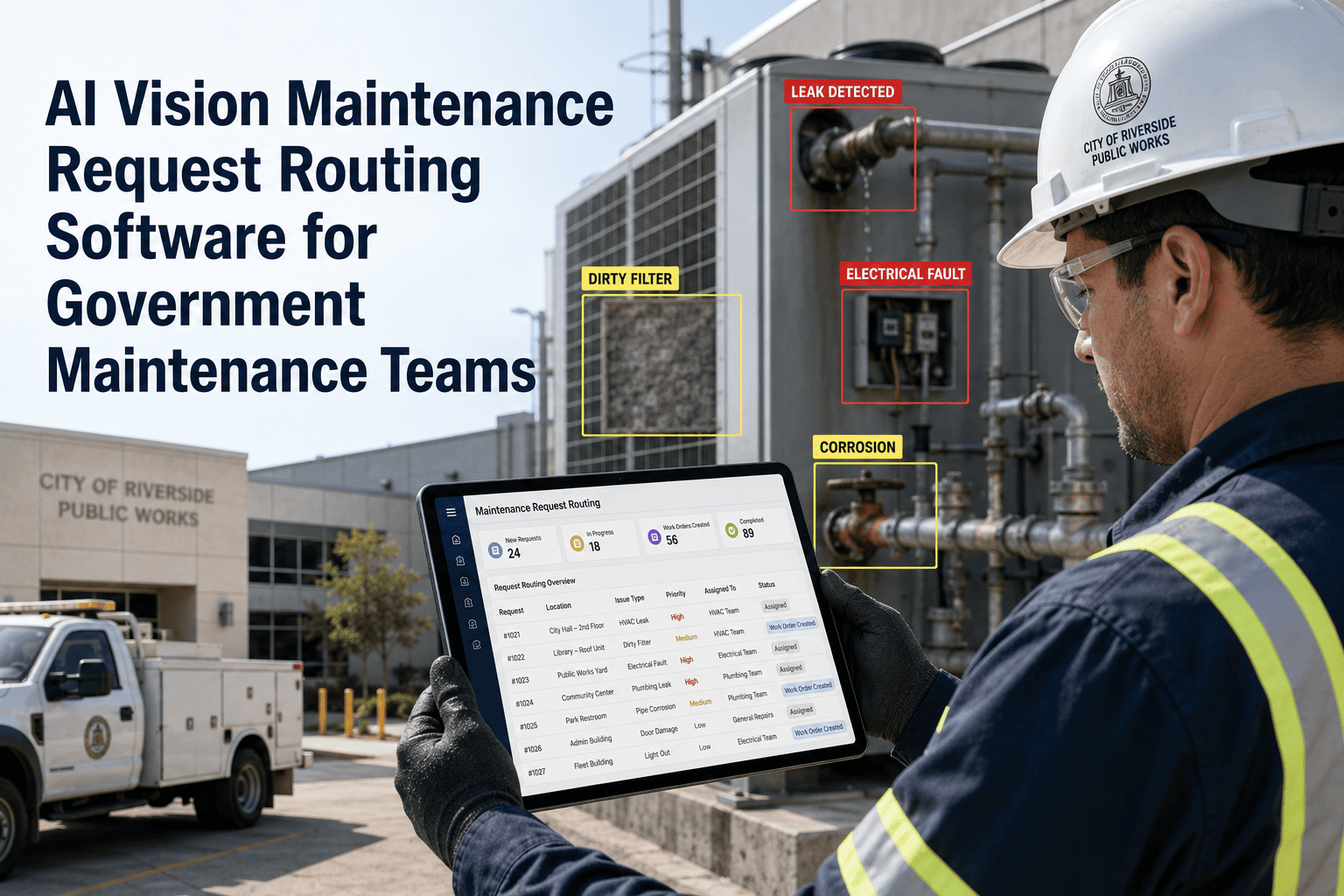
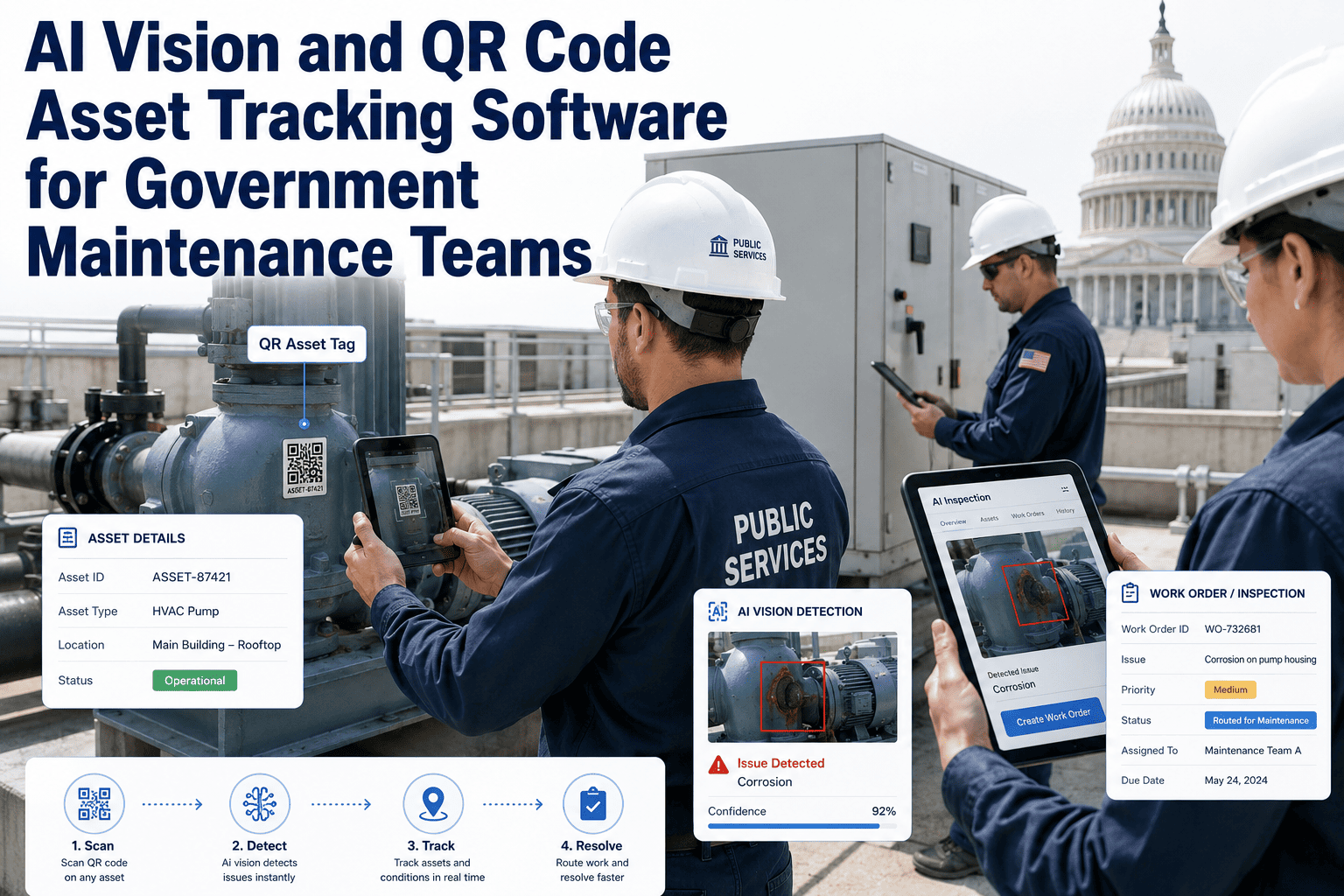
Public-sector maintenance teams operate under a unique pressure that private facilities rarely face: every dollar spent, every work order created, and every asset repair must be traceable, defensible, and documented for public accountability. Yet most municipal and government maintenance departments still route service requests through phone calls, paper forms, or shared email inboxes — systems that lose requests, obscure accountability, and produce no visual evidence of the condition that triggered the work order in the first place. OxMaint AI Vision Maintenance Request Routing Software modernizes this entirely: field staff capture photo or video evidence of the issue on a mobile device, AI Vision classifies the defect type and urgency, and the platform automatically routes the work order to the correct crew, asset record, and compliance log — without a dispatcher in the loop. From pothole documentation to HVAC failures in government buildings, every request arrives with visual evidence, an asset location, a classification, and an assigned owner within seconds of submission. If your government maintenance team is still routing requests manually, you are adding hours of administrative delay to every repair cycle and producing compliance records that will not hold up to a public records request or a state audit. Book a demo to see AI-powered work order routing on a live government maintenance dataset.
Article · Government / Public Works
AI Vision Maintenance Request Routing Software for Government Maintenance Teams
68%
of government maintenance requests routed manually experience delays of more than 24 hours before assignment
4.7x
Faster work order routing when AI vision classification replaces manual dispatcher review
100%
Of AI-routed work orders arrive with photo evidence — versus 12% for phone-based requests
The Routing Problem
Where Manual Request Routing Breaks Down in Public Works
No Visual Evidence
Phone and email requests describe problems in words. Technicians arrive at the wrong location, misidentify the asset, or bring the wrong equipment because no image was captured at the time of reporting.
No Asset Linkage
Manual routing creates work orders disconnected from the asset record. Repair history, warranty status, and prior maintenance data are unavailable to the technician — leading to repeat repairs on assets already flagged for replacement.
Accountability Gaps
Without automated assignment and timestamp logging, requests sit in queues with no escalation trigger. Supervisors discover delays only when residents or department heads complain — not from the system.
Audit Trail Failures
Public records requests and state audits require documentation of who received the request, when it was assigned, what was found, and when the repair was completed. Manual systems produce incomplete or unavailable records.
AI Routing Workflow
From Field Capture to Assigned Work Order in Under 60 Seconds
1
Field Capture
Staff or citizen photographs the issue via the OxMaint mobile app. GPS location and timestamp are recorded automatically at capture.
2
AI Classification
AI Vision analyzes the image, classifies the defect type (structural, mechanical, safety, cosmetic), and assigns a severity level in under 3 seconds.
3
Asset Matching
GPS coordinates and visual recognition match the request to the nearest registered asset in the OxMaint asset registry — linking full maintenance history automatically.
4
Auto-Routing
Work order is routed to the correct crew based on defect type, department, and geography — with priority level and SLA deadline set automatically from classification results.
5
Compliance Log
Every step — capture time, classification, assignment, response, and resolution — is stored in a tamper-evident compliance record ready for public records requests and audits.
Modernize Government Maintenance Routing With AI Vision
OxMaint deploys on existing mobile devices — no new hardware, no IT project, no disruption to current operations.
Use Cases
AI Vision Routing Across Government Asset Categories
| Asset Category |
Defect Types Detected |
Auto-Route Destination |
Compliance Record |
| Roads and Pavement |
Potholes, cracking, erosion, marking fade |
Public works road crew |
DOT asset register, repair log |
| Government Buildings |
HVAC failure, lighting outage, roof leak, safety hazard |
Facilities maintenance team |
Building compliance record, FM audit trail |
| Parks and Recreation |
Equipment damage, graffiti, drainage failure, hazard |
Parks maintenance crew |
Asset condition log, public liability record |
| Water and Utilities |
Pipe leak signs, valve damage, meter issues |
Utility maintenance team |
Infrastructure asset record, EPA compliance log |
| Fleet and Vehicles |
Body damage, fluid leaks, tire wear, safety defects |
Fleet maintenance shop |
Vehicle maintenance record, DOT inspection log |
Expert Review
Public Sector Maintenance Technology Research
"Government maintenance teams that implement AI-assisted work order routing report two immediate operational benefits: a 60 to 75 percent reduction in dispatcher workload and a near-complete elimination of requests lost in transition between reporting and assignment. The visual evidence captured at submission also fundamentally changes the quality of the maintenance record — giving asset managers data they previously had no way to collect at scale."
— American Public Works Association, Technology in Public Works Report, 2024
"Public accountability requirements are making AI-generated maintenance documentation increasingly valuable in government operations. In municipal environments where freedom of information requests and budget scrutiny are routine, the ability to produce a timestamped, photo-evidenced, automatically logged record of every maintenance request from report to resolution is transitioning from a nice-to-have to a legal and operational necessity."
— Government Technology Magazine, Smart Infrastructure Edition, 2024
FAQs
Frequently Asked Questions
Does OxMaint comply with government data security and sovereignty requirements?
OxMaint supports government-compliant data hosting configurations including FedRAMP-aligned cloud environments and on-premise deployment options for agencies with strict data residency requirements. All data in transit is encrypted with TLS 1.3 and at rest with AES-256. Role-based access controls ensure that maintenance records are only accessible to authorized personnel, with full audit logging of all system access events for security compliance reviews.
Book a demo to discuss your agency's specific security requirements.
Can citizens or the public submit maintenance requests through the AI Vision system?
Yes. OxMaint offers a public-facing request portal where residents can submit photo-evidenced maintenance requests for roads, parks, and public facilities directly from their smartphone. Submitted requests flow through the same
AI classification and routing workflow as staff-submitted requests, with the submitter receiving an automated acknowledgment and reference number. This eliminates the need for a dedicated 311 call center for routine maintenance requests while improving documentation quality.
How does OxMaint integrate with existing government asset management and GIS systems?
OxMaint integrates with Esri ArcGIS for asset location mapping, syncs with existing municipal asset registries via API, and supports data exchange with FAMS, IBM Maximo, and SAP Plant Maintenance used by government agencies. GPS coordinates captured at the time of request submission automatically link each work order to the correct asset in the GIS layer, making location-based asset tracking and infrastructure condition reporting available without any manual data entry.
What reporting does OxMaint provide for budget justification and council presentations?
OxMaint generates government-specific reporting including deferred maintenance cost estimates, infrastructure condition scoring by asset category, work order volume and cost trends by department, and SLA compliance rates. These reports are structured for direct use in budget presentations, council briefings, and grant applications. All figures are sourced from live operational data in
OxMaint, so there is no manual data assembly required before a council meeting or
budget review session.
AI Vision + Work Order Management
Give Your Government Maintenance Team the Routing System They Deserve
OxMaint AI Vision routes every maintenance request automatically — with photo evidence, asset linkage, crew assignment, and compliance documentation — from the moment it is captured in the field.