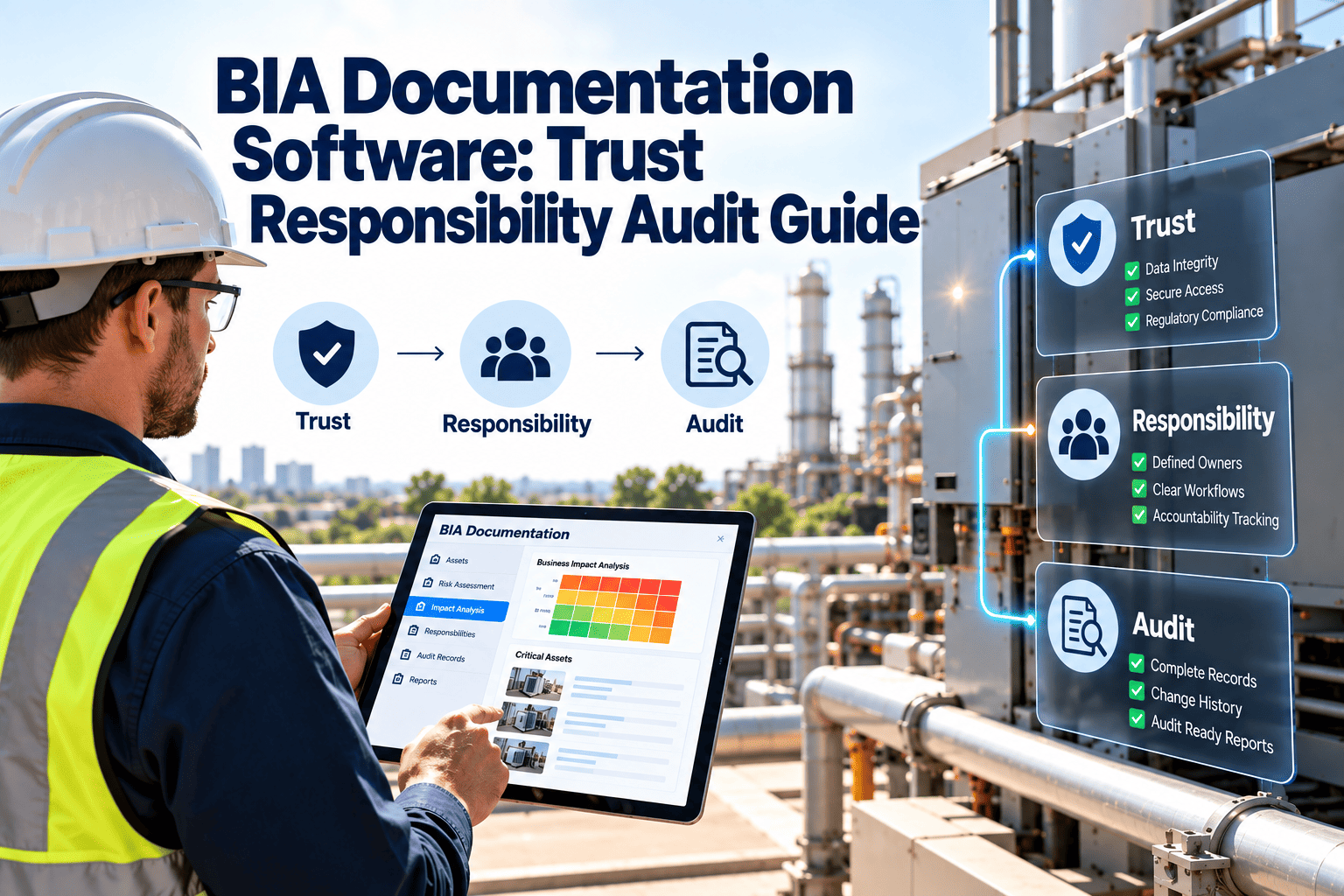
Facilities that serve Tribal communities, including schools, detention centers, offices, housing, dams, and irrigation systems, operate under a federal trust responsibility and heavy oversight. When the Department of the Interior Office of Inspector General, the Government Accountability Office, or a congressional committee asks what condition a facility is in, the answer has to come from records, not recollection. Gaps in inspection files, deferred maintenance logs, and work order history are what turn a routine request into a finding. Here is how BIA documentation software supports an audit-ready record.
BIA Documentation Software: Trust Responsibility Audit Guide
Keep facility inspection, maintenance, and deferred maintenance evidence organized so it can be produced for OIG audits, GAO reviews, and congressional oversight.
Who Is Asking, and What They Want to See
Each oversight body approaches facility documentation from a different angle, but all of them want a traceable line from a stated requirement to a documented action.
What Trust Responsibility Means for Facility Records
The federal trust responsibility to Tribes is broad, but for facilities it comes down to something practical: safe, functional buildings and infrastructure, maintained and documented to a defensible standard.
Documentation should answer five questions
- What do we own or operate, and where is it?
- What condition is it in, and how do we know?
- What deficiencies have been identified, and how serious are they?
- What was done about each one, by whom, and when?
- Why was one project funded before another?
Common Documentation Gaps That Draw Audit Attention
| Gap | Why it draws attention | Record that closes it |
|---|---|---|
| Inspection reports missing or inconsistent | Cannot show required safety inspections occurred | Scheduled inspection work orders with completion dates and attached reports |
| Deficiencies logged but no follow-up | Suggests known hazards were left unresolved | Deficiency linked to a corrective work order and closure evidence |
| Deferred maintenance tracked in spreadsheets | Difficult to verify methodology or trace to assets | Asset-level backlog with cost estimates and condition notes |
| Different sites use different formats | Data cannot be compared or rolled up | Standard templates and asset categories across locations |
| Staff turnover erases history | Knowledge lives with individuals | Records tied to the asset, not the employee |
| Funding decisions poorly documented | Prioritization looks arbitrary | Prioritization criteria and project justification attached to requests |
From Audit Request to Evidence: A Retrieval Pathway
Audit requests arrive with deadlines. The difference between a smooth response and a scramble is whether each step below is a search or a scavenger hunt.
Record Sets by Facility Type
Different facilities generate different evidence. Organizing records by type keeps each inspection regime clear.
- Life safety and fire system inspections
- Building systems condition
- Deficiency and repair tracking
- Renovation and repair project history
- Security system checks
- Life safety and HVAC records
- Corrective action logs
- Periodic inspection reports
- Emergency action records
- Structural and mechanical repairs
- Bridge inspection schedules
- Condition ratings and repair work
- Contractor documentation
- Preventive maintenance history
- Utility and system repairs
- Space and asset inventory
Documentation Maturity Ladder
Most organizations sit somewhere between paper and fully connected records. Use the ladder to see what the next step looks like.
Remote Sites and Field Realities
Many Tribal facilities are far from regional offices, and maintenance staff are often small teams covering large areas. Documentation systems must work for them or they will not be used.
- Long travel distances between sites
- Limited staff and competing emergencies
- Aging buildings with incomplete records
- Multiple funding sources with different reporting needs
- Simple mobile work order and inspection forms
- Photos attached at the point of work
- Recurring inspection schedules generated automatically
- Records organized by asset so history survives staff changes
Audit-Readiness Checklist
- Complete facility and asset inventory for each location
- Inspection schedule assigned and tracked for every required type
- Deficiencies categorized by severity with target dates
- Each deficiency linked to a corrective work order
- Completion evidence attached, including photos where useful
- Deferred maintenance items tied to specific assets
- Prioritization criteria written down and applied consistently
- Reports reproducible by facility, region, and date range
How Oxmaint Supports BIA Facility Documentation
Oxmaint maintenance management software provides a structured place to hold the records oversight bodies ask for. Confirm agency procurement, security, and records requirements as part of any evaluation.
| Oversight need | Oxmaint capability | Result |
|---|---|---|
| Prove inspections happened | Scheduled inspections and preventive maintenance | Dated completion records |
| Show deficiencies were addressed | Corrective maintenance work orders | Traceable finding-to-fix history |
| Explain backlog | Asset management and reporting | Asset-level maintenance history and condition notes |
| Track parts and materials | Inventory management | Cost and usage tied to repairs |
| Summarize for leadership | Dashboards and reports | Consistent views by facility or region |