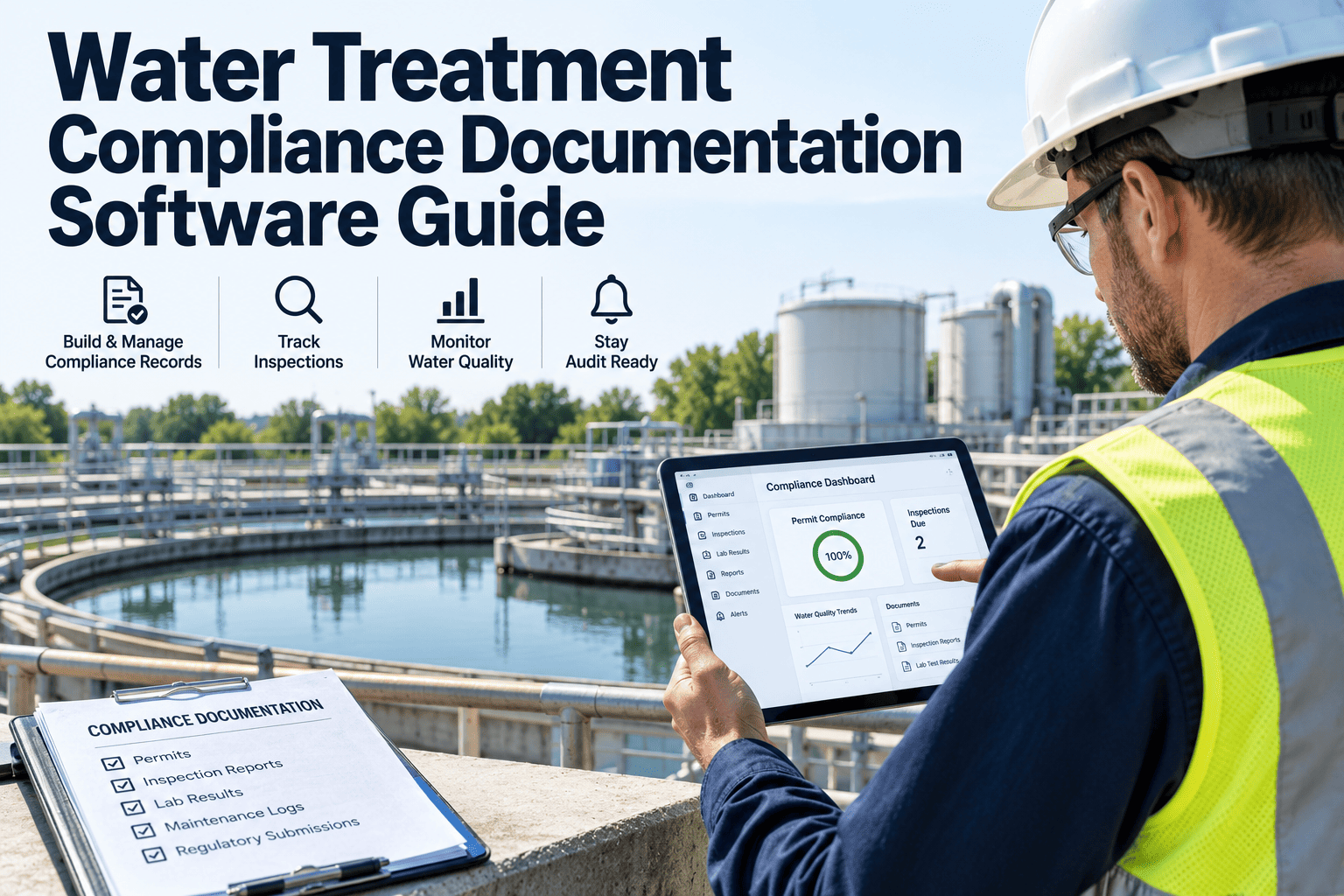
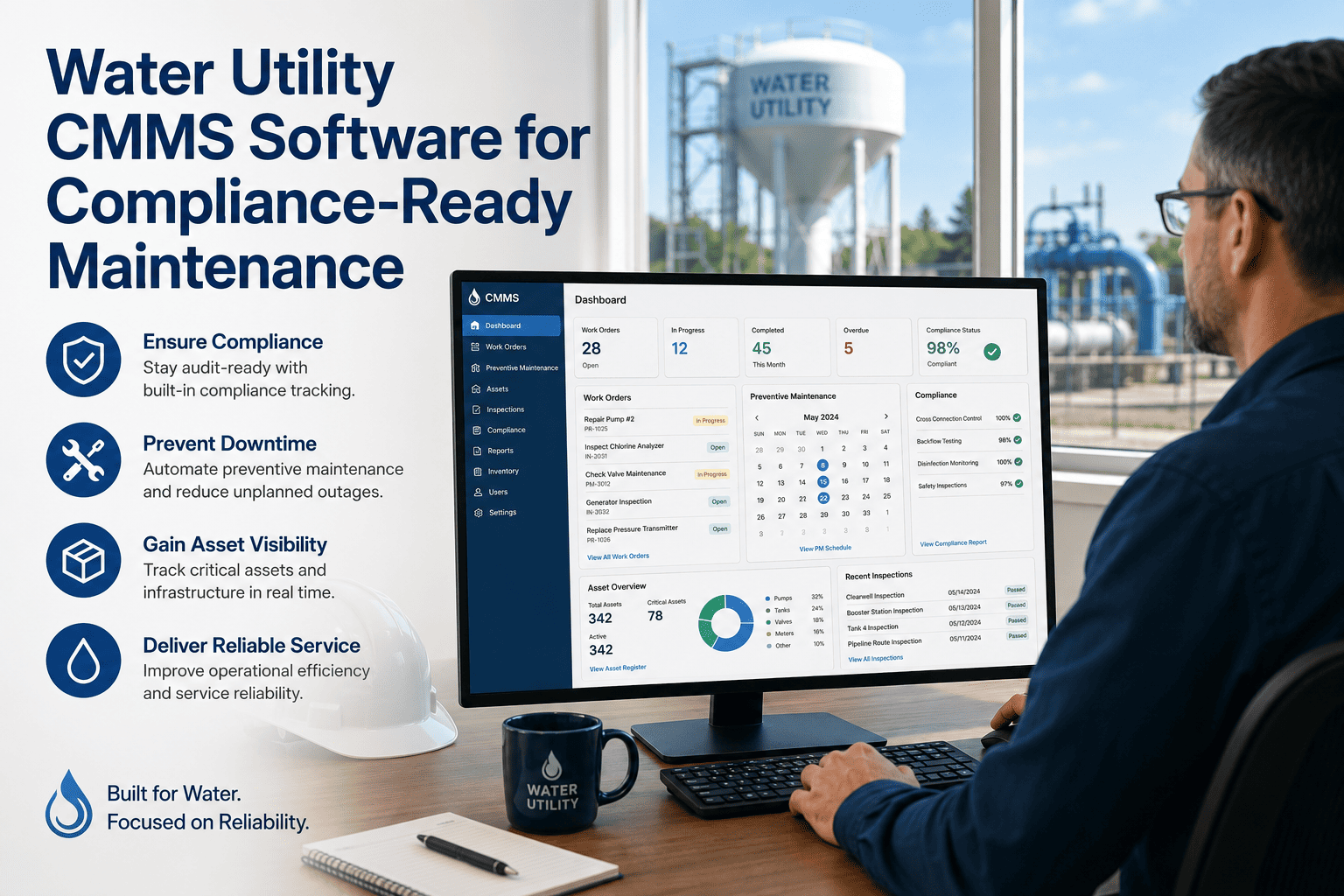
A water treatment plant doesn't fail compliance because the water is unsafe — it fails because a chemical feed log went missing, a turbidity reading was never transcribed from the SCADA printout, or a monthly operating report reached the state primacy agency two days late. Documentation, not treatment chemistry, is where most Safe Drinking Water Act violations actually originate. This guide breaks down the daily, monthly, and annual paperwork every public water system carries, why spreadsheets and paper logs quietly fall apart under that load, and how a CMMS-enforced documentation workflow keeps a plant defensible the moment a state inspector or auditor asks to see the record. See what an automated compliance log looks like against your own plant's monitoring schedule.
Water Treatment · Compliance Documentation
Every Reading, Every Report, Every Signature — Documented the Moment It Happens
Daily operator logs, monthly operating reports, Consumer Confidence Reports, and sanitary survey follow-ups all trace back to the same source data. A CMMS built for regulated water systems captures it once, flags exceedances instantly, and assembles the audit trail before your primacy agency ever has to ask for it.
The Documentation Load
What a Public Water System Has to Prove, and How Often
The Safe Drinking Water Act doesn't just require safe water — it requires a paper trail showing the water was tested, treated, and reported on schedule. That trail runs on three separate clocks at once, and missing any one of them is a violation regardless of what the water quality actually was.
Daily
Operator Logs and Continuous Monitoring
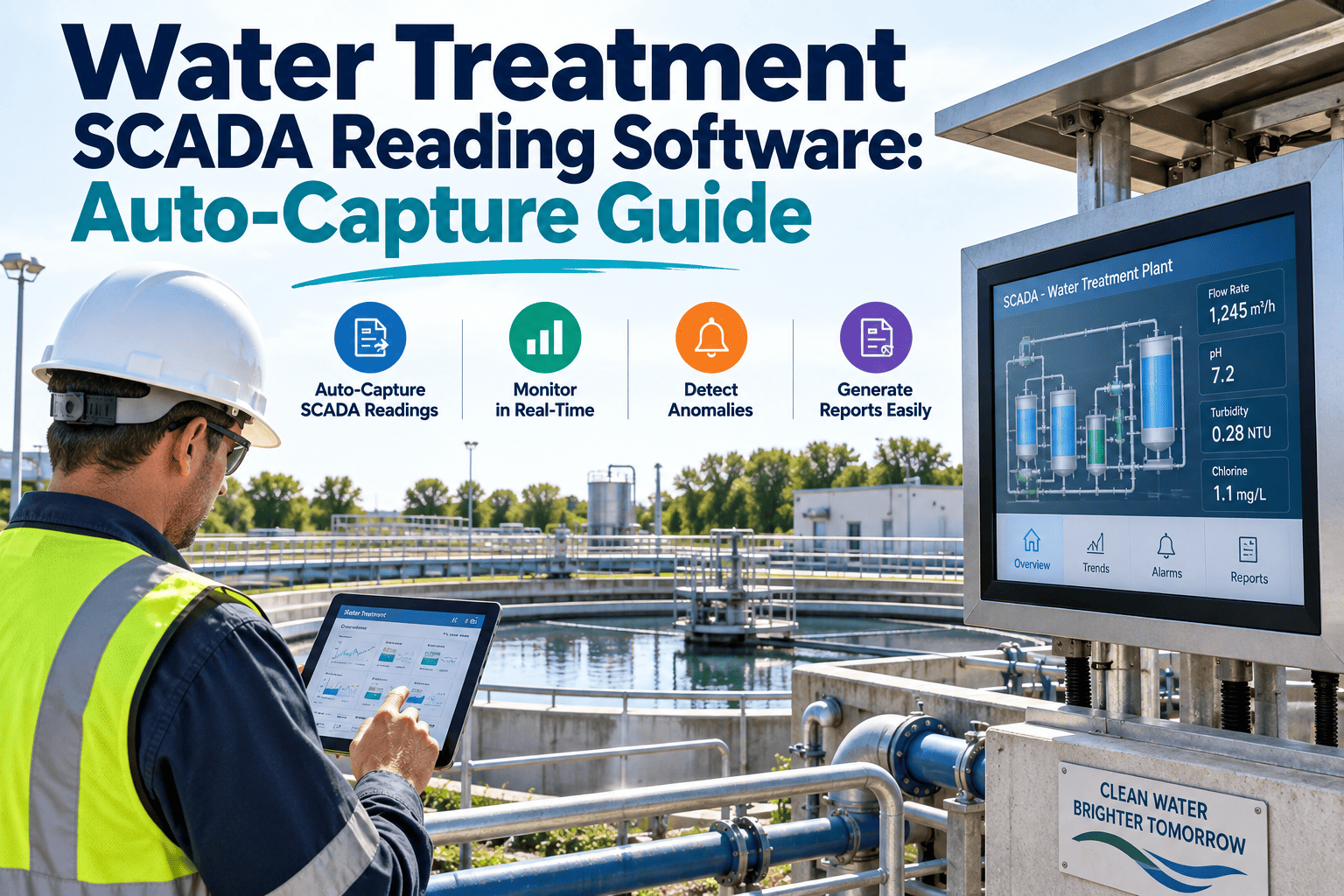
Chlorine residual, turbidity, pH, and flow readings recorded at fixed intervals, plus CT calculations for disinfection contact time. A single unlogged interval can void the day's compliance record even when the treatment itself was correct.
Monthly
Monthly Operating Reports to the Primacy Agency
Most states require a consolidated operating report summarizing production volumes, treatment performance, and any exceedances for the month, submitted on a fixed deadline that does not move for staffing shortages or equipment downtime.
Annual
Consumer Confidence Reports and Certification
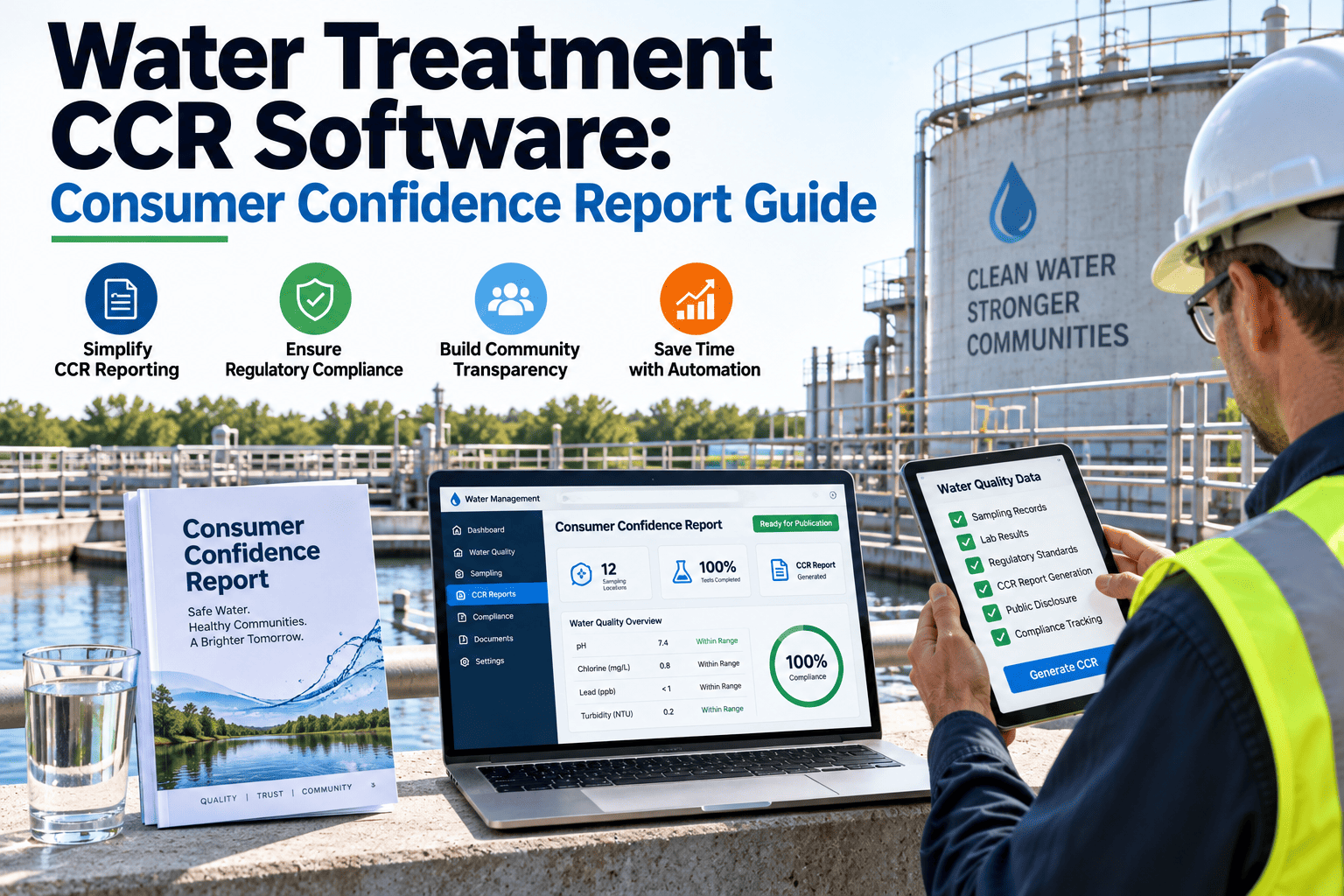
Community water systems must deliver a Consumer Confidence Report to customers by July 1 each year, covering source water, detected contaminants, and compliance status, with a certification letter confirming accuracy typically due to the state soon after.
Periodic
Sanitary Surveys and Corrective Action Tracking
State-conducted sanitary surveys generate findings that a system must formally close out, often on a defined timeline, with evidence of the corrective work performed rather than just a statement that it was completed.
Why Manual Logs Break Down
Spreadsheets Work Until the Plant Gets Busy
A binder of daily log sheets or a shared spreadsheet holds up fine during a quiet month. It starts failing the moment a plant is short-staffed, an operator is out sick, or an exceedance happens on a weekend and nobody enters it until Monday.
Paper and Spreadsheet Logging
Gap Readings entered hours or days after they were taken, with no timestamp tying the entry to the actual moment
Gap Exceedances discovered during month-end review instead of the shift they occurred
Gap Monthly report assembled manually from multiple binders, chemical logs, and lab slips
Gap Sanitary survey follow-ups tracked in email threads that get lost between operator shift changes
CMMS-Enforced Documentation
Fixed Readings logged directly on a mobile device at the point of collection, timestamped automatically
Fixed Threshold breaches trigger an alert and open a corrective work order the same minute they occur
Fixed Monthly operating report data pulled directly from the logged readings, not re-typed
Fixed Every sanitary survey finding tracked as an open task with an owner and a due date until closed
A missed log entry doesn't feel urgent until a sanitary survey asks for it.
Move daily readings, chemical feed records, and CCR data into one system that a state inspector can review in minutes instead of a filing cabinet.
Reference Table
Core Compliance Documents and Their Deadlines
Every one of these documents draws from the same underlying operating data. Treating them as separate paperwork exercises is exactly what causes a system to miss one while focused on another.
| Document |
Typical Frequency |
Primary Source Data |
Consequence of a Gap |
| Daily Operator Log |
Every shift |
Chlorine residual, turbidity, pH, flow, CT |
Unverifiable treatment performance for that period |
| Monthly Operating Report |
Monthly, fixed deadline |
Aggregated daily readings and production volumes |
Reporting violation independent of water quality |
| Consumer Confidence Report |
Annual, due July 1 |
Contaminant sampling results, source water data |
Public notification violation and customer distrust |
| Lead and Copper Rule Sampling |
Set sampling cycle |
Tap sampling results, corrosion control data |
Escalated monitoring and potential public notice |
| Sanitary Survey Corrective Action |
Per finding, on a set timeline |
Inspection findings, repair or process records |
Unresolved finding carried into the next survey cycle |
Built For
Every System Size Carries the Same Paperwork Risk
The specific numbers differ by system size, but the underlying documentation discipline is identical whether the plant serves three thousand people or three hundred thousand.
Small and Rural Systems
Often run by one or two certified operators covering every task, where a single missed log entry has no backup reviewer to catch it before the monthly report is due.
Municipal and Regional Utilities
Multiple treatment facilities and distribution zones reporting to one primacy agency, where consistent logging across every site is what keeps the consolidated report accurate.
Industrial and Private Water Systems
Facilities operating their own treatment for process or potable water, subject to the same monitoring and reporting obligations as a public utility of comparable size.
How It Works
From a Single Reading to a Submittable Report
A CMMS built around compliance data treats every reading as the start of a chain, not an isolated log entry that has to be re-assembled later by hand.
01
Capture at the Point of Collection
Operators log chlorine residual, turbidity, and chemical feed rates on a mobile device on the plant floor, timestamped and tied to the specific treatment unit or sample point.
02
Flag Exceedances Automatically
Any reading outside the configured regulatory threshold opens a corrective work order immediately, with the required response action and timeline attached.
03
Assemble the Monthly Report
Production volumes, treatment performance, and any exceedances for the reporting period are pulled directly from the logged data instead of retyped from separate sheets.
04
Track Sanitary Survey Findings to Closure
Each finding becomes an open task with an owner and due date, with the corrective evidence attached so it's ready before the next survey cycle begins.
05
Keep an Audit-Ready Record
Every reading, exceedance, and corrective action stays attached to the asset and the date it occurred, so a state review pulls a complete history instead of a partial one.
Common Questions
Water Treatment Compliance Documentation — FAQs
Does a CMMS replace the certified operator's judgment on treatment decisions?
No. It records the readings and decisions the operator already makes and keeps them timestamped and organized. Treatment judgment stays with the certified operator; the system just removes the risk of an entry being lost or entered late.
Can the same data feed both the monthly operating report and the annual CCR?
Yes. Both documents draw from the same underlying sampling and treatment data, so logging it once and reusing it for each report is exactly how
Oxmaint is set up to work.
How does this help with a sanitary survey specifically?
Each finding is tracked as an open item with an owner, a due date, and attached evidence of the corrective work, so a system can show closure status at any point instead of scrambling before the next survey.
What happens if a reading is missed during a staffing gap?
The system flags the missing interval instead of leaving a silent gap in the log, giving the operator on the next shift a clear prompt to document what happened rather than letting it go unnoticed until month-end review.
Is this only useful for large municipal systems?
No. A small system with one or two operators often has the least backup coverage for catching a missed log, which makes automated capture and alerting more valuable, not less.
Book a demo to see it set up for your system size.
Water Treatment Compliance · Oxmaint
Stop Rebuilding Reports From Scattered Logs
Capture every reading once, let exceedances open their own corrective work orders, and hand your primacy agency a record that's already organized instead of one you have to build from scratch under deadline pressure.