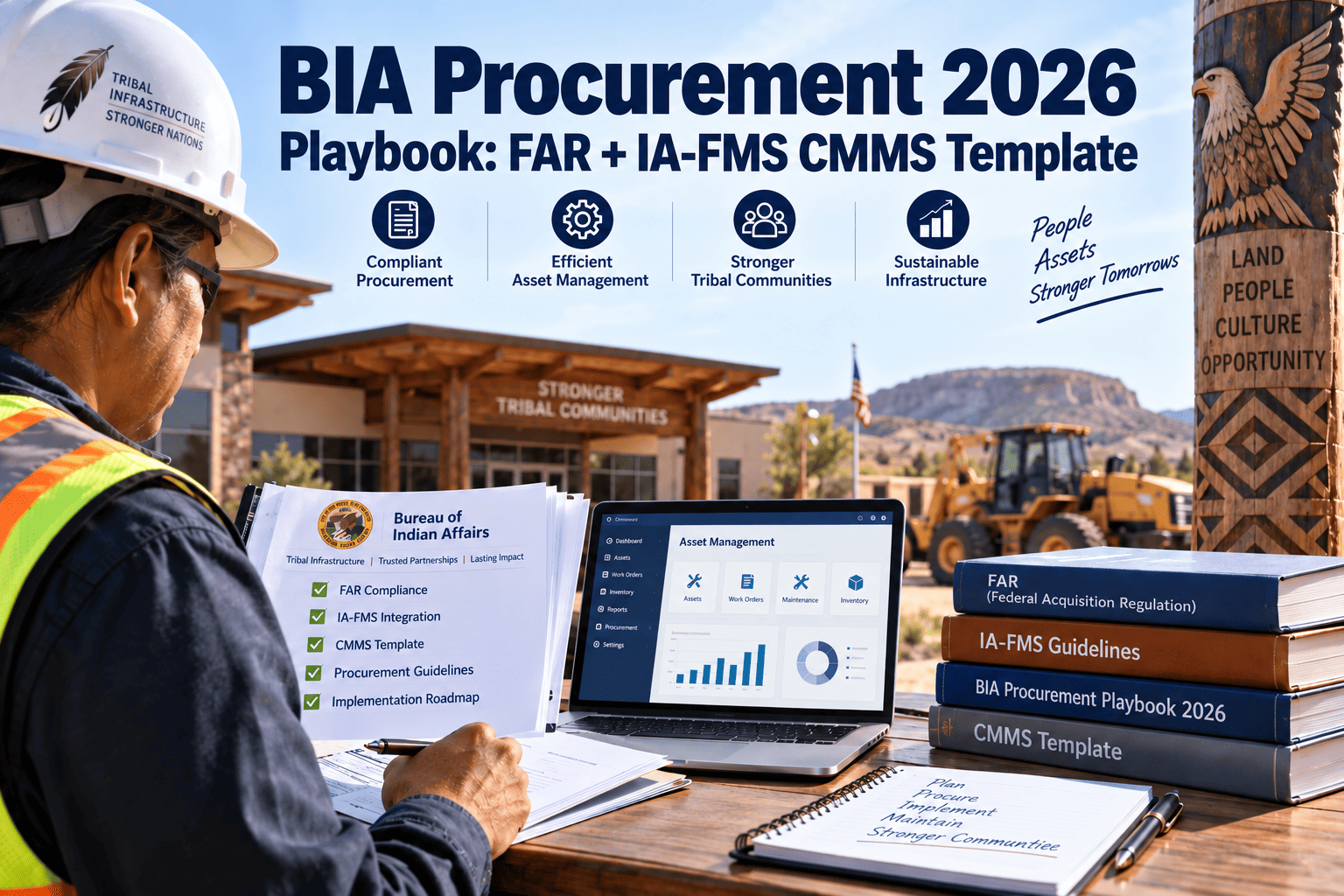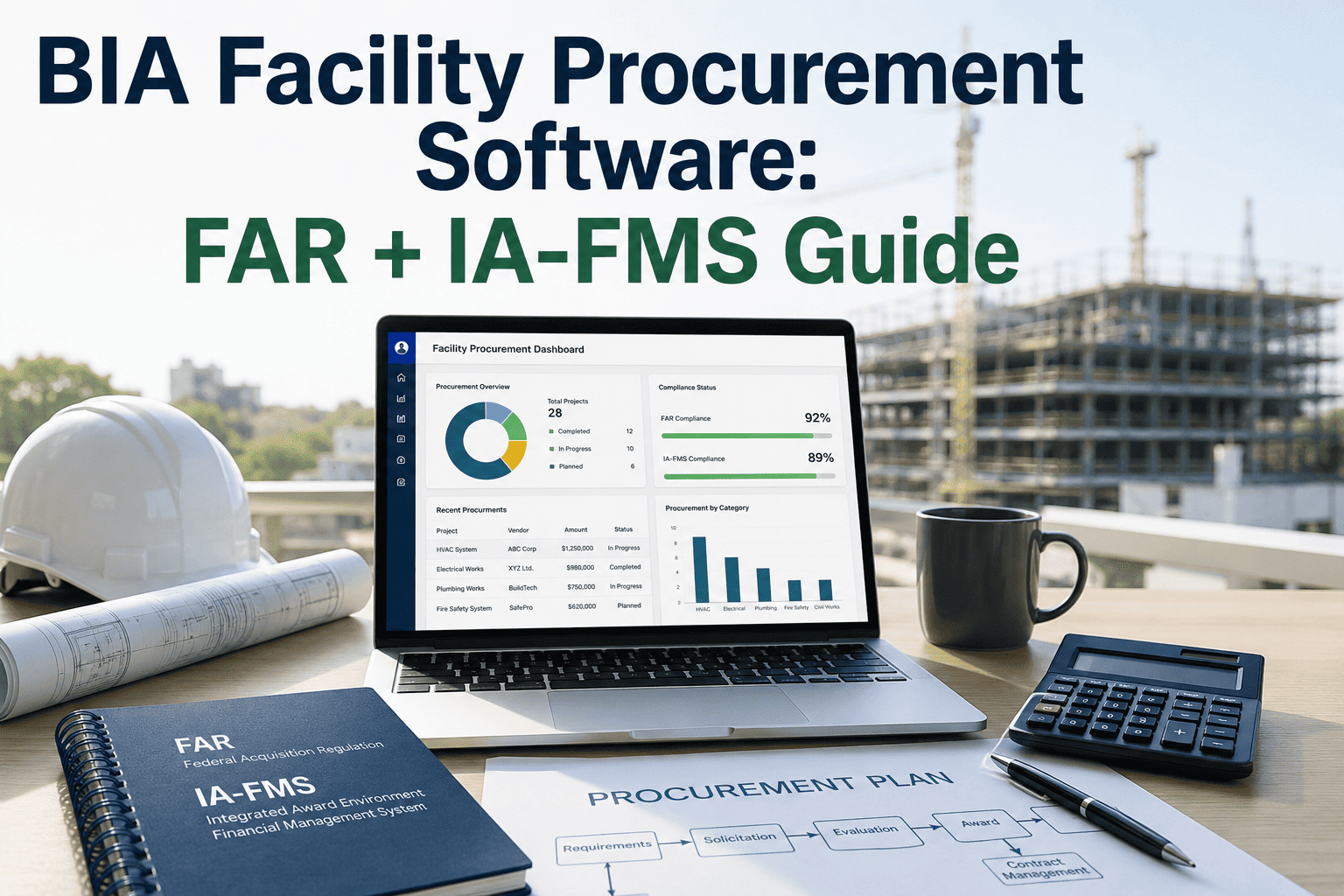
Every BIA facility work order touches three separate compliance systems at once — the Federal Acquisition Regulation governs how the purchase is made, IA-FMS decides which asset record the cost gets tied to, and Buy Indian Act preference or a 638 self-determination contract often decides who is even eligible to bid. A single roof repair at an agency office can sit stalled for weeks when the FAR justification, the IA-FMS asset ID, and the vendor eligibility check live in three disconnected systems that nobody reconciles until an auditor asks. Facility managers across Indian Affairs run into this friction on nearly every purchase above the micro-purchase threshold, and the delay is rarely about money — it is about paperwork that cannot find each other. The fix is not another procurement memo, it is a maintenance platform that ties the work order to the asset record and the compliance trail from the moment the request is written. See how Oxmaint connects FAR documentation, IA-FMS asset data, and 638 vendor workflow at https://calendly.com/oxmaintapp/30min.
BIA facility procurement software is a maintenance and acquisition tracking system that links FAR-compliant purchase documentation, IA-FMS asset and location records, and Buy Indian Act or 638 vendor eligibility data to a single work order. Instead of a facility manager chasing three separate systems for one roof repair or HVAC replacement, the purchase request, the asset history, and the compliance justification stay attached from requisition to closeout, cutting procurement cycle time and reducing unauthorized commitment risk.
Why BIA Facility Purchases Move Slower Than They Should
A maintenance technician at an agency school does not think in terms of FAR Part 8 required sources or Buy Indian Act set-asides. They think about a broken boiler. But the moment that repair crosses the micro-purchase threshold, it enters a compliance chain that most CMMS platforms were never built to hold. The purchase has to be justified against Federal Acquisition Regulation rules, tied to the correct asset inside IA-FMS, checked against Indian economic enterprise eligibility where the Buy Indian Act applies, and in many agencies, coordinated with a tribal 638 contractor who already performs the facility's maintenance program under the Indian Self-Determination and Education Assistance Act. Every one of those steps generates its own paperwork trail, and when those trails do not connect to the same work order, facility managers end up re-entering the same repair three times in three formats.
Federal Acquisition Regulation Part 8 sets required sources for supplies and services, and Indian Affairs acquisition policy layers Buy Indian Act preference on top. Contracting officers must document the source selection reasoning for every facility purchase above the micro-purchase level.
Indian Affairs runs its Facilities Management System on a Maximo-based structure of Organization, Site, Location, and Asset. Every repair, part, and labor cost is expected to post against the correct asset record, not a generic facility bucket.
Under P.L. 93-638, many tribes contract or compact to operate their own facility maintenance programs. Purchases still have to reconcile against federal asset inventories even when a tribal organization, not BIA staff, is doing the work.
Any facility staff member who commits the government to a purchase without a warranted contracting officer creates an unauthorized commitment. Above $2,500, it requires a ratification control number and a documented Determination and Findings.
Oxmaint ties FAR documentation, IA-FMS asset IDs, and vendor eligibility records to a single facility work order, so nothing gets re-entered three times.
Where BIA Facility Procurement Breaks Down
When a purchase request is written up separately from the IA-FMS asset record, contracting officers cannot see the repeat failure pattern that would justify a replacement instead of another patch repair, and repair-versus-replace decisions get made blind.
Buy Indian Act preference and 638 vendor status need to be confirmed before a solicitation goes out. Facility teams that only check eligibility after selecting a contractor create rework, delay, and occasional audit findings.
A facility manager who tells a vendor to start emergency work before a contracting officer signs off has created an unauthorized commitment. Without a system flagging this in real time, ratification requests pile up after the fact.
Across 12 regional acquisition offices, a purchase justification written in one region rarely transfers cleanly if the vendor, asset, or contract moves. Spreadsheet-based tracking loses the history that audits and O&M funding reviews require.
How Oxmaint Structures BIA Facility Procurement
Every purchase request generated from a work order carries the asset ID, location, and maintenance history forward automatically, matching the Organization, Site, Location, Asset structure IA-FMS already uses so nothing has to be re-keyed.
Vendor records store Indian economic enterprise status and 638 contract scope, so a solicitation is checked against Buy Indian Act preference and self-determination contract boundaries before it goes out, not after a bid is already in hand.
Purchase requests above the micro-purchase and $2,500 ratification thresholds are flagged for contracting officer sign-off before field crews can commit the government, cutting down on after-the-fact ratification cycles.
Every purchase, closeout, and asset condition update rolls into a standard reporting format across regions, giving the Division of Acquisitions and Bureau Procurement Executive a consistent view without waiting on manual regional summaries.
Procurement Pathways Facility Teams Manage Daily
From Work Order to Closed Purchase
Facility staff log the repair against the exact IA-FMS-style asset and location, not a general facility category.
System checks purchase value against thresholds and flags Buy Indian Act or 638 vendor eligibility requirements automatically.
Requests above the micro-purchase or ratification threshold route to the correct contracting authority before work begins.
Completed purchase, vendor, and cost data post back to the asset record, building the history the next repair-versus-replace decision needs.
See how facility teams across Indian Affairs use Oxmaint to route purchases, flag vendor eligibility, and keep asset history intact.
Tracked vs Untracked Facility Procurement
| Metric | CMMS-Tracked Program | Spreadsheet / Manual Tracking |
|---|---|---|
| Purchase-to-Asset Match Rate | Near-complete match at time of request | Frequently posted to generic facility codes |
| Vendor Eligibility Verification | Checked automatically before solicitation | Checked manually, often after selection |
| Unauthorized Commitment Exposure | Flagged before field crews commit funds | Discovered during after-the-fact ratification |
| Regional Reporting Consistency | Standard rollup format across all regions | Each region formats reports differently |
| Audit Documentation Readiness | Purchase justification attached at request time | Reconstructed manually when an audit is called |
Procurement Performance Benchmarks
What Changes After Structured Procurement Tracking
Where the Time Savings Come From
| Procurement Task | Manual Approach | Oxmaint-Tracked Approach |
|---|---|---|
| Asset Lookup for Purchase Justification | Separate search in a different system | Pulled automatically from the work order |
| Vendor Eligibility Confirmation | Phone call or email to acquisitions staff | Stored on vendor record, checked instantly |
| Ratification Documentation | Assembled after the fact from memory and email | Logged automatically at the point of commitment |
| Regional Rollup Reporting | Manually reformatted per region each cycle | Standardized dashboard across all regions |
Frequently Asked Questions
Asset-linked requisitions, vendor eligibility flagging, ratification tracking, and standardized regional reporting, built for how Indian Affairs facility teams actually work.