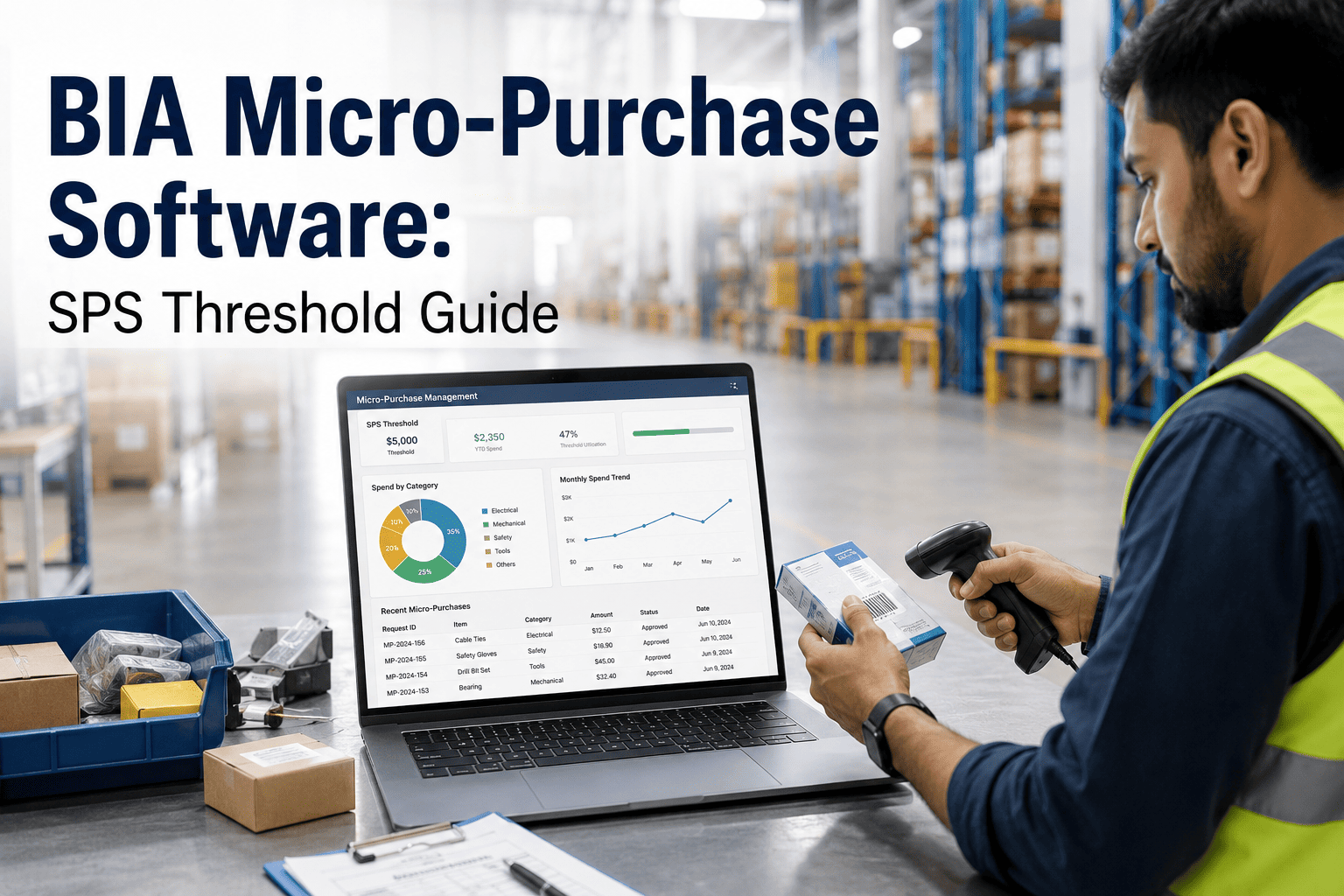
A BIA facilities maintenance shop does not lose money on the big contracts — those get scrutiny, quotes, and a contracting officer's signature. It loses time and audit standing on the small ones: the $340 pump seal, the $2,100 emergency compressor part, the $11,000 HVAC repair that quietly needs three price checks before anyone notices. The federal micro-purchase threshold rose to $15,000 on October 1, 2025, and the simplified acquisition threshold now sits at $350,000, which means more of a BIA maintenance budget than ever before flows through purchase-card buys that still need a receipt, a business purpose, and a defensible price history attached. OxMaint ties that documentation to the work order automatically, so the audit trail exists before the auditor ever asks for it.
Federal Facilities · FAR Part 13 · Purchase Card Compliance
BIA Micro-Purchase Software: Staying Inside the SAT Threshold Without Slowing Down Repairs
FAR Part 13 gives BIA facilities buyers three distinct lanes — micro-purchase, simplified acquisition, and above-SAT procurement — each with its own documentation burden. A CMMS that tags every purchase by threshold, links it to the triggering work order, and flags split-purchase risk before the card is swiped turns a compliance obligation into a byproduct of routine maintenance work.
$15,000
Current micro-purchase threshold, raised from $10,000 effective October 1, 2025
$350,000
Current simplified acquisition threshold, raised from $250,000 the same date
3–5 days
Typical statement reconciliation window most agencies require of cardholders
The Threshold Ladder
Four Dollar Bands, Four Different Procurement Paths
Every BIA facilities purchase lands in one of four bands, and the band determines what documentation the CMMS needs to attach before the work order closes. Getting the band wrong is the single most common finding in purchase card reviews.
Under $15,000
Micro-Purchase Threshold
Government purchase card is the preferred and often sole method. No competitive quotes required, no formal solicitation. Reasonable price and a valid business purpose are the bar. This is where the overwhelming majority of BIA facilities work orders — filter changes, pump parts, contract electricians, emergency plumbing — actually live.
$15,000 – $350,000
Simplified Acquisition Threshold
Simplified Acquisition Procedures apply. The buyer needs a documented scope of work, evaluation criteria where applicable, and quotes or price lists from at least three qualified sources before a best-value award. Small business and Buy Indian Act set-aside considerations attach at this band.
Above $350,000
Full Contracting Authority
Requires Contracting Officer
Full and open competition procedures apply, routed through the Division of Acquisitions and a contracting officer rather than a cardholder or requisitioner. FBMS purchase requests are mandatory regardless of funding source at this level.
Any Amount
Split-Purchase Risk
Breaking a known requirement into smaller purchases to stay under a threshold is prohibited under FAR 13.003(c)(2), regardless of intent. A requirement is the total quantity and price known at the time of purchase — not what fits on one receipt.
Where Facilities Shops Actually Get Flagged
Five Micro-Purchase Failure Points in BIA Facilities Maintenance
Most purchase card findings in facilities operations are not fraud — they are documentation gaps created by paper receipts, spreadsheet tracking, and purchases made faster than anyone logs them.
01
Same Vendor, Same Day, Two Receipts
A technician buys a pump seal in the morning and a coupling from the same supplier that afternoon because the first trip missed a part. On paper it looks like two purchases under threshold. To an auditor applying the "known requirement at time of purchase" test, it can look like a split.
Result: Flagged for review even when the intent was never to circumvent the threshold.
02
No Link Between Receipt and Work Order
The purchase card statement shows a $4,200 charge at an HVAC supply house. The work order shows a rooftop unit repair. Nothing in either system says the two are connected. Reconciliation becomes a manual cross-reference exercise every billing cycle.
Result: Reconciliation windows of three to five days get consumed by matching, not verifying.
03
No Price History for "Reasonable Price"
Micro-purchases still require a reasonable price determination. Without a record of what a part or service cost last time, cardholders have no baseline to compare against, and reviewers have no way to confirm the price was reasonable without asking the vendor directly.
Result: Price-reasonableness questions become vendor phone calls instead of a two-second lookup.
04
Threshold Band Determined After the Fact
A repair estimated at $12,000 grows to $16,500 once parts and labor are finalized — crossing from micro-purchase into simplified acquisition territory mid-job. Without a system tracking cumulative spend against the triggering requirement, nobody notices until the invoice lands.
Result: A purchase that needed three quotes gets processed as if it never crossed the line.
05
Emergency Repairs Bypass the Paper Trail
A burst pipe or failed generator gets fixed first and documented later, if at all. The urgency is legitimate — the documentation gap is not. Emergency purchases still need the same business-purpose and threshold documentation as routine ones, just captured faster.
Result: The highest-scrutiny purchases end up with the thinnest paper trail.
The Reconciliation Loop
How a Work-Order-Linked Purchase Card Cycle Works
1
Work Order Opens
A technician logs a failure or a PM task generates a work order automatically. The purchase requirement — parts, contract labor, a part number — is attached to that work order from the start, not created separately later.
2
Threshold Band Tags Automatically
As the estimated cost is entered, the system flags which band the purchase falls in — under $15,000, between $15,000 and $350,000, or above. If the estimate crosses a threshold mid-job, the tag updates and surfaces the change.
3
Cardholder Purchases and Uploads Receipt
The purchase is made against the card, and the receipt is photographed and attached to the same work order record on the spot — from a phone, from the shop floor, before the paper receipt has a chance to get lost.
4
Same-Vendor Purchases Cross-Check
The system checks whether the same vendor has been paid against related work orders in the same period, surfacing potential split-purchase patterns before the statement is submitted rather than after an audit finds them.
5
Statement Reconciles Against Linked Work Orders
At statement time, every card line item already has a work order, a receipt, and a threshold tag attached. Reconciliation becomes a review step instead of a reconstruction project.
Three Repairs, Three Bands
How the Same Facilities Shop Handles Each Threshold in Practice
The threshold band is not an abstract compliance category — it changes what a facilities manager has to do before the purchase card gets swiped. Three realistic BIA repair scenarios show how the documentation burden scales with dollar amount.
Micro-Purchase
$1,850
Boiler Circulation Pump Replacement
A circulation pump fails in a school heating loop mid-winter. The technician confirms the part number, checks the last purchase price on file for the same pump, and buys it same-day with the purchase card. No quotes required — the receipt, the work order, and the price reference are the whole record.
Simplified Acquisition
$28,400
Roof Section Repair After Storm Damage
Wind damage opens a section of roof over a facilities warehouse. The estimated repair cost clears the micro-purchase threshold immediately, so the shop documents a scope of work, requests quotes from three qualified roofing contractors, and records a best-value justification before awarding — even though the work still needs to start quickly.
Above SAT — Contracting Office
$410,000
HVAC System Replacement, Multi-Building
A full HVAC replacement across several buildings crosses the simplified acquisition threshold. The requisition routes through FBMS to the Division of Acquisitions, where a contracting officer manages full and open competition — well outside what a facilities cardholder can execute directly, regardless of urgency.
Purchase Card Discipline
The Threshold Doesn't Change How Fast a Repair Needs to Happen — It Changes What Has to Be on File Afterward
OxMaint tags every purchase-card transaction to its threshold band and attaches the receipt to the work order that triggered it, so BIA facilities teams can move at repair speed and still hand an auditor a complete record on request.
See It On Your Own Equipment
Every Repair Above Already Has a Threshold Band — Yours Do Too, Whether Anything Is Tracking Them or Not
A short walkthrough on your own facilities data shows exactly where purchase records are currently disconnected from work orders, and what closing that gap looks like day to day.
Before and After
Spreadsheet Tracking vs. Work-Order-Linked Purchase Records
| Compliance Task |
Spreadsheet and Paper Receipts |
Work-Order-Linked CMMS |
| Receipt-to-work-order match |
Manual cross-reference at month end |
Attached at time of purchase |
| Threshold band determination |
Judgment call, often after the fact |
Tagged automatically at estimate entry |
| Split-purchase pattern check |
Only visible if someone looks for it |
Surfaced before statement submission |
| Price-reasonableness reference |
Depends on who remembers last price |
Historical purchase price on the same part number |
| Audit request response time |
Days, pulling records from multiple places |
Minutes, filtered by work order or date range |
| Emergency purchase documentation |
Often reconstructed after the fact |
Captured from the phone during the repair |
What Each Band Actually Requires
Documentation Checklist by Threshold Band
Under $15,000
- Valid business purpose recorded
- Itemized receipt attached
- Reasonable price justification
- No competitive quotes required
$15,000 – $350,000
- Documented scope of work
- Minimum three vendor quotes
- Best-value award justification
- Small business set-aside review
Above $350,000
- FBMS purchase request required
- Routed to contracting officer
- Full and open competition
- Formal solicitation process
Every Purchase, Every Band
- No intentional threshold splitting
- Requirement defined at time known
- Same-day, same-vendor scrutiny
- Consolidated need treated as one buy
What an Auditor Actually Pulls
The Four Records Behind Every Defensible Purchase
A purchase card review rarely questions whether the repair was necessary. It questions whether the record proves the repair was necessary, priced fairly, and processed under the right procedure. Four pieces of documentation answer that question every time, regardless of which threshold band the purchase falls in.
Business Purpose
A short statement tying the purchase to a specific piece of equipment or facility need — not a generic category, but the actual failure or maintenance task that triggered the buy.
Itemized Receipt
A receipt showing what was purchased, from whom, and for how much — matched to the card statement line item rather than sitting in a separate folder.
Price Reference
Evidence the price was reasonable, whether that is a prior purchase of the same part, a vendor price list, or a documented quote comparison at the simplified acquisition band.
Threshold Determination
A record of which FAR Part 13 band the purchase fell in and why — the single item most often missing when a purchase is questioned after the fact.
What Changes on the Ground
Effect of Work-Order-Linked Purchasing on Facilities Operations
Same-Day
Receipt Capture
Receipts photographed and attached to the work order from a phone at the point of purchase, not reconstructed from a shoebox at month end.
Automatic
Threshold Tagging
Every purchase is tagged to its FAR Part 13 band as the estimate is entered, so the correct documentation requirement is visible before the purchase happens.
Searchable
Price History
Every past purchase on a part number or vendor is a lookup away, giving cardholders a defensible reference for price reasonableness.
Minutes
Audit Response
Pulling every purchase tied to a piece of equipment, a vendor, or a date range becomes a filtered report instead of a multi-day records search.
Common Questions
BIA Micro-Purchase and Threshold Questions
Does OxMaint replace FBMS or the purchase card program itself?+
No. OxMaint sits alongside FBMS and the GSA SmartPay purchase card, linking receipts and threshold tags to the maintenance work order that triggered the buy.
Book a demo to see how the two systems fit together.
How does the system know a purchase crossed from micro-purchase into simplified acquisition?+
The threshold tag on a work order updates automatically as the estimated or actual cost is entered, so a repair that grows past $15,000 mid-job is flagged rather than processed under the wrong procedure.
Can this help identify split-purchase risk before it becomes an audit finding?+
Yes. Same-vendor, same-period purchases tied to related work orders are surfaced for review before the statement is submitted, giving the cardholder or approving official a chance to document intent.
Does this work for emergency repairs where the purchase happens before paperwork is possible?+
Emergency work orders can be opened from a phone at the point of repair, with receipts and threshold tags attached as soon as connectivity allows, closing the documentation gap that emergency purchases usually create.
Is pricing history shared across a facility or only visible to the original cardholder?+
Price history on a part number or vendor is visible to authorized facilities staff across the shop, so any cardholder can check a prior price before making a reasonable-price determination.
Start a free trial to see it on your own equipment list.
Threshold-Aware Purchasing
Give Every Purchase Card Buy a Work Order, a Receipt, and a Threshold Tag From the Start
BIA facilities teams do not need slower purchasing — they need a record that keeps up with repair speed. OxMaint attaches the documentation as the work happens, so the audit trail is already built by the time anyone asks for it.