Municipal transportation departments answer to more than one federal rulebook at the same time. Bridges fall under the National Bridge Inspection Standards, signs and signals fall under the MUTCD, safety projects fall under the Highway Safety Improvement Program, and every one of these programs feeds into a single federal-aid funding eligibility file that FHWA can review at any time. A gap in any single asset class does not stay contained to that asset class — it puts the whole federal-aid relationship under review. Most agencies discover a documentation gap only during a stewardship review, when the fix costs far more time and money than staying ahead of it would have, which is why a growing number of public works teams now start a free trial before their next review cycle arrives.
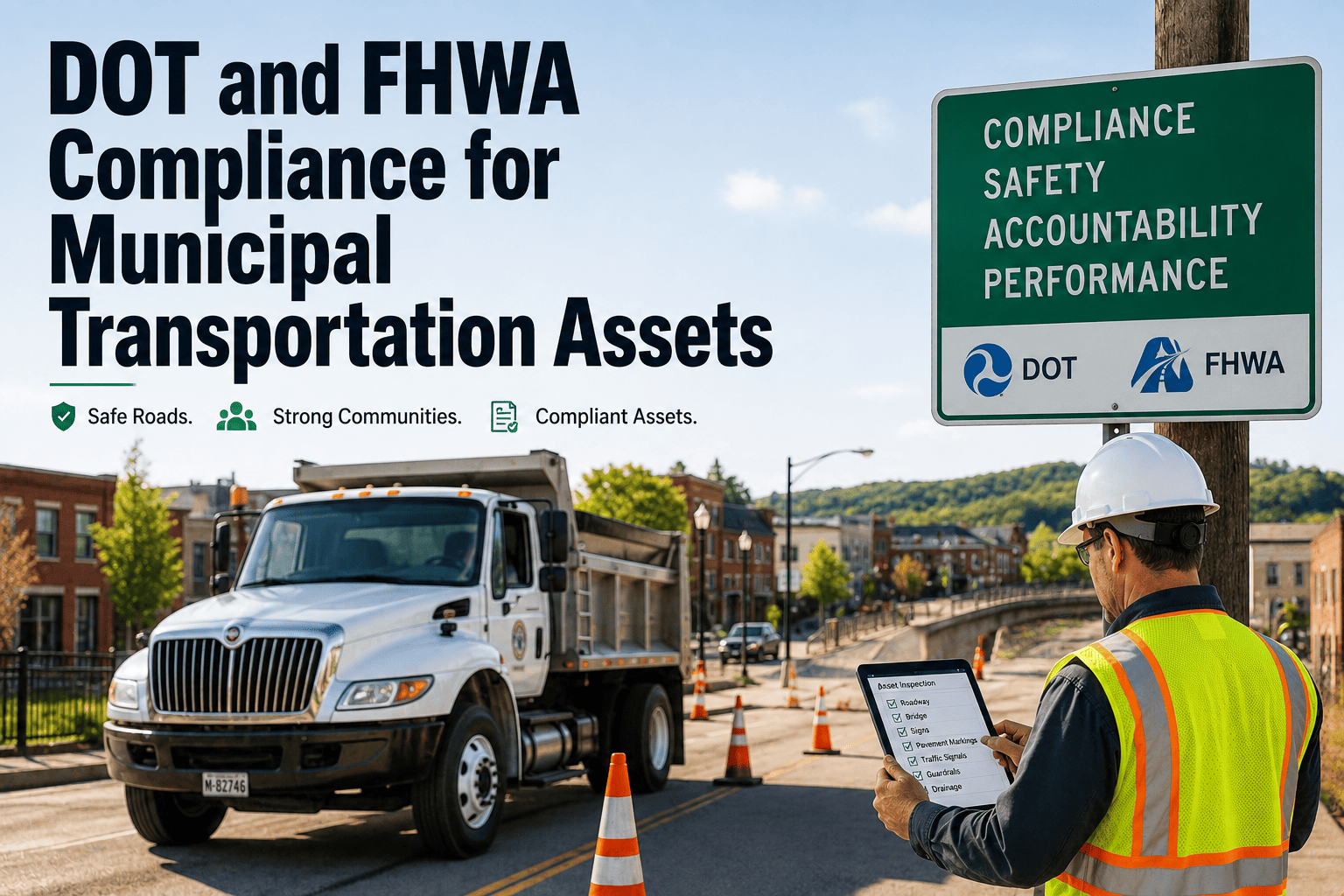
DOT and FHWA Compliance for Municipal Transportation Assets
Four federal programs, one funding relationship. See how bridges, signs, signals, and safety projects connect into a single compliance record — and how to keep it audit-ready year round.
Four Federal Programs, One Transportation Network
Every road-owning municipality is managing four overlapping compliance obligations whether or not it has named them as a program. Understanding how each one works — and how they report up to the same federal-aid funding decision — is the first step toward a defensible transportation asset file.
Every public highway bridge is inspected on a federally set clock, with the interval tightening as condition worsens. Findings feed the National Bridge Inventory that determines funding eligibility.
Agencies must run a documented method that keeps sign sheeting above minimum nighttime visibility levels. Compliance is judged on the method, not on zero individual sign failures.
Federal safety dollars follow crash data. Projects must be justified with documented crash frequency, severity, and benefit-cost analysis tied to the state's Strategic Highway Safety Plan.
FHWA stewardship reviews check whether documentation across every asset class is current. A gap discovered in one category can put the entire federal-aid relationship under scrutiny.
How Bridge Inspection Intervals Actually Work
Not every bridge is inspected on the same clock. Agencies can use a fixed 24-month default or adopt a risk-based framework that tiers structures into four interval categories based on condition, traffic, and structure type.
Extending past 24 months requires a Risk Assessment Panel of at least four reviewers, two of them licensed engineers, plus a written policy filed with FHWA — and every inspection must still be led by a qualified team leader with a PE license or comprehensive NHI training.
A Missed Interval on One Bridge Can Trigger a Review of Every Asset You Own
OxMaint tracks the correct inspection interval for every structure automatically — condition rating, risk tier, and team leader qualifications included — so nothing quietly slips past its due date.
Sign and Signal Retroreflectivity — What Actually Counts as Compliant
The MUTCD does not require every sign to score above the minimum retroreflectivity level at every moment. It requires agencies to run and document one of several approved assessment methods. The table below breaks down the categories and the method options most municipalities use.
| Sign Category | Federal Method Deadline | Common Assessment Method | Typical Sheeting Life |
|---|---|---|---|
| Regulatory Signs | Method required since June 2014 | Nighttime visual inspection or measured retroreflectometer readings | 7 – 10 years |
| Warning Signs | Method required since June 2014 | Nighttime visual inspection against a calibrated comparison panel | 7 – 10 years |
| Street Name Signs | Method required since January 2018 | Expected sheeting life / blanket replacement program | 7 – 10 years |
| Overhead Guide Signs | Method required since January 2018 | Control sign sampling or measured retroreflectivity | 10 – 12 years |
The one requirement that trips up most agencies is not sign condition — it is the missing paper trail. Without a written, consistently applied method on file, even a fully compliant sign inventory can fail an FHWA review. Book a demo to see how the method gets documented automatically.
The Real Cost of a Compliance Gap Is Rarely the Fine
Municipalities rarely lose money to a citation. They lose it to funding eligibility reviews, crash liability exposure, and rushed corrective work that could have been scheduled instead of forced.
Building a Defensible Compliance Program — 4 Phases
Most agencies are already doing pieces of this work. The gap is almost always structure — turning scattered inspections into one connected, exportable record across every asset class.
Register every bridge, sign, signal, and federal-aid road segment with location, install date, material, and jurisdiction class in a single system instead of four separate lists.
Assign the right NBIS interval per bridge risk tier, the right MUTCD assessment method per sign category, and the right crash-data collection window for HSIP-eligible segments.
Attach photos, condition ratings, inspector qualifications, and method records to every asset so a reviewer can trace the full history of any structure in minutes.
Generate NBI-ready bridge exports, sign method summaries, and HSIP benefit-cost records ahead of a stewardship review instead of scrambling once one is scheduled.
One System for Every Federal-Aid Asset Class
OxMaint connects bridge, sign, signal, and safety project records into a single compliance file. Public works teams can start a free trial or book a demo to see their network mapped in one place.
Every bridge gets the correct 12, 24, 48, or 72-month interval based on condition rating and risk tier, with inspector qualifications tracked alongside it.
Track the assessment method used per sign category and generate the written record FHWA reviewers ask for during a program check.
Attach crash history, benefit-cost analysis, and SHSP alignment notes directly to the project record instead of a separate grant file.
One register instead of four spreadsheets, with jurisdiction, install date, and asset class searchable across the entire network.
Produce inspection, condition, and method records for any asset instantly, ready for an FHWA stewardship or program review.
Assets approaching their due date or missing documentation surface on one dashboard, ranked by funding eligibility risk.
Frequently Asked Questions
How often must municipal bridges be inspected under NBIS?
Does every sign need to be replaced to comply with MUTCD rules?
What typically triggers a loss of federal-aid funding eligibility?
Do HSIP-funded safety projects need documentation after construction finishes?
Can one system manage bridges, signs, signals, and roads together?
FHWA Reviews the Records You Have — Not the Work You Did
A well-run compliance program only counts if it can be produced on demand. OxMaint keeps every bridge, sign, signal, and safety project inspection-ready and audit-ready at the same time.