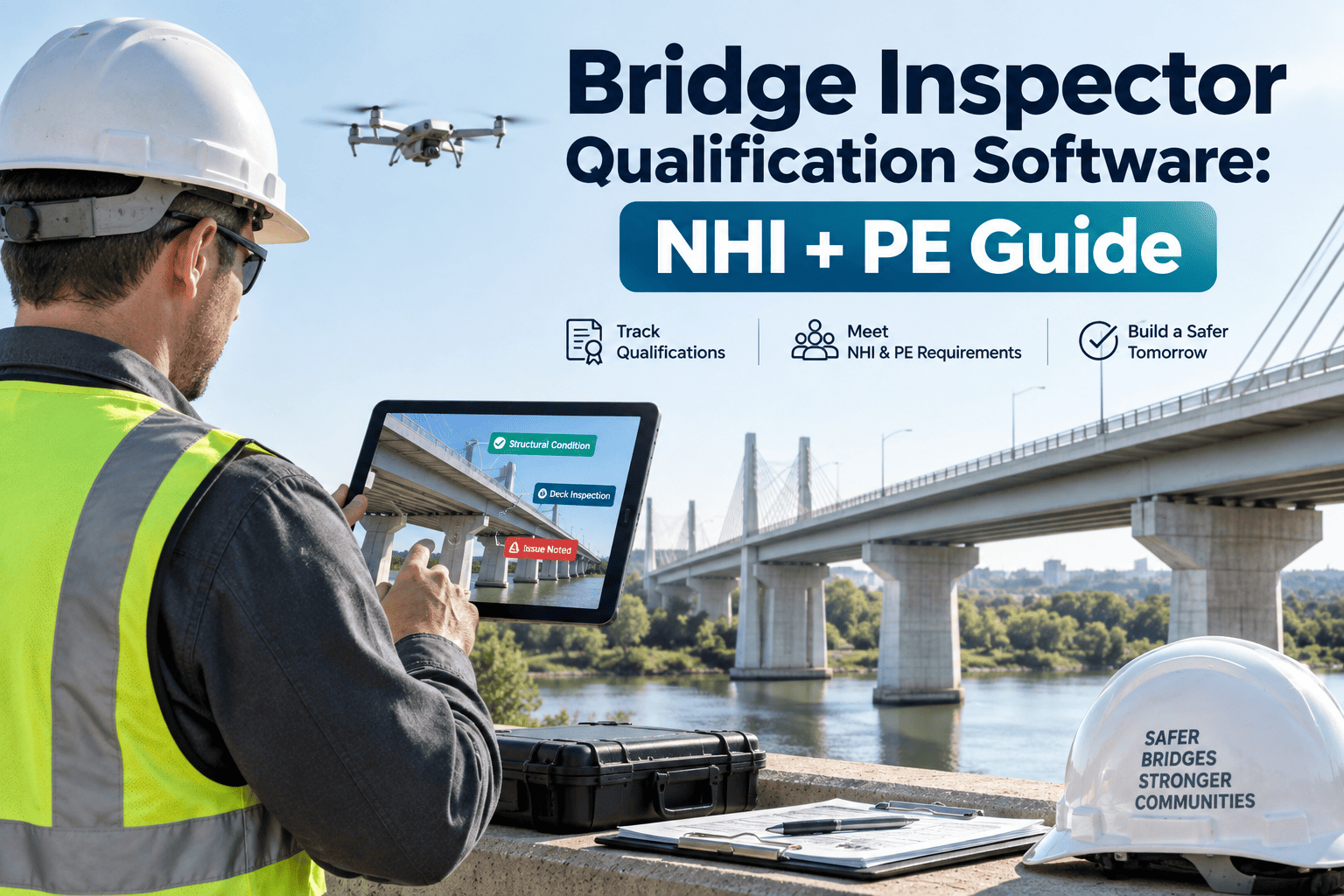
A bridge inspection is only as valid as the credentials of the person who performed it, and the National Bridge Inspection Standards track more than one kind of credential at once. A single team leader might need a current comprehensive training certificate, a rolling 18-hour refresher balance, a valid professional engineer license, and a specialty certification for nonredundant steel tension members — four separate clocks, each running on its own schedule, each capable of quietly expiring while everyone assumes someone else is watching it. Most bridge programs discover a lapse the hard way: during an FHWA program review, a legal challenge after an incident, or an audit ahead of a funding cycle, long after the inspections in question were already performed and filed. When one lapses, the inspection performed under that inspector's name can be challenged, and a state's federal bridge funding eligibility can be put at risk over a single missed renewal. OxMaint's qualification tracking platform keeps every credential, every expiration date, and every hour of required training in one place, instead of scattered across HR files and personal notebooks — reachable any time at app.oxmaint.ai.
Never Assign An Inspection To A Lapsed Credential Again
See how OxMaint keeps comprehensive training, refresher hours, PE licenses, and specialty certifications current and verified across your entire bridge inspection team.
Four Roles, Four Different Sets Of Requirements
23 CFR 650.309 does not set one bar for "bridge inspector" — it sets a different bar for each role on the inspection team, and a person can hold more than one qualification at a time, which is part of what makes a single unified record so useful. Knowing which requirement applies to which person, and which document proves it, is the first place qualification tracking usually breaks down when it is spread across separate personnel files.
Must be a registered Professional Engineer or have 10 years of bridge inspection experience, complete FHWA-approved comprehensive training with a score of 70 percent or better, and complete a cumulative 18 hours of refresher training every 60 months — with documentation kept on file for every one of those requirements and available whenever a review requests it.
Can qualify through one of four documented paths, ranging from a PE license plus limited experience, to passing the Fundamentals of Engineering exam plus two years of bridge inspection experience, to an associate's degree in engineering combined with specific training and field experience — each path requiring its own distinct combination of proof.
Any team leader inspecting nonredundant steel tension members must have completed FHWA-approved NSTM training — currently NHI course 130078 — a requirement that took full effect for inspections performed after June 6, 2024, and applies on top of standard team leader qualifications rather than replacing them.
Must complete FHWA-approved underwater bridge inspection training and score 70 percent or better on an end-of-course assessment, a separate credential track from the comprehensive above-water training most inspectors complete first, and one that has to be verified independently before any underwater work order is assigned.
Why One Missed Renewal Rarely Stays Small
A qualification lapse is rarely discovered the day it happens — it usually surfaces during an FHWA program review, a legal challenge after an incident, or an audit ahead of a funding cycle, by which point the inspections performed under that credential are already on record and difficult to unwind cleanly.
An inspection performed by someone whose qualification had already lapsed can be questioned during a legal review or an FHWA program evaluation, forcing a reinspection and putting the original finding in doubt at the worst possible time — often years after the original inspection was filed and the bridge's condition rating was already relied upon for planning decisions.
States are required to maintain documented personnel qualifications as part of NBIS compliance, and a pattern of undocumented or lapsed credentials found during a program review can factor into broader questions about a bridge program's federal funding standing, particularly when the pattern repeats across more than one inspector or district.
If a structural issue is later linked to a bridge that was inspected by someone without a current, documented qualification, the agency's defense becomes considerably harder to make, regardless of how thorough the inspection itself actually was or how experienced the inspector genuinely is.
Program managers are personally responsible for maintaining documentation supporting every inspector's qualifications, which means a gap discovered during review reflects directly on the person running the program, not just the individual inspector whose credential happened to lapse.
Stop Tracking Four Expiration Clocks In Four Different Places
Walk through how OxMaint maps comprehensive training, refresher hours, PE licensure, and specialty certifications to every inspector on your team, with alerts before anything lapses.
The Four Clocks Running On Every Bridge Inspector
None of these four timers reset on the same schedule, which is exactly why a spreadsheet built to track one of them quietly stops covering the others within a year or two.
The NHI 130101 introductory course or 130101A assessment must be completed within two years before an inspector can sit for the comprehensive training course — miss the window and the prerequisite has to be retaken before the comprehensive course can even be scheduled.
Every inspector needs a cumulative 18 hours of FHWA-approved refresher training over each rolling 60-month period, tracked as an ongoing balance rather than a single pass or fail event, which makes it easy to lose track of exactly how many hours remain.
Professional engineer licenses renew on a state-specific cycle, typically one to three years, and a lapsed license can invalidate a program manager or team leader's qualification the moment it expires, even if every other credential on file is current.
NSTM and underwater inspection training are completed once but must be verified before every assignment involving that inspection type, since the requirement applies per inspection type, not as a one-time career checkbox that never needs revisiting.
How OxMaint Tracks Bridge Inspector Qualifications
Qualification tracking works the same way asset maintenance does — a scheduled requirement, a completed record, and a clear signal when something is coming due. Applying that same discipline to credentials instead of equipment is what keeps a bridge program's paperwork as current as its inspections.
Comprehensive training certificates, refresher hours, PE license numbers, and specialty certifications are all attached to the inspector's profile, with source documents uploaded and searchable in one place instead of split across a personnel file, an email inbox, and a training coordinator's desk.
Instead of a single expiration date, refresher training is tracked as a running total against the 60-month requirement, so a program manager can see exactly how many hours remain before the cycle closes.
PE license renewals, refresher cycle closings, and specialty certification checks trigger alerts to both the inspector and the program manager well before the deadline, not after an inspection has already been performed and filed under a credential that has since expired.
Before a work order for an NSTM inspection or underwater inspection is assigned, the platform can confirm the assigned inspector holds the specific certification that inspection type requires, catching a mismatch before a crew is dispatched rather than after the inspection has already started.
A full qualification history for any inspector, or for the whole team, can be exported in the format a state DOT or FHWA division office expects during a program review, without reassembling files by hand from separate binders, inboxes, and personnel records the week the review is scheduled.
What Changes When Qualification Tracking Moves Off Spreadsheets
The gap between spreadsheet tracking and a live credential system rarely shows up in day-to-day work — it shows up the week an FHWA reviewer asks for documentation, or the day a program manager needs to confirm, in minutes rather than hours, that every inspector assigned this quarter actually holds a current qualification.
| Tracking Task | Spreadsheet / Paper Files | OxMaint Platform | Change |
|---|---|---|---|
| Time to confirm a team's full qualification status | 2 to 4 hours | Under 10 minutes | -90% |
| Expired credentials caught before assignment | Reactive, after the fact | Proactive, before dispatch | Prevented |
| Refresher hour tracking accuracy | Manual tally, error-prone | Running balance, automatic | Verified |
| Time to prepare for an FHWA program review | 1 to 2 weeks | Same day export | -85% |
| Inspectors with a fully current credential file | 61% | 97% | +36 pts |
Most agencies do not lose a qualification because an inspector stopped caring about training — they lose it because nobody was watching four different expiration clocks at once. A refresher cycle and a PE renewal rarely line up, and a program manager tracking both by memory or spreadsheet is one busy season away from missing one of them. The agencies that hold up best under an FHWA review are the ones where qualification status is checked automatically, every week, not reconstructed from paper files the month before the reviewer arrives. It is rarely a dramatic failure that causes the problem — it is a quiet accumulation of small oversights across a dozen inspectors and four different credential types, each one reasonable on its own and impossible to catch without a system built to watch all of them at once.
That kind of automatic checking is not about replacing a program manager's judgment — it is about making sure that judgment is based on current, accurate information instead of whatever was last updated in a spreadsheet several months ago. The programs that treat qualification tracking with the same discipline as bridge condition tracking are consistently the ones that walk into a review with nothing to explain.
Frequently Asked Questions
Give Your Bridge Program One Source Of Truth For Every Credential
Bring comprehensive training, refresher hours, PE licensure, and specialty certifications into one system your program manager can check in minutes, not one they have to rebuild before every review.