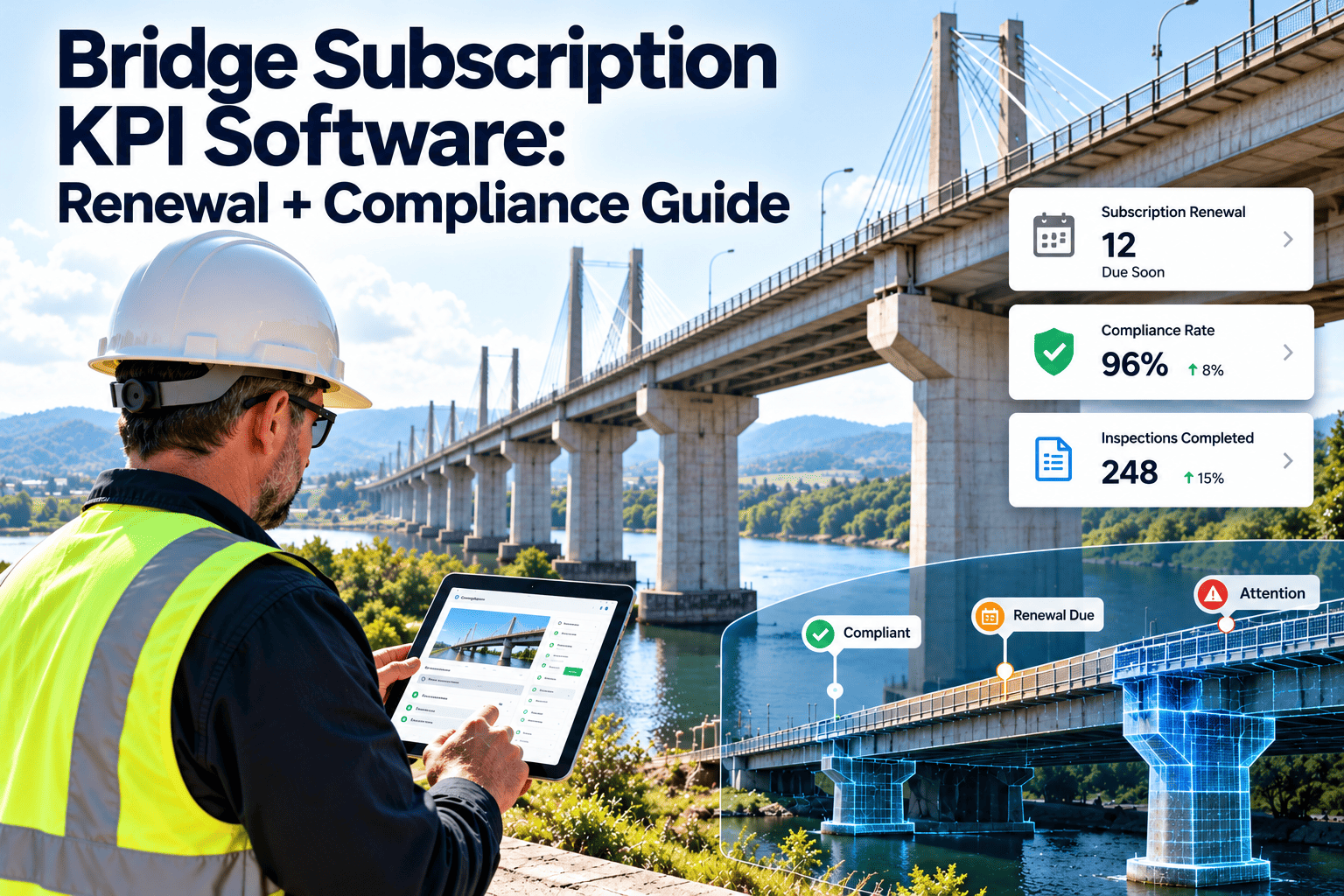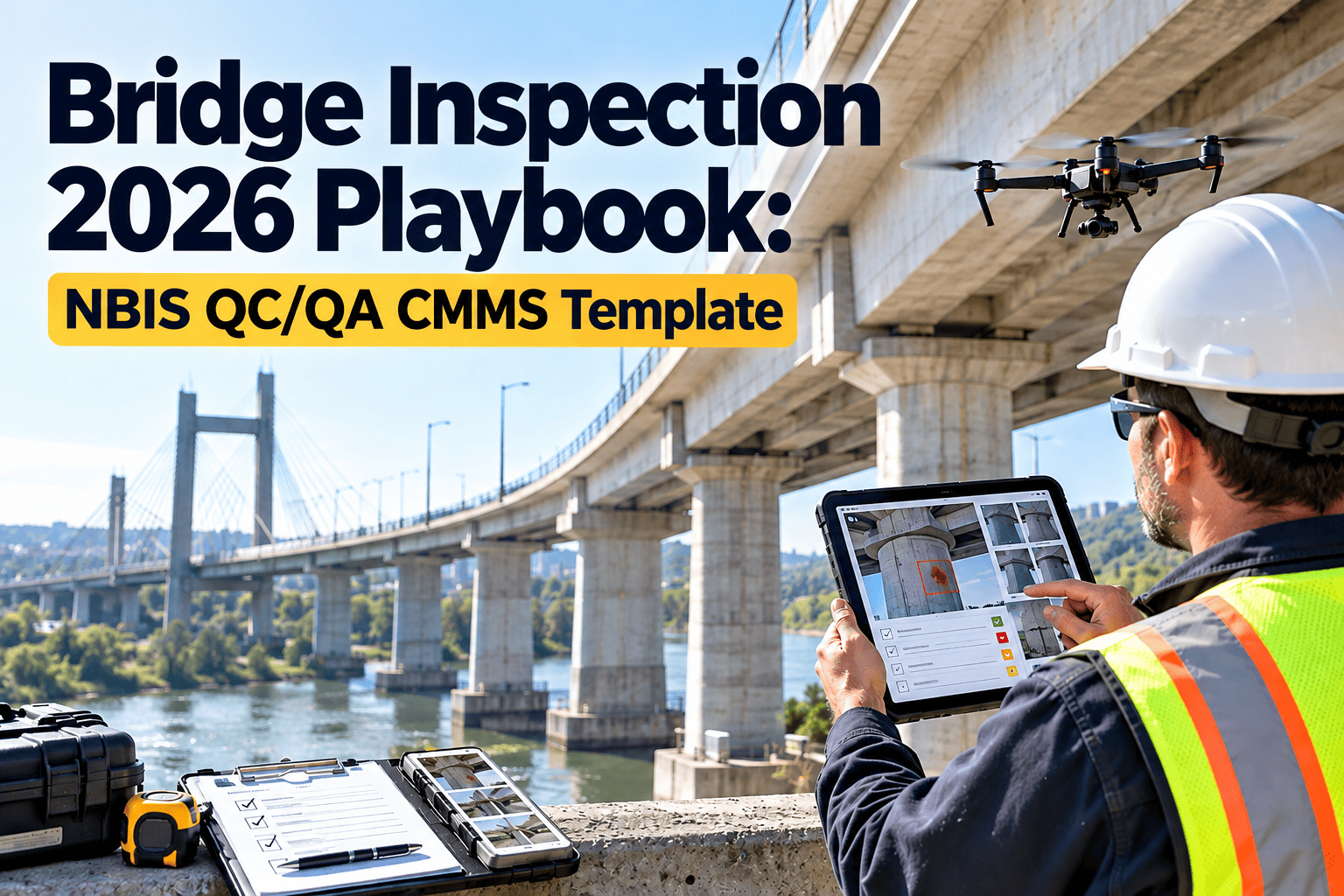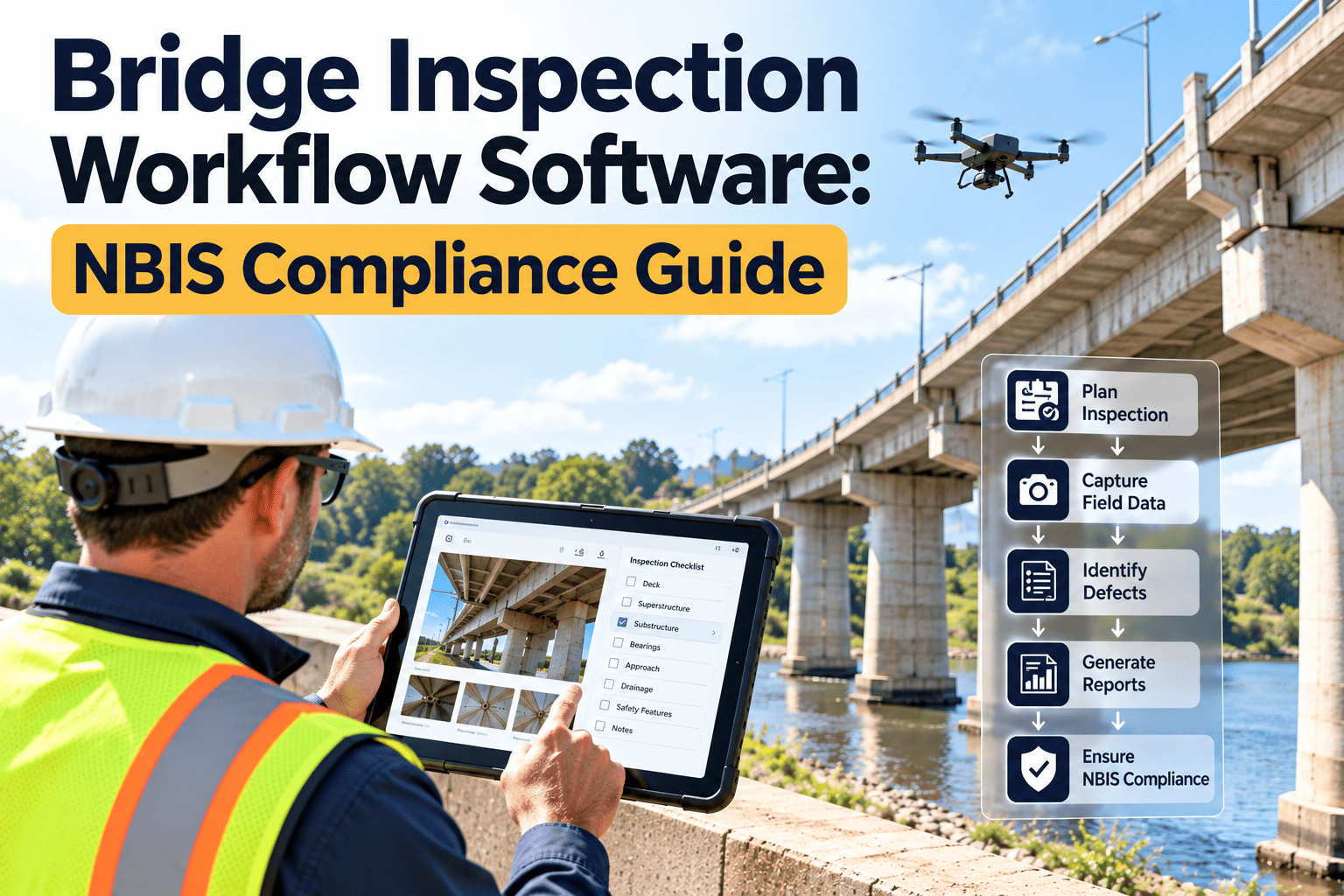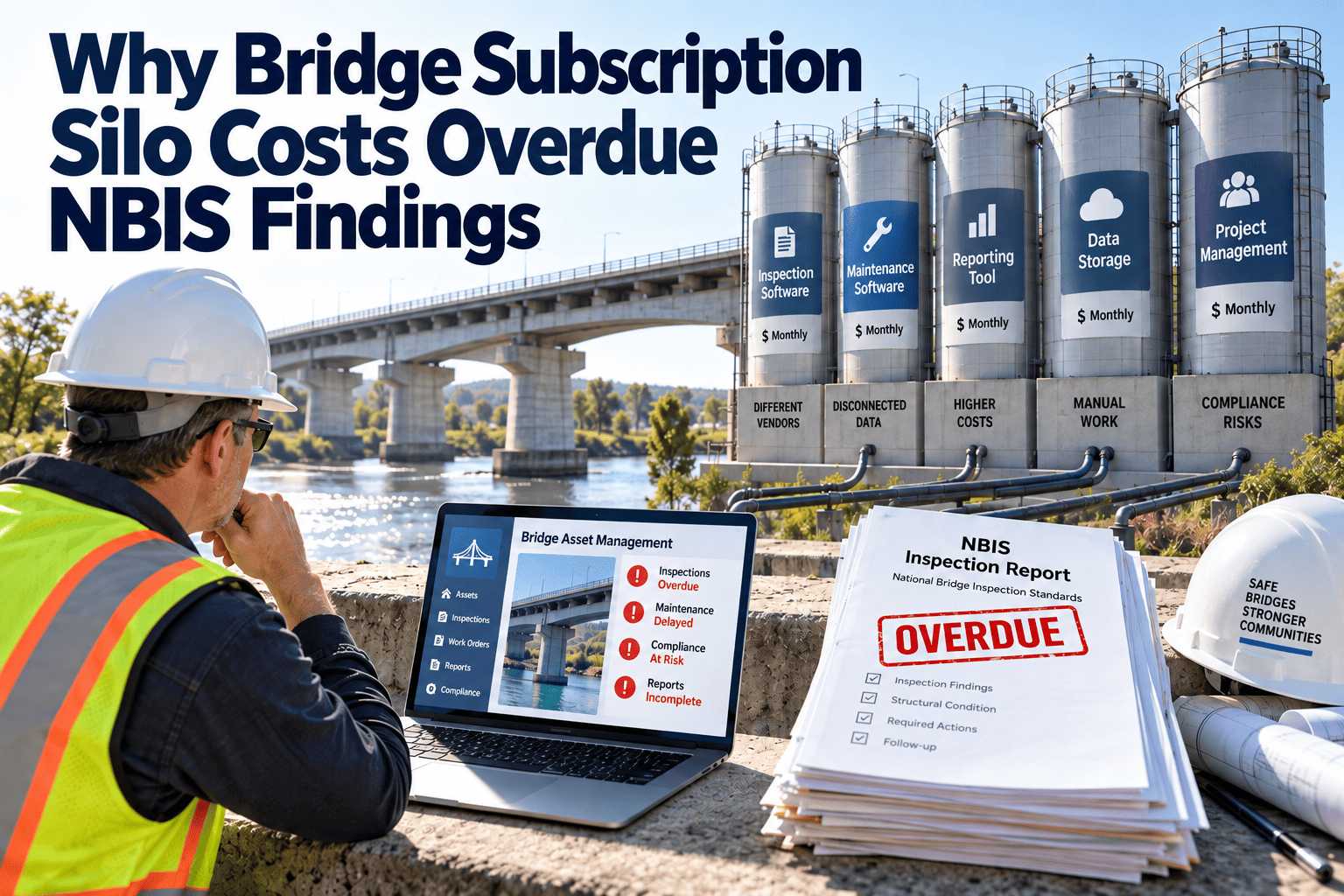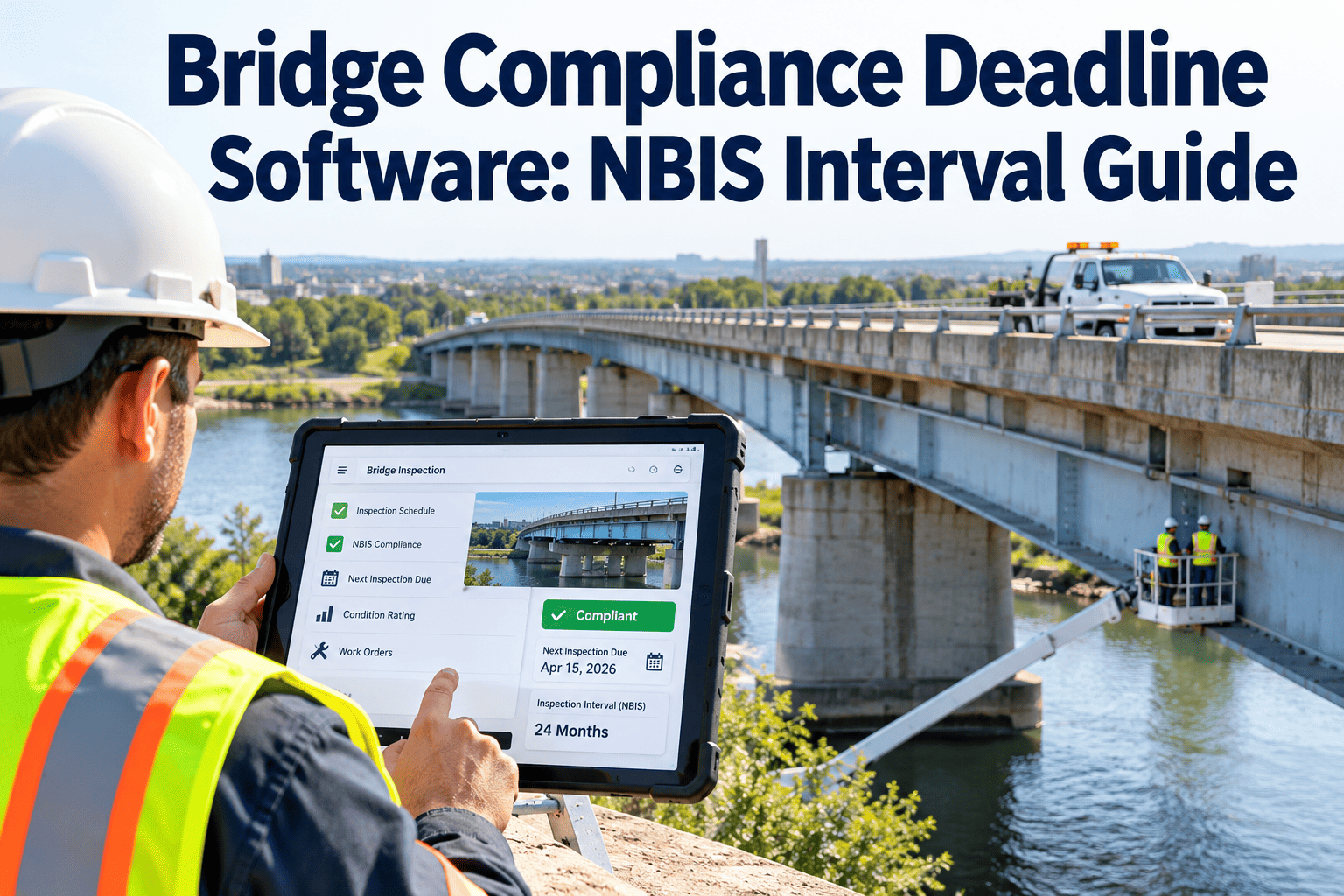
Every bridge in a state inventory runs on a clock. Routine inspections, fracture critical member checks, underwater dives, and annual National Bridge Inventory submissions each have their own interval, and each interval starts from a different date. When those dates live in spreadsheets or in a consultant's calendar, one missed update quietly turns into an overdue inspection. This guide explains how to track NBIS interval deadlines per bridge so owners can see what is due, what is late, and what is at risk. Programs that want a single place for those dates can begin in an inspection and work order platform built around the asset record.
Bridge Programs · NBIS Interval Tracking
Bridge Compliance Deadline Software: NBIS Interval Guide
Give every bridge its own deadline clock for routine, fracture critical, underwater, and special inspections, so state DOT and local owners can act before a due date becomes an overdue finding.
Month 0Month 6Month 12Month 18Month 24
Illustrative 24 month cycle. Actual intervals depend on bridge type, condition, and approved program.
The Deadline Problem
Why Bridge Deadlines Are Easy to Miss
A large bridge inventory has thousands of independent due dates. The difficulty is not knowing the rule. It is keeping each date current as inspections move, are rescheduled, or change scope.
Symptom
An inspection is completed but the next due date is never updated.
Cause
The date is entered by hand in a separate list from the inspection report.
Symptom
Underwater or fracture critical checks fall behind routine inspections.
Cause
Special inspection types are tracked on a different calendar than routine ones.
Symptom
Consultants and owners disagree about which bridges are due.
Cause
Each party keeps its own schedule with no shared source of truth.
Symptom
Critical findings are closed late or without proof.
Cause
Follow-up actions are not linked to the bridge record or given an owner.
Interval Lanes
Four Deadline Lanes Every Bridge Record Should Carry
The National Bridge Inspection Standards in 23 CFR Part 650, Subpart C set the framework. Bridge lengths below are illustrative of relative cycle length, not a statement of your program's approved intervals.
Routine inspection
Typically up to 24 months
Fracture critical member
Typically up to 24 months
Underwater inspection
Typically longer cycle
Special and in-depth
Set by condition and engineer
The 2022 update to the NBIS added provisions such as risk-based intervals subject to approval, so confirm the current regulation and your state's approved procedures before setting any interval.
What Drives a Due Date
Inspection Types, Drivers, and the Record You Need
| Inspection Type | What Sets the Due Date | Record to Keep |
|---|---|---|
| Routine | Date of last routine inspection plus the approved interval | Signed report, inspection date, team leader |
| Fracture critical | Date of last hands-on FCM inspection plus interval | FCM plan, member list, findings by member |
| Underwater | Date of last dive or assessment plus interval | Dive report, scour findings, substructure notes |
| Special or in-depth | Engineer decision tied to a condition or concern | Scope, methods, results, recommended actions |
| Damage or interim | Event such as a strike, flood, or overload | Event date, response time, outcome |
Risk Matrix
Prioritizing Bridges by Days to Due and Condition
Not every approaching deadline carries the same risk. Combining time remaining with bridge condition helps programs decide what to schedule first.
Days to due
Good condition
Fair condition
Poor or flagged
More than 90
Plan in cycle
Plan in cycle
Schedule early
30 to 90
Confirm crew
Issue work order
Assign this week
Under 30 or overdue
Escalate to lead
Escalate to manager
Immediate action
The Interval Clock
How a Due Date Should Be Calculated and Refreshed
The safest due date is derived, not typed. When the clock is computed from the last completed inspection, the date cannot drift away from the report.
01
Complete
The inspection is closed with a date, team leader, and report.
02
Apply interval
The approved interval for that bridge and type is added.
03
Generate task
The next inspection appears as a scheduled work order.
04
Warn early
Reminders fire at set lead times before the date.
05
Escalate
Overdue items move to a named manager with a reason code.
The Annual Cycle
NBI Submission, State Review, and Why Overdue Items Surface
States report inventory and inspection data to FHWA each year, and reviewers look at whether inspection dates align with required intervals.
Throughout the year
Inspections are completed, reports are reviewed, and condition ratings and inspection dates are entered into the state system.
Before submission
Program staff check for missing dates, inconsistent ratings, and bridges that appear overdue so records can be corrected or explained.
Submission
The state submits its National Bridge Inventory data on the schedule set by FHWA. Confirm the current deadline with your division office.
Review and follow-up
FHWA reviews compliance with the standards, and states address findings through corrective action plans where needed.
A deadline tracker that is current all year turns the pre-submission check from a scramble into a quick review.
Findings and Follow-Up
Closing the Loop on Critical Findings
An inspection deadline is met only when the findings it produces are tracked. Link every critical or urgent finding to a work order so it cannot be lost between reports.
Without linked tracking
- Findings sit inside a PDF report
- No owner or due date for the repair
- Status requested by email before each review
- Closure proof gathered after the fact
With linked tracking
- Each finding becomes a work order
- Owner, priority, and target date are set
- Status visible on the bridge record
- Photos and notes attached at closure
Weekly Discipline
A Deadline Review Checklist for Program Managers
List bridges due within the next 90 days by inspection type and region.
Confirm crews, consultants, and access equipment are assigned to each.
Review bridges already overdue and record the reason and recovery date.
Check that completed inspections updated their next due dates.
Verify critical findings have open work orders with owners.
Flag events such as strikes or floods that need interim inspections.
Oxmaint in the Workflow
Where Maintenance Software Fits a Bridge Inspection Program
Oxmaint does not replace engineering judgment or the state bridge management system. It organizes the recurring work, dates, and records around each bridge.
| Program Need | Oxmaint Capability |
|---|---|
| One record per bridge | Asset management with structure details, components, and history |
| Recurring inspection dates | Preventive maintenance scheduling with intervals per inspection type |
| Field data capture | Mobile inspection checklists with notes and photos |
| Repairs from findings | Corrective maintenance through work orders with owners and due dates |
| Visibility across the inventory | Dashboards and reports for upcoming, overdue, and completed work |
| Audit evidence | Compliance records tied to each completed task |
Program KPIs
Indicators That Show Whether Deadlines Are Under Control
Choose a small set of measures, define them in writing, and review them on a fixed rhythm.
On-time inspection rate
Inspections completed on or before the due date.
Overdue count and age
How many bridges are late and by how many days.
Report turnaround
Days from field inspection to approved report.
Critical finding closure time
Days from identification to documented resolution.
Date accuracy
Records where the due date matches the last inspection.
See Overdue Risk Before a Reviewer Does
Review how a bridge inventory can be loaded, scheduled, and monitored for upcoming and overdue inspections.
People and Roles
Who Owns Each Part of the Deadline Process
Deadlines slip when nobody owns the date. Assign each responsibility to a role, and record it on the bridge or the program.
Program manager
Owns the overall schedule, reviews upcoming and overdue lists, and decides when a late inspection needs escalation or a documented reason.
Team leader
Leads the field inspection, confirms qualifications are met, and submits findings and ratings so the next due date can be set correctly.
Reviewer or load rating engineer
Checks the report, confirms critical findings are identified, and signs off so the inspection can be treated as complete.
Maintenance supervisor
Receives repair work from findings, schedules crews, and closes work orders with photos and notes.
Common Mistakes
Scheduling Errors That Create Overdue Bridges
Most overdue items come from a small set of repeated mistakes. Knowing them makes them easier to design out of the process.
Mistake
Counting from the report date instead of the inspection date.
Fix
Store the field inspection date as its own field and compute the interval from it.
Mistake
Scheduling every bridge for the last possible month.
Fix
Spread work through the cycle so weather, access, and crew availability cannot push many bridges late at once.
Mistake
Forgetting that a bridge changed type or ownership.
Fix
Review structure data when a bridge is rehabilitated, replaced, or transferred, and update its inspection types.
Mistake
Leaving an interim inspection after an event untracked.
Fix
Create a work order when a strike, flood, or overload is reported, with an owner and a response date.
Special Cases
Situations That Change the Clock for a Bridge
Some bridges do not follow the standard cycle. Record the reason and the approval so a reviewer can see why a date differs.
| Situation | Effect on Schedule | Record to Attach |
|---|---|---|
| Approved reduced or extended interval | Bridge follows a different cycle than the default | Approval document and the basis for the decision |
| Newly built or rehabilitated bridge | Initial inspection must be scheduled on its own timeline | Opening date and first inspection plan |
| Bridge closed to traffic | Inspection needs may differ while closed | Closure date, reason, and reopening plan |
| Scour critical or posted bridge | Additional monitoring or plan of action applies | Plan of action and monitoring log |
| Temporary shoring or repair | May require extra checks until permanent repair | Repair details and inspection frequency |
Data Quality
Cleaning Inspection Dates Before They Are Submitted
A pre-submission review is faster when the data is already consistent. These checks catch the most common problems.
Every bridge has an inspection date for each required inspection type.
No inspection date is in the future or earlier than the bridge was built.
Condition ratings and narrative comments agree with each other.
Bridges with critical findings show a linked action and a status.
Structure identifiers match between the maintenance record and the state inventory.
Consultant deliverables are marked accepted before dates are finalized.
Running these checks monthly is easier than running them once under submission pressure.
Escalation
What Should Happen When a Bridge Goes Overdue
An overdue inspection is a management event. A written path keeps the response consistent between bridges and between years.
- Flag the bridge as overdue on the day the due date passes, not at the next monthly review
- Record the reason, such as access, weather, contractor delay, or a scheduling error
- Assign a recovery date and a named owner for completing the inspection
- Notify the program manager and, where required, the responsible state or federal contact
- Close the item only when the inspection is complete and the next due date has been generated
- Review repeated causes quarterly and adjust the schedule or staffing to prevent recurrence
Annual Planning
Building the Inspection Year Backward From the Due Dates
The most reliable programs plan the year once, then adjust. Starting from due dates keeps routine work from crowding out special inspections.
A
List what is due
Pull every bridge and inspection type due in the next twelve months.
B
Group by location
Cluster bridges by region, route, or waterway to cut travel and traffic control cost.
C
Place special work first
Schedule underwater and fracture critical checks around seasons and access limits.
D
Assign teams
Match qualified team leaders and consultants to each group.
E
Leave a buffer
Keep spare capacity for weather delays and interim inspections.
A plan like this makes a late bridge visible early, because the gap between planned and actual dates shows up as soon as a group slips.
Mobile Field Work
Capturing Inspection Completion at the Source
Dates are most accurate when they are recorded where the work happens. Field capture avoids retyping and the errors that come with it.
- Open the scheduled inspection on a phone or tablet at the bridge and confirm the structure
- Complete the checklist, add notes, and attach photos for each element or finding
- Record the inspection date and team leader before leaving the site
- Flag urgent findings immediately so a work order is created the same day
- Submit the record so the next due date is generated without manual entry
FAQs
Bridge Compliance Deadline Questions
What are NBIS intervals?
They are the inspection frequencies set under 23 CFR Part 650, Subpart C. Confirm current rules and your approved alternatives.
Can software set the interval for us?
It applies the interval your program approves. Engineers decide it. You can book a demo to see configuration.
How are overdue bridges identified?
Each bridge carries a computed next due date, so any past-due item appears in dashboards and escalation lists automatically.
Does this replace our bridge management system?
No. It supports scheduling, work orders, and records alongside it. You can open a workspace to test it.
Can consultants use the same schedule?
Yes. Shared assignments and records give owners and consultants one view of what is due and complete.
Turn Bridge Deadlines Into a Managed Schedule
Track every interval, finding, and follow-up per bridge, and stay ahead of the next inspection cycle.