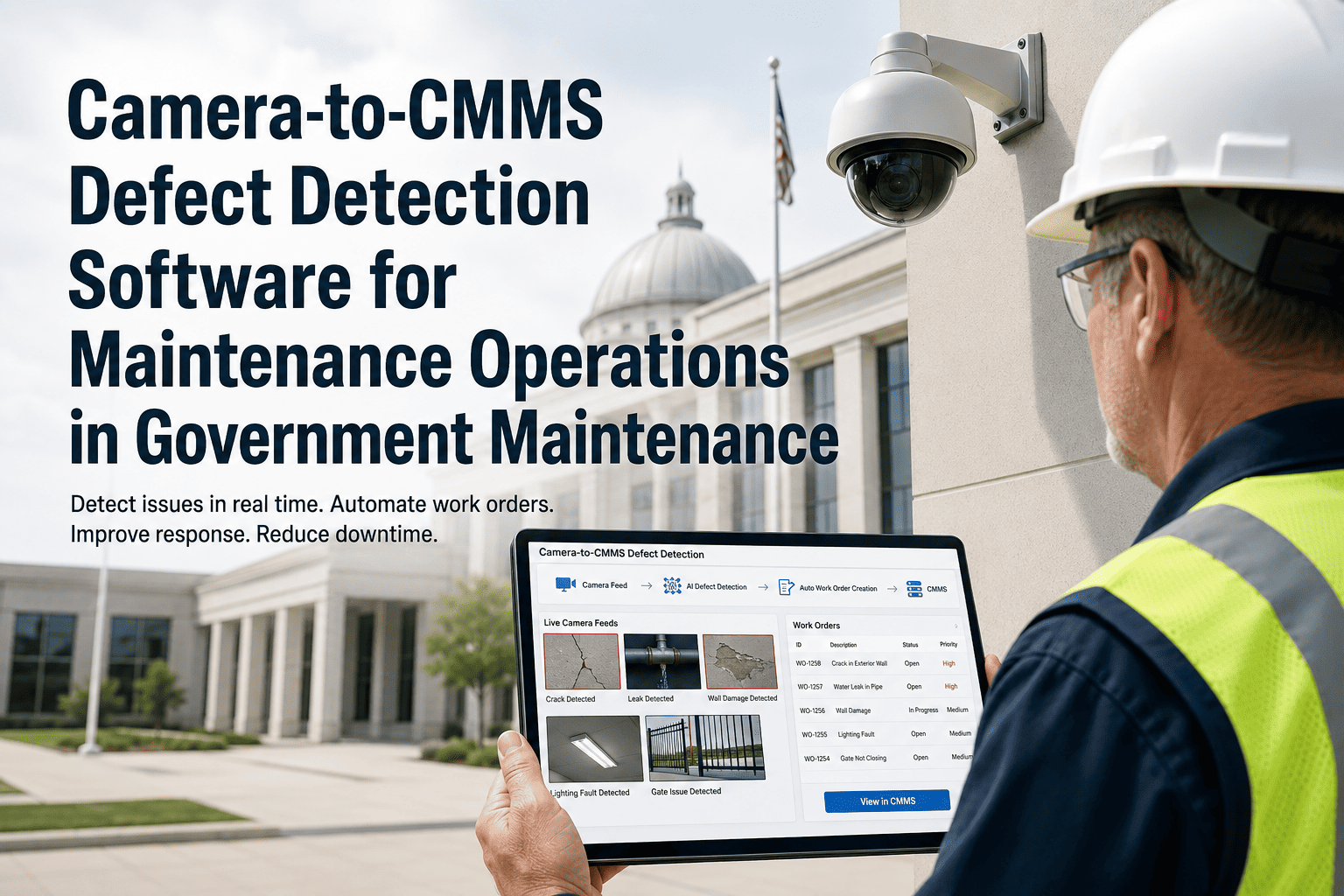
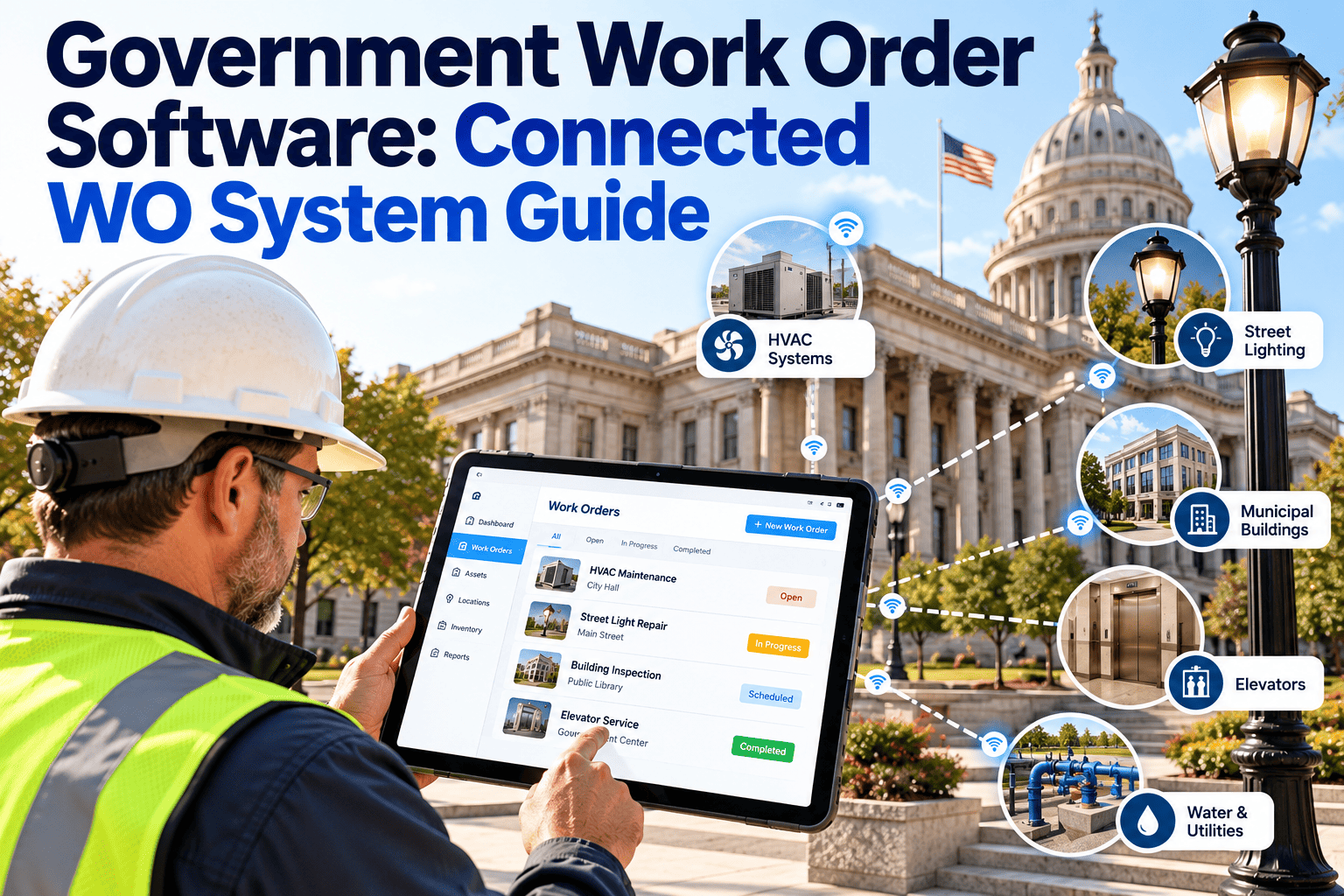
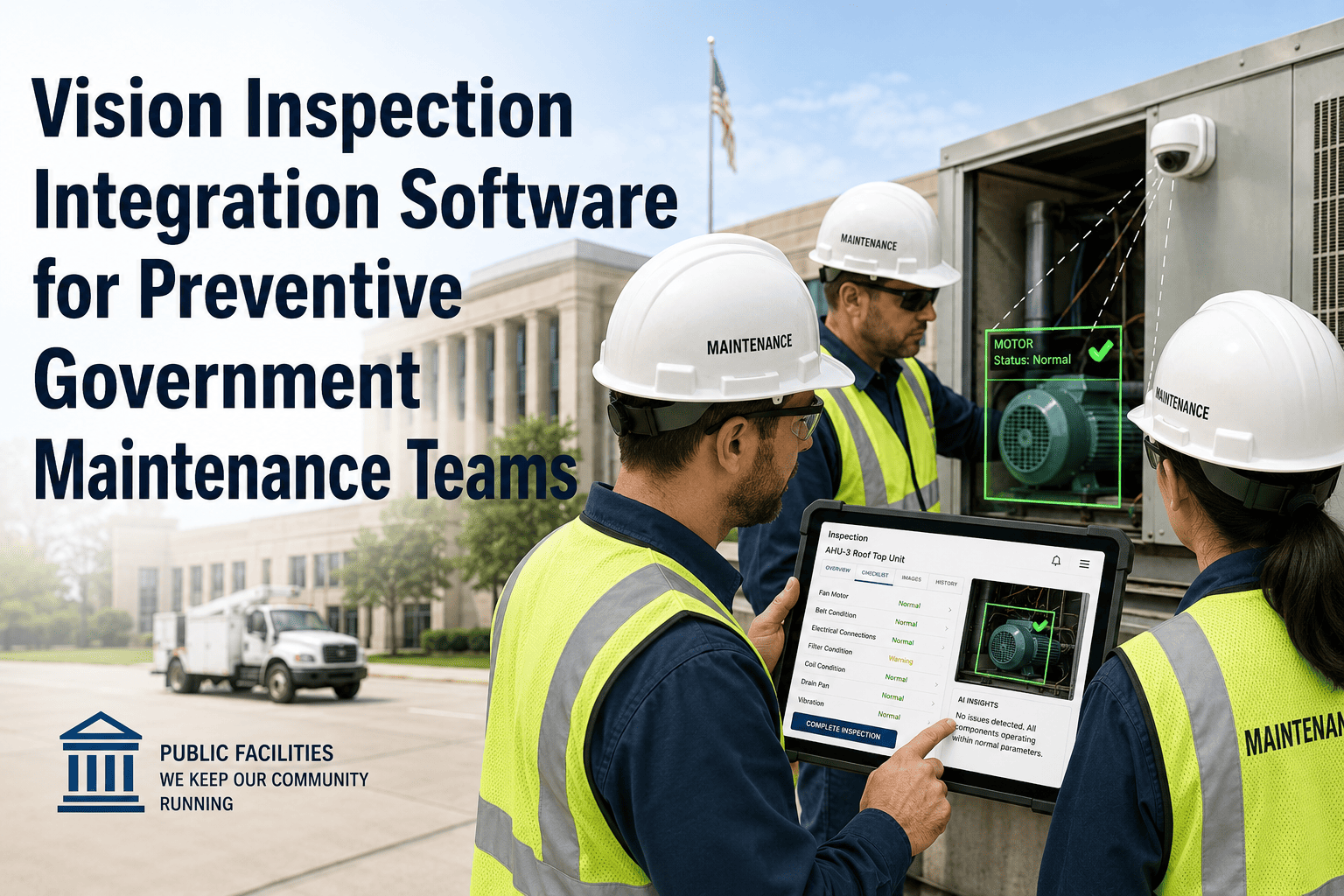
The gap between seeing a defect and acting on it is where infrastructure repair costs accelerate in government maintenance. A crack appears in a bridge deck. A camera records it. Nobody reviews the footage. Weeks later, what was a sealing job becomes a structural repair — at ten times the cost. Camera-to-CMMS defect detection closes that gap by removing every manual step between camera capture and crew dispatch: AI detects the defect, scores its severity, and OxMaint creates the work order — documented, routed, and traceable before the next shift. This page explains how the camera-to-CMMS pipeline works in government maintenance operations, what defect types it catches, and what public works agencies are measuring after deployment. To see it in action with your infrastructure, book a demo with the OxMaint team today.
Defect Detection · Camera to CMMS · Government Operations
Camera-to-CMMS Defect Detection for Government Maintenance Operations
Camera sees it. AI classifies it. CMMS creates the work order. No footage review, no manual entry, no delay — defects become dispatched work orders in under 2 seconds.
The Camera-to-CMMS Pipeline: How It Works
Camera Capture
Fixed cameras, drones, or mobile devices capture asset images. Existing ONVIF/RTSP infrastructure compatible.
AI Analysis
Vision model processes each frame. Defects classified by type, annotated with bounding box, scored 1–5 severity.
Threshold Check
Severity score checked against your configured thresholds per asset type and zone. No threshold = no work order.
CMMS Work Order
Work order created with annotated image, asset ID, defect details, and crew routing — complete in under 2 seconds.
Government Defect Categories: What AI Detects
Structural
Surface cracking, spalling, rebar exposure, delamination, joint failure
Safety incident / public liability
Corrosion
Rust spread, pitting, coating failure, galvanic corrosion at connections
Accelerating structural damage
Water / Leak
Pipe seepage, standing water, manhole overflow, roof membrane failure
Water damage / mold / service disruption
Surface Wear
Pavement cracking, pothole formation, marking degradation, drain blockage
Condition decline / access risk
Equipment
Fluid leaks, body damage, seal gaps, missing components, component wear
Service failure / downtime
Vandalism / Security
Graffiti, broken fixtures, unauthorized access indicators, debris accumulation
Public complaint / reputational
Defect-to-Work-Order Speed: Manual vs. AI Pipeline
Manual Inspection + Entry
4–72 hours (depends on inspection schedule)
Camera Review + Manual WO
1–8 hours (if footage is reviewed)
AI Camera to CMMS (OxMaint)
See the full camera-to-CMMS pipeline in a live demo — using government asset scenarios.
From defect detection to work order routing in under 2 seconds. No footage review. No manual entry. Full audit trail from first frame to job close.
Expert Perspective
The camera-to-CMMS pipeline is the most impactful change a government maintenance department can make today. Every other maintenance improvement — better crews, better schedules, better parts inventory — is limited by how quickly defects are found and documented. When AI closes the detection-to-work-order gap from days to seconds, everything else accelerates with it. Government agencies that have deployed this report not just faster response, but fundamentally better compliance records and tighter budget control, because they know what is actually happening to their assets in real time.
Public Works Technology Director — Metropolitan Infrastructure Council
Frequently Asked Questions
Will AI miss defects that a trained human inspector would catch?
Purpose-built infrastructure AI is trained on millions of defect images and consistently outperforms individual technician accuracy for pattern-based defects like early-stage cracking and corrosion onset — defects that humans miss when fatigued or pressed for time. OxMaint's vision models are calibrated for infrastructure environments and achieve under 5% false alert rates while maintaining high detection sensitivity.
Book a demo to review detection accuracy benchmarks for your specific asset types.
What happens when the AI detects a defect that turns out not to need a work order?
Government teams configure severity thresholds during onboarding — only detections above your defined score level generate work orders. Low-severity detections are logged for trending and supervisor review but do not dispatch crews. When a work order is completed and the technician notes the defect was not actionable, that feedback trains the AI model to reduce similar alerts over time, progressively improving accuracy.
Start a free trial to configure your thresholds.
Can the system handle multiple defect types on the same asset at the same time?
Yes. OxMaint AI can detect and classify multiple defect types from a single camera frame — for example, surface cracking and corrosion on the same bridge section. Each defect type generates a separate classification with its own severity score. If the asset has multiple findings above threshold, the work order includes all findings with separate annotations, allowing the crew to address everything in a single dispatch.
How does the system integrate with our existing procurement and work approval processes?
OxMaint supports multi-level approval workflows for government procurement requirements. Auto-generated work orders can be routed to supervisor review before crew dispatch, with configurable approval chains based on defect severity, work category, or estimated cost. Critical-severity defects can bypass approval for immediate dispatch while routine detections follow standard government approval workflows.
Book a demo to map your approval process to OxMaint's workflow configuration.
The footage exists. The defects are in it. The only question is how long before they become a work order.
OxMaint makes it under 2 seconds — from camera frame to crew dispatch, with a complete audit record for every detection in between.