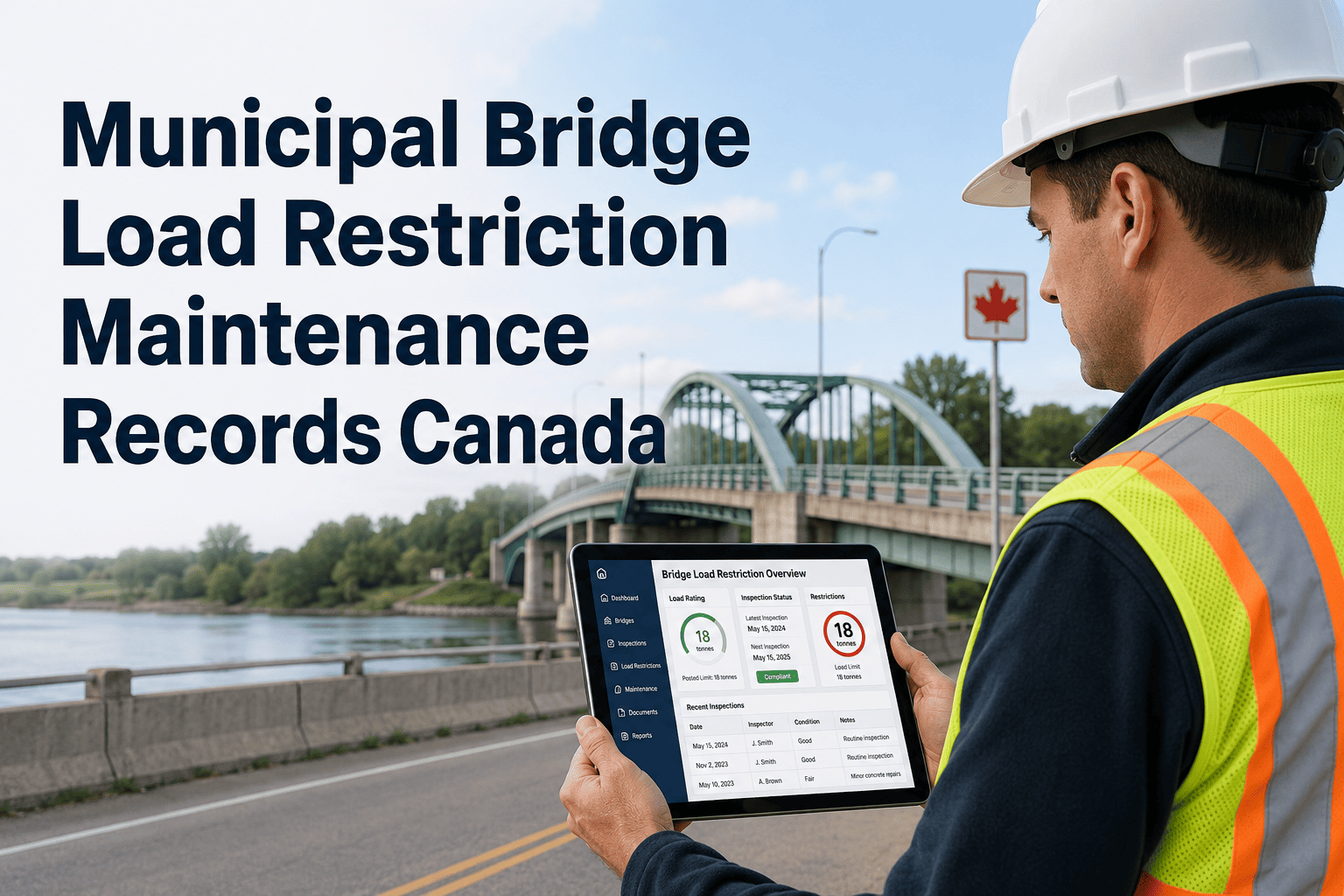
Canada has over 38,000 municipal bridges, and a growing proportion carry load restrictions that were applied reactively — after a condition inspection surfaced structural concerns that a proactive maintenance programme might have prevented or deferred. Load restrictions reduce pavement wear, but they also constrain emergency vehicle access, agricultural operations, and economic activity in ways that communities feel for years. OxMaint helps Canadian local governments document bridge inspections, assign load restriction records to asset histories, prioritize repair work, and build the funding-ready maintenance records that federal and provincial bridge programmes require. Book a demo to see how municipalities are using OxMaint to move from reactive restriction to proactive bridge asset management.
Article · Bridges · Asset Management · Canadian Municipalities
Municipal Bridge Load Restriction Maintenance Records for Canadian Local Governments
A structured guide to documenting bridge inspections, applying load restrictions with asset-linked evidence, prioritizing repairs, and building funding-ready maintenance records for Canadian municipal bridges.
38,000+
municipal bridges across Canada, majority owned by local governments with limited dedicated inspection budgets
43%
of Canadian municipal bridges are over 40 years old and approaching or past original design service life
$2.4M
average cost of a municipal bridge replacement versus $180K average for proactive structural maintenance
3 yrs
maximum recommended inspection interval for posted bridges under most provincial bridge inspection standards
Bridge Inspection Framework
The 5-Level Bridge Inspection Framework Canadian Municipalities Should Follow
Level 1
Routine Inspection
Annual or bi-annual
Visual walk-over inspection by municipal staff. Deck surface, joint condition, guardrail, drainage, approach pavement. Photo documentation. Feeds condition database.
Level 2
General Inspection
Every 2–3 years
Detailed visual inspection by qualified inspector. All accessible components scored on condition rating scale. Load restriction review triggered if any element drops below threshold.
Level 3
Principal Inspection
Every 5–6 years
Engineering assessment of primary structural elements. Requires close access — scaffolding, under-deck inspection. Load analysis updated. Repair priority and cost estimates produced.
Level 4
Special Inspection
Triggered by event or finding
Initiated after flood, impact, seismic event, or Level 2/3 finding requiring targeted investigation. Structural engineer sign-off required before bridge re-opens or restriction is adjusted.
Level 5
In-Depth Investigation
Pre-rehabilitation or as required
Full structural assessment for rehabilitation or replacement design. Load rating analysis, material testing, scour assessment at waterway crossings. Feeds capital programme.
Load Restriction Records
What a Compliant Bridge Load Restriction Record Must Document
A load restriction that exists only as a sign on the approach is a legal and operational liability. The restriction must exist as a documented asset record with a full evidence chain — from the inspection finding that triggered it to the engineering sign-off that set the limit. The table below shows what each field in a compliant load restriction record must contain.
| Record Field |
Required Content |
Evidence Type |
Responsible Party |
| Bridge ID and Location |
Provincial bridge number, GPS, road name |
Asset register entry |
Municipal asset manager |
| Restriction Basis |
Inspection finding, condition score, element ID |
Inspection report reference |
Qualified inspector |
| Gross Vehicle Weight Limit |
Limit in tonnes — axle and gross |
Engineering calculation |
P.Eng. sign-off |
| Restriction Date Applied |
Date, authority, by-law reference if applicable |
Council resolution or CAO directive |
Municipal clerk / admin |
| Signage Confirmation |
Sign installed, approach distance, both directions |
Photo with GPS and date stamp |
Public works crew |
| Notification Record |
Provincial ministry, emergency services, heavy operators |
Correspondence log |
Municipal engineer |
| Repair Priority and Plan |
Repair type, cost estimate, capital year |
Engineer's report or PM plan |
Public works / engineering |
| Restriction Review Date |
Next scheduled review — not to exceed 3 years |
Scheduled work order in CMMS |
Asset manager |
Funding Readiness
Building the Evidence Pack for Federal & Provincial Bridge Funding
ICIP, DMAF, and provincial bridge rehabilitation programmes all require structured condition documentation, inspection history, and repair cost justification. OxMaint's asset records and inspection reports generate exactly this evidence — exportable in the format funding adjudicators need.
Complete inspection history by bridge asset
Condition score trending over time
Load restriction record with engineering basis
Repair priority matrix with cost estimates
Deferred maintenance backlog by structure
Capital programme alignment report
See what a grant-ready bridge evidence export looks like
Book a Demo
Expert Review
Municipal Bridge Managers and Engineers on Asset Documentation
5 / 5
We had load restrictions on six bridges that existed as signs on the road and nothing else — no engineering basis on file, no inspection record linking the restriction to a condition finding, no review date, no notification record for emergency services. When we applied for ICIP bridge rehabilitation funding, the adjudicator asked for the condition documentation behind each restriction and we could not produce it for four of the six. We were deferred. After implementing OxMaint and rebuilding each restriction record from the ground up, our second application was approved because every restriction had a complete documented basis. That approval covered $1.8 million in rehabilitation work.
PE
Patricia Elms, P.Eng.
Director of Engineering, Ontario Rural Municipality · 19 yrs bridge and transportation infrastructure
5 / 5
The challenge with aging bridge inventory is knowing which structures are approaching the threshold that triggers a restriction before a condition emergency forces the decision reactively. OxMaint's condition score trending flagged three bridges moving into the caution zone on two consecutive inspection cycles — we got engineering assessments done proactively, implemented targeted repairs at $45,000 total, and avoided restrictions on all three structures. Without that trend visibility we would have discovered the same deterioration during a routine visual the following season and faced either a reactive restriction or an emergency closure.
FR
François Roy
Infrastructure Asset Manager, Quebec Regional County Municipality · 14 yrs municipal asset management
4 / 5
Managing emergency vehicle access is the operational dimension of bridge load restrictions that most municipalities underestimate. When we posted a 10-tonne restriction on a bridge on a key secondary road, we had not adequately documented or notified the county ambulance service about the detour impact — their tanker unit exceeded the posted limit. We now include emergency services access impact in every restriction record in OxMaint, with mandatory notification log before the sign goes up. That protocol change came directly from an OxMaint workflow template that we had not thought to configure until a near-miss made it obvious.
CD
Christine Dube
Public Works Director, New Brunswick Municipality · 16 yrs public infrastructure management
Frequently Asked Questions
Bridge Load Restriction Records — Common Questions
What is the legal liability exposure for a municipality with an undocumented bridge load restriction?
If a bridge under load restriction is involved in a structural incident — whether the restriction was exceeded or not — the municipality's first line of defence in litigation is demonstrating that the restriction was based on a documented engineering assessment, was properly posted and communicated, and was subject to a scheduled review. A restriction that exists only as a sign with no asset record, no engineering basis, and no review date is extremely difficult to defend. Most Canadian municipal liability insurers now require documented bridge inspection and restriction records as a condition of coverage. OxMaint provides the complete evidence chain — inspection, engineering basis, restriction record, notification log, and review scheduling — in one auditable asset record.
Book a demo to see the full record structure.
Which federal and provincial programmes provide funding for municipal bridge rehabilitation in Canada?
Key funding sources include ICIP (Investing in Canada Infrastructure Program) under Infrastructure Canada, DMAF for structures with climate vulnerability, and provincial bridge programmes in Ontario (OCIF formula funding, BRIG), Quebec (PRIMEAU and regional municipal support programmes), BC (ICSP), and Alberta (MSI). Most programmes require a structured asset management plan with inspection history, condition scores, and repair cost justification as part of the application.
OxMaint generates the required documentation for all of these programmes directly from the asset and inspection records built during normal operations — no separate reporting system needed.
How often should a bridge load restriction be reviewed and what triggers an early review?
Most provincial bridge inspection standards and best-practice frameworks recommend load restriction review at least every three years, or sooner if triggered by a structural event (flood, ice jam, vehicle impact), a condition change identified during routine inspection, a significant increase in observed traffic loading, or a repair that may affect the structural basis of the restriction. Each of these triggers should generate a scheduled inspection work order in OxMaint, automatically linked to the bridge asset record. The review result — whether confirming, adjusting, or lifting the restriction — is then documented and attached to the restriction record with a new review date set.
Book a demo to see how restriction review scheduling works.
Can OxMaint manage bridges that are inspected by external engineering firms rather than municipal staff?
Yes. OxMaint supports both internal and external inspection workflows. When a contracted engineering firm conducts a principal or in-depth inspection, their report can be uploaded directly to the bridge asset record, with key condition scores and findings entered as structured data by the municipal asset manager. All subsequent work orders, repair records, and restriction updates are then linked to the same asset record regardless of who originated each entry. This ensures the municipality always holds the complete asset history, even as engineering contracts change over time. Explore the
free trial to set up your bridge asset register.
OxMaint Bridge Asset Management · Canadian Municipalities
Build the Bridge Records That Protect Your Community and Unlock Rehabilitation Funding
Every bridge inspection, load restriction, repair record, and capital priority in a single auditable CMMS — so your funding applications have the evidence they need, and your liability exposure has the documentation it requires.