DOT Guardrail Inspection and Repair Tracking Software
By James Smith on June 5, 2026
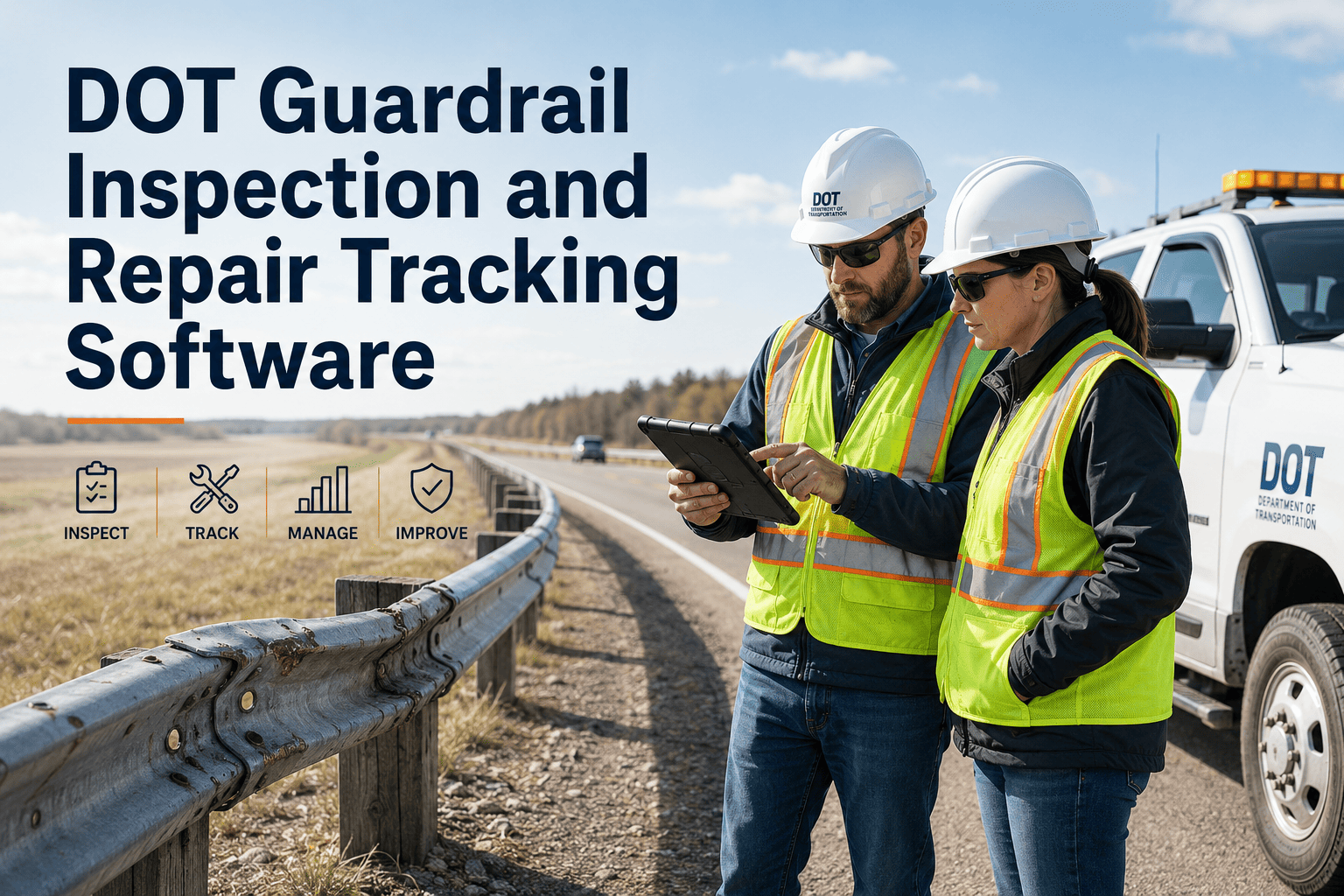
Guardrails fail silently — damaged in a minor collision, left unreported, and discovered only when the next crash sends a vehicle over the edge. State and county DOT teams manage thousands of miles of guardrail under FHWA inspection requirements, yet most departments still track damage reports and repair status in spreadsheets that have no connection to the field. OxMaint AI closes that gap with a mobile inspection and work order system purpose-built for roadway safety assets — giving DOT crews digital checklists, photo documentation, and a complete audit trail for every segment inspected.
Inspect, flag, assign, repair, and document every guardrail segment from a mobile device. OxMaint keeps your road safety maintenance audit-ready and your crews working on verified priorities — not guesswork.
miles of guardrail across US highway and secondary road systems requiring regular DOT inspection
61%
of guardrail-related fatalities occur on segments with documented prior damage that was not repaired within 30 days
$420K
average cost of a guardrail-related fatality lawsuit where maintenance records cannot be produced
Inspection Protocol
DOT Guardrail Inspection Checklist — OxMaint Digital Format
Each inspection is geo-stamped, photo-documented, and automatically linked to the asset segment ID and milepost location in OxMaint.
Structural Condition
Post spacing within specification — no missing posts
Rail height within 27–31 inch standard (MASH / NCHRP 350)
No bent, bowed, or cracked rail sections
No missing or loose hardware at splice connections
Post base corrosion — record severity level (1–4)
Crash Damage Assessment
Impact deflection measured and within deflection zone
No exposed anchor cable or broken terminal sections
No snagging hazards on damaged face (sharp metal)
Damage length and section count documented with photo
Traffic hazard flag required — yes or no with reasoning
End Terminal Condition
SKT / MASH terminal intact — no missing components
Breakaway cable anchor embedment verified
No vegetation obscuring terminal visibility
Terminal slope grade within tolerance
Flare length adequate for speed zone (AASHTO standard)
Damage-to-Repair Workflow
From Crash Damage Report to Closed Repair — in OxMaint
1
Damage Reported
Crew, officer, or citizen submits a damage report via OxMaint mobile. Photo, location, and severity are captured on-site.
2
Work Order Created
OxMaint generates a repair work order with asset segment ID, milepost, and parts estimate — assigned to the responsible crew zone.
3
Parts Pulled from Inventory
Rail sections, posts, hardware, and terminal components are logged against the work order. Inventory count updates automatically.
4
Repair Closed with Proof
Technician closes the work order with before-and-after photos, GPS stamp, and completion timestamp. Audit-ready in seconds.
Measured Results
Guardrail Maintenance Performance — Paper vs OxMaint
Metric
Spreadsheet / Paper
OxMaint Digital
Impact
Avg crash damage to repair start
11 days
2.4 days
-78%
Inspection photo documentation rate
22%
100%
Full coverage
Segments with unknown last inspection date
38%
0%
Eliminated
Parts cost per repair — tracked accuracy
Estimated only
Exact per work order
Full cost visibility
FHWA audit preparation time
2–3 weeks
Under 4 hours
-96%
OxMaint AI — Road Safety Asset Management
Every unrepaired guardrail section is a liability your department owns. OxMaint tracks every damaged segment from report to verified repair — with full photo documentation and audit-ready records.
Guardrail is one of the few highway safety assets where the failure mode is completely invisible to the traveling public until there is a crash. A post that was bent in a minor hit at 2:00 AM may look structurally intact from the road — but it has lost its deflection capacity entirely. DOT inspection programs that rely on paper logs and memory-based segment tracking miss damage for weeks or months. Digital inspection systems with GPS-stamped photo records and automatic work order generation change the response curve from weeks to days — and they change the legal posture of the department from "we don't know" to "here is our complete maintenance record."
Highway Safety Engineering Consultant
Former State DOT Roadside Safety Program Manager — 17 Years FHWA Standards Experience
FAQ
Frequently Asked Questions
OxMaint uses a location hierarchy that can be configured to match your DOT route and milepost structure — state route number, segment ID, begin milepost, and end milepost. Each guardrail asset record carries these attributes, so when an inspection is submitted or a work order is closed, the record is searchable and reportable by route or milepost range. For FHWA reporting or internal condition assessments, OxMaint can filter and export all maintenance activity by route corridor or county boundary. Book a demo to see the route-based asset hierarchy configuration.
Yes. OxMaint includes a parts catalog that covers standard guardrail components — W-beam sections, posts, blockouts, hardware kits, terminal assemblies, and cable anchors. When a repair work order is closed, the technician selects parts used, quantities consumed, and supplier lot if required. The inventory count decrements automatically and a low-stock alert fires when safety stock levels are reached. Every repair's parts cost is stored in the asset's maintenance history for lifecycle cost analysis and budget justification. Start your free trial and configure your guardrail parts catalog.
OxMaint includes a request submission portal that can be used by authorized external reporters — including highway patrol, county sheriff units, or bridge inspection contractors — to log damage reports directly into the maintenance queue. Each submission creates a work order draft that the DOT supervisor reviews and activates for assignment. The original reporter receives an automated confirmation and optional status update when the repair is completed. Book a demo to configure the external damage reporting portal for your agency's workflow.
OxMaint stores every inspection record, damage report, repair work order, and parts transaction in a permanent, tamper-evident asset history. For FHWA audits, OxMaint can export a compliance report by route segment showing every inspection date, inspector ID, findings, corrective actions, and repair completion with photo evidence. Reports are generated in minutes — not weeks. Every record includes GPS coordinates, device ID, and timestamp metadata that satisfies federal documentation standards for roadway safety asset maintenance. Start your free trial to test the compliance report format for a pilot guardrail route.
Damaged guardrail should be repaired in days — not discovered at the scene of a second crash. OxMaint tracks every segment from damage report to verified repair with full DOT-grade documentation.
Mobile inspections. Crash damage work orders. Parts tracking. FHWA compliance records. Built for DOT road safety teams.