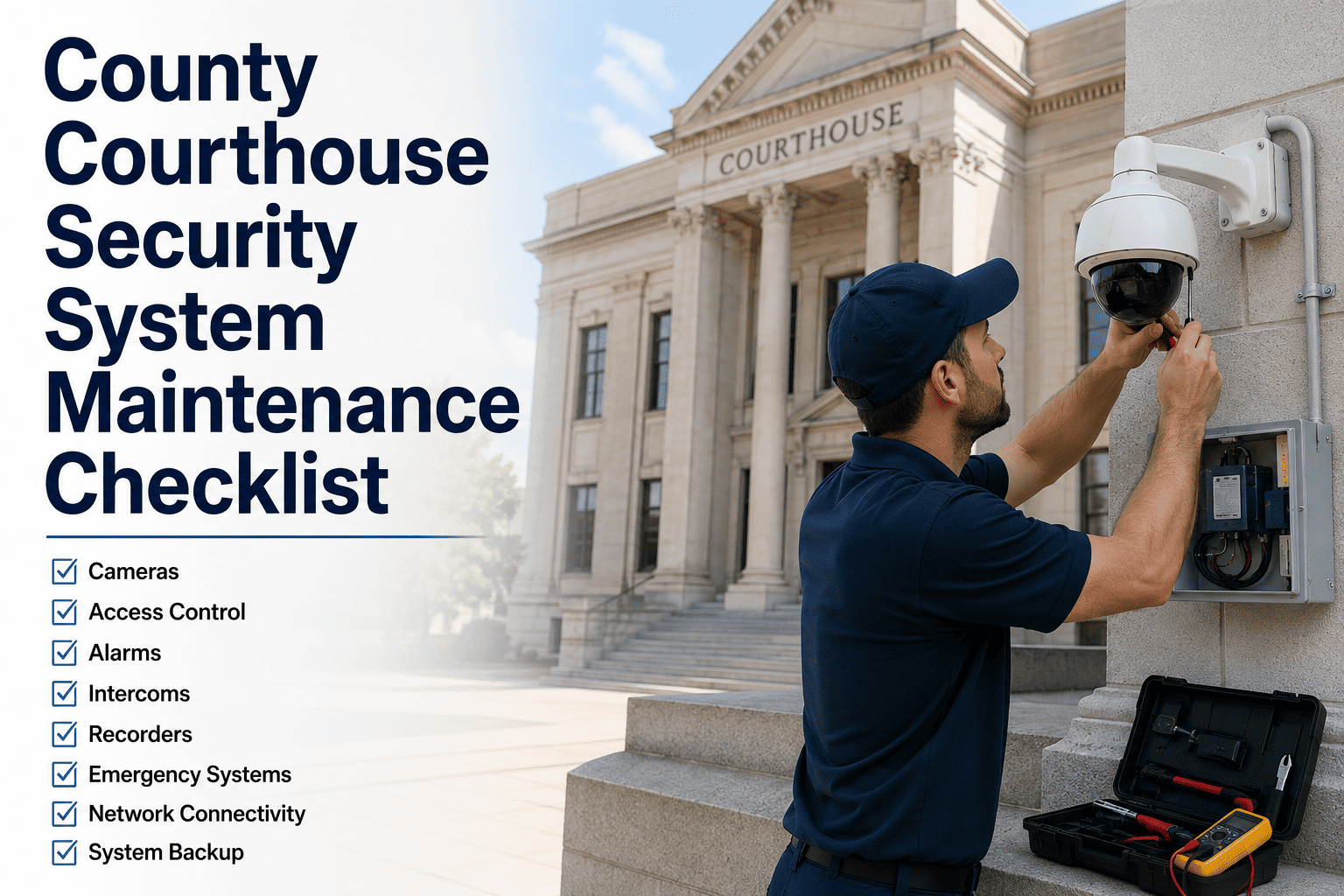
Courthouses are among the most security-sensitive public buildings in the United States — housing judges, juries, witnesses, and sensitive evidence under one roof. Yet most county facilities still track camera inspections, access control panels, and alarm systems in spreadsheets or paper logs. OxMaint replaces that fragmented approach with a single CMMS platform that schedules every inspection, captures pass/fail results on mobile, and builds a compliance-ready audit trail automatically. Book a demo to see how courthouse facilities teams cut missed inspections by over 60%.
Justice Facilities · Inspection Management
County Courthouse Security System Maintenance
Camera networks, access control, alarms, elevators, emergency systems — a structured inspection for courthouse facility teams with compliance tracking built in.
6
Security system categories every courthouse must inspect on a scheduled cycle
73%
of courthouse security failures traced to missed or undocumented routine maintenance
48 hrs
average window before an unresolved access control fault becomes a reportable incident
100%
of federal courthouse security audits require documented inspection logs with timestamps
The 6 System Categories
What a Complete Courthouse Security Inspection Covers
A courthouse inspection that only covers cameras is incomplete. Security operations depend on the integration of six distinct system categories — each with its own inspection cadence, failure modes, and compliance requirement. Missing any one creates a gap that neither insurance carriers nor court administration will accept.
01
CCTV & Camera Network
Image clarity and lens condition
Pan-tilt-zoom function check
Recording continuity & storage
Blind-spot assessment at entry points
02
Access Control Systems
Card reader and credential response
Door-held-open alarms functional
Tailgating sensor calibration
Fail-safe / fail-secure power modes
03
Intrusion Alarm Systems
Motion detector zone coverage
Panel battery backup test
Central station communication check
False alarm log review
04
Doors, Gates & Barriers
Controlled entry door hardware
Panic hardware and release function
Vehicle bollard and gate cycles
Interlock vestibule sequencing
05
Elevators & Secure Lifts
Secure floor key-override function
Emergency phone test
Camera coverage inside car
Annual load and safety inspection
06
Emergency & Life Safety
Fire alarm pull station test
Mass notification speaker levels
Duress button response time
Emergency lighting activation
Inspection Frequency Guide
Inspection Cadence by System — What Courthouse Teams Must Track
| System | Daily | Weekly | Monthly | Annual | Compliance Ref |
|---|---|---|---|---|---|
| CCTV / Camera Network | Recording check | Image clarity audit | Full coverage map | DVR/NVR lifecycle | DHS PSCA |
| Access Control | Door fault log | Credential review | Panel firmware | Full system audit | IBC / NFPA 101 |
| Intrusion Alarms | — | Zone walk-test | Battery test | Full certification | UL 2050 / NFPA 72 |
| Doors & Barriers | Visual | Hardware torque | Panic device | Load / cycle test | ANSI A156 |
| Elevators | — | Emergency phone | Camera & key | State certification | ASME A17.1 |
| Emergency / Life Safety | — | Speaker level | Duress response | Full evacuation drill | NFPA 72 / OSHA |
Failure Risk Matrix
What Happens When Courthouse Security Inspections Are Skipped
HIGH RISK
Access Control Failure
Unauthorized entry into restricted courtrooms, judge chambers, or evidence storage. Average remediation cost: $34,000–$120,000 per incident depending on breach severity.
HIGH RISK
Camera Blind Spots
Evidence chain-of-custody disputes, inability to reconstruct security incidents. Federal courthouse audits flag unmonitored zones as critical non-conformances.
MEDIUM RISK
Elevator Emergency Phone Failure
ADA Section 4.10.14 mandate. A failed emergency phone in a public courthouse elevator triggers immediate state inspection and potential closure order.
MEDIUM RISK
Duress Button Lag > 30 sec
Response time above 30 seconds fails most courthouse security standards. Undetected failures discovered only during a real incident — after harm has occurred.
COMPLIANCE RISK
Undocumented Inspections
Even correctly maintained systems trigger findings if records are missing. Auditors cannot accept verbal confirmation — timestamped digital logs are the standard.
COMPLIANCE RISK
Alarm False-Positive Rate > 10%
High false-alarm rates desensitize staff, delay real responses, and trigger county sheriff re-evaluation of monitoring contracts — a costly procurement reset.
Expert Review
What Courthouse Facility Managers and Security Professionals Are Saying
5 / 5
We had 14 cameras across the building with no single log of when each was last inspected. When the county auditor arrived, we could not produce documentation for six of them. Moving to a CMMS with asset-level inspection scheduling meant every camera became a tracked asset with its own PM cycle and evidence photo. The next audit took 20 minutes instead of two days — and we had zero findings on the camera network.
MK
Marcus Kellner, CFM
Facilities Director, Mid-Atlantic County Courthouse Complex · 16 yrs public building operations
5 / 5
The access control panel in Courtroom 4 had a door-held-open fault that was being manually reset by the deputy every morning for three weeks without a work order being created. That failure mode is exactly what compliance auditors look for — recurring unreported faults. Linking every fault reset to a mandatory work order creation in OxMaint removed that blind spot entirely. Recurring faults now surface as asset health trends, not one-off resets.
SR
Sandra Reyes
Security Systems Manager, Southwest District Courthouse · 11 yrs courthouse security operations
4 / 5
The elevator inspection was the gap nobody expected. State certification was current, but the in-car camera and emergency phone had not been logged in 18 months because they were not on anyone's PM schedule — only the annual state inspection was. Once we added monthly camera and phone checks as recurring OxMaint work orders tied to the elevator asset record, we found the emergency phone in Elevator 2 had a marginal signal that would have failed the next state inspection. Fixed before the auditor showed up.
TN
Thomas Nguyen
Building Operations Supervisor, County Justice Center · 9 yrs courthouse facility management
Frequently Asked Questions
Courthouse Security Maintenance — Common Questions
What federal or state standards govern courthouse security system inspections?
Courthouses must comply with a combination of standards depending on ownership: federal facilities follow DHS Physical Security Criteria and GSA PBS-P100, while state and county courthouses follow state building codes, NFPA 72 for alarm systems, NFPA 101 for egress, ASME A17.1 for elevators, and individual county sheriff or court administration security policies. OxMaint lets you attach the relevant standard to each inspection so technicians know exactly what they are verifying against on every PM cycle.
How often should courthouse access control systems be fully audited versus inspected?
Routine inspections — credential response, door-held-open alarms, fail-safe power modes — should run monthly. A full audit covering user access reviews, firmware versions, credential deactivation records, and panel event logs should be conducted annually or after any personnel change event. Most county security policies require a documented reconciliation of active credentials against current employee or contractor rosters at least twice per year. Book a demo to see how OxMaint builds both workflows into a single asset record for each access panel.
Can OxMaint handle multi-building courthouse campuses with different inspection owners?
Yes. OxMaint supports multi-site asset trees where each building, floor, or zone can have its own assigned technician, inspection schedule, and compliance report. Work orders route to the correct team automatically, and facility directors see a consolidated compliance dashboard across all buildings without having to collect reports manually. This is particularly useful for county campuses where the main courthouse, annex, and parking structure each have different security system vendors. Explore the free trial to set up your campus structure.
What evidence format do courthouse security audits typically require from inspection records?
Auditors from county administration, state oversight bodies, and insurance carriers typically require timestamped inspection logs, technician sign-off with name and credential, pass/fail results per inspection item, corrective action work orders for any failed items, and photo documentation for high-criticality assets like cameras and access panels. Paper checklists and spreadsheets rarely meet this bar for large-scale audits. OxMaint generates exportable audit packs that include all required evidence fields for each asset and inspection cycle — book a demo to see a sample export.
Courthouse CMMS · OxMaint Safety & Compliance
Stop Managing Courthouse Security Maintenance on Spreadsheets
Every camera, access panel, alarm zone, elevator, and duress button in your courthouse is a scheduled asset. OxMaint turns this checklist into a live, mobile-first PM programme — with evidence capture, compliance dashboards, and audit-ready exports built in from day one.