Public infrastructure networks across the United States are rapidly reaching a critical tipping point — aging bridges, deteriorating sewer lines, and stressed dam structures demand constant vigilance. Historically, assessing these massive public assets required putting human inspectors in precarious situations: dangling from ropes under bridge decks, wading through toxic sewer pipes, or scuba diving in turbulent dam spillways. This reliance on manual inspection has restricted the frequency and scope of asset monitoring, leading to a sprawling maintenance backlog and undetected structural failures.
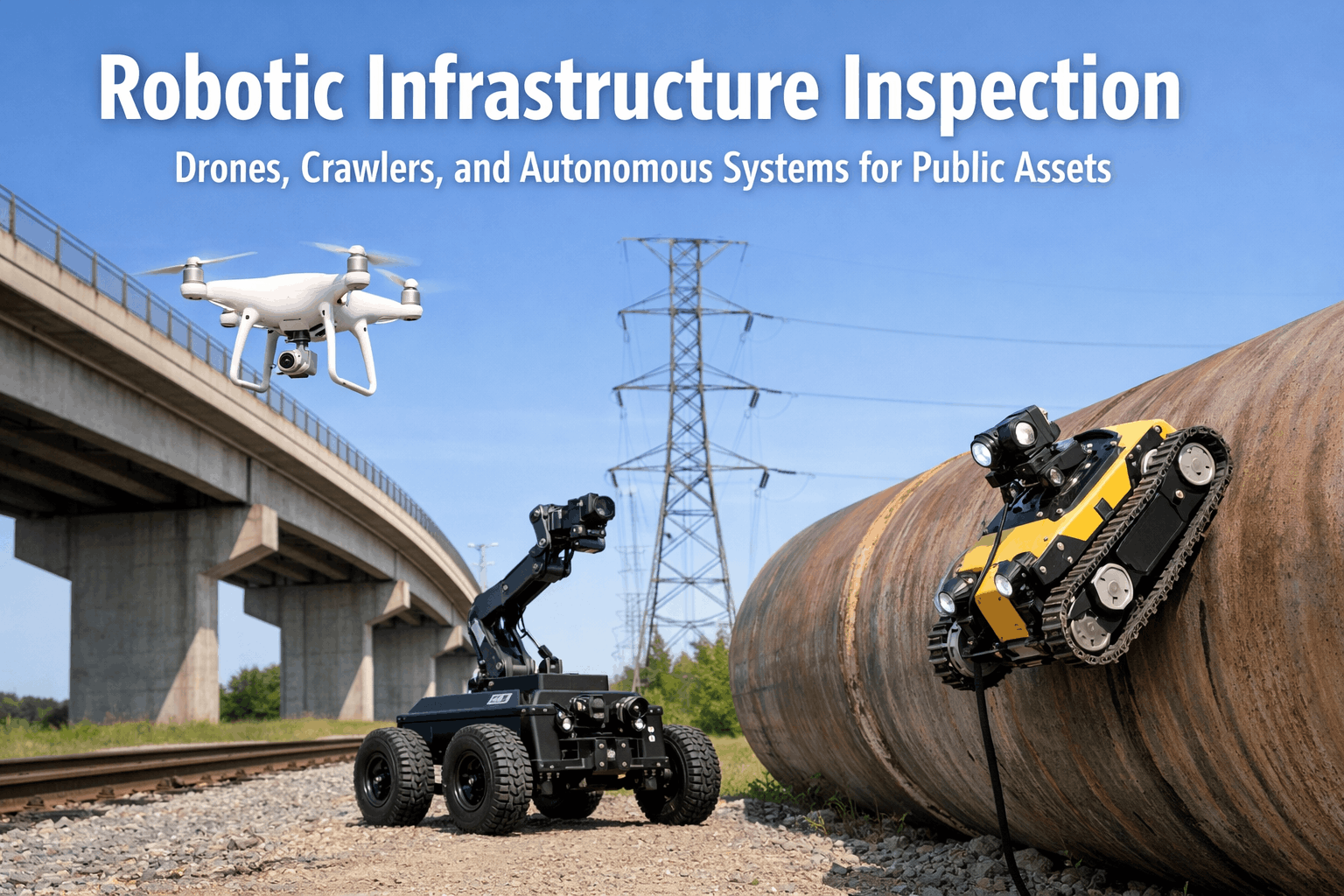
The solution lies in the deployment of specialized robotic inspection technology. Drones inspect bridges and roofs with high-resolution sensors. Crawlers survey sewer pipes and tunnels without confined space entry. Underwater ROVs assess dam structures in dangerous currents. Robotic inspection reduces human risk, covers more assets in less time, and generates precise, repeatable condition data. Oxmaint AI integrates these robotic data streams—video feeds, LiDAR scans, and sonar readings—into a unified CMMS platform, giving government agencies the governance framework they need to manage autonomous inspection data and translate it into actionable maintenance workflows. Start free trial today.
Robotic Inspection Framework 2026
Robotic Infrastructure Inspection: Drones, Crawlers, and Autonomous Systems for Public Assets
Managing public infrastructure demands far more than clipboards and visual estimates. From drone bridge inspections to sewer crawler robots, this guide equips public works directors and maintenance managers with the operational strategies and CMMS tools needed to integrate autonomous inspection technology — reducing risk and improving asset condition assessment without disrupting public services.
85%Risk Reduction
10xFaster Assessment
40%Cost Savings
100%Data Traceability
The Robotic Assessment Maturity Spectrum
Government infrastructure inspection programs typically fall into one of three maturity levels. While many agencies remain in the "Manual" category — relying entirely on human physical presence and paper reporting — Oxmaint helps organizations advance toward "Augmented" and "Autonomous" postures where drones, crawlers, and ROVs feed structured data directly into a CMMS for predictive maintenance planning.
Augmented (Robot Assisted)
28%
Autonomous (AI Integrated)
10%
Critical Robotic Deployment Pillars
Successfully integrating robotic inspection into government operations requires a structured approach that spans payload selection, data management, and work order generation. A comprehensive CMMS acts as the central authority for this data — ensuring every gigabyte of drone video or crawler sonar is logged, analyzed, and linked to a specific infrastructure asset.
Robotic Inspection Integration CheckpointsOperational Framework
Aerial
Drone Asset Surveys
Utilize drones for bridge deck analysis, government building roof inspections, and tower assessments. Capture high-res photogrammetry to map structural spalling or roof membrane degradation.
Height Risk
Subterranean
Sewer Crawler Robots
Deploy tethered crawlers to survey municipal sewer pipes and stormwater tunnels. Identify blockages, root intrusion, and structural cracking without requiring dangerous confined space entry.
Confined Risk
Aquatic
Underwater ROVs
Operate Remotely Operated Vehicles (ROVs) to inspect dam facings, bridge pilings, and reservoir intakes. Use sonar and visual feeds to assess scour and concrete integrity in turbid waters.
Subsea Risk
Data
Digital Twin Generation
Compile robotic sensor data into 3D digital twins of public assets. Compare current scans against historical models to track deterioration rates of bridge supports or tunnel linings over time.
Data Silo Risk
Action
Automated Work Orders
Link robotic defect identification directly to your CMMS. When a drone spots a roof leak, automatically generate a repair ticket with GPS coordinates and images attached for the maintenance crew.
Delay Risk
Safety
Risk Mitigation Logging
Document hazard avoidance by tracking how many manual inspections were replaced by robotic alternatives. Provide concrete ROI metrics on reduced scaffolding costs and lowered insurance premiums.
Liability Risk
Infrastructure Defect Severity Matrix
In public asset management, identifying a defect via robot is only the first step; assessing its severity is crucial. A minor crack in a pedestrian path requires different action than profound scouring at a bridge foundation. This matrix helps public works directors prioritize CMMS work orders based on the robotic condition assessment.
5
Critical Structural Failure
ROV identifies severe foundation scour; drone spots compromised load-bearing bridge members. Immediate closure and emergency repair needed.
4
Severe Deterioration
Crawler detects impending sewer pipe collapse; drone finds significant roof membrane failure. High priority scheduling required.
3
Moderate Damage
Identified root intrusion blocking 40% of pipe; visible concrete spalling on municipal building facade. Plan within next quarter.
2
Minor Wear
Surface-level cracking detected by autonomous drone; minor sediment buildup seen by crawler. Monitor in next inspection cycle.
1
Baseline Acceptable
Asset matches original structural parameters. Digital twin updated with current imagery. No maintenance action required.
Integrate Robotic Data into Your Maintenance Workflows
Oxmaint centralizes the vast amounts of data generated by drones, crawlers, and ROVs, converting raw video and sensor telemetry into actionable, prioritized work orders for your maintenance teams — purpose-built for government infrastructure management.
Core Robotic Deployment Domains
A robust robotic infrastructure assessment program utilizes specialized hardware for specific environments. Implementing these technologies through automated CMMS workflows ensures comprehensive coverage, precise data capture, and rapid repair response across every public asset type.
Aerial
Drone Bridge Inspection
Annual/Post-Event
Deploy UAVs to capture underside decking, piers, and cables. Eliminates the need for snooper trucks and lane closures while providing superior visual and thermal data.
Thermal ScanCrack MappingNo Lane ClosureHD Visuals
Facilities
Drone Roof Inspection Government
Semi-Annual
Assess expansive municipal building roofs for HVAC leaks, membrane tears, and pooling water using thermal imaging. Removes fall risks for facility personnel.
Thermal LeaksHVAC CheckZero Fall RiskArea Mapping
Subsurface
Robotic Pipe Inspection
Condition Based
Utilize sewer crawler robots to navigate complex pipe networks. Capture pan-and-tilt video to categorize structural defects and inflow/infiltration issues in municipal lines.
Inflow CheckRoot IDNo Confined EntryPan/Tilt Video
Aquatic
Underwater ROV Assessment
Triennial
Deploy submersible ROVs to inspect dam spillways, reservoir intakes, and bridge pilings below the waterline. Gather sonar and visual data without hazardous commercial diving operations.
Sonar MappingScour CheckZero Dive RiskTurbid Vision
Analytics
Autonomous Inspection Tech
Continuous
Leverage AI algorithms to automatically detect anomalies in robotic data feeds. Train software to identify rust, spalling, and cracking faster and more accurately than manual review.
AI Defect IDChange TrackingData StitchingPredictive Models
Integration
CMMS Data Pipeline
Immediate
Seamlessly push robotic findings into your CMMS. Auto-generate work orders with attached media and precise locations, bridging the gap between data collection and physical repair.
Auto TicketsMedia AttachGPS LocationRapid Repair
The Cost of Manual Methods: Risk Escalation Pyramid
The risk escalation pyramid illustrates that relying on manual inspections for vast public assets creates a backlog that eventually leads to catastrophic failure. Neglecting modern robotic inspection technology means slower assessments, higher costs, extreme danger to personnel, and ultimately, crumbling infrastructure that endangers the public.
$5k - $15k
Robotic Baseline
Drone or crawler deployment captures comprehensive digital twin. No lane closures, no confined space entry, zero injury risk. Highly accurate data logged in CMMS.
Frequency: High Efficiency
$50k - $150k
Manual Scaffolding
Traditional inspection requires snooper trucks, traffic control, complex scaffolding, or hazardous confined space permitting. Slow data collection; high risk of worker injury.
Frequency: Slow / Logjammed
$10M+
Catastrophic Failure
Uninspected asset fails (e.g., bridge collapse, major sewer main burst). Massive emergency rebuild costs, severe public disruption, and potential loss of life.
Frequency: Due to Neglect
Modernize Your Public Asset Inspections
Don't wait for manual inspection backlogs to mask critical infrastructure deterioration. Oxmaint provides the digital infrastructure to ingest robotic assessments, track structural health, and automate maintenance workflows — keeping your crews safe and the public protected.
Frequently Asked Questions
Q. How does a drone bridge inspection compare to manual methods?
A drone bridge inspection is significantly faster, safer, and often more comprehensive than manual methods. Instead of requiring lane closures, snooper trucks, and inspectors in harnesses, a drone can map the entire structure in hours. It uses high-definition and thermal cameras to identify cracking, spalling, and rust that human eyes might miss. All this data is then fed into Oxmaint CMMS to create a lasting digital record and trigger necessary repairs.
Sign up for Oxmaint to manage your inspection data.
Q. What are the benefits of a sewer crawler robot?
Sewer crawler robots entirely eliminate the need for dangerous confined space entries by municipal workers. They navigate narrow, toxic, and submerged pipe environments to deliver clear video and sonar data regarding blockages, root intrusions, and structural degradation. This allows public works departments to pinpoint exact repair locations without exploratory digging, reducing street disruptions and maintenance costs.
Q. Can autonomous inspection technology replace human engineers?
No, autonomous inspection technology is designed to augment, not replace, human expertise. Drones and crawlers handle the dangerous, tedious data collection, while AI helps flag potential anomalies. However, licensed engineers and maintenance professionals must still review the data, verify the severity of the defects, and determine the appropriate repair strategy using a system like Oxmaint to manage the resulting work orders.
Schedule a demo to see how human expertise and robotic data intersect.
Q. How does Oxmaint handle the massive amounts of data generated by robotic infrastructure assessments?
Oxmaint is designed to organize and contextualize large data sets. Instead of having fragmented video files on hard drives, Oxmaint links robotic media directly to the specific asset record (e.g., "Bridge Pier 4" or "Storm Drain Segment A"). When AI or a reviewer spots a defect in the footage, a work order is generated that includes the relevant video clip, GPS location, and asset history, ensuring the repair crew has exactly what they need.
Q. What types of public assets are best suited for underwater ROV inspection?
Underwater ROV (Remotely Operated Vehicle) inspections are ideal for critical submerged infrastructure where human diving is exceptionally dangerous or impossible. This includes dam facings, spillway tunnels, reservoir intake structures, bridge scour at river bottoms, and municipal water storage tanks. ROVs equipped with sonar can provide clear structural imaging even in highly turbid (muddy) waters where cameras are ineffective.