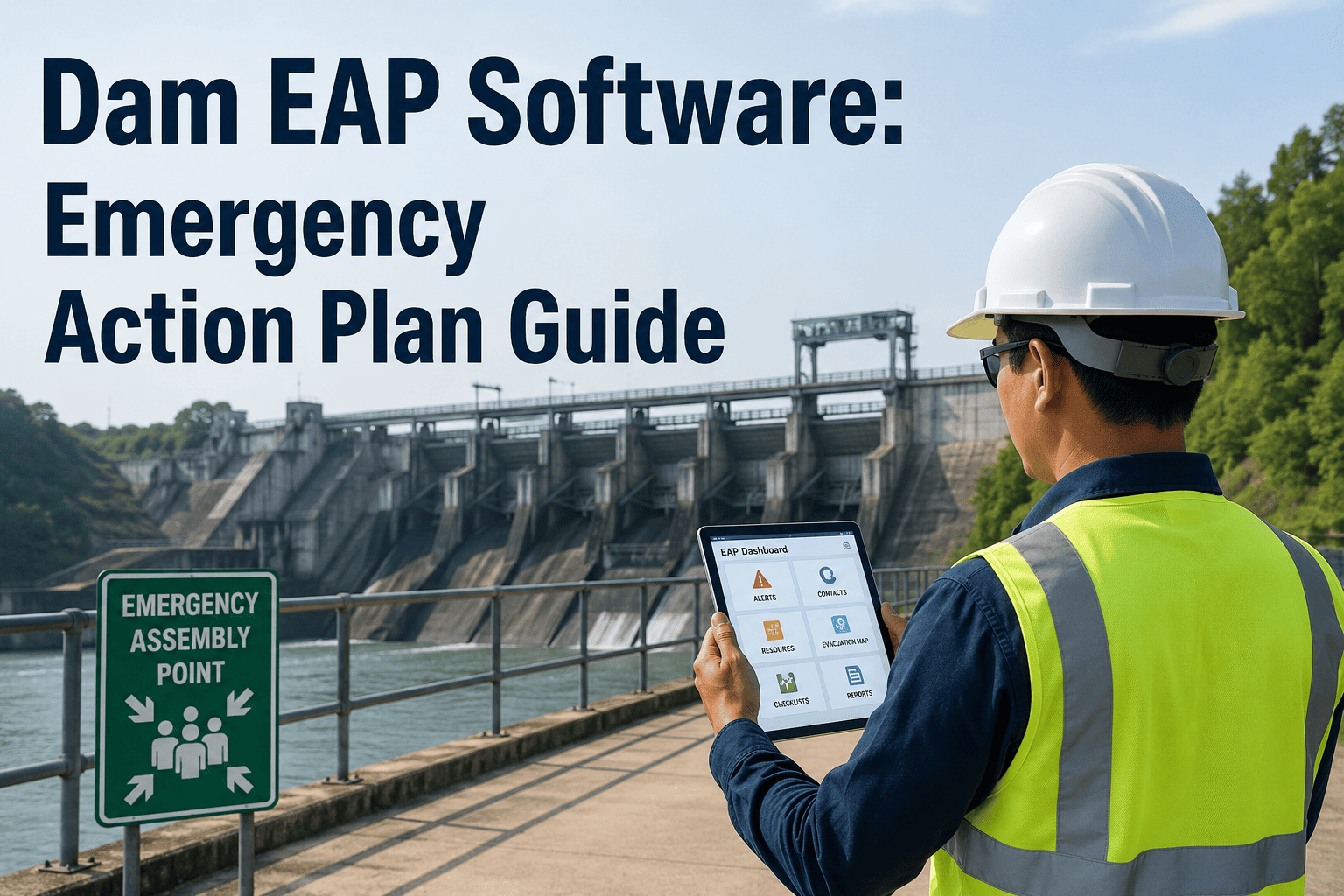
When a high-hazard dam shows the first sign of trouble — a new seep at the toe, a spillway crest overtopping during a storm, a crack nobody can explain — the difference between a controlled response and a downstream tragedy usually comes down to one document: the Emergency Action Plan. Yet most EAPs still live as static PDFs on a shared drive, disconnected from the exercise logs, inundation maps, and notification contacts that keep them usable on the one day they matter. Dam safety regulators expect these plans reviewed on a fixed schedule, exercised at defined intervals, and updated the moment a downstream contact or land-use condition changes. A missed review date or a stale call list is not paperwork drift, it is a life-safety gap. Sign in to OxMaint to bring EAP documents, exercise tracking, and inundation map version control into one auditable system.
Turn Your Dam's Emergency Action Plan Into a Living System, Not a Forgotten PDF
OxMaint keeps your Emergency Action Plan documents, exercise records, notification flowcharts, and inundation maps current, version-controlled, and ready to hand to a state dam safety inspector on request — no spreadsheet, shared drive, or sticky note required.
The Six Core Elements Every Dam EAP Must Contain
FEMA's Federal Guidelines for Dam Safety (FEMA P-64) lay out six elements that regulators expect to find in every Emergency Action Plan, regardless of state. Missing or outdated content in any one of these sections is the most common reason an EAP gets sent back during review.
Notification Flowcharts
A step-by-step chart showing exactly who the dam owner or operator calls first, in what order, and how the message escalates to county emergency management, downstream operators, and state dam safety staff. A flowchart with an outdated phone number is functionally useless.
Emergency Detection & Classification
Defined alert levels — typically ranging from a non-failure unusual event through potential failure to an active failure condition — with observable triggers for each level, so the person on site knows exactly when to escalate rather than guessing.
General Responsibilities
Named roles, not just job titles, for the dam owner, operator, and every responding agency. When the on-call engineer changes jobs, the EAP should not silently go stale until the next scheduled review catches it.
Preparedness
The training, equipment, and pre-staged materials that need to already be in place before an event happens — sandbags, pumps, communication equipment, and a trained team that has actually rehearsed the plan, not just read it once.
Inundation Maps
Dam-breach modeling, prepared under FEMA P-946 guidance, that ties specific water-surface elevations and warning times to the areas and structures downstream that would flood. These maps drive the entire notification and evacuation sequence.
Appendices
Training logs, exercise records, and the full history of plan updates — the section a reviewing agency typically asks for first, because it proves the plan is actually maintained rather than filed away and forgotten.
Why Spreadsheet-Based EAP Tracking Falls Apart
Missed Annual Reviews
A shared drive does not send a reminder. States like Maryland set a fixed May 1 submission date for the revised EAP, and a missed deadline can hold up acceptance until the next cycle.
Stale Inundation Maps
Downstream development changes, a new subdivision goes in, a bridge is rebuilt — and the inundation map on file still reflects conditions from years earlier because nobody flagged the update.
Untracked Exercise Cycles
When an inspector asks for proof the plan was exercised within the recommended five-year window, "we think so" is not an answer that satisfies a dam safety audit.
How OxMaint Manages the Full Dam EAP Lifecycle
A dam EAP is not a document you file once — it is a recurring operational cycle of review, exercise, and revision. OxMaint's CMMS is built to carry that cycle automatically instead of relying on someone remembering a date on a calendar.
Annual Review & Renewal Reminders
OxMaint tracks each dam's required review cadence and any state-specific deadline — such as a fixed annual submission date — and generates reminders well ahead of the due date, with escalation if a review is left incomplete.
Tabletop, Functional & Full-Scale Exercise Logs
Every exercise — whether a tabletop discussion, a functional drill, or a full-scale field exercise — is logged with date, participants, and lessons learned, building the exercise history regulators expect within the recommended five-year cycle.
Inundation Map Version Control
The current approved inundation map is linked directly to the EAP record. When a new dam-breach study is completed, the prior version is archived rather than overwritten, preserving a complete revision history.
Notification Flowchart & Contact Management
Downstream property owners, county emergency management, and state dam safety contacts are stored as living records, not static text in a PDF, so a call tree can be verified and tested rather than assumed accurate.
Regulator-Ready Document Trail
Every review, revision, and exercise is timestamped and attributable, so producing a complete compliance history for a dam safety program takes minutes instead of a scramble through old email threads.
EAP Requirements Snapshot Across Selected State Dam Safety Programs
Every state dam safety program sets its own specifics, but the pattern below repeats in most jurisdictions: a hazard classification trigger, a required review cadence, and a distinct local wrinkle worth knowing before you file.
| State Program | Hazard Class Trigger | Review Frequency | Distinct Requirement |
|---|---|---|---|
| Maryland | High & Significant Hazard | Annual, due May 1 | Revised EAP submitted to the Dam Safety Division for acceptance |
| North Carolina | High & Intermediate Hazard | Per program schedule | Simplified EZ-EAP template available for small high-hazard dams |
| Massachusetts | High & Significant Hazard | Per program schedule | Electronic submission required to both the Office of Dam Safety and MEMA |
| California | All except Low Hazard | Per program schedule | EAP must be based on an approved dam-breach inundation map under state law |
| South Carolina | High & Significant Hazard | Per program schedule | Program staff can draft a pre-populated EAP with inundation maps and call trees |
Requirements vary by state dam safety program and change over time — always confirm the current rules with your regulating agency before relying on this summary.
Hazard Classification: What It Means for Your EAP Obligation
Minimal EAP Obligation
Failure would cause minimal economic loss and no expected loss of life. A formal EAP is generally not mandated, though basic emergency contact information is still good practice.
EAP Strongly Recommended or Required
Failure could cause economic loss, environmental damage, or disruption to lifeline facilities without expected loss of life. Many states now require a full EAP at this tier, not just recommend one.
EAP Mandatory, Highest Scrutiny
Failure is expected to cause loss of human life downstream. A current, exercised EAP is mandatory nationwide, and an approved EAP is also a condition of eligibility for FEMA's High Hazard Potential Dam rehabilitation grant program.
What Changes When Your EAP Lives Inside a CMMS
Frequently Asked Questions — Dam EAP Software
Which dams actually need an Emergency Action Plan?
Every dam classified High Hazard Potential needs a current EAP, and a growing number of states now require or strongly recommend one for Significant Hazard dams as well. Sign in to OxMaint to check how your dam's classification maps to your state's specific requirement.
How often does an EAP need to be reviewed and exercised?
Most programs expect at least an annual review and update, with a full exercise recommended at least once every five years under ASDSO guidance. Some states, like Maryland, set a fixed annual submission date rather than a floating deadline.
What exactly is an inundation map and why does it drive the EAP?
It is a dam-breach flood model, prepared under FEMA P-946 guidance, that shows which areas would flood and how much warning time downstream residents would have. Book a demo to see how OxMaint version-controls inundation maps against your live EAP.
Can OxMaint help me hit a state-specific filing deadline?
Yes — deadlines like a fixed annual submission date can be configured per dam, with reminders sent well ahead of the date so the review is never a last-minute scramble. Sign in to OxMaint to set up your dam's review schedule.
What happens if an EAP review or exercise deadline is missed?
Beyond the direct safety risk, an outdated or unexercised EAP can affect state program acceptance and, for High Hazard Potential dams, eligibility for FEMA's rehabilitation grant program, which requires an approved EAP on file. Book a demo to see how continuous tracking closes that gap.
Stop Managing Life-Safety Deadlines in a Shared Drive
OxMaint keeps your dam's Emergency Action Plan, inundation maps, notification contacts, and exercise history current, connected, and ready the moment a regulator — or an actual emergency — asks for them.