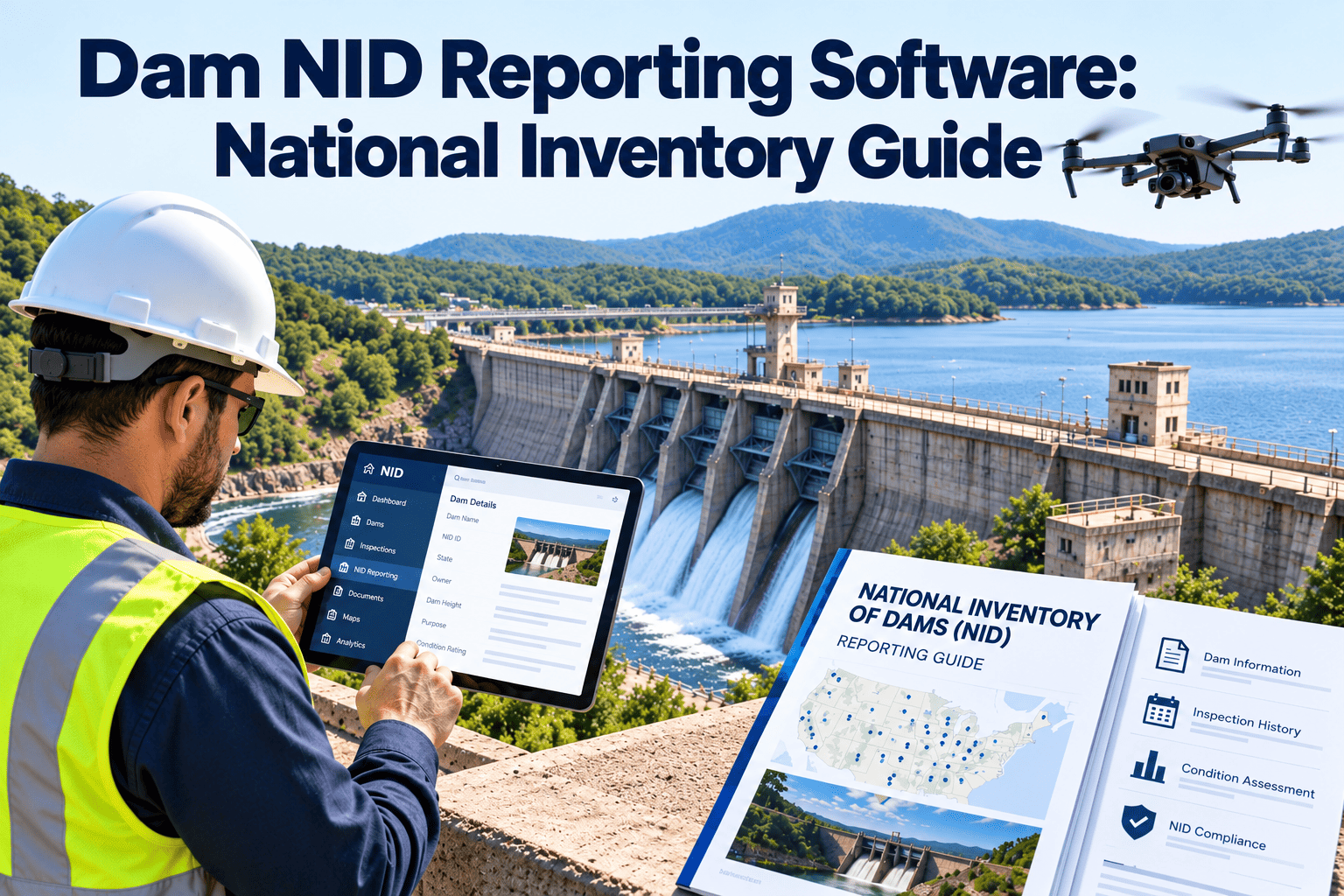
The National Inventory of Dams (NID) is the national database of dams maintained by the U.S. Army Corps of Engineers, built from records that state regulators and dam owners supply. Each dam record carries more than 70 data fields, covering location, height, storage, hazard potential, condition, inspection dates, and emergency action plan status. When those fields live in spreadsheets, consultant reports, and shared drives, every update cycle turns into a scramble. This guide explains what NID reporting expects from owners and how a maintenance management platform keeps the source records current all year.
What the National Inventory of Dams Actually Is
Purpose
- A single national record of dams that pose potential risk to life and property, plus many that serve water supply, flood control, power, and recreation.
- A planning tool for emergency managers, regulators, insurers, and engineers who need consistent dam data across state lines.
- A foundation for national reporting on dam safety program performance and for federal dam safety funding discussions.
Who feeds it
- State dam safety agencies submit and validate most non-federal records.
- Federal agencies maintain records for the dams they own or operate.
- Dam owners supply the underlying facts: dimensions, modifications, inspection findings, and emergency plan status.
Federal law directs USACE to maintain the inventory and refresh it with state input. Submission windows and formats are set by the program, so confirm current requirements with your state dam safety office.
Which Dams Belong in the Inventory
Why NID Data Goes Stale Between Updates
- Dimensions copied from a 1970s drawing and never reverified
- Last inspection date stored in a consultant PDF, not the owner record
- Emergency action plan revision date tracked in a separate binder
- Modification history buried in email threads
- Different staff holding different versions of the same dam record
- Inspection completion updates the dam record automatically
- Repairs and modifications attach to the same asset history
- Emergency plan reviews appear as scheduled, trackable tasks
- One approved version of each field, with an edit trail
- Export-ready data before the state asks for it
The usual root causes
- No owner for data quality, so fields are corrected only when a regulator asks.
- Inspection reports and asset data live in different systems, so findings never reach the inventory record.
- Ownership and contact changes are not captured when land, utilities, or districts transfer dams.
- Rehabilitation work is completed in the field but never reflected in height, spillway, or outlet fields.
- Annual updates depend on one experienced person who knows where everything is.
The Data Families Inside a Dam Record
| Field family | Typical content | Where the data comes from |
|---|---|---|
| Identification | Dam name, other names, state ID, federal ID | Asset register, state permit file |
| Location | State, county, river, latitude, longitude, nearest city | Survey data, GIS verification |
| Ownership | Owner name, owner type, contacts, operator | Legal records, owner profile |
| Purpose and type | Purposes served, dam type, core type, foundation | Design documents, engineering reports |
| Dimensions | Height, length, structural height, hydraulic height | As-built drawings, field survey |
| Storage and drainage | Maximum and normal storage, surface area, drainage area | Hydrologic studies, reservoir surveys |
| Spillway and outlet | Spillway type, width, capacity, outlet works | Hydraulic analysis, inspection findings |
| Risk and condition | Hazard potential, condition assessment, assessment date | Inspection reports, regulator review |
| Regulation and inspection | Regulating agency, inspection frequency, last inspection date | State program data, work order history |
| Emergency preparedness | EAP prepared, last EAP revision, inundation maps | EAP document control, drill records |
Field names and definitions come from the USACE NID data dictionary. Use it as the controlling reference when you map your asset fields.
Hazard Potential Is Not Condition: Reading the Matrix Correctly
| Hazard potential | Consequence of failure | Typical oversight emphasis |
|---|---|---|
| High | Probable loss of life | Frequent inspection, current emergency plan, regular exercises |
| Significant | No probable loss of life, but major economic or environmental damage | Periodic inspection, emergency plan in many states |
| Low | Limited damage, mostly to the owner's property | Less frequent inspection, focus on maintenance |
| Undetermined | Classification not yet assigned | Needs regulator evaluation |
Condition assessment categories
Inspection frequency by hazard class is set by each state. Many programs inspect high hazard dams annually, but your regulator's rule governs.
From Field Observation to NID-Ready Data in Six Steps
A Year-Round Calendar That Makes the Annual Update Routine
Shift this calendar to match your state's submission window, then work backward so approvals finish before the deadline rather than on it.
KPIs That Show Whether Your NID Data Can Be Trusted
The bars illustrate how the dashboard is read. Set your own targets with your regulator and engineer of record.
How Oxmaint Supports Dam Records and Reporting
Routine Dam Maintenance Tasks That Feed Inventory Accuracy
| Maintenance activity | Record it updates | Why it matters for reporting |
|---|---|---|
| Periodic engineering inspection | Condition, last inspection date, deficiency list | Supports condition assessment and inspection currency |
| Spillway and outlet exercising | Operational status, gate repair history | Shows that release capability has been verified |
| Seepage and instrumentation readings | Piezometer, weir, and settlement trends | Provides evidence behind condition changes |
| Vegetation and burrowing control | Embankment condition, corrective actions | Documents routine care of earthen dams |
| Rehabilitation or modification | Height, spillway, outlet, and modification fields | Keeps physical data aligned with the structure |
| Emergency plan review | Plan status, revision date, contact list | Supports preparedness fields for high hazard dams |
Dam Data Trends Owners Should Plan Around
- Greater emphasis on emergency preparedness. Regulators and emergency managers increasingly expect current plans, tested contact trees, and inundation information tied to each dam.
- Aging infrastructure. Many dams in the inventory were built decades ago, so original drawings, undocumented repairs, and deferred maintenance are common record gaps.
- Risk-informed decisions. Dam safety programs increasingly use risk information to prioritize investigations and funding, which depends on consistent hazard and condition data.
- Monitoring technology. Remote sensors for water level, seepage, and movement can feed condition-based workflows when readings cross defined limits.
- Climate and extreme rainfall. More frequent heavy storms push owners to revisit spillway capacity assumptions and document reservoir operating changes.
What this means for your maintenance system
Who Owns the Dam Changes What You Need to Track
Utilities and water districts
- Large portfolios across many sites
- Need consistent inspection schedules and shared reporting
- Often manage dams alongside canals, pipelines, and plants
Municipalities and counties
- Few dams, limited staff, frequent turnover
- Need documented procedures that survive staff changes
- Often depend on outside engineers for inspections
Industrial and mining owners
- Dams tied to process water or tailings storage
- Need combined dam safety and operational records
- Face additional oversight depending on dam type
Private and homeowner associations
- Small dams with unclear funding and responsibility
- Need simple, repeatable inspection and repair tracking
- Often lack original design documents
Assign Clear Roles for Dam Data Ownership
Even a two-person team benefits from naming who approves each type of change. Data quality improves when someone is accountable for it.
NID Reporting Readiness Checklist
Data foundation
- Every dam has a unique asset record and state ID
- Coordinates verified against current imagery
- Owner and operator contacts are current
- Hazard classification matches the regulator's file
- Dimensions trace to a drawing or survey
Operational discipline
- Inspection intervals scheduled by hazard class
- Emergency plan revision dates tracked
- Deficiencies linked to work orders
- Rehabilitation changes update the dam record
- Named person approves data changes
Common NID Reporting Mistakes
- Treating hazard potential as a condition rating and mixing the two in reports.
- Leaving a modification, such as a raised crest or new spillway, out of the inventory record.
- Reporting an emergency plan as current when its contact list has not been checked.
- Using a rounded or estimated height without noting the source.
- Overwriting old values without keeping a change history.
- Waiting for the state data request before starting the audit.