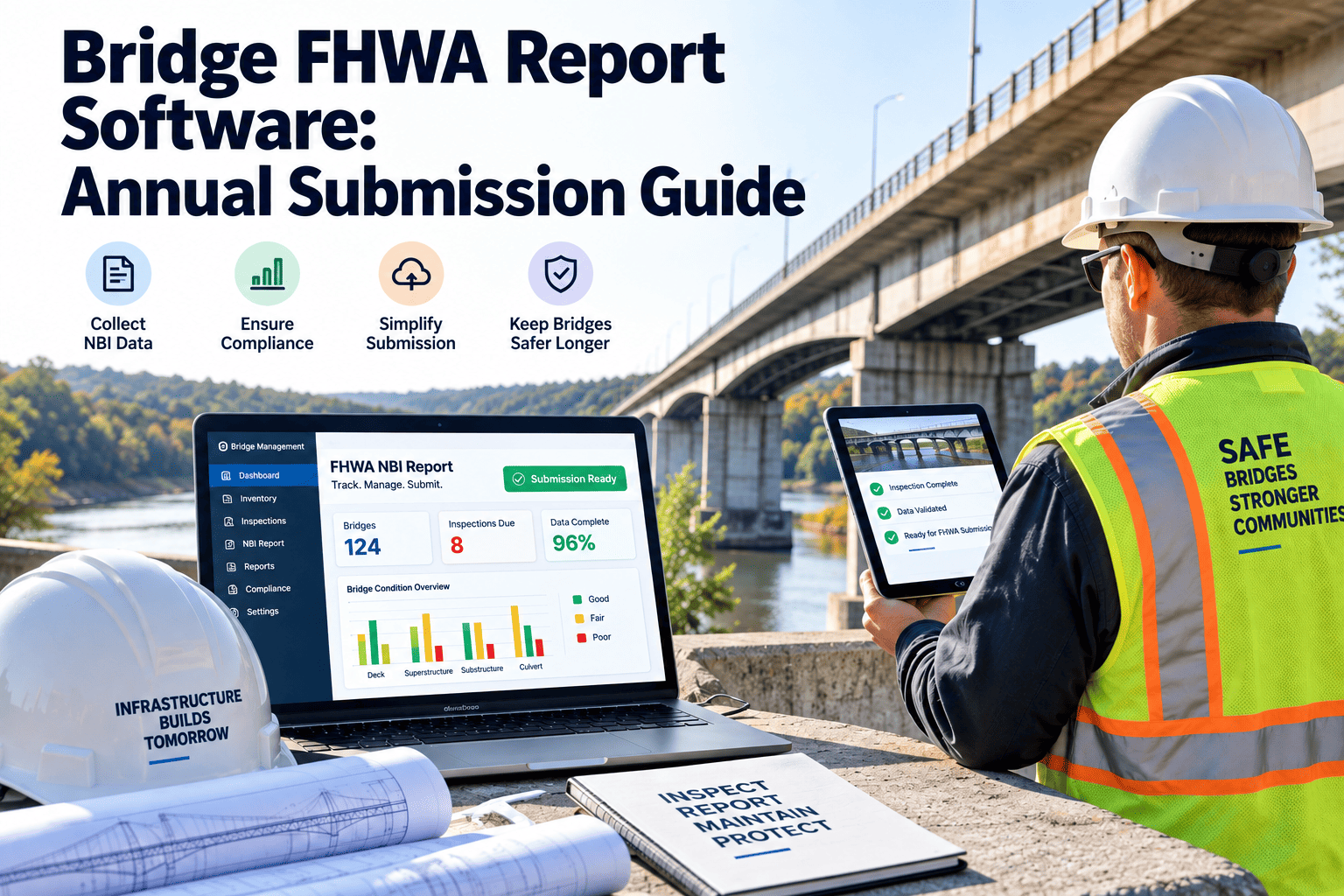
Every state DOT and every Bureau of Indian Affairs bridge program answers to the same clock each year: an annual data submission to the Federal Highway Administration's National Bridge Inventory, built from thousands of individual inspection records, coded to a federal specification, and due whether or not the underlying inspection data is actually ready. Agencies that treat this as a spreadsheet exercise in February lose weeks to reconciliation errors that a properly configured maintenance system would have caught in real time, and the two-way link between bridge inspection software and a defensible NBI package is what separates a clean submission from a corrective action plan.
Bridge Asset Management · FHWA / NBI Reporting
Bridge FHWA Report Software: Building an Annual Submission That Survives Review
A practical guide to structuring inspection data, element condition records, and critical-finding documentation into an NBI submission-ready package under 23 CFR Part 650 Subpart C and the Specifications for the National Bridge Inventory (SNBI) — with a CMMS workflow that state DOTs, county bridge programs, and tribal (BIA) bridge owners can run year-round instead of assembling once a year.
623,218
bridges in the U.S. National Bridge Inventory subject to NBIS reporting requirements
23
metrics FHWA scores annually to judge a state bridge program's NBIS compliance
Mar 2026
first bridge inventory submission FHWA will accept coded to the new SNBI format
2015
year element-level reporting became mandatory for all National Highway System bridges
Why the Annual NBI Submission Is Harder Than a Data Export
The National Bridge Inventory is not a passive archive — it is the dataset FHWA uses to calculate sufficiency ratings, allocate Bipartisan Infrastructure Law bridge formula funding, and flag structures for the Bridge Investment Program. A late, incomplete, or miscoded submission does not just embarrass a bridge program; it can trigger a Plan of Corrective Action and put the following year's federal-aid apportionment under closer scrutiny.
What FHWA Actually Validates on Receipt
01Every structure defined as a bridge under 23 CFR 650.305 has a current record, including newly opened and newly demolished structures for the reporting year
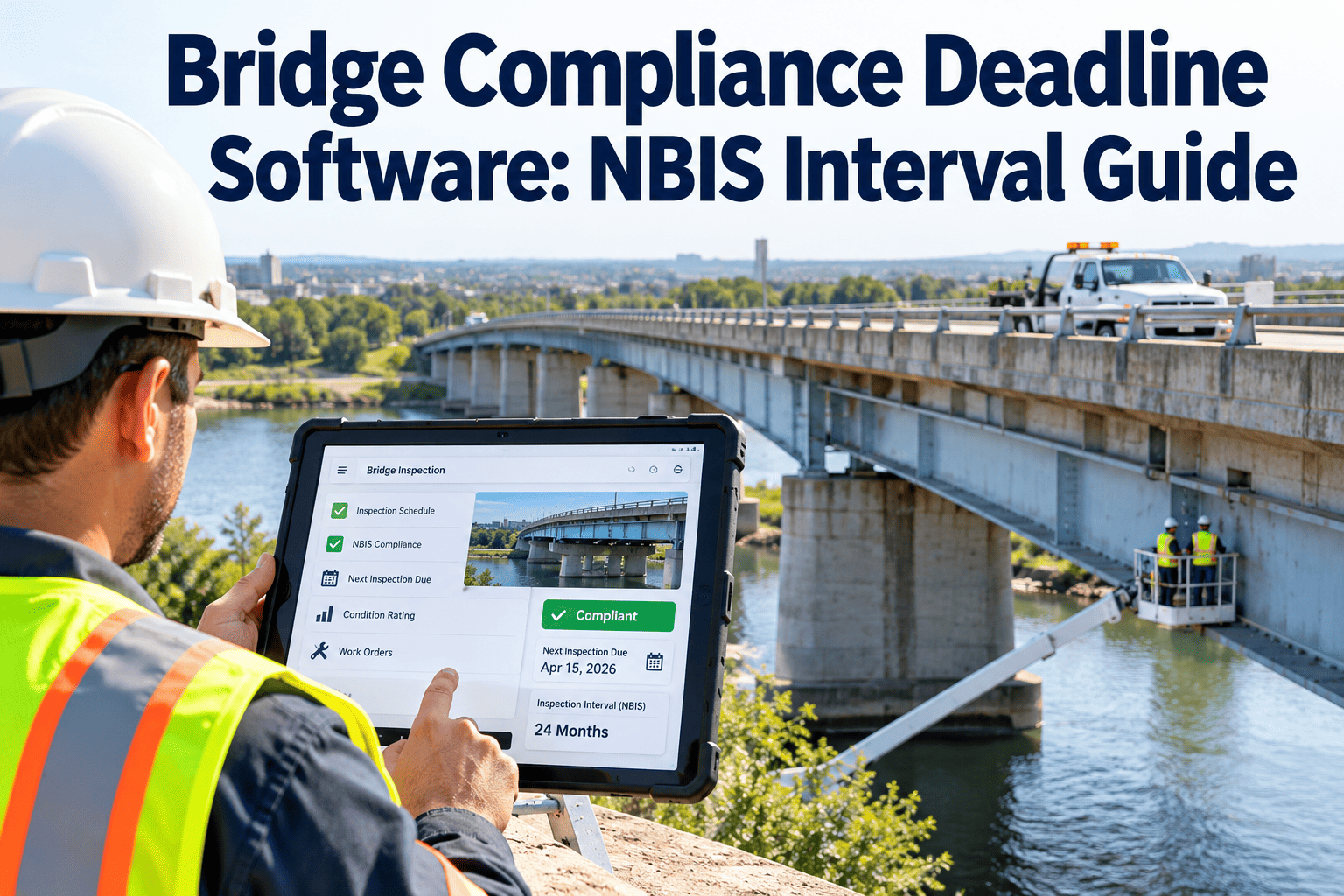
02Inspection dates fall within the interval assigned to that structure — fixed 24-month cycles or an approved risk-based interval up to 48 months
03Element-level condition data is present for every NHS bridge, coded to the AASHTO Manual for Bridge Element Inspection categories
04Critical findings identified during inspection show a documented resolution or an active monitoring plan, not a silent gap in the record
The Regulatory Chain Behind Every Data Field
The National Bridge Inspection Standards, codified at 23 CFR Part 650 Subpart C under the statutory authority of 23 U.S.C. 144, were substantially revised in a final rule published May 6, 2022, with most provisions effective June 6, 2022. That rule incorporated by reference the FHWA Specifications for the National Bridge Inventory (SNBI, March 2022), which replaced the 1995 Recording and Coding Guide as the definitive source for how every inventory and inspection item must be coded before it reaches the NBI.
SNBI Transition Timeline — What Bridge Programs Are Reporting Against
2015
Element-level inspection data becomes mandatory for all National Highway System bridges under MAP-21
May 2022
Revised NBIS final rule published; SNBI incorporated by reference at 23 CFR 650.317, superseding the Coding Guide
2022–2025
States transition inspection data collection and internal systems to SNBI-compliant coding ahead of first submission
Mar 2026
First bridge inventory data submitted to the NBI under the SNBI schema, replacing legacy Coding Guide fields
Tribal and BIA Bridge Programs Carry the Same Obligation
The 2022 NBIS update, implementing a MAP-21 requirement, extended full applicability to tribally owned bridges, meaning Bureau of Indian Affairs and tribal transportation programs now sit under the identical reporting, inspection-interval, and critical-finding documentation rules as a state DOT — often with a fraction of the inspection staff and no legacy bridge management system to lean on.
The Six Places Annual Submissions Break
Inspection interval drift
A bridge assigned a risk-based interval slips past its due date because no system is tracking interval assignment separately from a generic calendar reminder, and the gap only surfaces during FHWA's compliance review.
Element data collected but not coded
Field inspectors record condition observations in notes or photos that never get translated into the specific element, defect, and condition state codes the NBI schema requires, leaving a structurally complete inspection that fails submission validation.
Critical findings without a closed loop
A critical finding gets a phone call and a temporary fix, but no work order, no resolution date, and no record that ties the finding to the corrective action FHWA expects to see documented.
Structure inventory changes unreported
A new bridge opens, a culvert is reclassified, or a structure is demolished mid-year, and the inventory count submitted in March no longer matches what exists on the ground.
Personnel qualification records incomplete
Team leader qualifications — PE license or NHI comprehensive training completion — are not cross-referenced against who actually performed each inspection, a gap the 2022 rule's expanded personnel criteria specifically targets.
Spreadsheet handoff between systems
Inspection data lives in one tool, work order history in another, and the annual submission file gets assembled by hand from exports — the single largest source of transcription error in state bridge programs.
Where a CMMS Replaces the Once-a-Year Scramble
A maintenance management platform built around asset records, scheduled inspections, and work orders turns the annual submission from a reconstruction project into a report generated from data that was captured correctly the first time. That only works if the system is structured around the same units FHWA validates against.
From Field Inspection to Submission-Ready Package
1
Structure Record
Each bridge exists as an asset with its assigned inspection interval, NBI structure number, and ownership classification pre-loaded
2
Mobile Inspection
Field teams complete element-level condition entries and photo documentation against the current SNBI coding structure, offline-capable at remote crossings
3
Critical Finding Trigger
A flagged critical finding automatically opens a work order with a resolution deadline, closing the loop FHWA reviewers look for
4
Interval Monitoring
Dashboards surface any structure approaching or past its inspection due date months before the annual review, not during it
5
Export Package
Inventory, inspection, element, and finding-resolution data export in a structure aligned to NBI submission fields, ready for the state's final validation pass
Manual Assembly vs. a Structured CMMS Workflow
See a state's bridge inventory structured for SNBI submission before you build your own.
Walk through how inspection intervals, element data, and critical findings map to an export-ready NBI package.
Pre-Submission Checklist
Every structure meeting the 23 CFR 650.305 bridge definition has a current-year record, including additions and removals
Inspection dates for every structure fall inside its assigned fixed or risk-based interval
Element-level condition data is complete for all National Highway System structures
Every critical finding shows a documented resolution, repair, or active monitoring plan
Team leader qualifications are on file and match the inspector of record for each structure
Load rating and posting data reflects any condition changes identified during the reporting year
Export file structure matches the current SNBI schema, not the legacy Coding Guide field layout
What FHWA's Annual Compliance Review Is Actually Scoring
Beyond the data file itself, FHWA Division offices conduct an annual National Bridge Inspection Program review against 23 metrics spanning organization, personnel qualification, inspection frequency, and data quality, rating each Compliant, Substantially Compliant, Conditionally Compliant, or Non-Compliant. A bridge program with clean, system-generated documentation for interval adherence and critical-finding closure enters that review with most of the paper trail already assembled.
Building the Case for a Bridge-Specific CMMS Workflow
Bridge programs evaluating a maintenance platform for FHWA reporting should look for asset structures that map directly to NBI structure numbers, mobile inspection forms that mirror SNBI element and condition-state coding, and work order logic that automatically links a critical finding to its resolution record. General-purpose maintenance software without this structure still requires a manual translation step at submission time — the same bottleneck a purpose-built workflow removes. Oxmaint's asset and inspection management tools are built around exactly this structure/inspection/work-order relationship, so the annual export reflects what was captured in the field rather than what someone reconstructed under deadline pressure.
Frequently Asked Questions
What is the difference between the Coding Guide and the SNBI?
The Coding Guide was the 1995 standard for reporting bridge data to FHWA; the SNBI, incorporated by reference in the 2022 NBIS final rule, replaces it and governs the field structure for submissions beginning March 2026.
Do local and county-owned bridges have the same reporting obligation as state DOT bridges?
Yes — any structure meeting the bridge definition on a public road, regardless of owner, is reportable to the NBI, though the state DOT typically compiles and submits the combined inventory to FHWA.
How does risk-based inspection frequency affect the annual submission?
A structure on an approved risk-based interval of up to 48 months is validated against that specific interval, not a blanket 24-month cycle, so the submission must reflect the correct assigned interval per structure.
Can a CMMS generate the actual NBI submission file?
A well-structured CMMS exports inventory, inspection, and element data aligned to submission fields; most states still run the file through their own validation and formatting step before transmitting to FHWA.
Book a demo to see the export structure.
What happens if a critical finding is not documented as resolved by submission time?
An open, undocumented critical finding is one of the fastest paths to a Plan of Corrective Action during FHWA's compliance review, since it signals a gap in the monitoring and reporting procedures the 2022 rule requires.
Stop Rebuilding Your NBI Package From Scratch Every March
Structure inspections, element data, and critical findings around one asset record, and the annual FHWA submission becomes an export — not a reconstruction project.