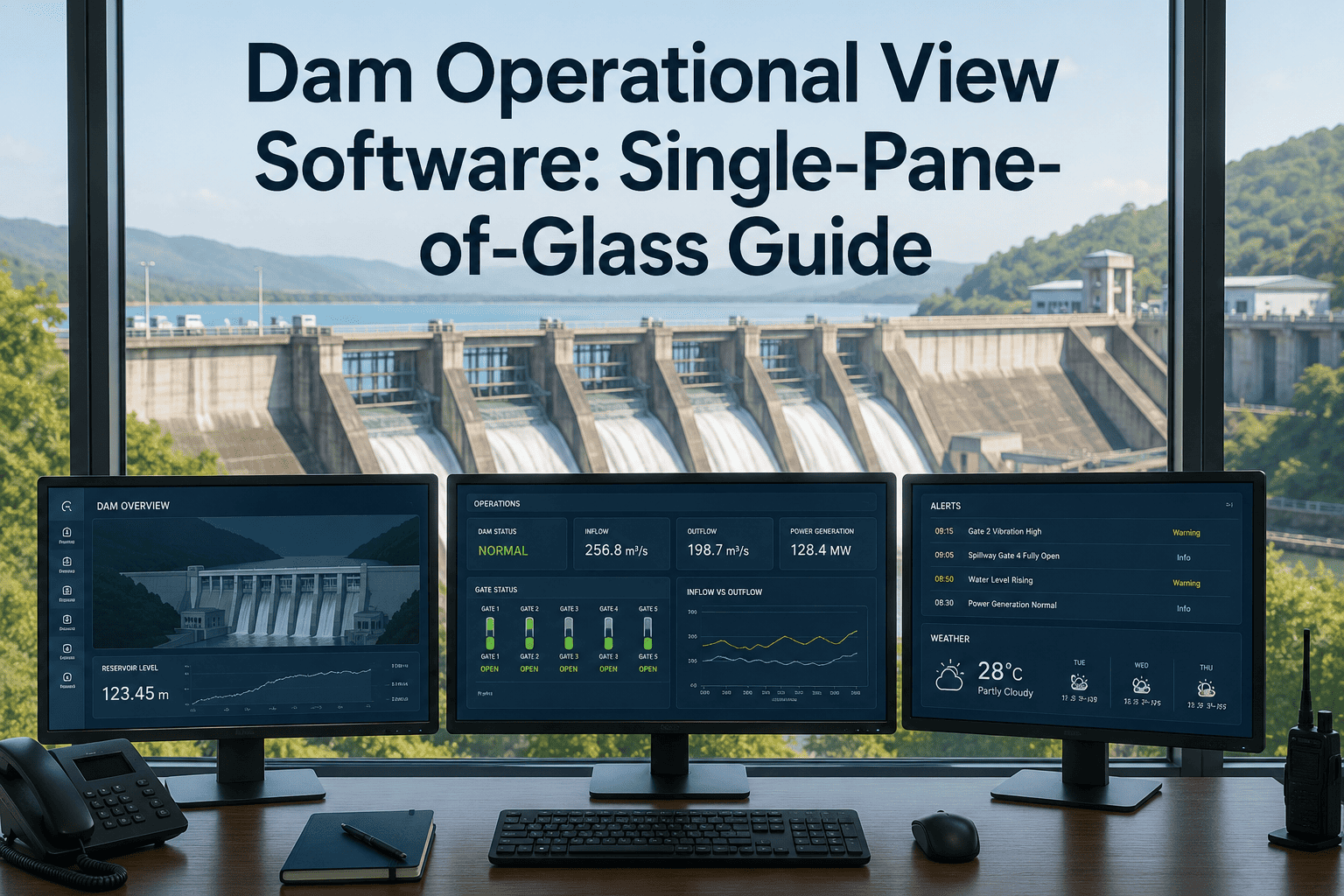
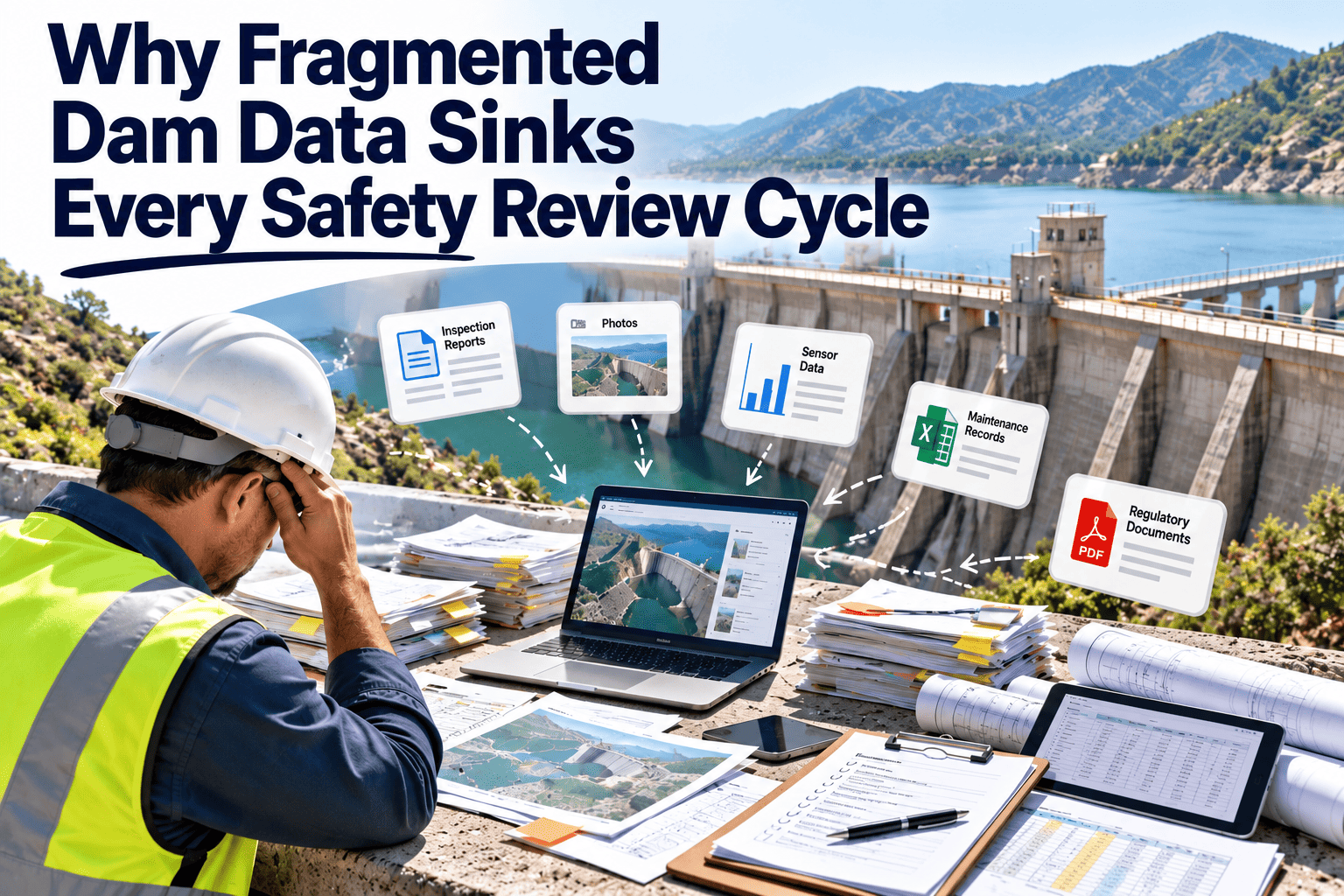
A dam safety officer's job comes down to one question asked at the worst possible moment: is this reading normal, or is it the start of something. Answering that well requires seeing piezometer trends, the last visual inspection findings, open maintenance work on the spillway gates, and the compliance document history all at once — and at most dams today, those four things live in four different places. Instrumentation data sits in a telemetry vendor's portal, inspection reports are PDFs in a shared drive, maintenance is tracked on a separate work order system if it is tracked digitally at all, and the regulatory file is whatever the engineer of record last compiled by hand. A single-pane-of-glass operational view puts all four in front of the person making the call, before the call has to be made under pressure.
Dam Safety · Operational View · Single Pane of Glass
Dam Operational View Software — One Screen for Sensors, Inspections, and Maintenance
Dam safety officers do not have time to check four systems during a high-water event. Here is what a true single-pane-of-glass operational view combines, and why regulators keep asking for exactly this.
4
Separate systems a dam safety officer typically checks during a single high-water decision
92,000+
Regulated dams in the United States, most operated by teams without a unified operational dashboard
70%
Of significant-hazard dams flagged in condition assessments for deferred maintenance or monitoring gaps
Minutes
Not hours — the timeframe a unified view is built to deliver a full asset status picture in
What Gets Combined
The Four Panels a Real Single Pane of Glass Actually Combines
Vendors use the phrase "single pane of glass" loosely. For a dam, it only means something if it genuinely brings together the four data types a safety officer has to cross-reference to make a sound operational judgment.
Live Readings
Instrumentation Data
Piezometer pressure, inclinometer movement, seepage weir flow, and reservoir water level feeds pulled into one timeline instead of separate telemetry vendor logins.
Visual Findings
Inspection Records
Periodic and post-event visual inspection findings, photos, and condition ratings, linked to the exact structure or feature they describe rather than filed as a standalone report.
Repair Status
Maintenance History
Open and closed work orders on spillway gates, mechanical and electrical equipment, and outlet works, showing whether a known deficiency has actually been resolved.
Audit Trail
Regulatory Documentation
Emergency Action Plan updates, dam safety inspection reports, and prior regulator correspondence kept together instead of assembled by hand before every review.
A High-Water Event, Two Ways
The Same Rising Reservoir, Handled Two Different Ways
Without a Unified View
Reservoir levels are climbing overnight. The duty engineer checks the telemetry portal, sees a piezometer trending upward, and has to call the inspection contractor to ask when the downstream toe was last walked. Nobody is immediately sure whether the seepage collection system had an open work order from last month's inspection. The decision on whether to notify the state dam safety office gets made an hour later than it should have, based on partial information pieced together over the phone.
With a Unified Operational View
The same rising piezometer reading appears on the same screen as the toe drain's last inspection date, the status of the seepage collection work order from last month, and the current EAP notification contact list. The duty engineer sees the full picture in one place and makes the notification call with confidence, minutes into the event instead of an hour in.
Reading the Signals
How Instrumentation Thresholds Should Actually Read on the Dashboard
Piezometer Pressure
Normal Range
Seepage Weir Flow
Watch Level
Inclinometer Movement
Normal Range
Reservoir Water Level
Alert Level
What a Unified View Adds to Every Threshold
Context, not just a number
A watch-level seepage reading means one thing on its own, and something entirely different next to an open toe drain work order from three weeks earlier. The dashboard is built to show both at once.
Before and After
What Changes When the Four Data Types Are Actually Unified
OxMaint · Dam Safety · Unified Operational View
The Reading, the Inspection, and the Work Order Belong on One Screen.
OxMaint brings instrumentation trends, inspection findings, maintenance history, and regulatory documentation into a single operational view, so the person making the call during a high-water event has the full picture in front of them.
Regulator Expectations
What Regulators Actually Look For During a Dam Safety Review
Traceable Instrumentation History
A continuous record of readings, not a gap-filled export pulled together the week before the review, showing the trend leading up to the current reading.
Closed-Loop Deficiency Tracking
Evidence that inspection findings actually led to a maintenance work order and a documented resolution, not just a finding that was noted and left open.
Current Emergency Action Plan
A notification contact list and inundation reference that has been reviewed and updated on schedule, not one that still lists a contact who left two years ago.
Consistent Operational Records
Shift logs and operational decisions that match the instrumentation data on file, rather than a narrative that cannot be traced back to a specific reading or event.
Dam Safety Officers Ask
Single-Pane-of-Glass Operational Views — Common Questions
Can OxMaint pull data directly from our existing telemetry and instrumentation vendor?
+
Most telemetry platforms feed data into OxMaint on a scheduled or live basis.
Book a demo to confirm compatibility with your current instrumentation vendor.
Does this replace our Emergency Action Plan or our engineer of record's role?
+
No. OxMaint keeps the EAP, contact lists, and inundation references organized and current, but the plan itself and the engineering judgment behind it remain owned by your team and engineer of record.
How does a unified view help during an actual regulator site visit?
+
Instrumentation history, inspection findings, and closed work orders export together instead of being assembled by hand, cutting preparation time significantly before a review.
Start a free trial to preview a sample export.
Can multiple dams in a portfolio be viewed from one dashboard?
+
Yes. Owners and operators managing several structures can view each dam individually or roll up status across the full portfolio from a single login.
What happens to the operational view during a shift change?
+
The incoming duty engineer sees the exact same instrumentation, inspection, and maintenance status the outgoing engineer was working from, removing the gap a verbal handoff can leave behind.
OxMaint · Dam Operational View · Single Pane of Glass
Make the Call With the Full Picture, Not Four Separate Logins
OxMaint unifies instrumentation readings, inspection records, maintenance history, and regulatory documentation into one operational view, giving your dam safety team the context to act with confidence when it matters most.