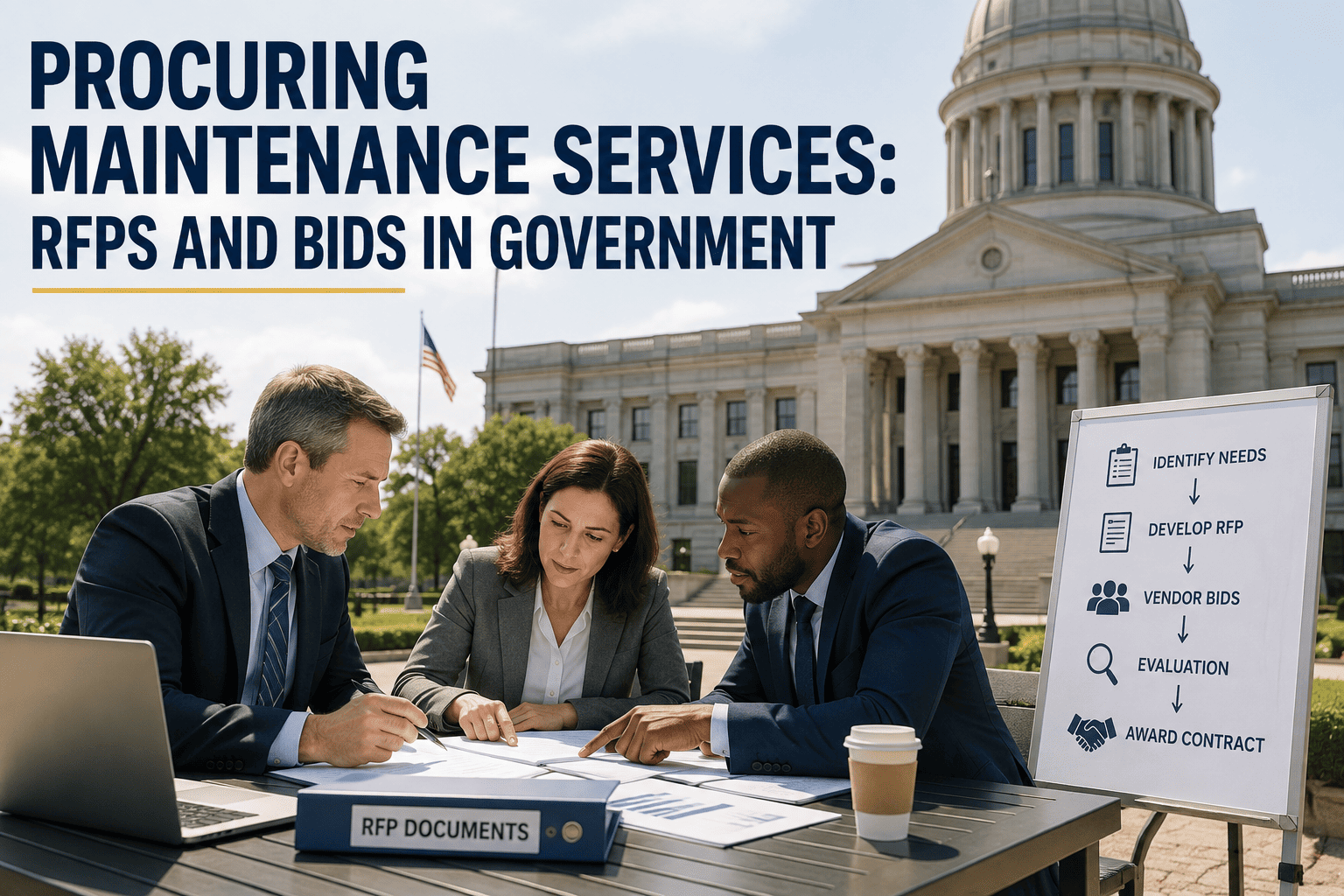
Government procurement of maintenance services — from HVAC and elevator upkeep to fleet, grounds, and public works equipment — hinges on the quality of your Request for Proposal (RFP). A well-structured maintenance services RFP not only attracts qualified vendors but also ensures competitive pricing, clear service-level agreements (SLAs), and long-term value for taxpayers. Municipal procurement maintenance teams that invest in rigorous RFP design consistently report 20–30% lower lifecycle service costs and fewer emergency repair overruns. If your agency is still managing bid evaluations and post-award compliance on spreadsheets, it is time to modernize — you can Start Free Trial with OxMaint or book a walkthrough to see how AI-powered CMMS bridges the gap between procurement and execution.
Is your maintenance services RFP buying value — or just the lowest bid?
Public sector RFPs that reward only price typically deliver 15–25% higher emergency repair costs over a five-year contract. Structure your government maintenance bid to score vendor capability, compliance, and predictive uptime — not just the cheapest hourly rate.
How to structure a government RFP for maintenance services
A robust municipal RFP for maintenance follows a seven-part structure aligned with public procurement standards. Missing any section invites scope ambiguity, bid protests, and contract drift — costing the average mid-sized municipality $28K–$65K annually in change orders.
Scope of Work (SOW) & Asset Register
List every asset under contract — equipment IDs, locations, manufacturers, model numbers, and current condition scores. Vendors cannot price accurately without an exhaustive asset register. Tie the SOW to ISO 55000 asset management principles.
Service-Level Agreements (SLAs) & KPIs
Define response times (e.g., critical downtime: 2 hours), resolution times, MTTR targets, and PM completion rates. Include financial penalties for missing SLAs and bonuses for exceeding OEE targets by measurable margins.
Compliance & Certifications
Specify required licenses, OSHA safety records, FMCSA compliance (for fleet), insurance minimums, and background-check requirements. Require vendors to submit 3 years of safety incident data (TRIR scores).
Pricing Structure & Cost Transparency
Move beyond flat hourly rates. Require breakouts for labor tiers, overtime multipliers, trip charges, consumables, and emergency call-out fees. Request unit pricing for the top 20 most common repair scenarios.
Technology & Reporting Requirements
Mandate digital work orders, real-time status dashboards, and CMMS integration capabilities. Vendors should provide quarterly maintenance analytics reports — mean time between failures (MTBF), PM compliance %, and asset condition indices.
Transition Plan & Knowledge Transfer
Require a 60–90 day transition plan from the incumbent vendor, including historical maintenance data handover, asset condition audits, and a documented escalation matrix. Knowledge loss during transitions costs agencies 10–15% extra in year-one diagnostics.
Evaluation Criteria & Scoring Methodology
Publish the scoring matrix in the RFP itself. Transparency reduces bid protests and signals to vendors that technical merit carries real weight — not just bottom-line cost.
Best evaluation criteria for public works maintenance bids
The most common failure in government maintenance procurement is over-weighting price. Public works procurement leaders using a weighted-scoring model allocate cost at 30–35% of total points, reserving the majority for capability, track record, and technology readiness.
A 180-asset municipal facility using this model reduced year-one maintenance spend by $42,000 and cut unplanned downtime by 28% versus the prior low-bid contract — because the winning vendor's predictive maintenance capabilities outweighed a 6% price premium.
| Evaluation Category | Weight | What to Score | Red Flags |
|---|---|---|---|
| Technical Approach | 40% | PM strategy, root-cause analysis methodology, staffing plan, response time commitments | Generic boilerplate SOW, no asset-specific plan |
| Past Performance | 20% | 3–5 references of similar size/scope, TRIR safety scores, contract renewal rate | High turnover, terminated contracts, TRIR above industry average |
| Price | 30% | Blended hourly rate, emergency call-out fees, consumables markup, total 3-year projected cost | Unrealistically low bid (30%+ below median), hidden trip charges |
| Technology Readiness | 10% | CMMS capability, mobile work orders, API integration, analytics reporting cadence | Paper-based reporting, no asset-level data sharing, no predictive maintenance |
Lowest-bid vs. best-value maintenance procurement
Government agencies that switch from lowest-bid to best-value RFPs see a dramatic shift in maintenance outcomes. The lowest-bid model creates a race to the bottom — vendors under-staff, defer preventive maintenance, and recoup margin on emergency markups.
How OxMaint helps government teams manage maintenance contracts
Procuring the right vendor is only half the battle — you must enforce the contract. OxMaint gives public sector procurement and facilities teams an AI-powered CMMS to track SLA compliance, verify vendor work orders, and prove value to oversight boards with real-time analytics.
SLA Compliance Tracking
Automatically timestamp every vendor work order from creation to closure. Flag SLA breaches in real time and generate penalty reports for contract administrators — no manual spreadsheet reconciliation.
Outcome: Eliminate 100% of manual SLA audit hoursMaintenance Analytics & KPI Dashboards
Track MTBF, MTTR, PM compliance %, and asset condition indices on live dashboards. Export quarterly reports for city council or oversight committee meetings in one click.
Outcome: Cut reporting time from 2 weeks to 10 minutesPredictive Maintenance Engine
AI models analyze asset history and sensor data to predict failures 7–21 days before they happen. Shift your vendors from reactive call-outs to planned interventions — and hold them accountable for predictive KPIs.
Outcome: Reduce unplanned downtime 30–50%Centralized Asset & Inventory Registry
Give every bidder the same single source of truth for asset data, spare-parts inventory, and maintenance history. Eliminate scope disputes and ensure vendors price accurately during the RFP phase.
Outcome: Reduce scope-change orders by 35–45%See how OxMaint enforces your next maintenance contract
Book a 30-minute demo and we will map your RFP evaluation criteria, SLA tracking, and vendor reporting to a live OxMaint workspace configured for your agency's assets.
Government maintenance RFP FAQs
What should be included in a government maintenance services RFP?
A complete public sector RFP for maintenance services includes a detailed scope of work with a full asset register, measurable SLAs with penalty clauses, required certifications and insurance, a transparent pricing structure (not just hourly rates), technology and reporting requirements, a vendor transition plan, and a published evaluation scoring matrix. Omitting the scoring methodology is the most common cause of bid protests. You can standardize this process by centralizing asset data in a CMMS like OxMaint — Start Free Trial to export a clean asset register for your next RFP.
How is price weighted in a municipal maintenance RFP?
Best practice in municipal procurement for maintenance is to weight price at 25–35% of the total score, with the remaining 65–75% allocated to technical approach (35–45%), past performance (15–25%), and technology readiness (5–10%). Over-weighting price above 50% correlates with higher emergency repair costs, lower PM compliance, and shorter vendor tenure — typically costing 15–25% more over a five-year contract lifecycle.
How long does the government maintenance procurement process take?
From RFP issuance to contract award, a typical government maintenance bid takes 60–120 days: 2–3 weeks for vendor questions, 4–6 weeks for proposal preparation, 3–4 weeks for evaluation and scoring, and 2–4 weeks for negotiations and board approval. Federal or state-funded projects may add 30–60 days for additional compliance reviews. Build this timeline into your incumbent transition plan to avoid service gaps.
Can we require vendors to use a specific CMMS in the RFP?
Yes. Government RFPs for maintenance services can mandate that vendors use the agency's designated CMMS for all work orders, asset updates, and reporting. This ensures data continuity across contract transitions and eliminates vendor lock-in on proprietary platforms. Specify API integration requirements, mobile work-order submission, and reporting cadence in the technology section of your RFP — then enforce it with real-time dashboards.
How do you prevent bid protests in public maintenance procurement?
The three most effective protest-prevention strategies are: publish the evaluation scoring matrix in the RFP itself, use a diverse evaluation committee of 3–5 scorers with documented rationale per category, and debrief unsuccessful bidders with category-level scores (not narratives). Transparency reduces protest rates by an estimated 70–80% and signals to quality vendors that technical merit genuinely matters. Book a demo to see how OxMaint's audit trail supports transparent vendor evaluations — Book a Demo.
Stop managing maintenance contracts on spreadsheets
Give your procurement team the CMMS that enforces SLAs, tracks vendor performance, and proves value to oversight boards — all in one AI-powered platform built for government and public works teams.
Free 14-day trial · No credit card