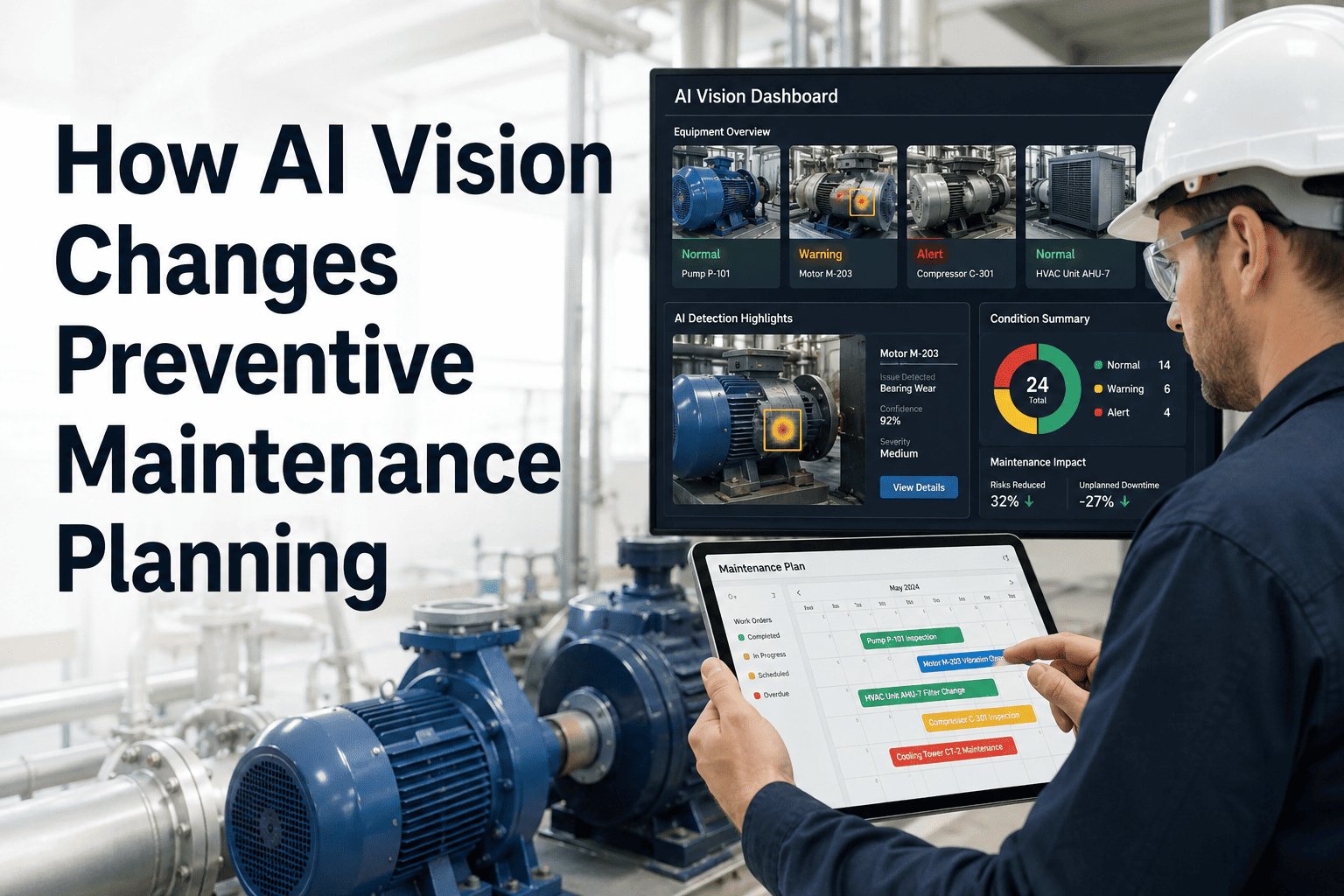
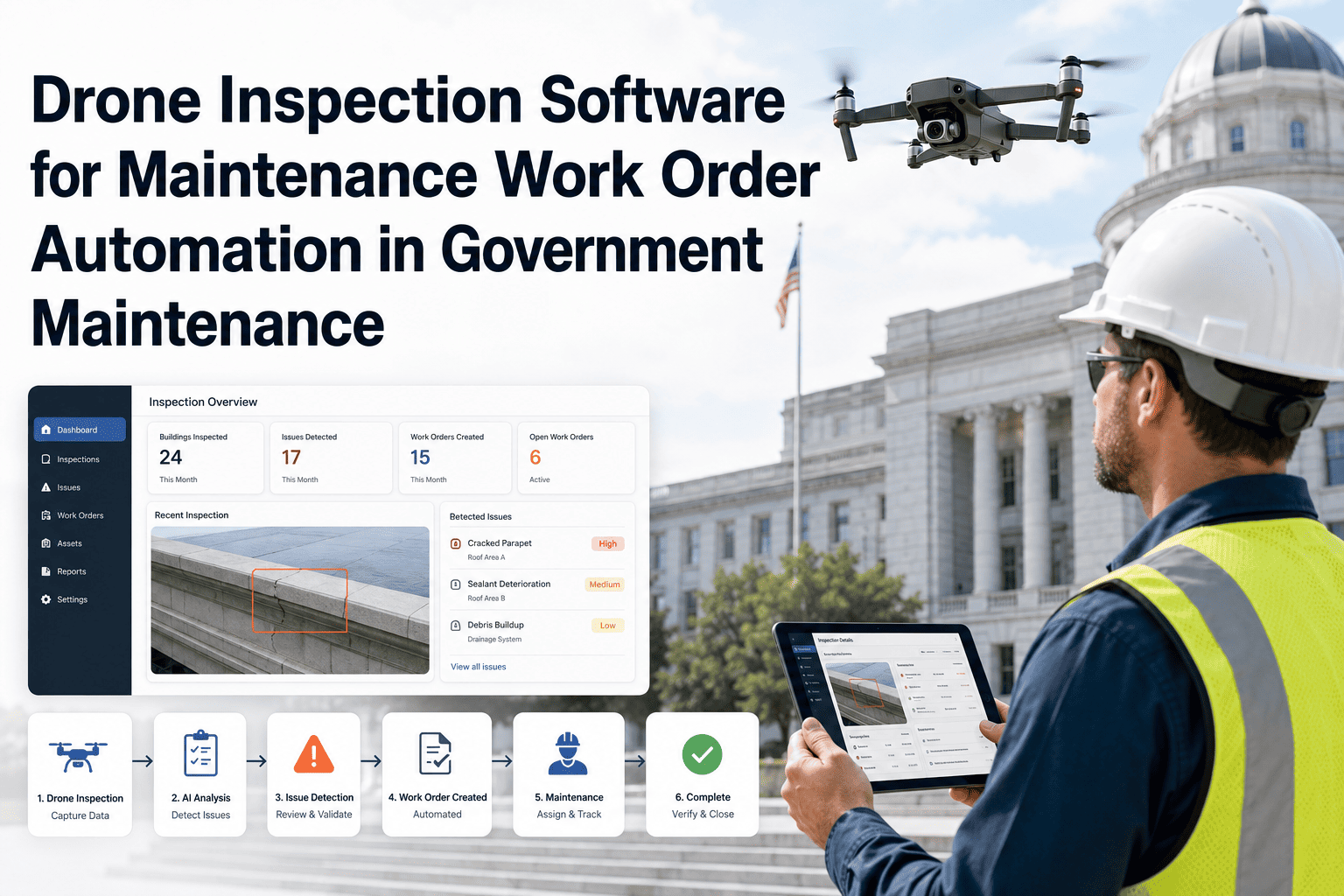
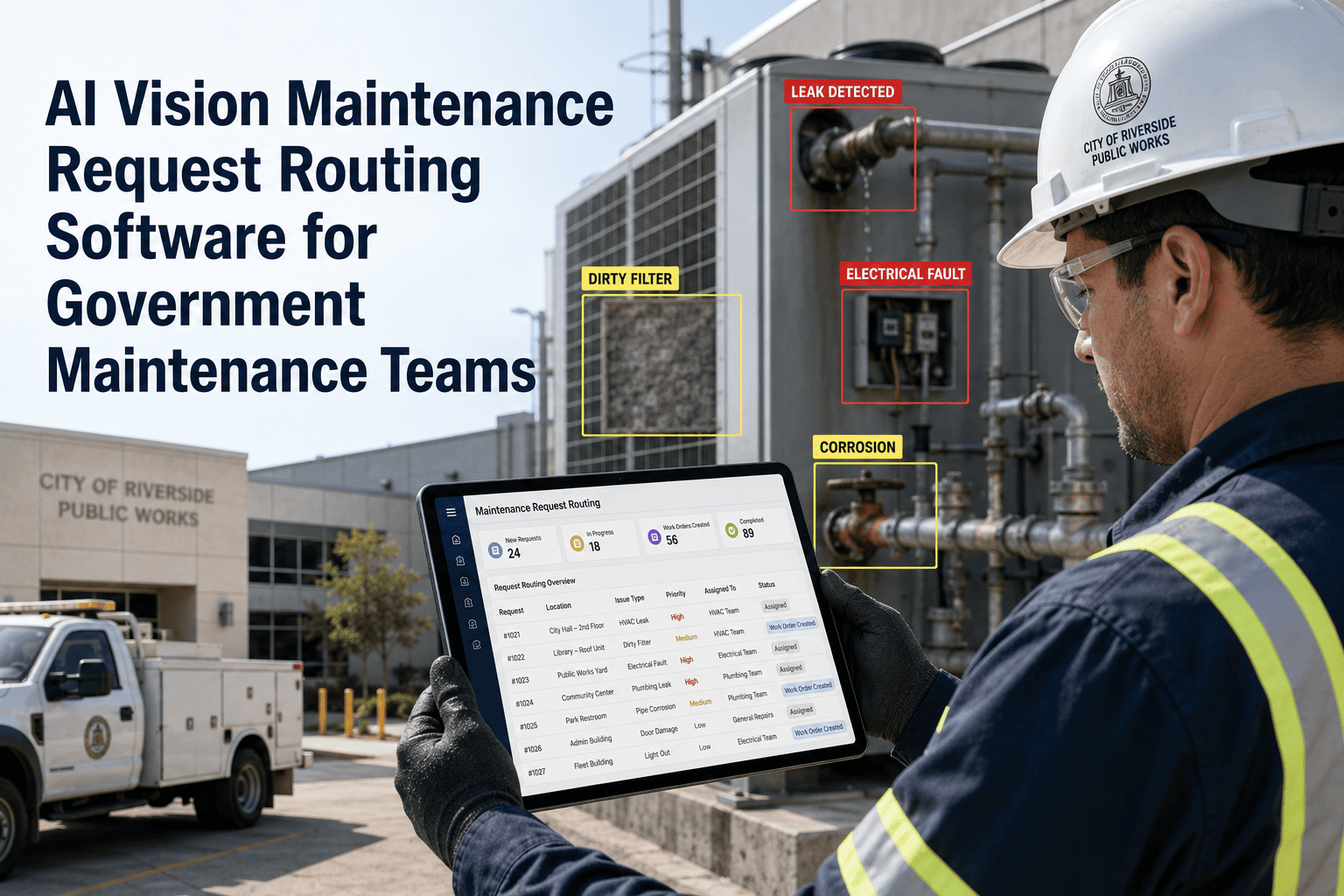
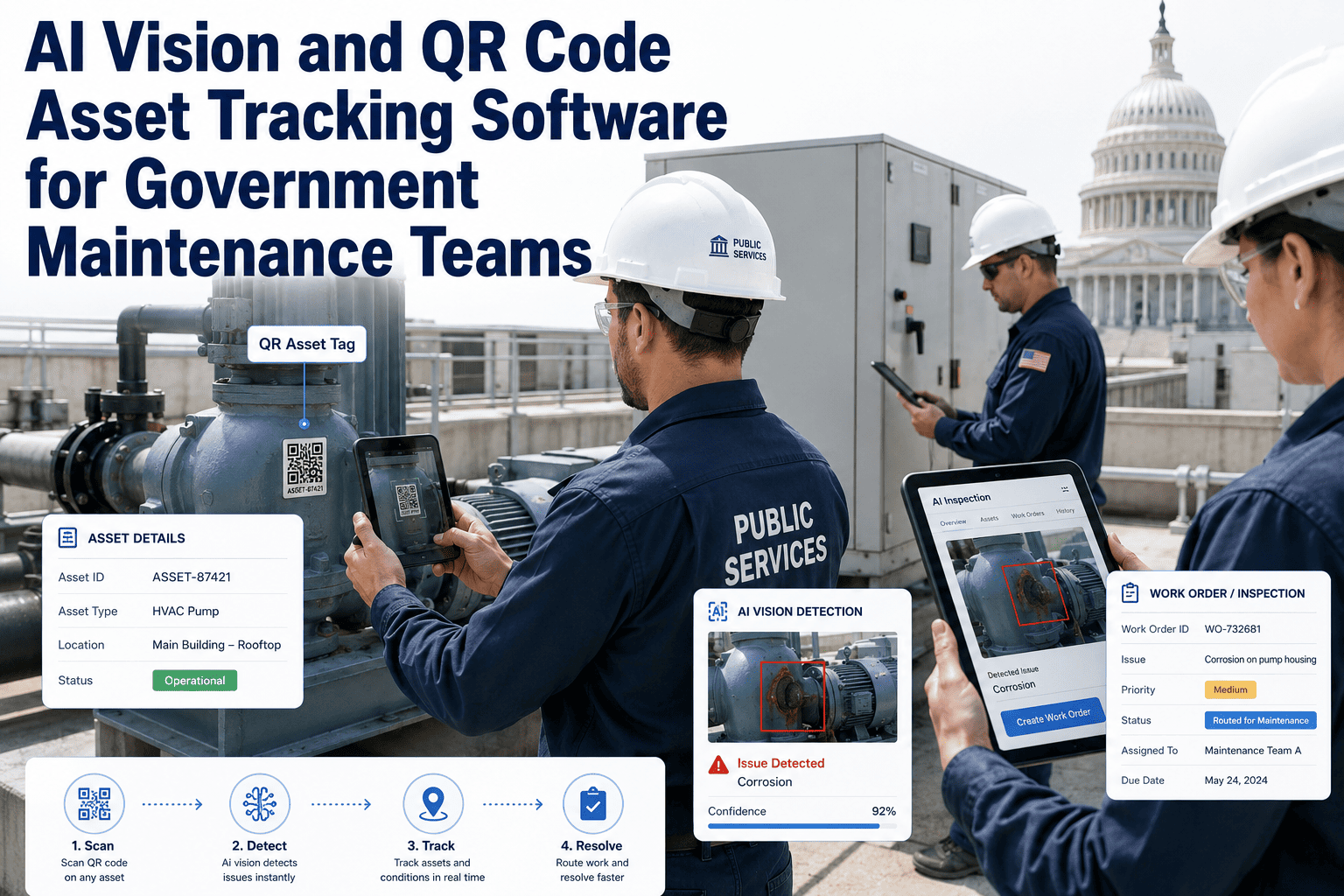
Preventive maintenance planning has always been a balancing act between doing too much maintenance too early and doing too little too late. For government maintenance teams managing public works assets — roads, utilities, fleets, and facilities — that balance has traditionally been set by calendar schedules and manufacturer recommendations, not by what the asset is actually doing. AI vision changes that equation fundamentally. Cameras mounted at critical points on equipment, structures, and infrastructure send a continuous stream of visual data that, when properly analyzed and connected to your CMMS, shifts the basis of every PM decision from time-elapsed to condition-observed. Book a 30-minute demo with OxMaint to see how condition-based PM planning works in a live government maintenance environment, or start your free trial and connect your first camera feed today.
AI Vision · Preventive Maintenance · Government Public Works
How AI Vision Shifts Preventive Maintenance from Calendar to Condition
Government maintenance teams have run on fixed PM schedules for decades. AI vision cameras introduce real-time condition data that makes those schedules smarter — and more defensible when audit season arrives.
Traditional PM Planning
Inspect every 30 days regardless of asset condition
Replace parts on fixed intervals — some too early, some too late
Maintenance history lives in paper logs or siloed spreadsheets
Reactive work orders dominate when schedules miss actual degradation
Result: 30–40% of PM tasks unnecessary · 15–20% of failures still unplanned
AI Vision-Informed PM Planning
Inspect when visual condition data signals early degradation
Replace parts when wear patterns cross defined thresholds
Camera images auto-attached to asset history in CMMS at every inspection
Proactive work orders generated before failure — based on what the camera sees
Result: PM tasks aligned to actual need · Unplanned failures reduced by up to 45%
Where AI Vision Adds the Most Value in Government PM Planning
Five Infrastructure Categories That Change With Visual Condition Data
01
Water and Wastewater Infrastructure
Pump housings, pipe joints, and clarifier mechanisms show visual signs of corrosion, leakage, and mechanical wear weeks before failure. AI cameras mounted at key points feed visual inspection data into your CMMS, replacing monthly manual walk-rounds with continuous monitoring.
PM interval reduction: 40% · Unplanned failures: down 52%
02
Road and Bridge Infrastructure
Surface cracking, joint deterioration, and structural deflection patterns are visible changes that cameras can track over time. Instead of scheduling inspections by calendar, bridge and road maintenance teams can prioritize inspection resources to assets showing active visual deterioration.
Inspection efficiency: 3x improvement · Emergency repairs: reduced by 38%
03
Public Buildings and Facilities
HVAC mechanical rooms, electrical switchgear bays, and rooftop equipment benefit from visual monitoring of thermal patterns, fluid accumulation, and mechanical component position. AI vision flags anomalies that fixed sensors miss because they are not in the right location.
Energy-related failures: down 29% · HVAC PM accuracy: up 44%
04
Fleet and Heavy Equipment
Depot cameras and on-vehicle cameras track fluid leaks, tyre condition, body damage, and loading equipment wear. PM plans shift from mileage-only triggers to condition-plus-mileage triggers — catching heavy-use vehicles before they fail in the field.
Roadside breakdowns: reduced 47% · Fleet availability: up 19%
05
Electrical and Street Lighting
Camera-based luminosity monitoring and pole condition tracking eliminate the need for physical patrol routes for lighting maintenance. Anomalies trigger work orders automatically, and historical images document the progression from first detection to repair for audit purposes.
Patrol labour cost: down 33% · Mean time to repair: reduced 55%
Data Comparison
Calendar-Based vs AI Vision-Informed PM: Government Fleet Benchmark
| PM Metric |
Calendar-Based Schedule |
AI Vision-Informed Schedule |
Improvement |
| Unnecessary PM tasks per quarter |
34% of all tasks |
9% of all tasks |
74% reduction |
| Unplanned failure rate |
18 per 100 assets/year |
8 per 100 assets/year |
56% reduction |
| Mean time between maintenance events |
30 days (fixed) |
44 days (condition-triggered) |
47% longer cycles |
| Audit documentation completeness |
62% of records complete |
97% of records complete |
56% improvement |
| PM labour cost per asset per year |
$840 average |
$510 average |
39% lower cost |
Source: Municipal maintenance programme benchmarks, 2023–2024. Data aggregated from 14 government maintenance teams across water, roads, and facilities sectors.
Implementation Roadmap
How Government Teams Shift to AI Vision-Informed PM in Four Phases
Phase 1
Asset Prioritization and Camera Placement
Identify the top 20% of assets by failure consequence and install cameras at points that capture meaningful visual condition data. Do not attempt to cover everything at once. Focus first on assets where visual condition data changes PM decisions.
Timeline: 4–8 weeks
Phase 2
CMMS Integration and Alert Configuration
Connect camera alerts to asset records in your CMMS. Configure alert thresholds that trigger PM work orders — not reactive repairs. Map each camera to the specific asset it monitors and set the condition flags that move that asset up the PM queue.
Timeline: 2–4 weeks
Phase 3
PM Schedule Adjustment and Technician Training
Replace fixed calendar triggers with condition-range triggers in your CMMS PM schedule. Technicians need to understand that not seeing a work order for a monitored asset is confirmation of good condition, not a system gap. Training on interpreting visual condition alerts is essential.
Timeline: 3–6 weeks
Phase 4
Performance Review and PM Interval Refinement
After 6–12 months, compare actual condition data against PM triggers to refine thresholds. Assets that consistently show good condition when a PM is triggered may warrant longer intervals. Assets showing consistent early degradation may need shorter cycles or more camera coverage points.
Timeline: Ongoing — quarterly reviews
OxMaint · AI Vision CMMS for Government Teams
Shift Your PM Planning from Fixed Schedules to Real Condition Data
OxMaint connects AI vision camera feeds to your asset PM schedules, automatically adjusting work order triggers based on what cameras see — not just what the calendar says. Built for public-sector maintenance teams managing complex multi-site asset portfolios.
Expert Review
What Maintenance Planning Professionals Say About AI Vision in Government PM
The shift from calendar PM to condition-triggered PM is the most significant change in public-sector maintenance management in 20 years. AI vision is the enabling technology — but it only delivers value if the camera data actually feeds into work order generation. Teams that install cameras without integrating them into their CMMS are essentially paying for a security system, not a maintenance tool.
Senior Asset Manager, Regional Infrastructure Authority · 22 years in public works maintenance
We reduced our preventive maintenance budget by 28% in year one after connecting AI vision to our CMMS PM schedules. The savings came entirely from eliminating inspections that the camera data confirmed were unnecessary — assets in good condition, documented visually, with no work order triggered. That visual record also satisfied our audit requirements without a single additional report.
Director of Facilities and Fleet, Municipal Government · 14 years managing public asset maintenance
Frequently Asked Questions
AI Vision and Government Preventive Maintenance Planning
How does AI vision camera data actually change a PM work order in the CMMS?
When a camera detects a defined visual condition — fluid accumulation, surface cracking, abnormal equipment position, or heat signature — it sends an alert to the CMMS with the asset identifier. The CMMS reads that alert, checks the asset's current PM schedule status, and either advances the next scheduled inspection or creates a condition-triggered work order. The result is a PM event grounded in what the asset looks like right now, not what a spreadsheet says should happen this month.
Book a demo to see this workflow live in OxMaint.
Do we need to replace our existing PM schedules entirely when we adopt AI vision?
No — and you should not. AI vision adds a condition-monitoring layer on top of your existing PM programme, not a replacement. Some assets may not be monitored by cameras at all, and those continue on their existing calendar schedule. For monitored assets, the calendar schedule becomes a maximum interval backstop: the camera can trigger an earlier inspection, but no asset goes longer than the calendar maximum without a PM regardless of what the camera shows. This hybrid approach is the standard implementation path for government teams.
Start your OxMaint trial to configure hybrid schedule rules for your asset fleet.
How do we justify condition-based PM intervals to auditors and regulators?
Condition-based PM is generally more defensible to auditors than calendar-based PM because it is grounded in documented evidence rather than arbitrary time intervals. When a CMMS stores camera images linked to each PM decision — showing the asset condition that triggered or delayed the work order — auditors can trace every maintenance decision to a specific visual record. Most government audit frameworks accept condition-based evidence as equivalent to or better than calendar compliance, provided the evidence is stored systematically and the decision rules are documented. OxMaint automatically links camera images to work order records to support this audit trail.
What types of AI vision cameras work best for government preventive maintenance applications?
For most government maintenance applications, the camera type matters less than the integration capability and the specificity of the detection model. Fixed IP cameras with onboard analytics are the most practical for infrastructure monitoring — they operate continuously without requiring a technician to point them. Pan-tilt-zoom cameras are useful at large sites where a single camera needs to cover multiple inspection points. Thermal cameras add value in electrical and mechanical applications where heat signatures indicate degradation before any visible change appears.
Our team can advise on camera selection for your specific asset types.
OxMaint · Preventive Maintenance for Government
Your PM Schedules Should Reflect Asset Condition, Not Just Asset Age
OxMaint brings AI vision data directly into your preventive maintenance planning — adjusting inspection frequency, advancing work orders on early condition signals, and building the visual audit trail your compliance programme requires. Purpose-built for public-sector maintenance teams.