A public works work order that reads "fixed broken light" is functionally indistinguishable from one that reads "did not fix broken light" by the time a Freedom of Information Act request arrives, a contractor dispute escalates, or a Government Accountability Office audit team asks for evidence. The 2024 revision of Government Auditing Standards (GAGAS, the "Yellow Book"), effective December 15, 2025, materially raised the bar on documentation defensibility for government audit organizations. Across the public works domain, 70% of construction-related disputes are attributed to inadequate documentation (FMI Corporation industry research) — and quality-control failures cost the US construction sector $31.3B annually. Camera evidence does not improve maintenance work itself; it improves the WORK ORDER RECORD that proves the work happened, captures what was found, and creates the audit-grade trail that survives years of downstream scrutiny. Oxmaint's AI-vision work-order system structures every photo with timestamp, GPS, technician ID, AI-extracted defect classification, and direct work-order linkage — turning a phone-camera snapshot into a defensible municipal record.
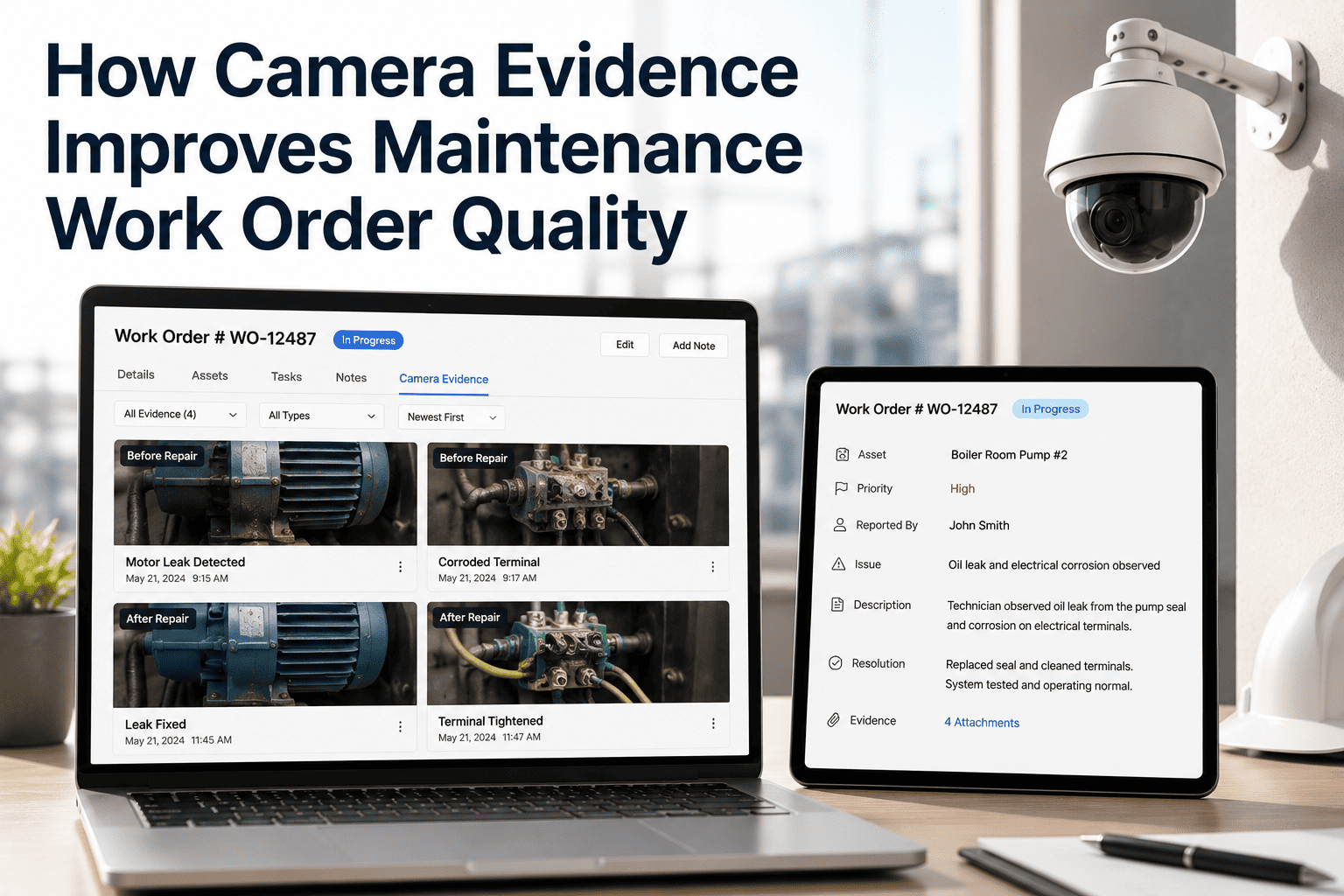
How Camera Evidence Improves Maintenance Work Order Quality
Two technicians can perform the same repair on the same streetlight on the same day. The difference between a 3/10 work order record and a 9/10 work order record is not the labor or the part — it is what the camera captured and what the AI vision system extracted from that capture.
The Six Dimensions of Work Order Record Quality
Work order "quality" is not a single attribute — it is a measurable performance across six distinct dimensions, each of which fails or succeeds independently. Camera evidence and AI vision systematically elevate every dimension, but the lift is most dramatic on Defensibility, Auditability, and Traceability — the three dimensions that protect the agency in dispute or audit. Photo evidence and work order quality in public works measures every record against this six-axis model.
The Three-Tier Evidence Ladder — From Snapshot to Audit-Grade Record
Not all photo evidence is created equal. The transition from a phone-camera snapshot to an audit-grade work order attachment moves through three distinct tiers — each adding metadata, structure, and downstream utility. AI vision annotation for maintenance records defines the lift between Tier 2 and Tier 3.
The Anatomy of a High-Quality Maintenance Photo
A photo on its own is not evidence. The evidence is in the metadata surrounding the photo — the structured information that links the image to a specific work order, a specific asset, a specific moment, a specific technician, and a specific defect. Work-order photo metadata for government CMMS captures every dimension below on every image.
A Photo Without Metadata Is a Memory. A Photo With Metadata Is Evidence.
OxMaint stamps every maintenance photo with the structured metadata fields government audit organizations expect under GAGAS — automatically, on capture, without changing how technicians work in the field.
The Downstream Use Cascade — One Photo, Five Records
A maintenance photo is captured once at the work order's completion. From there, that single image flows through five distinct downstream use cases — each materially improving an operational or compliance outcome for the municipality. The economics of camera evidence depend less on the moment of capture and more on the cascade of uses that follow.
The Quality Scoring Rubric — How Auditors Actually Score Records
Internal audit teams and external Yellow Book auditors do not evaluate work orders against a vague "good record" standard. They apply a scoring rubric to a sample of records and report findings. The rubric below is a synthesised version of what most public-sector audit organisations apply during a deferred-maintenance or asset-management review under GAGAS 2024 Revision conditions.
The Economics — What a Camera-Evidence Program Returns on Public Spend
Camera-evidence ROI in a government maintenance context concentrates in three places: avoided disputes, reduced audit-preparation time, and faster downstream operations. The numbers below use municipal benchmarks against a mid-size public works department managing ~12,000 maintainable assets.
The KPIs a Public Works Director Tracks on a Camera-Evidence Program
Once camera evidence is standard, the KPIs shift from "did the work happen" to "what is the quality of the record." These six metrics surface whether the program is functioning as designed — or quietly drifting back to a text-only baseline.
Photo Attachment Rate
Percentage of closed work orders with at least one attached photo. Below 80% signals technician adoption gap or mobile capture friction. Strong programs require a photo to close certain work order categories.
AI Classification Coverage
Percentage of attached photos that received AI-vision defect classification. Below threshold indicates either photo-quality issues, model coverage gaps, or unmapped asset types — each addressable.
GPS Verification Rate
Percentage of photos with GPS coordinates within tolerance of the recorded asset location. Mismatches surface either incorrect asset assignment or location-falsification risk — both findable in the data.
Before / After Pairing Rate
Percentage of repair work orders with both a "before" and an "after" photo captured. Strongest dispute-protection metric; targets vary by work category (higher for capital, lower for routine).
Evidence Retrieval Time
Median time from records-request or audit query to producing the full evidence pack for a specific asset or WO. Above 30 minutes erodes the operational lift the camera-evidence program is supposed to deliver.
Disputed Closures Reopened
Number of work orders reopened due to contractor dispute or follow-up complaint after closure. The metric that proves the camera evidence is doing the defensibility work the program was built for.
Expert Review — A Director of Public Works Perspective
I have run public works maintenance for two municipalities over the past 14 years, and the single largest change in record quality came not from any process improvement or training initiative — it came from requiring a photo to close a work order. The text-only era produced records that satisfied no one downstream: the council asked questions we could not answer, the contractor disputes were a coin-flip on which side had better documentation, and the auditors filed findings every cycle on the same root cause. Once photos were standard, the next step was metadata — making sure those photos had GPS, timestamps, technician identification, and asset linkage. Once metadata was standard, the next step was AI vision — letting the system classify the defect, search across the photo library, and surface patterns no human reviewer could find at scale. Each layer is incremental. None of them require the technician to do meaningfully more work in the field. But the downstream lift — at the auditor's desk, at the council meeting, in the dispute hearing — is not incremental. It is the difference between an agency that can prove what it did and one that can only assert it. Under the 2024 Yellow Book revision, that distinction is no longer a nice-to-have. It is the standard.
Frequently Asked Questions
How does AI-vision photo classification work without making technicians do more in the field?
The classification happens asynchronously, after the technician captures the photo. When a public-works technician takes a photo from the mobile app, the image uploads with its standard metadata (GPS, timestamp, technician ID, asset link). The AI vision model runs inference in the cloud — typically completing classification within 30–90 seconds — and writes the defect tags, severity score, and detected objects back to the work order record. The technician sees nothing different. The supervisor and the auditor see a fully annotated photo on the record. Book a demo to walk through the technician workflow vs the supervisor workflow.
What happens to camera evidence under a FOIA or public records request?
Public records laws vary by state, but most US municipal jurisdictions treat maintenance work-order photos as public records unless they fall under a specific exemption (sensitive infrastructure, security-related assets, ongoing litigation). OxMaint's records-request workflow allows the agency to filter, redact, and export a complete evidence pack — photos, metadata, audit trail — without manually digging through device storage. Records requests that previously consumed days of staff time are typically completed in under an hour with a properly indexed photo library. Visual evidence audit trail for municipal maintenance is the workflow underneath this capability.
Does the system handle photo evidence when technicians work in areas with no cellular connectivity?
Yes. The OxMaint mobile app captures photos and metadata fully offline — including GPS coordinates, timestamp, technician identity, and asset link via QR scan. The image and metadata are stored locally on the device and sync automatically when connectivity is restored. AI vision classification runs once the upload reaches the cloud, but the work order can be closed in the field regardless of connectivity. This matters for rural infrastructure, bridges, water utilities, and any government maintenance work in low-coverage areas. Start free to test the offline workflow.
Can the camera evidence integrate with our existing GIS or asset management system?
Yes. OxMaint integrates with Esri ArcGIS, Cityworks, Maximo, and most municipal asset management systems via standard REST APIs and a bidirectional sync layer. Photo evidence flows back to the GIS layer keyed by asset ID, which means the camera record is visible on the spatial map alongside the asset's other attributes. Government IT teams typically validate the integration in 2–4 weeks; the photo evidence becomes a queryable layer in the existing infrastructure data model. Camera evidence in contractor dispute resolution integrates with contract management systems as well.
How long does it take a public works department to move from text-only work orders to AI-annotated camera evidence?
A municipal public works department with ~150 technicians and ~22,000 annual work orders typically reaches full deployment in 8–12 weeks. Weeks 1–3: asset registry alignment with GIS, QR tagging on critical infrastructure. Weeks 4–6: mobile app rollout to crews, photo-capture workflows established, parallel paper records still accepted. Weeks 7–9: AI classification activated, audit trail enabled, supervisor dashboards live. Weeks 10–12: paper records phased out, full digital-evidence operations, photo-attachment KPI hits target. Most departments see the first dispute defended on camera evidence within the first 90 days post-deployment. Book a demo to map the deployment phases for your department.
The Next Audit Cycle Will Score Your Records Whether You Built the Evidence or Not.
OxMaint turns every maintenance work order into a defensible, AI-annotated, audit-grade record — built around how technicians already work in the field, and aligned to the documentation standards your auditors are already applying under the 2024 Yellow Book.