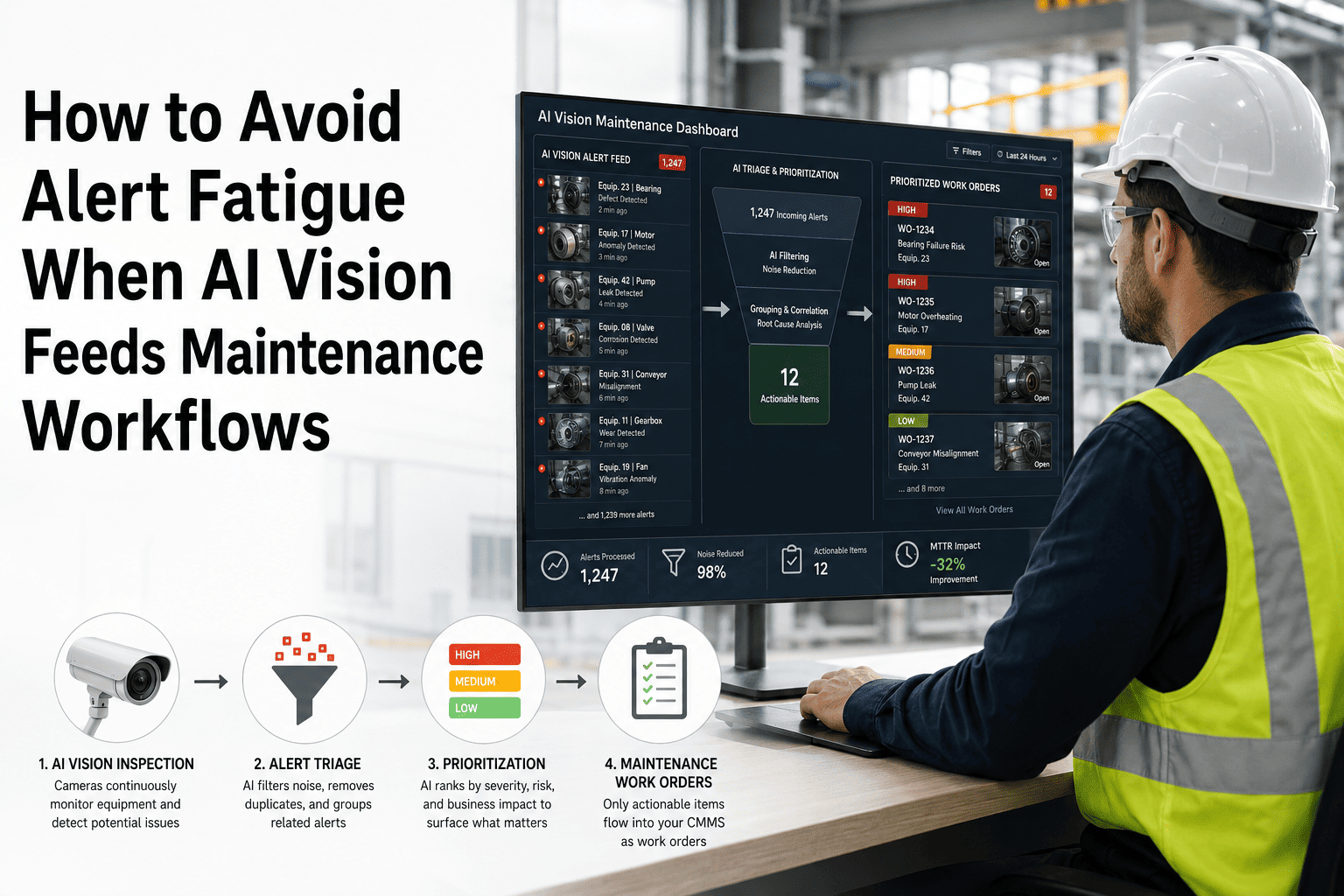
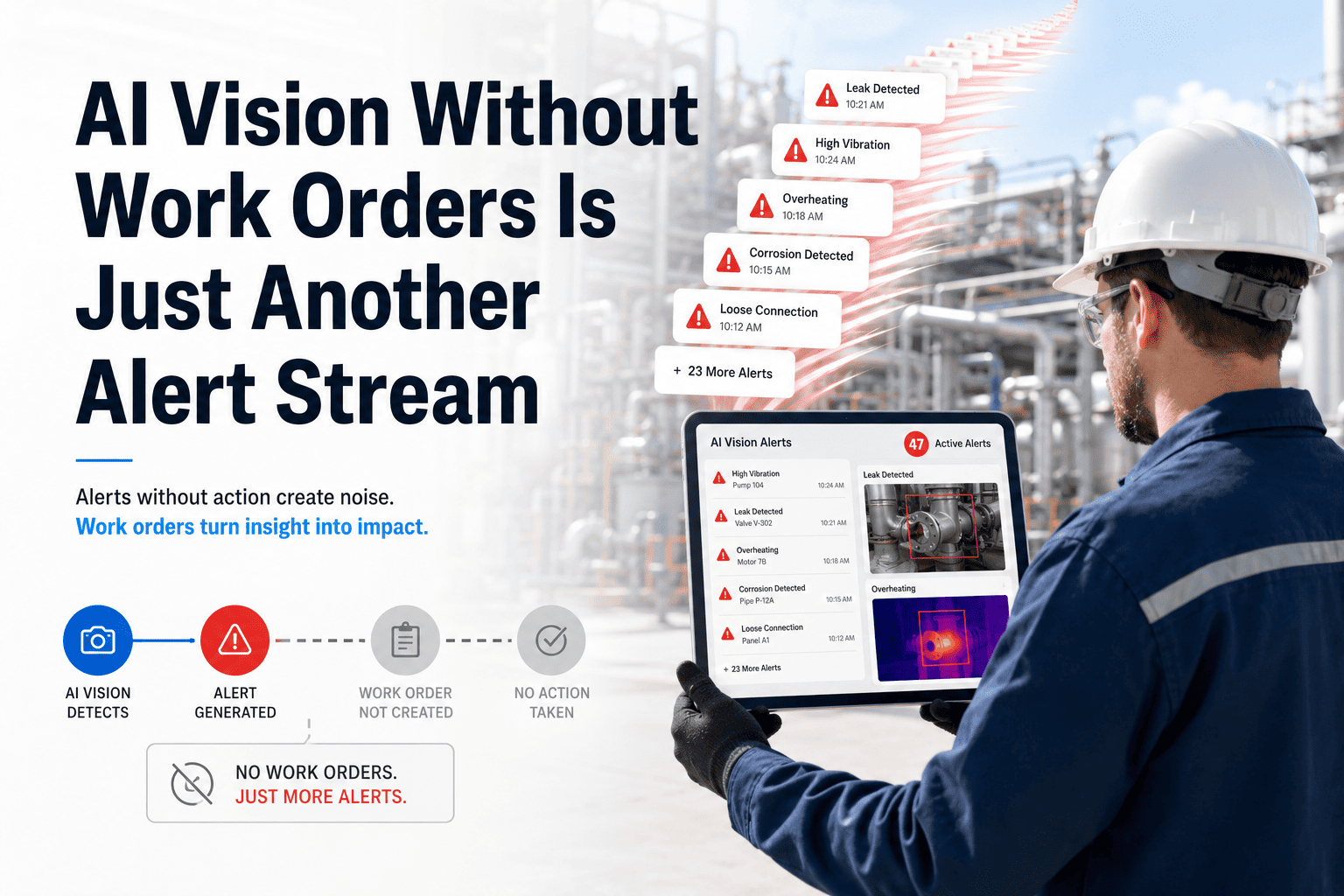
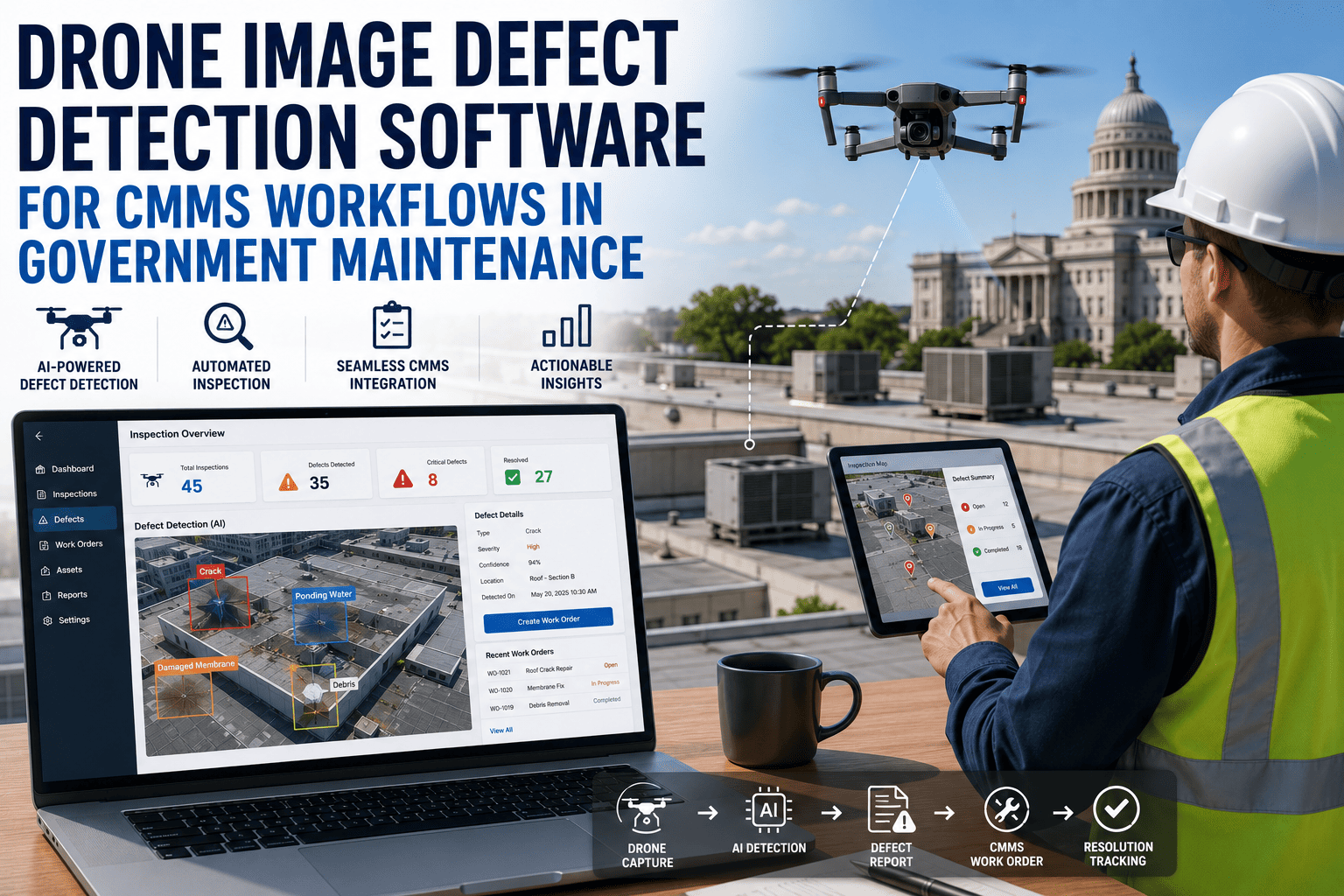
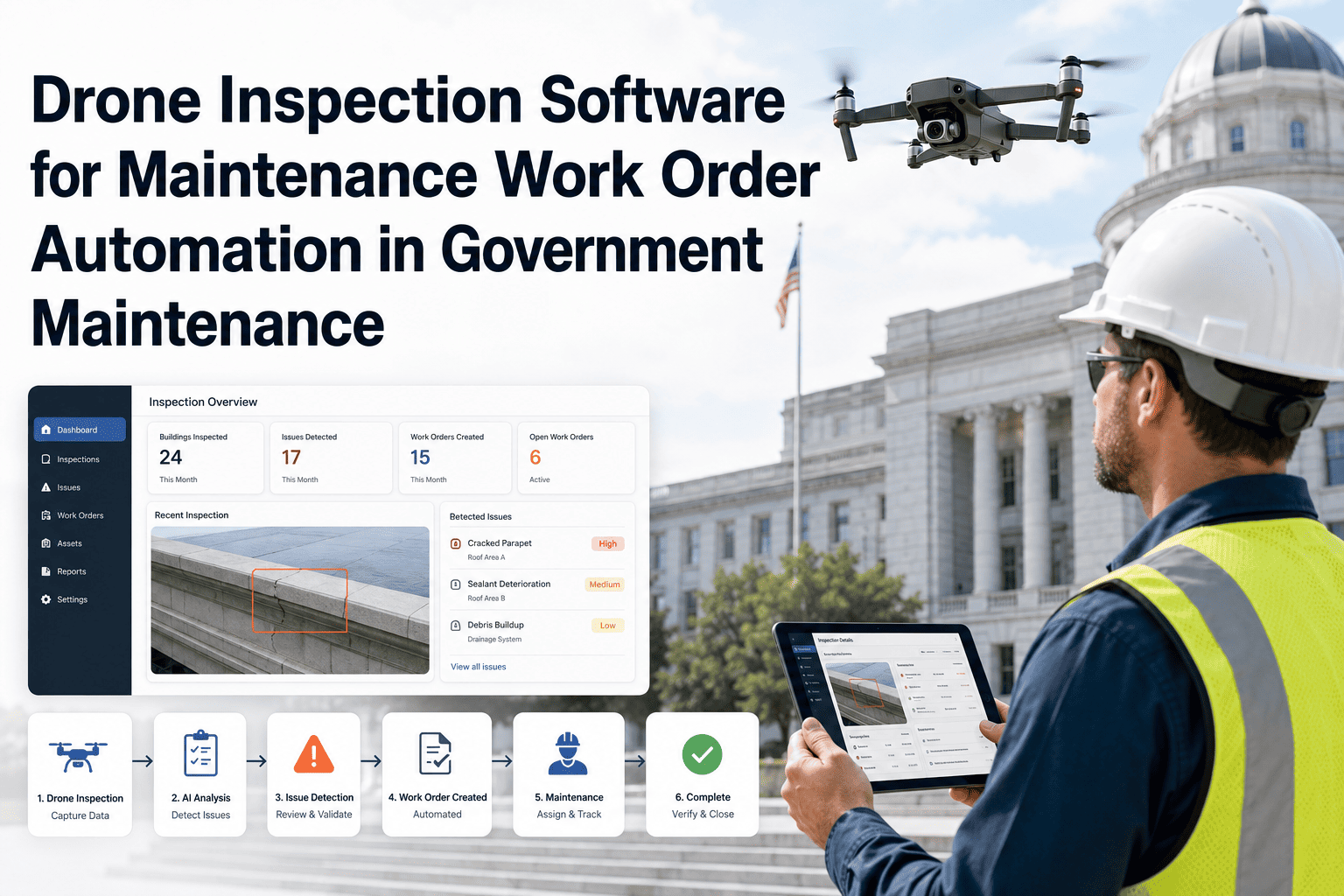
A typical mid-sized US municipality runs 12 to 40 AI-enabled cameras across roads, bridges, water treatment plants, and public facilities — and generates between 200 and 2,000 visual anomaly alerts per week. The uncomfortable truth: in most public works departments, fewer than 8% of those alerts become tracked work orders. The rest sit in dashboards nobody monitors after the deployment week, in inboxes that route to nowhere, in chat channels where the city engineer scrolled past them on a Friday afternoon. Against an ASCE 2025 deferred-maintenance backlog of $105 billion across U.S. roads alone, an alert that never becomes an action is not a productivity gap — it is a public-safety liability. Oxmaint's AI Vision-to-Work-Order automation closes that gap by converting every classified alert into an assigned, tracked, audit-ready work order in your CMMS — with the asset history, technician routing, and resolution evidence a public works director needs to defend the spend. Read on for the architecture, the conversion funnel, and the government-specific use cases that determine whether your AI vision investment pays back in 18 months or sits unread forever — and see how a work order automation system built for the public sector turns visual alerts into accountable maintenance work.
AI Vision · Work Order Automation · Government & Public Works
AI Vision Without Work Orders Is Just Another Alert Stream
Two systems. Same camera. Radically different outcomes. The diptych below is what separates a $200K AI vision pilot that gets shelved from one that pays back in 14 months.
Alert Stream Only
Camera detects pothole
↓
AI classifies severity
↓
Alert appears in dashboard
↓
No assigned owner
↓
Alert ages 7+ days
↓
Citizen 311 complaint forces emergency repair at 4.6× cost
VS
Alert + Work Order System
Camera detects pothole
↓
AI classifies severity
↓
WO-2026-4471 auto-created with photo + GPS
↓
Routed to district 7 paving crew
↓
Resolution logged with before/after photo
↓
Repair closed in 38 hours · Full audit trail · Citizen never had to call
73%
Of public-sector AI vision alerts never trigger documented action without CMMS integration
$105B
U.S. deferred road maintenance backlog (ASCE 2025 Report Card)
4.6×
Emergency repair cost multiplier vs scheduled repair from same alert
14 mo
Typical payback period when AI vision is wired into a CMMS work order engine
The Real Cost: What Happens to an Alert That Never Becomes a Work Order
Public works leaders who have seen an AI vision deployment fail know it rarely fails because the model was wrong. It fails because nothing happens after the model is right. Below is the typical decay path of a correctly-classified alert in a municipality that bought the camera but never connected it to a work order system.
T+0 min
Alert generated
Camera flags a 12-inch pothole on Route 4. Confidence 94%. Alert posts to vendor dashboard with a thumbnail image.
Active attention
T+4 hrs
Alert seen but not acted on
Operations supervisor reviews the alert, decides it can wait until Monday, closes the tab. No record of the decision exists outside their head.
Decision without record
T+1 day
Alert buried under new alerts
37 new alerts have arrived. The original pothole has scrolled off the visible dashboard. No owner. No deadline. No notification.
No accountability
T+1 week
Repeat alert, same camera, same defect
The pothole has grown. New alert posts as if it were a separate event. The system has no memory linking the new detection to the old one. Operations may even count it as a new "find" in their KPI report.
Duplicate detection
T+1 mo
Citizen 311 complaint forces emergency response
A driver reports vehicle damage from the pothole. The complaint generates a higher-priority emergency repair order. Paving crew is pulled off a scheduled project. Cost is 4.6× what it would have been at T+0.
Reactive emergency
T+3 mo
Audit asks "what did the AI system do here?"
An internal audit, a council inquiry, or a tort claim from the citizen who damaged their vehicle asks for the AI vision history on Route 4. The vendor dashboard shows alerts but no actions. There is no defensible record of why no work order was created. The AI investment becomes a liability rather than a defense.
Defensibility lost
From Camera Frame to Closed Work Order: The Six-Stage Integration Pipeline
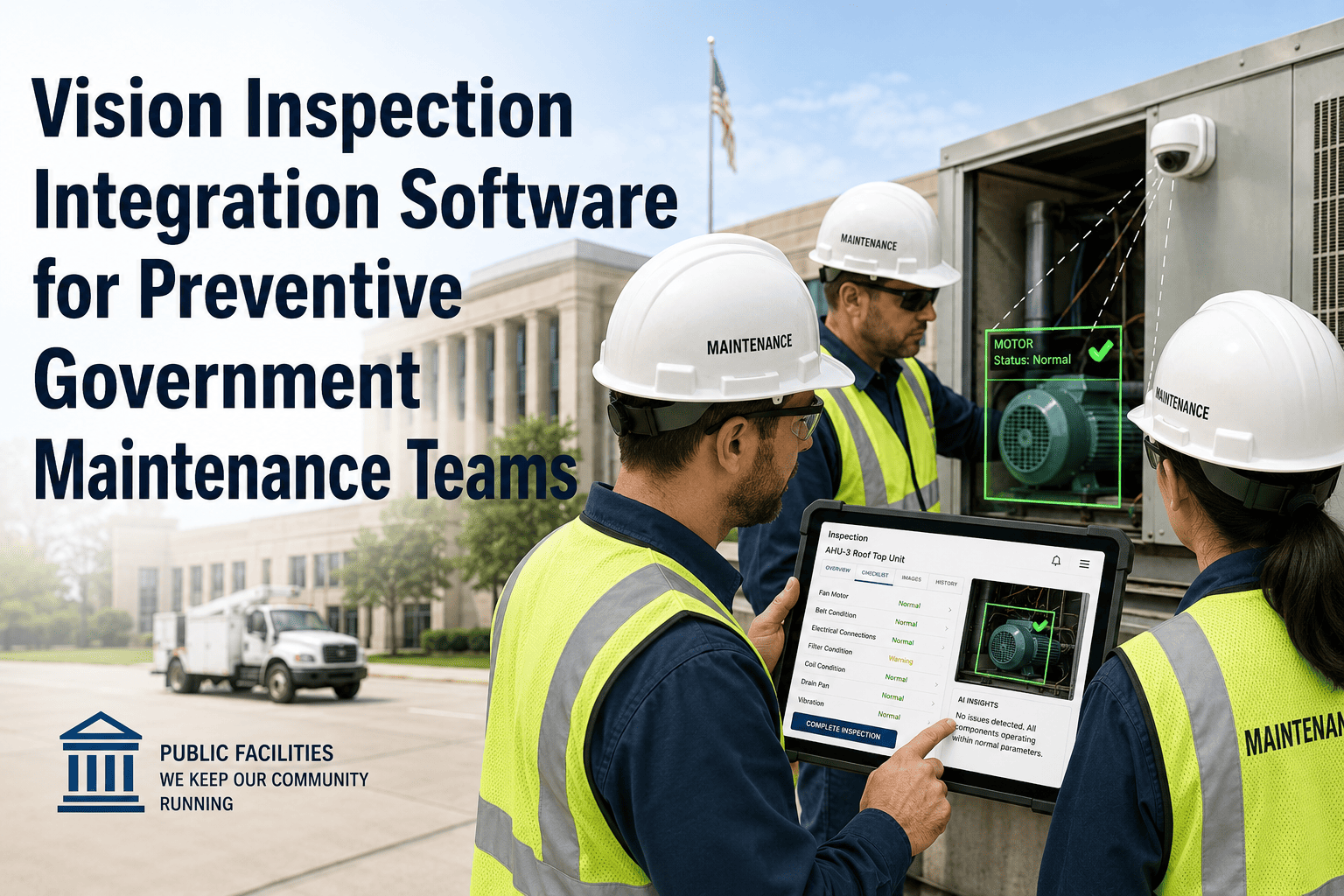
An AI vision system wired correctly into a CMMS does not stop at "detection." It runs a pipeline that ends at "closed work order with audit-ready evidence." Each handoff between stages is automatic, timestamped, and immutable. The architecture below is what AI vision inspection systems for municipal roads look like when they are designed for accountable public works delivery instead of dashboard demos.
01
Frame capture
RTSP/ONVIF stream from existing CCTV, dashcam, or fixed gantry. No specialized hardware required. Edge processing keeps bandwidth low.
→
02
AI classification
Pre-trained model identifies defect type and severity class. Outputs a structured payload: asset ID, defect category, confidence, GPS, image.
→
03
Oxmaint webhook
Detection payload arrives at Oxmaint's vision intake endpoint. Asset matched against the public works hierarchy. Duplicate-alert suppression applied.
→
04
Work order created
WO-YYYY-XXXX auto-generated. Priority set by severity class. Photo, GPS, asset ID, and detection timestamp attached. Full audit log started.
→
05
Technician assigned
Routing rules dispatch by district, skill set, and current workload. Mobile push notification to assigned tech. Citizen 311 cross-checked.
→
06
Resolution + audit trail
Tech closes WO with before/after photo. Resolution time, parts used, and cost auto-logged. Audit-ready record from frame to fix.
From alert stream to action stream
Stop Paying for Cameras That Never Trigger a Single Tracked Repair
Oxmaint connects your existing AI vision system — whatever vendor, whatever model — to the work orders, assets, and technician routing your public works department already uses. No rip-and-replace. Just the missing piece between detection and accountable action.
Government & Public Works Application Gallery
AI vision is industry-agnostic. The work order routing that turns it into accountable maintenance is not. Below are the four highest-volume public-sector use cases where Oxmaint's vision-to-work-order automation pays back fastest, with the specific routing logic each requires.
A1
Road Surface & Pothole Detection
Camera source
Dashcam fleet on patrol vehicles · fixed corridor cameras
Detection
14 pavement distress categories per Dubai RTA model class
Routing logic
By district + pavement crew skill + severity threshold
WO trigger
Auto-create at confidence > 85% and defect size > class threshold
A2
Bridge & Structural Monitoring
Camera source
Drone inspection imagery · fixed structural cameras
Detection
Crack propagation, spalling, exposed rebar, joint deterioration
Routing logic
Structural engineer review first, then field crew assignment
WO trigger
Two-tier: inspection WO at low severity, repair WO at high severity
A3
Traffic Signals & Street Lighting
Camera source
Existing traffic management cameras at intersections
Detection
Lamp-out detection, signal phase mismatch, sign damage or rotation
Routing logic
By signal grid + on-call electrical tech + after-hours escalation
WO trigger
Immediate P1 for safety-critical signals · P3 for cosmetic damage
A4
Water Treatment & Pump Stations
Camera source
SCADA-integrated cameras at pump houses, treatment plants
Detection
Leak signatures, valve position, gauge readings, intrusion
Routing logic
By plant + certified operator class + EPA reporting flag
WO trigger
Auto-WO with regulatory category for any compliance-tagged defect
Alert-to-Action Conversion: Why the Funnel Matters More Than the Camera
An honest public works director measures their AI vision investment by what percentage of alerts become closed, documented repairs — not by how many alerts the system generated. The two funnels below show the same camera infrastructure under both architectures, based on aggregated operational data from CMMS implementations across public works departments.
Vision + Oxmaint Work Order
The Financial Case: AI Vision ROI Only Exists If the Work Order Engine Exists
Scenario: Mid-sized municipality · 30 AI-enabled cameras · 800 alerts/week
Total AI vision investment (cameras, models, licensing)
$280K – $420K initial · $90K – $140K annual
Alert volume per year (800/week × 50 weeks)
40,000 alerts
Alerts converted to documented action (alert-only architecture)
3,200 (8% conversion)
Cost per alert converted (alert-only)
$87 – $131 per actioned alert
Alerts converted to documented action (Oxmaint integrated)
31,200 (78% conversion)
Cost per alert converted (Oxmaint integrated)
$9 – $13 per actioned alert
Emergency repair avoidance (4.6× cost multiplier on ~12K alerts/year)
$1.4M – $2.1M annual saving
Citizen complaint reduction · 311 call volume drop
52 – 71% reduction
Payback period — Oxmaint integration on existing AI vision spend
11 – 14 months
Public Works KPIs Oxmaint Tracks Out of the Box
Target: >75%
Alert-to-WO Conversion Rate
Percentage of classified AI vision alerts that became tracked work orders. The single most important KPI for any vision investment. Below 30% means the camera is paying salary to nobody.
Target: <48 hrs
Mean Time to Assignment (MTTA)
Average elapsed time from alert creation to technician assignment. Best-in-class public works departments hold this under 12 hours for P1 alerts and under 48 hours for P3.
Target: >85%
Resolution-with-Evidence Rate
Percentage of closed work orders with before/after photos attached. Without photo evidence, a closed WO is just an assertion — not an audit-ready record for council or insurance review.
Target: <15%
Duplicate Alert Rate
Percentage of alerts that fire repeatedly for the same unresolved defect. High duplicate rates indicate the alert pipeline is generating noise instead of accountability.
Target: >65%
Proactive vs Reactive Ratio
Percentage of work orders triggered by AI vision detection vs by citizen 311 complaints. Inverting this ratio is the operational definition of a smart-city public works program.
Target: 100%
Audit-Trail Completeness
Percentage of closed WOs with complete chain: detection image, classification, timestamps, assignment, resolution photo, cost. Every gap is a litigation or audit risk.
Expert Review
"
The mistake almost every public works department makes when they buy AI vision is treating it as an inspection tool rather than as a work order trigger. They evaluate the AI on detection accuracy — 92% on potholes, 89% on cracks — and then deploy it without ever asking the harder question: what does the camera do when it is right? In the field, I have audited municipalities running 18-month-old camera pilots that generated 60,000 alerts and produced 4,200 documented repairs. That is a 7% conversion rate, on an investment that the city council was told would transform infrastructure delivery. The fix is not better AI. It is a CMMS that receives the detection, owns the routing decision, and forces the documentation. Without that, the camera is just an expensive way to feel like the city is doing something. Oxmaint's vision-to-work-order automation is the bridge that decides whether the AI spend was capital expenditure or capital exposure.
Dr. Marcus Whitfield, P.E., AICP
Former Deputy Director of Public Works · 23 years municipal infrastructure operations · Specialism in AI vision deployment and CMMS-integrated maintenance program design
Frequently Asked Questions
Q1
How does AI vision actually connect to a CMMS work order? Is there a real API or is this still marketing speak?
It is a real, structured integration. Oxmaint exposes a vision intake webhook that accepts a JSON payload with asset ID, defect category, severity class, confidence score, GPS coordinates, and an image URL or base64-encoded thumbnail. Most AI vision vendors — including iFactory, Mind Foundry, and the major edge-AI platforms — can post directly to this webhook. On receipt, Oxmaint matches the alert against your asset hierarchy, applies your duplicate-suppression and severity routing rules, and creates a fully-populated work order. The full integration takes 2 to 4 weeks for a typical municipal deployment.
Book a demo to see a live alert-to-work-order flow with your vendor's payload format.
Q2
What types of government infrastructure work best with AI vision + work order automation?
The pattern holds wherever defects are visually detectable and the maintenance workflow is well-defined. The highest-return categories in public works are road surfaces and potholes (highest alert volume, fastest payback), bridge and structural monitoring (highest stakes, strongest audit case), traffic signals and street lighting (citizen-visible, immediate political return), and water and wastewater infrastructure (regulatory compliance multiplier). Lower-return categories include buildings interior maintenance (most defects are not camera-visible) and parks landscaping (high seasonal variance confuses the model). Start with one high-volume category, prove the funnel, then expand.
Q3
How do we prevent alert fatigue when the AI vision system starts firing hundreds of alerts per day?
Alert fatigue is what kills 70%+ of AI vision deployments in the first 12 months. Oxmaint addresses this with three mechanisms:
severity-based routing (low-severity alerts go into a batched weekly digest, not the live feed),
duplicate suppression by asset + defect type (the same pothole does not generate 14 alerts over two weeks), and
auto-WO thresholds (alerts only become work orders when both confidence and severity exceed the policy threshold you set per asset class). The result is that supervisors see decisions to make, not a wall of noise.
Start a free Oxmaint trial to configure these thresholds against your historical alert data.
Q4
How does this fit with our existing public works inspection workflow and 311 citizen reporting system?
Oxmaint treats AI vision alerts and citizen 311 reports as two intake channels into the same work order engine. When a citizen reports a pothole that an AI camera already detected, the system links the reports rather than duplicating them — and when an AI detection precedes a citizen report by two weeks, that timeline becomes part of the audit record showing the city was already acting on the issue. Existing inspection-based work orders, contractor work orders, and PM schedules continue to operate alongside the vision pipeline. The vision channel adds to your workflow; it does not replace it. Most municipalities see a 52–71% reduction in 311 call volume within the first 12 months as proactive vision-triggered repairs close issues before citizens notice them.
Q5
What does the deployment timeline look like for a 30-camera municipal pilot?
A realistic timeline is
Week 1–2 asset hierarchy build and AI vendor webhook configuration,
Week 3–4 severity routing rules and technician dispatch logic per district,
Week 5–6 shadow mode operation (alerts create draft WOs that are reviewed but not dispatched, to validate the rules),
Week 7–8 live cutover with daily review meetings to tune false-positive thresholds. By Week 12, the system runs without daily oversight, with a weekly KPI dashboard reviewed in the public works director's standing meeting.
Book a demo to see the implementation playbook with the
municipal asset tracking configuration applied to your specific camera fleet.
Close the gap between alert and action
Your Cameras Already See the Problem. Make Sure Your Department Acts on It.
Every AI vision alert that does not become a documented work order is an unrealised investment, an unguarded liability, and a citizen complaint waiting to happen. Oxmaint is the work order engine that turns detection into delivery — across roads, bridges, signals, and water infrastructure, in one auditable record for every closed repair.