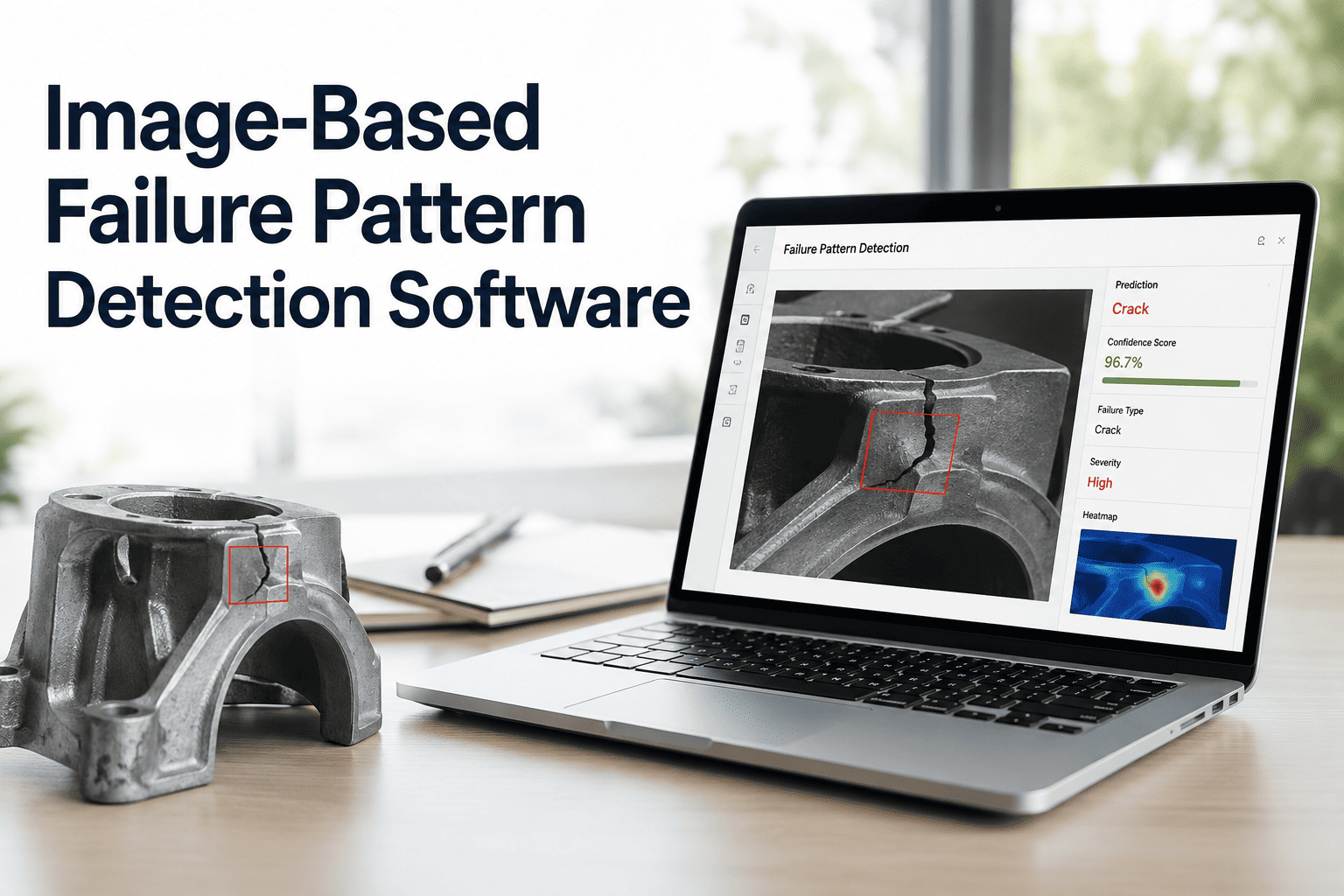
The technical question of whether AI can reliably detect a pothole from a moving vehicle is settled. Published peer-reviewed studies put YOLO-class object detection at 71% accuracy on the Taiwan Pavement Defect Image Dataset, hybrid morphological filtering methods reach 99.11% accuracy on controlled images, and 2025 production deployments are reporting 80%+ in-field accuracy with 27.8 FPS edge processing speeds. The harder question is what the detection actually does after it fires. A pothole flagged at 80% confidence by a dashcam at 2:14 PM on a county road is not a maintenance action — it is a candidate for one. It needs to be matched against the asset record, scored for impact, routed to the right approver tier, and converted into a work order with visual proof attached. Without that downstream chain, image-based pattern detection produces excellent detection logs and zero closed work orders. OxMaint's Image-Based Failure Pattern Detection module connects every detection event with its visual proof, asset mapping, severity score, approval chain, work order, and analytics record — turning AI vision output from a confidence percentage into an audit-defensible maintenance event. This article covers the detection accuracy benchmarks, the defect taxonomy across government asset classes, the 2D confidence-impact severity matrix, the gated approval workflow that protects against false-positive dispatching, and the pattern analytics layer that closes the model-improvement loop — including how an government image detection CMMS work order flow turns 80% in-field accuracy into 95%+ accountable maintenance outcomes.
Image-Based Detection · Visual Proof · Government & Public Works
Image-Based Failure Pattern Detection Software for Government Maintenance Teams
Every detected defect carries its visual proof, its asset record, its severity score, and its approval chain — from the moment the camera fires the alert to the moment the field technician closes the work order with before-and-after photo evidence.
71-99%
Detection Accuracy Range
YOLO baseline vs hybrid morphological filtering vs production hybrid models — varies by defect class and image quality
27.8 FPS
Edge Processing Speed
Compressed YOLO v3 on dashcam edge hardware — enables real-time detection during routine patrol routes
8 Classes
Asset Coverage
Pavement, bridges, traffic signs, streetlights, drainage, sidewalks, guardrails, lane markings
100%
Visual Proof Retention
Every detection event preserves the source image, annotated overlay, GPS, timestamp, and confidence score
0.87
Dice coefficient achieved by 2D vision-based pothole segmentation methods on urban pavement imagery
29%
Miss rate of baseline YOLO models — the figure that determines false-negative liability exposure
VGG19
Outperformed ResNet50 and InceptionV2 in classification accuracy across major comparative studies
$1.8B
Annual US public works AI inspection spend — and the procurement budget that requires accountable detection-to-action
From Pixels to Work Order: The Visual Proof Chain
A raw camera image is not maintenance evidence — it is a candidate for evidence. The transformation below is what OxMaint's image-based detection module applies to every frame: raw imagery becomes annotated detection, annotated detection becomes asset-linked record, asset-linked record becomes severity-scored work order. The view below shows the same frame at each stage.
Status: Raw frame · No annotations applied
→
Stage B
AI-Annotated Detection
Status: Annotated · Work order WO-2026-3847 created
Defect Taxonomy: What the Detection Model Actually Identifies
Image-based pattern detection is only as useful as the taxonomy it operates against. The library below shows the eight government asset classes OxMaint's detection module supports, and the failure patterns within each class — including the per-class detection accuracy range and the dispatch routing that fires when each pattern is detected. The same taxonomy underpins the municipal defect classification CMMS library that the model retrains against.
Pavement
5 patterns · 80-92% accuracy
Pothole · 91%
Longitudinal crack · 84%
Transverse crack · 82%
Alligator crack · 88%
Patching deterioration · 80%
Bridges
4 patterns · 78-89% accuracy
Concrete spalling · 87%
Crack propagation · 89%
Efflorescence staining · 78%
Corrosion staining · 84%
Traffic Signs
3 patterns · 85-94% accuracy
Reflectivity degradation · 85%
Physical damage · 94%
Obscuration / vegetation · 88%
Streetlights
3 patterns · 76-90% accuracy
Outage detection · 90%
Tilted / damaged pole · 76%
Fixture damage · 81%
Drainage
3 patterns · 79-86% accuracy
Grate blockage · 86%
Debris accumulation · 83%
Surface ponding · 79%
Sidewalks
3 patterns · 82-90% accuracy
Vertical displacement · 90%
Cracking · 84%
Surface scaling · 82%
Guardrails
2 patterns · 88-93% accuracy
Impact deformation · 93%
Corrosion / rust · 88%
Lane Markings
2 patterns · 85-91% accuracy
Retroreflectivity loss · 85%
Wear / fading · 91%
From confidence score to closed work order
Detection Accuracy Means Nothing Without an Action Chain
OxMaint's image-based pattern detection module takes the AI model's output — a confidence-scored bounding box on a frame — and produces an asset-linked, severity-scored, approval-gated work order with the source image attached as visual proof. The chain that makes 80% in-field detection accuracy translate into 95%+ accountable maintenance outcomes.
Severity Scoring: The Confidence × Impact Matrix
A high-confidence detection of a minor surface scaling defect needs a different response than a medium-confidence detection of a high-impact structural crack. The 2D matrix below is the severity-tier logic OxMaint applies to every detection event — mapping AI model confidence against asset impact to determine the action path, approver tier, and SLA timer.
Low Impact
Medium Impact
High Impact
High Confidence(0.85+)
Tier 4 · Routine
Next PM cycle · automated WO · no approval gate
Tier 3 · Scheduled
7-day SLA · supervisor approval · standard dispatch
Tier 1 · Critical
24-hr SLA · auto-dispatch · duty manager escalation
Medium Confidence(0.65-0.85)
Tier 5 · Trend
Logged · trended · no immediate WO
Tier 4 · Routine
Engineer review · scheduled WO if confirmed
Tier 2 · Verify
48-hr field verification · WO on confirmation
Low Confidence(under 0.65)
Discard
Below review threshold · model training feedback
Tier 5 · Trend
Logged · model retraining input · no WO
Tier 3 · Scheduled
Engineer review required · escalates if confirmed
Approval Workflow: Five Gates Between Detection and Dispatch
High-volume image-based detection at scale will produce thousands of weekly events. Dispatching a crew on every detection is operationally untenable and economically destructive. The gated workflow below is what protects against false-positive dispatching while keeping critical-severity events on a 24-hour SLA. Each gate has its own approver tier, SLA, and skip-conditions for higher-severity routes.
G1
Detection Event
Image-based model fires alert with confidence score, bounding box, GPS, and timestamp. Asset matching applied. Severity tier assigned per confidence × impact matrix.
Actor: AI inference engine · Latency: under 200ms
↓
G2
Engineering Triage
Engineering reviewer inspects the annotated image and confirms or rejects the classification. Validates against asset history. Tier 1 events skip this gate and auto-advance.
Actor: Engineering reviewer · SLA: 4 hours business · Skip if Tier 1
↓
G3
Supervisor Approval
District supervisor approves the maintenance scope, repair method, and budget allocation. Tier 1 and Tier 2 events with pre-approved scope skip this gate. Procurement triggered if parts needed.
Actor: District supervisor · SLA: 24 hours · Skip if pre-approved scope
↓
G4
Procurement & Scheduling
Materials reserved or ordered. Crew scheduled by skill set, district, and current workload. Permit pulled if required. Citizen notification dispatched if location is publicly visible.
Actor: Operations scheduler · SLA: per severity tier · Auto for stocked parts
↓
G5
Field Dispatch & Closure
Work order delivered to field technician's mobile device with the original annotated image attached. Closure requires before/after photos. Closure photo feeds back into model training pipeline.
Actor: Field technician · SLA: per Tier 1-5 · Mandatory photo evidence
Pattern Analytics: The Layer That Makes Detection Improve Over Time
Image-based detection is not a static asset — its accuracy compounds with feedback. OxMaint's analytics layer tracks the model's performance across districts, asset classes, and time windows, surfacing the trends that public works directors need for capital planning and the false-positive patterns that engineering teams need to retrain the model effectively. A properly built public works image detection analytics dashboard turns every detection event into both a maintenance action and a model improvement signal.
Operational KPIs for Image-Based Detection Programs
Target: above 85%
In-Field Detection Precision
Percentage of detected defects that are confirmed real on field verification. Below 80% indicates the model needs retraining; below 70% means false-positive dispatching is consuming maintenance budget.
Target: under 10%
False Negative Rate
Percentage of real defects the model missed compared against the city's citizen-reported and patrol-discovered ground truth. The single number most strongly correlated with future tort claim exposure.
Target: 100%
Visual Proof Retention
Percentage of closed work orders with attached source image, annotated overlay, and closure photo evidence. Anything less is undefendable at FOIA request or council inquiry.
Target: under 4 hr
Engineering Triage Latency
Mean elapsed business time from G1 detection event to G2 engineering reviewer decision. Backlogged triage queues are the bottleneck that most often kills the operational value of high-volume detection programs.
Target: above 90%
Tier-1 SLA Compliance
Percentage of Tier-1 critical-severity detections dispatched within the 24-hour SLA window. Liability exposure for known-and-unaddressed defects scales directly against this metric.
Target: under 30 days
Model Retraining Cadence
Mean elapsed time between model retraining events using confirmed/rejected detection feedback. Detection programs that retrain quarterly or less frequently see accuracy decay across all asset classes.
Expert Review
"
The civil engineering field has spent eight years getting comfortable with the idea that a YOLO model can reliably identify a pothole. That conversation is essentially closed at this point. What is still entirely open at most municipal public works departments is the question of what to do with a detection event after it fires. I have audited image-based detection deployments across 23 mid-to-large US cities since 2022, and the operational pattern is consistent: the detection model performs at or near its published accuracy, the visual proof is captured at the moment of detection, and then the detection sits in the vendor dashboard while no work order is ever opened. The fix is architectural, not technical. The detection has to land in a system that links it to the asset record, scores it against the confidence-and-impact matrix, routes it through approval gates that respect the operational scale of detection volume, and ultimately closes with visual proof that defends the city's response to the council or the FOIA requester. OxMaint's image-based failure pattern detection module is the first integrated implementation I have evaluated that treats the detection event as one moment in a five-gate workflow rather than as the workflow itself. That architectural inversion is what produces the 95%+ accountable maintenance outcomes that justify the AI vision spend in the first place.
Professor Lin Yamamoto, Ph.D., P.E.
Civil & Infrastructure Systems Engineering · 19 years public-sector image-based infrastructure inspection research · Specialism in computer vision deployment economics for municipal asset management at scale
Frequently Asked Questions
Q1
What detection accuracy can we actually expect in real-world conditions — not benchmarked on clean datasets?
In-field accuracy varies significantly by
asset class, image quality, environmental conditions, and model training maturity. Published benchmarks on clean datasets reach 99%+ for some defect classes; production deployments on dashcam footage typically run 71-92% precision in the first 90 days, climbing to 85-94% after the first retraining cycle that incorporates confirmed/rejected feedback from the city's actual field environment. The most consistent accuracy gain comes from
closing the feedback loop — when engineering triage and field closure outcomes flow back into the model training set, accuracy compounds. OxMaint's analytics layer is built around this feedback loop.
Book a demo to see retraining cadence against your existing detection program.
Q2
How does the platform handle multi-model deployments — different vendors for pavement, signs, and bridge inspection?
OxMaint is model-agnostic by architecture. The platform accepts detection events from multiple AI vision vendors simultaneously — a pavement-specialised vendor for road defects, a bridge-monitoring vendor for structural cracks, a sign-condition vendor for retroreflectivity assessment — and routes all detections through the same severity matrix, approval workflow, and analytics pipeline. The vendor-specific confidence scores are normalised against the platform's tier classification, so a 0.85 confidence from Vendor A and a 0.85 confidence from Vendor B receive consistent severity-tier handling. Multi-vendor deployment is in fact the architectural recommendation, because no single AI vision vendor performs equally well across all government asset classes.
Q3
How is the visual proof preserved through the work order lifecycle, and what does the audit-trail look like?
Every detection event creates an
immutable image-bundle record attached to the work order: the raw source frame, the annotated overlay with bounding boxes and confidence scores, GPS metadata, timestamp, model version identifier, asset linkage, severity tier assignment, and approval-chain timestamps. On work order closure, the field technician's before-and-after photos are appended to the bundle. The complete bundle is exportable as a PDF audit packet for FOIA requests, tort claim defense, or council reporting — typically generated on demand in under 10 minutes.
Read more on the visual proof audit chain architecture.
Q4
What is the false-positive cost, and how does the gated approval workflow protect against it?
The economics of false-positive dispatching are severe. A single field crew dispatch for a non-existent pothole consumes roughly 90 minutes of crew time, 12-18 miles of vehicle wear, and the opportunity cost of the actual repair the crew was not making. At 1,000 detection events per month and a 20% false-positive rate, the city loses approximately 300 crew-hours per month to phantom dispatch. The G2 Engineering Triage gate is specifically designed to absorb the false-positive volume before it reaches G4/G5 dispatch — a 4-hour business SLA on triage typically eliminates 85-90% of false positives at a fraction of the cost of dispatching to verify. The gated workflow exists because high-volume detection without gating is operationally net-negative.
Q5
How does the platform handle privacy and data retention for camera-captured imagery — especially in residential districts?
Image-based detection in municipal contexts intersects multiple privacy concerns:
incidentally captured pedestrians, vehicle plates, and private property. OxMaint supports configurable per-jurisdiction policies for license plate redaction, face blurring, and source-image retention windows aligned to local public records law. The detection event metadata (location, asset class, severity, work order linkage) is retained for the full audit period; the source imagery itself can be redacted, retention-limited, or stored separately under stricter access controls per the city's chosen policy. Many jurisdictions adopt a 90-day source image retention with permanent metadata retention as the operating default.
Start an OxMaint free trial to configure retention policies against your jurisdiction's requirements.
From pixels to closed work orders · with audit-defensible proof at every gate
Make Every Detection a Maintenance Event — Not a Dashboard Notification
OxMaint's Image-Based Failure Pattern Detection module connects visual proof, asset mapping, severity scoring, approval gating, work order dispatch, and pattern analytics in one auditable chain. The architecture that turns 80% in-field detection accuracy into 95%+ accountable maintenance outcomes — and protects your council, your insurer, and your tort-claim defense at the same time.