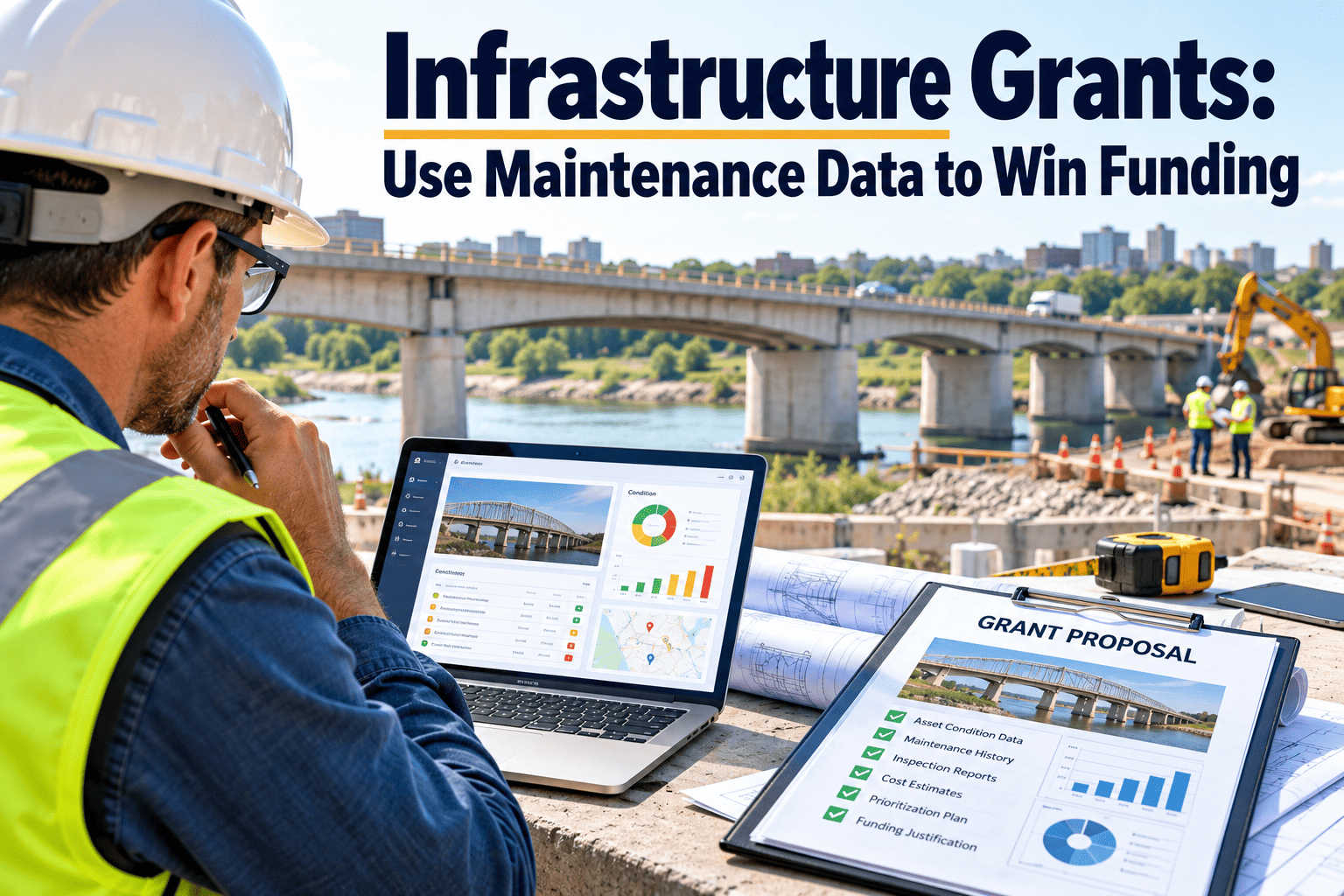
Reviewers of infrastructure grants read hundreds of applications that describe the same problem: aging roads, bridges, water lines and buildings that need money. What separates a funded application from a declined one is often proof. Documented asset condition, inspection history, repair cost and a credible maintenance plan show that the applicant knows its system and will protect the investment. This guide explains which maintenance records strengthen a grant file, how to organize them before a deadline, and where gaps usually appear. A team that wants to centralize this evidence can try Oxmaint as the source for its application data.
Infrastructure Grants: Use Maintenance Data to Win Funding
Limited maintenance budgets make outside funding critical. Show reviewers condition, risk and stewardship with records that were captured in daily work, not rebuilt in the final week.
Why maintenance data now sits inside the grant file
What funders are trying to avoid
- Paying to build or replace something that is then neglected
- Funding projects whose need is asserted but not measured
- Awards to applicants who cannot deliver or report on schedule
What your records can prove
- The need exists and is measurable by condition and failure history
- Your agency already maintains what it owns
- Future operating costs have been considered
Program rules change by year and by agency. Always read the current notice of funding opportunity for the exact documents, scoring criteria and match requirements before you plan your evidence.
Two applications for the same project
Application without maintenance records
- Need described as "aging" with no condition ratings
- Photos collected in a rush from staff phones
- Repair history estimated from memory
- Maintenance plan stated in one sentence
Application backed by maintenance records
- Condition scores and inspection dates listed by asset
- Dated photos attached to inspection findings
- Repair counts and costs pulled from work order history
- Preventive schedule showing how the new asset will be kept up
Map each application section to a maintenance record
Most applications ask similar questions under different headings. Use this map to decide which exports to prepare.
| Application question | Maintenance evidence | Typical source in a CMMS |
|---|---|---|
| Why is this project needed? | Condition ratings, failure and repair frequency, deficiencies still open | Inspection records, work order history by asset |
| What is the risk of not funding it? | Criticality ranking, service disruptions, safety findings | Asset criticality fields, corrective work orders |
| Can you maintain it afterward? | Preventive schedules, staffing, compliance rate, spare parts plan | PM schedules, completion reports, inventory |
| Is the cost estimate credible? | Past repair and replacement costs for similar assets | Cost per asset and per work order |
| How will you measure results? | Baseline and target metrics, reporting cadence | Dashboards and scheduled reports |
The data-readiness checklist
Work through this list at least a quarter before an application window opens. Each gap you close early is a day you do not lose later.
Keep grant evidence ready all year
Oxmaint stores asset records, inspections, work orders and costs in one place, so a deadline becomes an export rather than a scramble.
Funding sources that often ask for asset evidence
The table below is a planning aid, not a program guide. Names, scoring and eligibility change, so confirm each one against the latest official notice.
| Funding type | Evidence reviewers commonly expect | Records to prepare |
|---|---|---|
| Federal transportation discretionary grants | Clear need, benefits and costs, readiness to deliver | Pavement and bridge condition, crash or failure history, repair costs |
| Bridge funding programs | Inspection ratings, preservation history, load or safety concerns | Inspection reports, deficiency lists, preservation work orders |
| Water and wastewater revolving funds | Asset management plan, condition assessment, capital plan | Asset inventory, break and repair logs, replacement forecast |
| Airport improvement funding | Inspection compliance, pavement condition, safety findings | Self-inspection records, pavement reports, corrective actions |
| State and local capital programs | Match funding, ranked priorities, long-term cost | Capital plan inputs, deferred maintenance list, lifecycle cost |
A grant calendar built around your maintenance cycle
Capture data as work happens
Inspections, condition updates and closed work orders feed the record automatically.
Audit the data
Check for missing IDs, stale ratings and work orders left open without notes.
Pre-build the evidence pack
Prepare standard exports by asset class so you can adapt them to each program.
Tailor, do not rebuild
Select the records that answer the stated criteria, and explain them in plain language.
Report from the same system
Use the same data for progress reports, which keeps claims consistent.
Common data gaps that weaken applications
Inventory without condition
A list of assets that has no recent rating cannot support a priority argument.
Costs buried in invoices
If repairs are not tied to assets, you cannot show the cost of keeping them alive.
Preventive work not logged
Reviewers cannot credit stewardship that exists only in a supervisor's memory.
Inconsistent rating scales
Different crews scoring differently makes comparison across the system unreliable.
Unclosed deficiencies
Old open findings suggest a system that identifies problems but does not resolve them.
Overstated claims
Claims that records cannot support invite scrutiny and can damage the whole application.
Tell a clear story with the numbers
Make condition ratings consistent and defensible
A rating is only persuasive if a reviewer can see how it was produced. Write down the scale, the criteria for each level and who assigns the score, then apply it the same way across crews and sites.
Rank risk with a simple likelihood and consequence view
Funders want to know why this project comes before others on your list. A transparent risk grid explains the order without requiring a complex model. The example below shows the logic, not real data.
Likelihood should come from condition, age and failure history. Consequence should come from service impact, safety, cost and how many people depend on the asset.
Show the lifecycle cost, not only the construction cost
Applications that list only the build price leave reviewers to wonder who pays for the next twenty years. Pair the capital request with the cost of keeping the asset serviceable.
Acquire
Design, construction or purchase, and commissioning records.
Operate
Energy, staffing and routine inspections over the service life.
Maintain
Preventive tasks, expected repairs and parts, based on your own history.
Renew
Rehabilitation or replacement timing and the funding plan behind it.
Write the maintenance plan narrative reviewers can score
Include
- Who is responsible for the asset after construction
- Which preventive tasks will run, how often and under which standard
- How inspections are recorded and how findings become work orders
- How you will fund ongoing maintenance within your operating budget
Avoid
- General statements such as "we will maintain it properly"
- Promises that exceed your staffing or budget
- Numbers that you cannot reproduce from your own records
- Copying language from another agency's application
What to prepare for different asset groups
Roads and pavement
Pavement condition by segment, patching and crack sealing history, and the backlog of reported defects.
Bridges
Inspection findings, preservation tasks such as washing, joint repair and drain cleaning, and open deficiencies.
Water and sewer
Pipe and pump records, break and blockage history, flushing and inspection programs.
Buildings and parks
Facility condition, life-safety checks, playground inspections and recurring repair costs.
Airports
Daily self-inspection records, lighting and pavement findings, and corrective action closure.
Fleet and equipment
Service history, downtime, repair cost per vehicle and a replacement cycle tied to condition.
After the award: reporting without double work
Grant agreements normally require progress reports, financial reporting and sometimes performance measures. If the same system that supported the application also tracks the funded work, reporting becomes an export instead of a research project.
A 30-day sprint to get grant-ready
If a deadline is already on the calendar, focus on the assets named in the project and leave the rest of the system for later. A narrow, accurate record beats a broad, uncertain one.
Define the evidence scope
List the assets in the project, the criteria in the notice, and the records each criterion needs.
Fill the biggest gaps
Inspect assets without current ratings, add photos, and link past repairs to the correct asset.
Run and review reports
Export condition, cost and compliance summaries, then check them against field knowledge.
Write and verify
Draft the narrative, cite each number to a record, and have a second person verify the figures.
Use the same evidence beyond the application
Letters of support and public meetings
- Give partners a one-page summary of need, using the same figures as the application
- Show residents before-and-after photos tied to dated inspections
- Explain how existing maintenance protects the public investment
Match funding and budget conversations
- Document local spending already committed to the asset group
- Show how the project reduces recurring repair costs
- Keep a clear record of in-kind labor if the program allows it
Consistency matters. When the grant file, the budget request and the public presentation all use the same records, reviewers and officials are more likely to trust each of them.
Final review: questions a skeptical reviewer would ask
Assign someone outside the writing team to answer these five questions with the records open. Fixing a weak answer a week before submission is far easier than defending it during a reviewer follow-up or a post-award audit, and it often reveals a missing photo, a stale rating or a repair that was never linked to the right asset.
Where Oxmaint fits in grant preparation
Capabilities that supply application evidence
- Asset management with location, attributes, condition and criticality
- Inspection checklists with photos, notes and timestamps
- Work orders with labor, parts and cost by asset
- Preventive maintenance scheduling and compliance reports
- Dashboards and exportable reports for grant files and progress updates
A CMMS supports an application by organizing evidence. It does not guarantee an award. Quality still depends on inspection discipline and honest ratings.
Frequently asked questions
What maintenance data helps most in an infrastructure grant application?
Current condition ratings, dated inspections, repair history with costs and a documented preventive schedule. Together they show need and stewardship.
How early should we start preparing the data?
Ideally a full quarter before the application window, with ongoing capture all year. You can book a demo to plan the setup.
Can a small agency compete using this approach?
Yes, because reviewers value clarity and credibility, not size. Start with your most critical assets and build outward.
Does the CMMS replace an asset management plan?
No. It supplies the records and reports that feed the plan. The plan still needs policy decisions, service levels and a capital forecast.
How can we begin without a large project?
Pick one asset class and load it first. You can sign up and test inspections and work orders on that group.
Make every inspection count toward your next award
Build the evidence reviewers want while you do the maintenance work you already do. Oxmaint helps public agencies keep asset, inspection and cost records ready for funding.