Municipal Work Order Management Systems: Complete Guide 2026
By Taylor on February 6, 2026
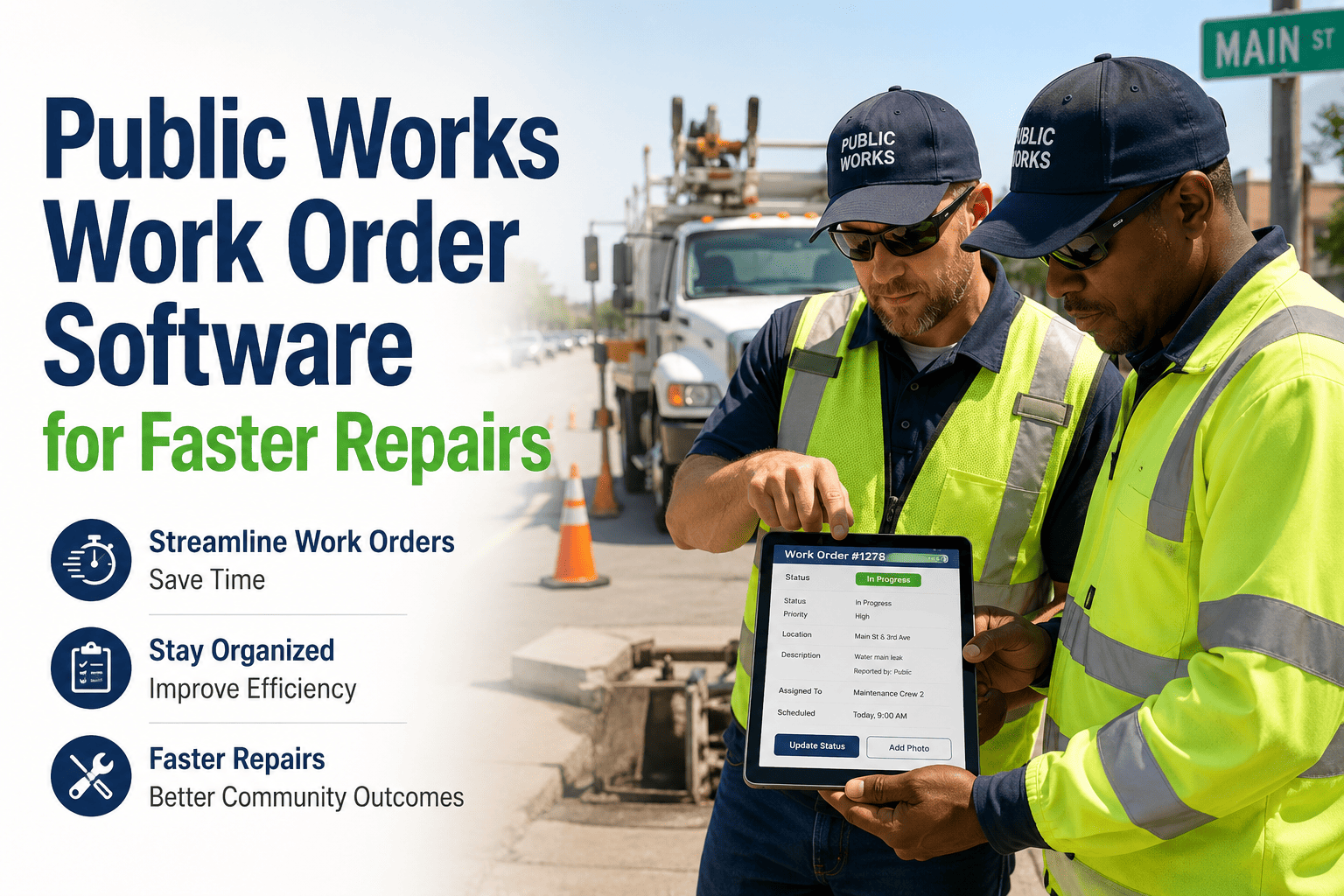
Municipal work order management is no longer just about tracking repair requests—it's about orchestrating the entire operational backbone that keeps cities functional. From pothole repairs and water main breaks to park maintenance and building inspections, modern municipalities process thousands of work orders monthly across dozens of asset categories. A single misrouted work order can delay a critical repair, trigger citizen complaints, and expose the agency to liability claims worth far more than the repair itself.
This guide provides public works directors, operations managers, and city administrators with a comprehensive framework for implementing and optimizing digital work order management systems. We cover the complete lifecycle from citizen request intake through completion verification, and provide actionable steps to eliminate paper-based inefficiencies, improve response times, and build data-driven maintenance operations. Municipalities ready to modernize their work order operations can start their free trial today.
Operational Reality
The Hidden Cost of Manual Work Order Management
70%
of municipalities still use paper or spreadsheet-based work orders
40%
of technician time lost to paperwork, travel, and searching for information
90%
of top-performing agencies use digital CMMS for work order management
Source: APWA, IFMA, and Government Technology Benchmark Reports 2024-2025
The stakes are higher than ever. Citizens expect Amazon-speed responsiveness from their local government. Council members demand data-driven accountability. Insurance carriers require documented maintenance histories. And aging infrastructure means work order volumes are increasing 8-12% annually while budgets remain flat. The gap between paper-based operations and digital work order management isn't just an efficiency issue—it's a fiscal and liability crisis that compounds every year a municipality delays modernization.
The Digital Work Order Lifecycle: Request to Resolution
While manual systems treat work orders as isolated repair tickets, digital work order management creates a connected lifecycle where every request generates actionable data. Each completed work order contributes to asset history, informs capital planning, and provides audit-proof documentation. Understanding this lifecycle is the foundation of operational excellence.
Digital Work Order Lifecycle Framework
From citizen request to data-driven asset intelligence
01
Request Intake
Citizen 311, staff portal, IoT sensors, and inspections feed requests into a unified digital queue
02
Triage & Prioritize
Auto-classify by asset type, urgency, location, and SLA requirements with smart routing rules
03
Dispatch & Execute
Mobile-equipped crews receive assignments with GPS routing, asset history, and required materials
04
Verify & Close
Photo documentation, supervisor approval, citizen notification, and data feeds to asset records
Implementing a digital work order lifecycle allows municipalities to track every request from intake to resolution with timestamped accountability. Automated routing eliminates the dispatcher bottleneck where requests sit in an inbox for hours. Mobile execution ensures technicians arrive with the right information, parts, and tools—reducing return trips by 35-50%. And verified completion with photo documentation creates the audit trail that protects against liability claims and satisfies insurance requirements.
Paper vs. Digital: The Work Order Management Comparison
The difference between paper-based and digital work order management isn't incremental—it's transformational. Legacy processes built on clipboards, phone calls, and spreadsheets create information black holes where requests disappear, priorities shift without documentation, and completed work goes unverified. Digital systems create transparent, accountable, and measurable operations.
Work Order Management Approach Comparison
✗
Paper / Spreadsheet Systems
Phone/email request intake with manual logging
Dispatcher assigns via radio or whiteboard
No real-time visibility into crew status
Paper forms completed at end of day
Asset history locked in filing cabinets
Monthly reports compiled manually
No photo verification of completed work
Slow, Unaccountable & Risky
✓
Digital CMMS Platform
Multi-channel intake: 311, portal, app, sensors
Auto-routing by trade, zone, and priority
Real-time GPS crew tracking and status
Mobile completion with timestamps and photos
Complete digital asset history with cost tracking
Real-time dashboards and automated reports
Before/after photo verification standard
Fast, Transparent & Audit-Ready
Digital work order management doesn't just speed up existing processes—it enables entirely new capabilities. Predictive maintenance triggers work orders before failures occur. Citizen-facing portals reduce phone calls by 60-70%. And accumulated asset data transforms maintenance from a cost center into a strategic planning function that drives capital investment decisions.
Digital Work Order Performance Impact
Measured improvements from CMMS implementation across municipal operations
45%
Faster Response
Request-to-Resolution Time
35%
More Productivity
Technician Wrench Time Increase
98%
SLA Compliance
On-Time Completion Rate
100%
Audit Trail
Documented & Timestamped
Mobile Access: The Field Technician's Command Center
The mobile app is where digital work order management delivers its greatest impact—transforming field technicians from clipboard-carrying repairmen into data-connected professionals. When a technician arrives at a job site with complete asset history, repair procedures, parts availability, and photo documentation tools in their pocket, first-time fix rates increase 30-40% while return trips plummet.
Mobile CMMS: Essential Field Capabilities
GPS Routing
Optimized route planning sends technicians to the nearest high-priority job, reducing drive time 20-30%.
Asset History
Complete repair history, specs, and manuals accessible at the asset—no calling the office for information.
Photo Verification
Before/after photos with GPS stamps create audit-proof completion records and liability protection.
Offline Mode
Full functionality without cellular coverage—syncs automatically when connection restores. Zero data loss.
The ROI Equation: Digital vs. Manual Work Orders
Investing in a digital work order system is often viewed as a technology expense, but the financial reality of manual operations tells a different story. The accumulated cost of lost productivity, duplicate work, liability exposure, and missed preventive maintenance far exceeds the investment in digital transformation. Proactive modernization is the fiscally responsible choice.
ROI Calculator: Digital CMMS vs. Paper Operations
Based on a mid-sized municipality (50-200 employees, 10,000+ assets)
Paper/Manual Operations
Lost Productivity$180k - $450k/yr
Duplicate/Return Trips$60k - $150k/yr
Liability Exposure$100k - $500k/claim
Citizen SatisfactionLow / Complaints Rising
Annual Hidden Cost: $400k - $1.2M+
VS
Digital CMMS Platform
Platform Investment$15k - $60k/yr
Implementation$5k - $25k one-time
Liability ProtectionDocumented / Defensible
Citizen SatisfactionHigh / Transparent
Annual Investment: $20k - $85k
Municipalities that implement digital work order systems also benefit from reduced insurance premiums through documented maintenance histories, improved bond ratings through demonstrated asset stewardship, and stronger grant applications backed by operational data. The financial argument for digital work order management is overwhelming: the cost of inaction far exceeds the cost of modernization.
Modernize Your Work Order Operations
Stop losing productivity to paper processes and phone-tag dispatch. Oxmaint delivers mobile work orders, automated routing, and real-time dashboards that transform municipal operations. Schedule a consultation to see the platform in action.
Implementation: Building a Digital Work Order Operation
Building a digital work order operation is a phased journey that builds capability incrementally while delivering measurable value at each stage. Municipalities that attempt to deploy every feature simultaneously achieve only 30-40% of potential benefits, while structured implementations consistently deliver 80-95% of projected outcomes within 12 months.
Work Order Management Maturity Model
Level 1
Digital Foundation (Months 1-3)
Asset Registry BuildDigital Work Order FormsMobile App DeploymentBasic Request Portal
Level 2
Workflow Optimization (Months 4-6)
Auto-Routing RulesPM Schedule AutomationSLA Tracking & AlertsCitizen Notification System
Start with the basics: build your digital asset registry and get work orders off paper. Then optimize workflows with automated routing and preventive maintenance scheduling. Finally, leverage accumulated data for predictive operations and capital planning integration that transforms maintenance from reactive cost to strategic investment.
Citizen Request Integration: The Public-Facing Portal
Modern citizens expect to interact with their government digitally—reporting potholes via smartphone, tracking repair status online, and receiving notification when work is completed. Providing multilingual, accessible request portals ensures that every resident can participate in maintaining their community regardless of language or technical ability.
Accessible Citizen Request Portal
Inclusive request submission that serves every resident
QR Code Scan
Web Portal
Mobile App
311 Phone
Email Intake
Social Media
In-Person
IoT Sensors
Real-Time Status Updates
Citizens track their request from submission through completion—reducing follow-up calls by 60-70%.
Multilingual Support
Request portals available in community languages with auto-translation for internal routing and response.
Duplicate Detection
Smart matching prevents 15-25% of duplicate requests from creating redundant work orders—saving crew time.
Empower your citizens with transparent serviceGet Started →
Effective citizen engagement through digital request portals builds community trust while reducing administrative burden. When residents can see that their pothole report was received, assigned to a crew, and completed with before/after photos—all without a single phone call—satisfaction scores increase 40-55%. Book a Demo.
Transform Your Municipal Work Order Operations
Join the leading municipalities using Oxmaint to deliver faster response times, transparent citizen communication, and data-driven maintenance operations. Take the first step toward operational excellence today.
How long does it take to implement a digital work order system?
Most municipalities can go live with basic digital work orders within 2-4 weeks. The critical first step is building your asset registry—which can be done incrementally by starting with high-priority assets (water, sewer, roads) and expanding. Full optimization including automated PM schedules, citizen portals, and advanced reporting typically reaches maturity within 6-12 months. The key is starting immediately with basic digital work orders rather than waiting for a "perfect" implementation plan.
How do we get field crews to adopt a mobile work order app?
Adoption depends on making the app easier than the current process—not harder. Modern CMMS mobile apps use large buttons, drop-down selections, and one-tap status updates rather than extensive typing. Key adoption strategies include: involving field supervisors in configuration, starting with tech-friendly crews as champions, demonstrating that the app eliminates end-of-day paperwork, and showing crews how asset history on their phone helps them fix things right the first time. Most departments achieve 85-90% adoption within 4-6 weeks of structured rollout.
Can we integrate citizen 311 requests directly into the work order system?
Yes. Modern CMMS platforms accept requests through multiple channels—web portals, mobile apps, email, and API connections to existing 311 systems. When a citizen submits a pothole report through the portal, the system automatically creates a work order, categorizes it by type and location, checks for duplicates, applies SLA timelines, and routes it to the appropriate crew. The citizen receives automated status updates through resolution without any manual intervention from dispatch staff.
How does a CMMS help with asset tracking and capital planning?
Every completed work order feeds data into the asset's digital history—repair type, cost, parts used, labor hours, and condition assessment. Over time, this creates a comprehensive Total Cost of Ownership (TCO) profile for each asset. When a fire hydrant has accumulated $8,000 in repairs over three years and its replacement cost is $12,000, the data makes the capital replacement decision obvious and defensible. This asset intelligence transforms budget requests from opinion-based to evidence-based, achieving 90%+ approval rates for data-backed capital plans.
Is the system secure enough for government use?
Enterprise-grade CMMS platforms built for government use employ bank-level encryption, role-based access controls, SOC 2 compliance, and secure cloud hosting (typically AWS GovCloud or equivalent). Data is encrypted in transit and at rest. Role-based permissions ensure that field technicians see only their assigned work orders while supervisors access department-wide data and administrators control system configuration. Regular penetration testing and security audits maintain compliance with government IT security requirements.