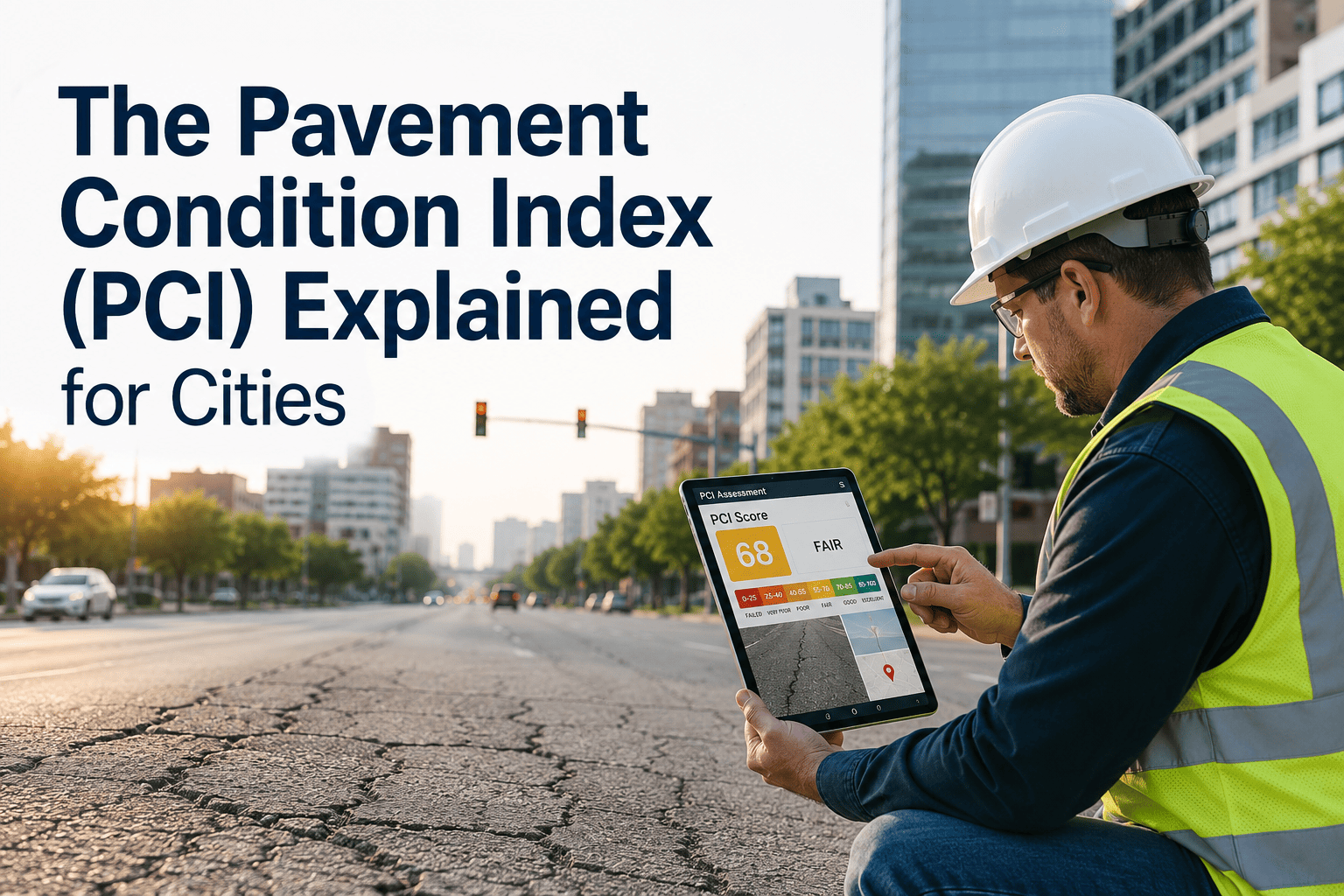
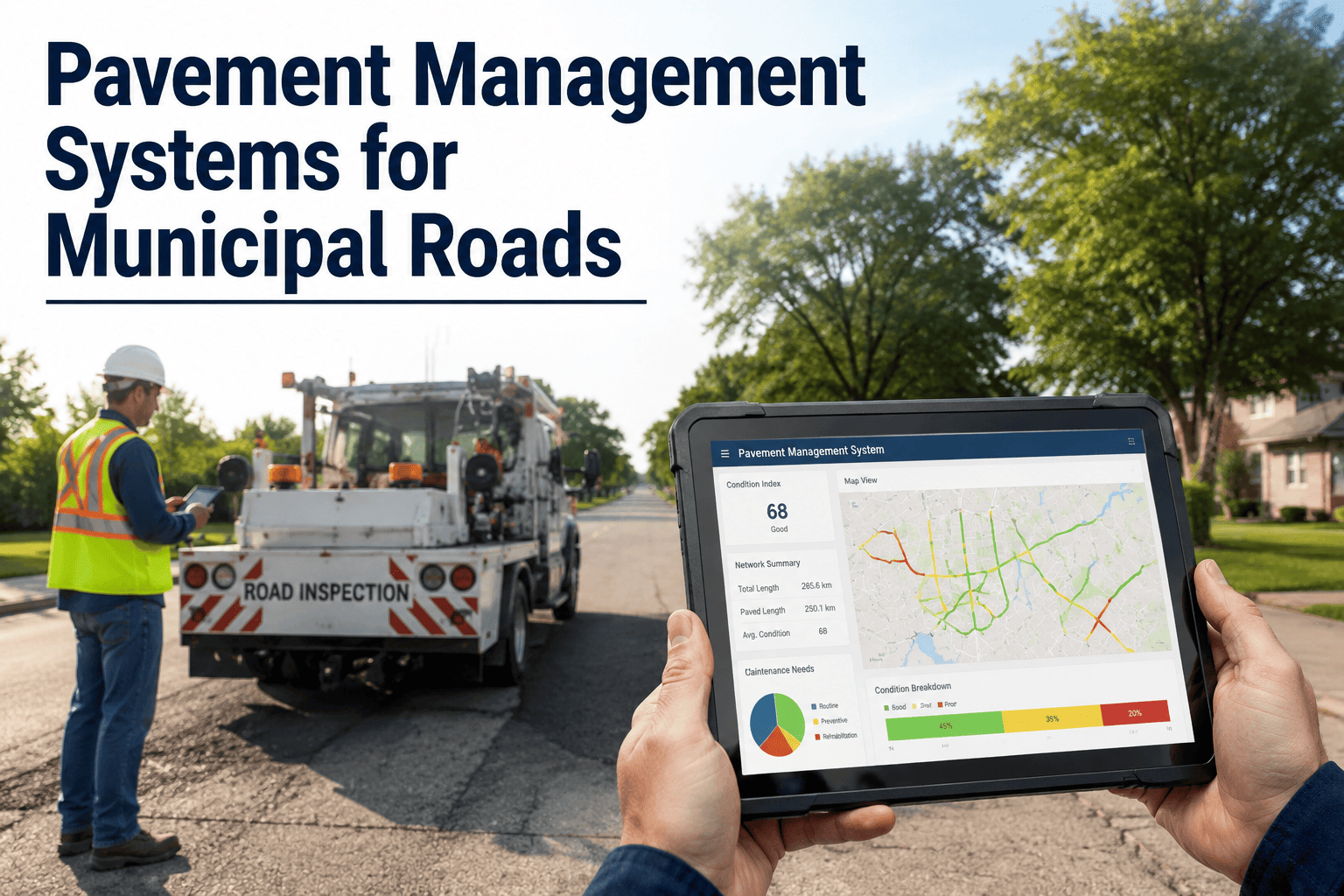
When a resident calls to complain that Elm Street is "falling apart," that is an opinion. When your survey says Elm Street scores a PCI of 48, that is a number you can budget, defend to council, and put in a grant application. The Pavement Condition Index is how a road's condition becomes a single score from 0 to 100 that everyone — engineers, elected officials, and the public — can read the same way. It is the bridge between what a road looks like and what you do about it, and it turns cracks, ruts, and potholes into a defensible plan. This page explains exactly how that number is built and how to use it. Start a free trial with Oxmaint to turn your road surveys into PCI-driven decisions.
The Basics
One Number, Understood the Same Way Everywhere
0–100
The scale. 100 is a flawless new road; 0 is complete failure. Dimensionless and easy to communicate to non-engineers.
ASTM D6433
The standard. Developed by the U.S. Army Corps of Engineers, it makes a 72 in Vermont mean the same as a 72 in Arizona.
Visual
The method. A trained surveyor catalogs surface distress — type, severity, extent — rather than relying on gut feel or complaints.
Because it is standardized and repeatable, PCI is the shared language of road health. That single score decides whether a road gets a crack seal this year, an overlay next year, or reconstruction in the next capital budget — and it lets you compare any two roads objectively and track a network's health over time.
How the Number Is Built
From Field Survey to Final Score in Five Steps
1
Divide into sample units
Split each road into inspectable sample units of about 2,500 square feet — typically one lane width by 100 feet. Large networks survey a representative sample for 95% confidence.
2
Record every distress
For each defect, log three things: the distress type, the severity (low, medium, high), and the quantity in square feet, linear feet, or count.
3
Convert to density and deduct value
Divide each distress quantity by the sample area to get density, then map density-severity to a deduct value using the ASTM curves. Worse distress deducts more.
4
Correct for overlap
Multiple distresses cannot simply be added — that double-counts. An iterative procedure produces a single corrected deduct value for the sample unit.
5
Subtract from 100
PCI equals 100 minus the corrected deduct value. Roll sample-unit scores up to a section and network PCI for reporting and planning.
Worked Example
125 sq ft alligator cracking in a 2,500 sq ft unit
gives
5% density at medium severity
maps to
deduct value ~25
so
100 − 25 = PCI 75
One distress alone dropped this unit from a perfect 100 to 75 before any other defect is counted. That is how quickly structural cracking erodes a score.
What Surveyors Look For
The Distresses Behind the Score
Load-Related (Structural)
Caused by traffic weight and base failure. The expensive kind — often signals the road needs structural repair, not just a surface seal.
Alligator / fatigue cracking · Rutting · Shoving · Slippage cracking · Potholes
Age & Climate-Related
Caused by oxidation, thermal cycling, and freeze-thaw. Often treatable cheaply with surface seals if caught early.
Block cracking · Transverse / longitudinal cracking · Weathering · Raveling · Bleeding
ASTM D6433 defines 19 asphalt distress types, each graded low, medium, or high. The most consequential survey mistake is confusing load-related alligator cracking with age-related block cracking: one needs reconstruction, the other needs a surface seal. Get that wrong and the PCI is structurally meaningless. That is why inspector training and reference photos matter as much as the math.
Turn Distress Surveys Into Auditable PCI Scores
Oxmaint captures distress type, severity, and location per sample unit, runs the ASTM corrected-deduct-value math automatically, and tracks PCI trends across your network — eliminating manual calculation errors and building the defensible record grants and councils demand.
Reading the Score
What Each PCI Band Actually Means
86–100
GoodOnly routine monitoring. Preventive seals keep it here cheaply. Do nothing structural.
71–85
SatisfactoryRoutine preservation. Crack sealing and surface treatments hold the score.
56–70
FairSchedule preventive work now. Above 70 is the cost-effective zone; act before it drops.
41–55
PoorProgram rehabilitation. Mill-and-overlay territory; preservation window has closed.
0–40
Very Poor to FailedMajor rehab or full reconstruction. The most expensive outcome of waiting.
The scale is not linear. A road at PCI 70 declines slowly, but the same road at 55 begins a rapid slide that multiplies repair cost 5 to 10 times within a few years. That is why the number is a warning system, not just a report card — and why a network target of 70 keeps most roads in the cheap-to-maintain zone.
PCI vs. IRI
Two Numbers That Answer Different Questions
PCI
"What is wrong with the road, and how badly?"
A visual index of surface distress — cracking, rutting, potholes. Diagnoses the problem and drives treatment selection. Collected by visual survey.
IRI
"How does it feel to drive on?"
The International Roughness Index measures ride quality with a profilometer. A road can score high on one and low on the other; best practice tracks both.
Frequently Asked Questions
Pavement Condition Index: Common Questions
Who created the PCI and why is it standardized?
The U.S. Army Corps of Engineers developed it as an airfield rating system; ASTM D6433 standardized it for roads. Standardization is what lets agencies compare scores and compete for grants.
Track standardized PCI in Oxmaint.
Why can't I just add up the deduct values?
Because overlapping distresses would be double-counted, over-penalizing the road. The corrected deduct value uses an iterative curve to combine them fairly into one number before subtracting from 100.
How often should we run a PCI survey?
Most agencies survey every three years. High-traffic or freeze-thaw roads may justify annual checks, since distress can appear within three to four years under harsh conditions.
Can automated surveys replace manual ones?
Best practice is hybrid: automated collection for network-level updates, with trained manual verification on ambiguous or high-priority sections where distress interactions still need a human eye.
Book a session to design your survey workflow.
What network PCI should a city target?
Seventy is the commonly cited target — the boundary above which most roads stay serviceable with cheap preventive treatments instead of costly structural rehabilitation.
Give Every Road a Number You Can Defend
Oxmaint turns field distress surveys into ASTM-compliant PCI scores, tracks them across your network, and links each number to the right treatment and budget — so "the road is bad" becomes "this segment scores 48 and needs mill-and-overlay this year." Data instead of opinions.