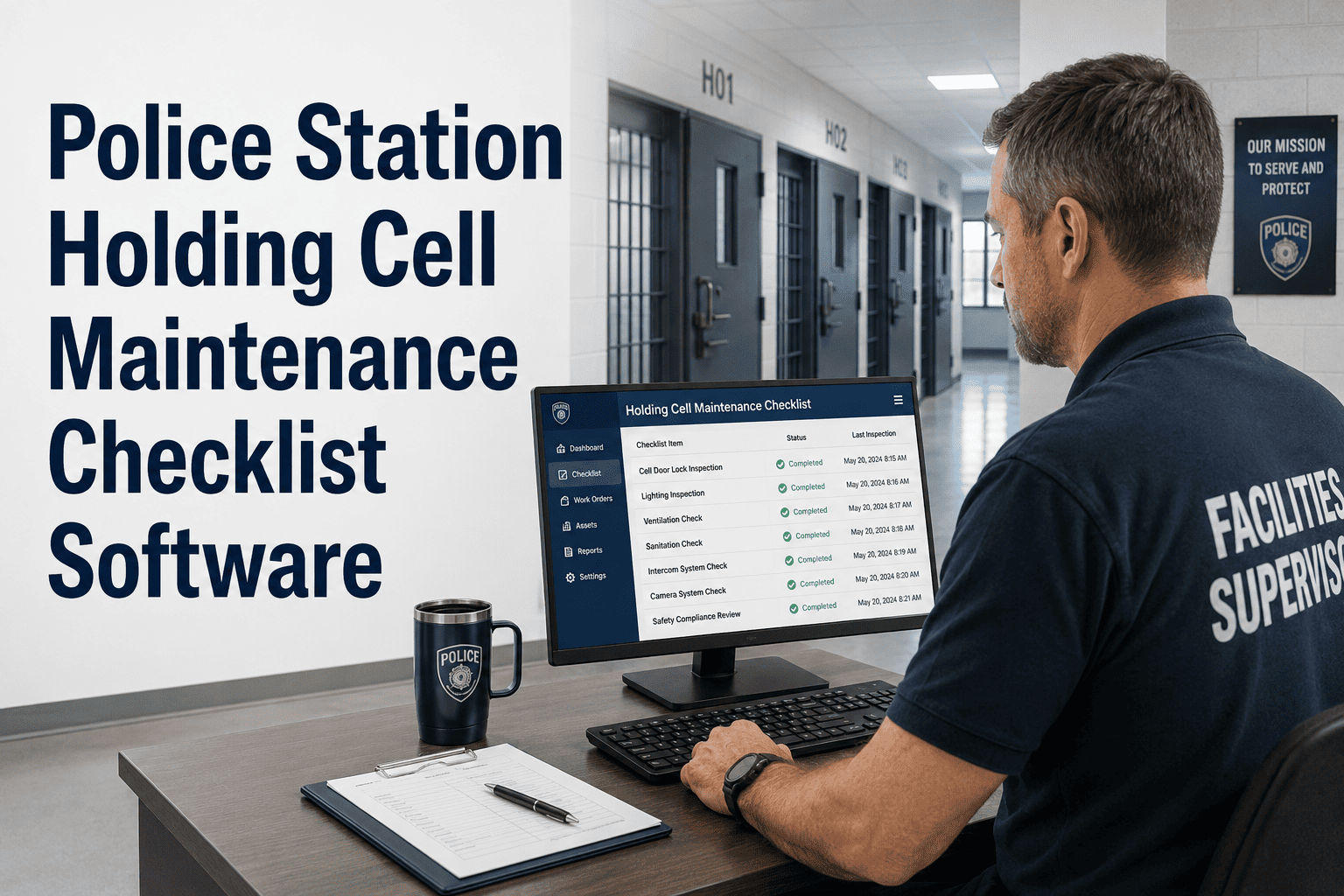
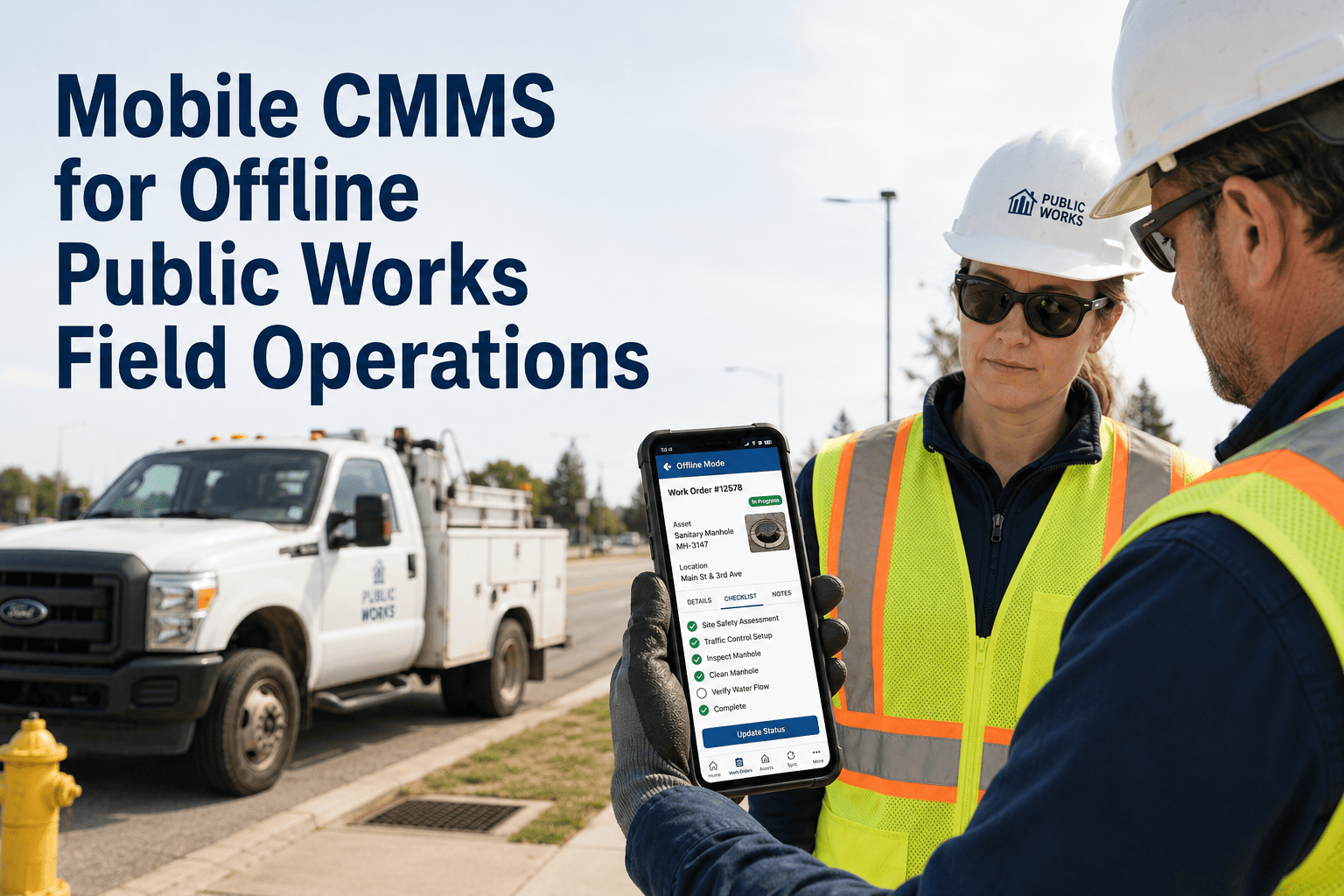
Holding cell maintenance sits at the intersection of life-safety compliance, civil rights law, and daily operational risk. A failed cell door lock, a compromised plumbing fixture that could become a ligature point, or an HVAC failure in a sealed cell block are not routine maintenance events — they are liability events with potential constitutional and criminal consequences for the facility. OxMaint's Compliance Tracking module digitises holding cell inspections with mandatory photo gates, timestamped sign-offs, automatic work order escalation, and audit records that survive any civil rights review or correctional inspection. Facility managers get real-time visibility; legal and risk teams get defensible documentation. Book a demo to see how police facilities use OxMaint for compliance-ready maintenance.
Compliance Checklist · Police Facilities · Audit-Ready Records
Police Station Holding Cell Maintenance Checklist
Liability management, constitutional compliance, and daily operational safety — all on one mobile platform with automatic audit trails built for police facility managers.
83%
of jail facility lawsuits cite inadequate documentation as a contributing factor
ADA
Title II compliance requires accessible holding facilities — maintained and documented
8th
Amendment claims arising from inadequate detention conditions are a top civil litigation risk
24hr
Maximum typical holding period — conditions must be documented for the full custody window
Holding Cell Compliance Framework — Key Standards
ADA Title II
Accessible cell dimensions, grab bars, accessible fixtures — maintained and documented
OSHA 1910.36
Emergency exit access, exit lighting, and egress path maintenance in detention areas
State Jail Standards
Cell condition, sanitation, and environmental conditions per jurisdiction standards
PREA (42 U.S.C. 15601)
Camera coverage, sightline maintenance, and ligature point removal requirements
Cell Structural Integrity
Plumbing & Fixtures
Locking Systems
HVAC & Air Quality
Ligature Risk
Sanitation
Area 01 — Cell Structural & Door Systems
Cell Structural Integrity and Locking Systems
Cell wall, floor, and ceiling conditions determine both security containment and detainee safety. Structural defects — loose fixture mounts, damaged wall surfaces, or compromised cell door frames — create both escape risk and injury risk. Locking system failures in holding cells have direct legal consequences because they directly affect the legal validity of detention.
Structural & Locking Inspection
Daily — All Occupied Cells
Cell walls, floor, and ceiling visually inspected for structural defects — any crack, hole, or penetration that could conceal contraband or compromise structural integrity logged with photo and exact cell location; all wall-mounted fixtures confirmed secure with no movement under manual load test
Record: Photo with cell ID · Role: Facility Officer on Duty
Cell door lock mechanism tested — primary electronic lock actuates on command from control room; manual backup lock operates without key binding; door frame contacts are flush with no gap exceeding 3mm at latch point; door swing unobstructed through full range
Record: Lock test result with time · Role: Facility Officer on Duty
Emergency release function tested from control room — door opens within manufacturer specification response time on emergency release command; all emergency release systems tested weekly per manufacturer schedule; test results logged with operator name and time
Record: Emergency release test log (weekly) · Role: Control Room Officer
Observation window integrity confirmed — window glass or polycarbonate panel intact with no cracks, crazing, or delamination that would impair visibility; window frame seal intact preventing moisture ingress; sightline to all areas of cell confirmed unobstructed from corridor observation point
Record: Visibility confirmation log · Role: Facility Officer on Duty
Area 02 — Plumbing, Fixtures & Ligature Risk
Plumbing Fixtures and Ligature Point Assessment
Holding cell plumbing fixtures carry dual risk: functional failure (broken toilet, no water supply) creates constitutional conditions-of-confinement exposure, while fixture design and mounting condition determines ligature risk. PREA and detention design standards require that ligature points be identified, documented, and managed — and this applies to fixture condition, not just initial installation design.
Plumbing & Ligature Risk Checklist
Daily Inspection — All Active Cells
Toilet and integrated washbasin operation confirmed — flush activates and completes; cold water supply to washbasin functional; no continuous running water that would indicate valve failure; all fixture mounting bolts confirmed flush and recessed with no exposed protrusion above 6mm
Record: Fixture operation log per cell · Role: Facility Officer on Duty
Ligature risk assessment completed — any change in fixture condition that could create a new ligature point (broken fixture creating gap, loose mounting creating void, damaged fixture cover creating edge) logged immediately and risk classification applied; high-risk items trigger immediate work order and cell removal from service pending repair
Record: Ligature risk assessment with photo — mandatory escalation if new risk found · Role: Facility Supervisor
Drain covers and plumbing access panels checked — all drain covers secured and tamper-evident; no gap between drain cover and floor surface exceeding 5mm; plumbing access panels in cell walls locked and confirmed tamper-free; any signs of tampering logged as security incident and reported to supervisor
Record: Security check log · Role: Facility Officer on Duty
Area 03 — Environmental Conditions
HVAC, Lighting & Environmental Compliance
Conditions-of-confinement litigation frequently cites inadequate temperature control, ventilation failure, or lighting deficiencies as civil rights violations under the 8th and 14th Amendments. Temperature and ventilation records for detention areas are among the first documents requested in civil litigation — a gap in environmental monitoring records is often treated by courts as evidence that conditions were not maintained.
Environmental Conditions Checklist
Twice Daily — All Occupied Cells
Cell temperature measured and recorded — thermometer reading documented for each cell block; temperature confirmed within jurisdiction-required range (typically 65–85°F); any cell reading outside range triggers immediate HVAC investigation and temporary housing relocation of occupants if correction cannot be made within 2 hours
Record: Temperature reading with timestamp per cell block · Role: Facility Officer on Duty
Ventilation airflow confirmed functional — supply and return vents unobstructed; no odour indicating sanitation system failure or mould presence; CO2 levels in enclosed cell areas spot-checked monthly with calibrated meter; any persistent odour of waste or mould triggers inspection work order
Record: Ventilation check log · Role: Facility Officer on Duty
Lighting levels confirmed adequate — all cell lights functional with no burned or flickering lamps; corridor lighting sufficient for unobstructed observation; emergency lighting batteries tested monthly with automatic self-test function logged; cells without adequate lighting removed from service until resolved
Record: Lighting check log + emergency lighting test date · Role: Facility Officer on Duty
OxMaint's Compliance Tracking module creates a permanent, timestamped record for every cell inspection — temperature readings, lighting checks, ligature assessments, and work orders all linked to the cell's asset record. When a civil rights audit or DOJ review arrives, your documentation is ready in under 10 minutes.
Documentation Impact — Before vs After Digital Compliance Tracking
Inspection Completion Rate
Defect-to-Work Order Time
Missed Inspection Incidents
Expert Review
JP
James Portillo
Police Facility Compliance Director · 19 years · POST Certified Facility Inspector · ADA Title II Compliance Specialist
The documentary gap in police holding cell maintenance is not about neglect — most facilities conduct their inspections. The problem is that the act of inspection and the record of inspection become disconnected. An officer checks the cell at 0200, finds nothing unusual, and moves on. The paper log may not get updated until shift change or may be skipped entirely during a busy night. In a civil lawsuit filed 18 months later, the absence of that 0200 record is treated as evidence that the inspection never occurred. OxMaint's mobile checklist solves this by requiring the officer to complete the digital form at the cell — the timestamp and GPS confirm presence, and the record is created in the moment of inspection. That is the evidentiary difference between a defensible record and an indefensible gap.
Frequently Asked Questions
What records do civil rights investigators typically request in a holding cell conditions complaint?
DOJ and state civil rights investigators typically request temperature logs, inspection records, maintenance work orders, and response times to reported defects for the period in question. They look specifically for gaps in documentation and for the interval between defect identification and repair.
OxMaint's compliance records module produces all of these document types in a single exportable report, including the complete chain from defect identification through work order creation, assignment, and close-out — eliminating the most common documentation gaps that create liability exposure.
How often should holding cells be formally inspected and documented?
Best practice and most state jail standards require visual checks every 30–60 minutes for occupied cells, daily documented inspections covering structural, fixture, and environmental conditions, and weekly comprehensive maintenance inspections.
OxMaint's automated scheduler can be configured to match your jurisdiction's specific requirements, with alerts to supervisors when any inspection window is missed — creating accountability across all shifts without manual oversight.
Can OxMaint track ligature risk assessments alongside routine maintenance records?
Yes. OxMaint's inspection forms can include dedicated ligature risk assessment fields with mandatory photo capture for any flagged items. These records are stored against the specific cell asset record with a complete change history, so any new or resolved ligature risk is fully traceable. When a new risk is identified, an escalation work order is automatically generated and routed to the facility supervisor.
Start a free trial to configure your cell inspection forms with ligature assessment gates built in.
How does OxMaint support multi-precinct police facility management?
OxMaint operates across unlimited locations with a centralised dashboard giving facility directors visibility into inspection compliance, outstanding work orders, and defect trends across all precincts simultaneously. Each facility maintains its own asset records and inspection history, and cross-facility compliance reports can be generated for departmental reviews.
Book a demo to see multi-precinct compliance dashboards.
OXMAINT · POLICE FACILITIES · COMPLIANCE TRACKING
Defensible Records. Instant Audits. Zero Documentation Gaps.
OxMaint gives police facility managers a complete digital compliance programme — mobile inspections, automatic work orders, ligature risk tracking, and audit-ready records exportable in minutes for any civil rights review or facility inspection.