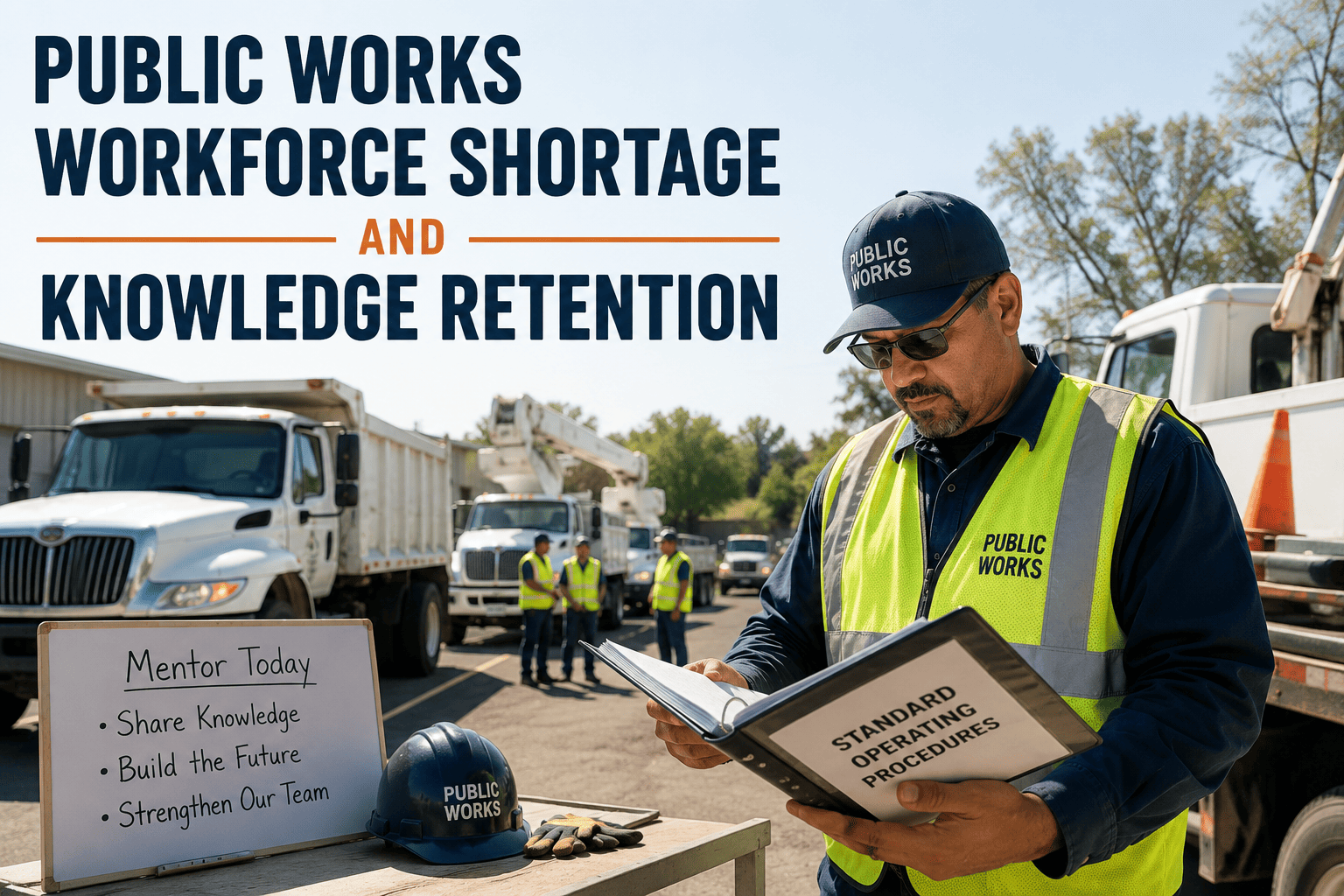
The public works workforce shortage is no longer a future concern — it is an operational crisis hitting municipal agencies today. With an estimated 40% of public works employees eligible to retire by 2030, local governments are losing decades of undocumented maintenance expertise on asset maintenance, fleet repair, and infrastructure management. Every retiring technician takes critical knowledge of aging water systems, road networks, and specialized equipment out the door, leaving thinner crews to manage complex assets with paper binders and reactive maintenance strategies. Capturing this institutional knowledge before it walks out the door — and bridging the public works skills gap — requires a digital-first approach to workforce strategy. You can Start Free Trial of OxMaint today to begin digitizing your maintenance workflows.
40% of your most experienced public works crew could retire by 2030. Is their knowledge captured?
The municipal workforce shortage is draining institutional expertise from water plants, fleet garages, and street departments. Reactive maintenance and paper work orders cannot bridge the gap. OxMaint digitizes decades of maintenance know-how so new hires inherit a system — not a blank slate.
Why the public works labor shortage is a knowledge emergency
Public works departments nationwide are operating with crews 20–30% smaller than a decade ago while infrastructure ages. The American Public Works Association reports that the public sector workforce shortage is most acutely felt in specialized trades — heavy equipment mechanics, water treatment operators, and traffic signal technicians. When these professionals retire, they don't just leave a vacancy; they leave a knowledge void. Unlike a factory where equipment manuals live in a central database, municipal maintenance has long relied on "tribal knowledge" — the veteran mechanic who knows that Pump #3 leaks if you torque the flange above 60 ft-lbs, or the streets supervisor who can patch a particular intersection in half the time because he knows the soil conditions.
The government staffing shortage turns minor inefficiencies into major liabilities. Without documented maintenance procedures, new hires take 6–12 months longer to reach full productivity. Emergency repairs take longer because nobody knows where the shutoff valves are or which spare parts fit legacy pumps. Compliance reporting — from FMCSA driver vehicle inspection records to EPA water quality logs — becomes guesswork. The cost of NOT acting is measured in extended equipment downtime, compliance violations, and burned-out crews.
Four pillars of public works knowledge retention and workforce strategy
Addressing the public works retirement wave requires more than hiring. Municipalities need a structured approach to capture, transfer, and sustain operational expertise across staff turnover cycles. Below are the four strategic pillars that resilient agencies are deploying in 2024.
Skills Gap Assessment & Workforce Mapping
Catalog every asset, identify the specific skills required to maintain it, and map those skills to your current crew. Flag single-points-of-failure where only one technician knows a critical procedure. A mid-sized utility (180 assets) identified 43 critical procedures known by a single eligible-to-retire employee in under three weeks using OxMaint's asset-skill matrix.
Structured Apprenticeship & Mentorship Programs
Pair retiring veterans with new hires on active work orders. Use digital checklists so the veteran's procedural knowledge is captured in real time — not in a binder that gathers dust. Agencies report reducing new-hire ramp-up time by 40% when mentorship is tied to structured CMMS work orders rather than shadowing alone.
Digital Knowledge Capture via CMMS
Every completed work order should generate an institutional record — photos of the failure, parts used, torque specs, troubleshooting steps, and time-to-repair. OxMaint's AI automatically extracts patterns from work order history so the next technician — regardless of tenure — sees the most relevant solutions first.
Standardized Preventive Maintenance Schedules
Convert "we've always done it this way" into scheduled PM triggers with step-by-step digital procedures. When a senior operator retires, the PM schedule and its attached instructions stay in the system — ensuring water pumps, generators, and fleet vehicles are maintained to the same standard regardless of who holds the wrench.
A 90-day plan to capture retiring knowledge before it walks out the door
Knowledge retention in government settings cannot be a five-year strategic plan — it must be an immediate, tactical sprint focused on the highest-risk expertise. Use this 90-day timeline to build a digital knowledge baseline before the next retirement notice lands on your desk.
Audit & Risk Identification
Import all asset records into OxMaint. Flag every asset maintained primarily by staff within 5 years of retirement. Conduct exit-interview-style knowledge sessions with veterans: record 30-minute video walkthroughs of the 10 most complex maintenance procedures. Upload photos, manuals, and handwritten notes to each asset profile.
Digitize Procedures & PM Schedules
Convert paper PM checklists into digital work order templates inside OxMaint. Have retiring staff validate each step. Attach torque specs, safety warnings, required PPE, and parts lists to every task. Set up automated PM triggers so schedules don't depend on institutional memory.
Mentored Execution & System Go-Live
Route all new work orders through OxMaint. Pair veterans with junior staff; require the junior technician to complete the digital work order while the veteran supervises. The system captures photos, parts, and notes in real time — building a searchable knowledge base with every completed job.
How OxMaint solves the public works knowledge retention crisis
OxMaint is built for the realities of municipal maintenance — aging infrastructure, shrinking crews, and the urgent need to capture expertise before it disappears. Here is how OxMaint's AI-powered CMMS and EAM platform maps directly to the workforce shortage challenge.
Digital Work Orders with Built-In Procedures
Eliminate paper work orders forever. Every OxMaint work order carries step-by-step instructions, safety protocols, parts lists, and photo documentation. New technicians follow validated procedures — not memories — reducing training time by up to 50% and eliminating guesswork on critical infrastructure.
Automated Preventive & Predictive Maintenance
Don't let retirement waves interrupt your PM schedules. OxMaint automatically generates preventive maintenance work orders based on meter readings, calendar intervals, or condition triggers. AI-driven predictive analytics flag asset failure patterns before they become emergencies — so institutional memory isn't the only early-warning system.
Centralized Asset & Equipment Knowledge Base
Every pump, vehicle, generator, and traffic signal gets a permanent digital record — manuals, repair history, photos, parts cross-references, and vendor contacts. When a 30-year veteran retires, their knowledge stays in the asset profile, not in their head. Search any asset and instantly see everything known about it.
Maintenance Analytics & Compliance Reporting
Generate FMCSA, EPA, and internal audit reports in one click. OxMaint tracks mean time to repair (MTTR), mean time between failures (MTBF), PM compliance rates, and labor hours by asset. Demonstrate compliance and operational readiness even with a leaner, less-experienced crew.
From retirement risk to operational resilience: a municipal scenario
BEFORE OXMAINT
A city public works department with 220 assets — including water pumps, fleet vehicles, and HVAC units across 12 facilities — faced the retirement of its lead mechanic with 28 years of experience. Maintenance was managed via paper work orders and three-ring binders. Critical procedures lived only in the mechanic's head. PM compliance hovered around 52%. Unplanned downtime cost an estimated $48,000 annually in emergency contractor labor and overtime.
AFTER IMPLEMENTING OXMAINT
Over a 60-day deployment, the department digitized 180 work order templates, imported all asset records with attached manuals and photos, and ran the lead mechanic through structured knowledge-capture sessions tied to each asset. Within six months, PM compliance rose to 94%, unplanned downtime dropped 38%, and two new hires reached full productivity in 4 months instead of the historical 10-month average. The retiring mechanic's expertise now lives permanently in OxMaint — searchable by any technician, any time.
Stop losing expertise with every retirement. Start capturing it with OxMaint.
Your most experienced crew members won't be there forever. Book a 30-minute demo and see how OxMaint digitizes institutional knowledge, automates preventive maintenance, and gets new hires productive in half the time.
Public works workforce shortage and knowledge retention: what you need to know
What is causing the public works workforce shortage?
The public works workforce shortage is driven by a convergence of factors: a massive retirement wave (40% of public sector maintenance staff are eligible to retire by 2030), fewer young workers entering skilled trades, uncompetitive public-sector wages compared to private industry, and a lack of structured apprenticeship pipelines. The result is a municipal staffing shortage where vacancies stay open 90+ days and remaining crews absorb unsustainable overtime loads.
How can municipalities capture retiring employees' knowledge?
Municipalities capture retiring knowledge by deploying a CMMS like OxMaint that digitizes work orders, attaches procedural instructions and photos to every asset, and records completed maintenance history in a searchable database. Pair this with structured exit interviews, video walkthroughs of complex procedures, and mentorship programs where veterans validate digital checklists alongside junior staff. Book a demo to see how OxMaint structures knowledge capture.
What is the public works skills gap and how does it affect maintenance?
The public works skills gap is the difference between the specialized technical expertise required to maintain aging municipal infrastructure (water systems, fleet, traffic signals, HVAC) and the skills available in the current labor pool. It affects maintenance by extending repair times, increasing unplanned downtime, raising contractor costs, and creating compliance risks when procedures are performed incorrectly or skipped entirely due to lack of trained staff.
How does a CMMS help with government knowledge retention?
A CMMS like OxMaint helps government agencies retain knowledge by centralizing asset records, maintenance history, procedural instructions, parts data, and compliance documentation in one searchable platform. When a technician retires, their accumulated expertise — encoded in thousands of completed work orders, photos, and validated PM templates — remains accessible to every future employee. This transforms institutional memory from a single-person dependency into an organizational asset. Start your free trial to begin building your knowledge base.
How long does it take to implement a CMMS for public works knowledge capture?
A focused OxMaint deployment for a mid-sized public works department (150–250 assets) typically takes 30–60 days. The first 30 days focus on importing asset data and digitizing critical PM schedules. Days 31–60 involve validating procedures with senior staff and rolling out digital work orders to the full crew. Knowledge capture is ongoing — every work order completed in OxMaint adds to the institutional knowledge base automatically.
Your infrastructure outlasts your workforce. Make sure the knowledge does too.
Join the public works agencies using OxMaint to digitize maintenance, preserve institutional expertise, and keep operations running — no matter who retires next. See it on your assets in 30 minutes.
Free 14-day trial · No credit card required