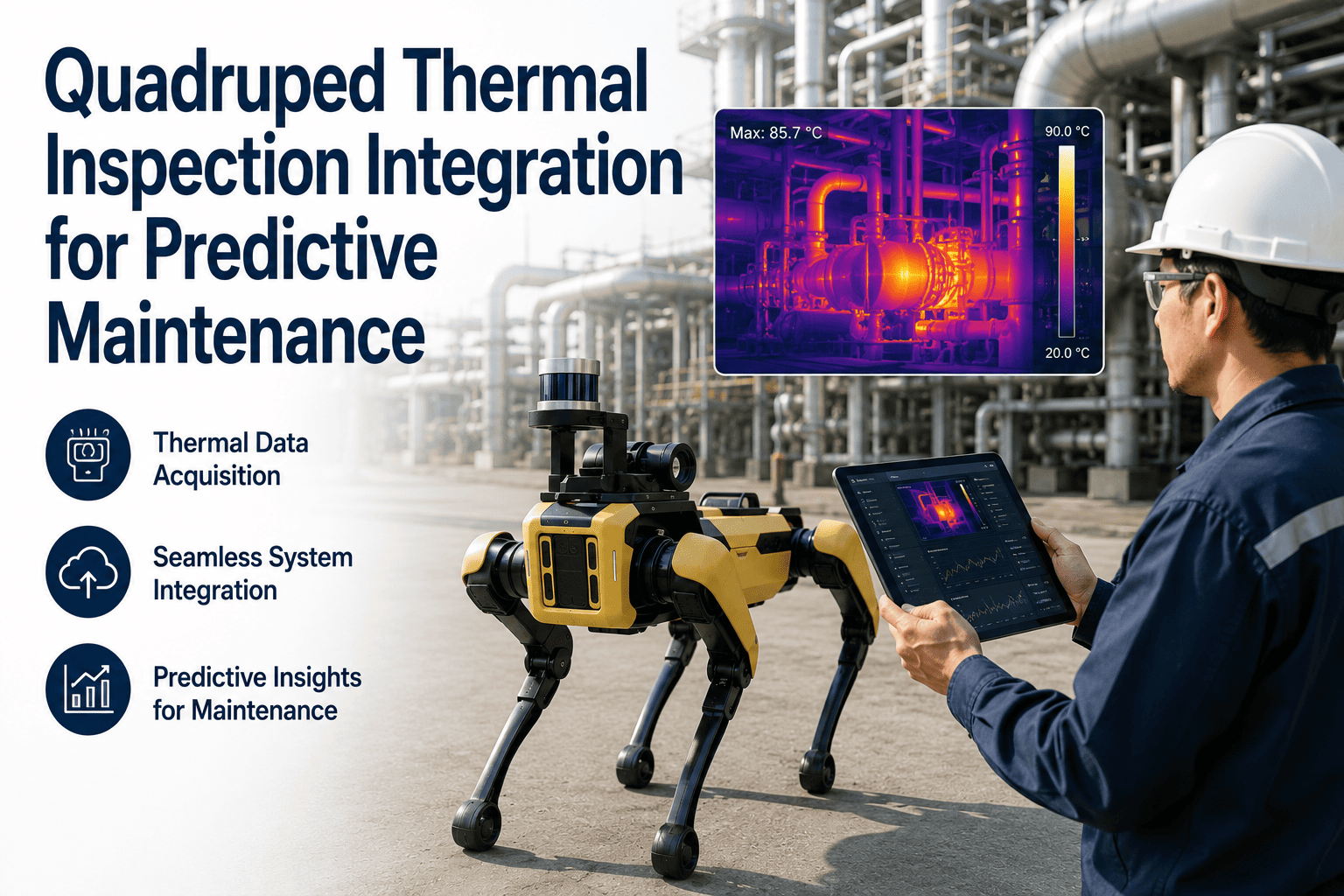
Thermal imaging mounted on quadruped robots gives government maintenance teams a powerful early warning system for electrical faults, bearing overheating, insulation failure, and pipeline blockages — but that warning only reaches the right people when it flows directly into a predictive maintenance workflow. Without integration, thermal anomalies sit in inspection reports that technicians rarely review on the same timeline as the heat signature that triggered them. Public works facilities running Oxmaint's predictive maintenance platform convert quadruped thermal findings into PM-adjusted work orders automatically, reducing emergency repair incidents on critical infrastructure by up to 48% in the first year. Book a demo to see how thermal findings from your robot become predictive maintenance triggers in Oxmaint, or sign up free to import your current asset register and configure your first thermal threshold.
What Thermal Anomalies Predict — and What It Costs to Miss Them
Electrical Connection Overheating
High Leads to arc flash, panel failure, service outage
Motor Bearing Hot Spot
High Average motor replacement cost: $8,000–$25,000
Pipe Insulation Degradation
Moderate Leads to heat loss, condensation damage, regulatory flag
Switchgear Thermal Signature
High Switchgear replacement: $50,000–$300,000+ for public utilities
Roof / Building Envelope Leak
Lower Early detection cuts remediation cost by 60–80%
How the Thermal-to-Predictive Maintenance Loop Works
Predictive
Maintenance
Loop
1
Thermal Scan Executed
Robot patrols asset zones, capturing IR temperature data per equipment point on a scheduled route.
2
Threshold Comparison
Each reading is measured against the normal operating baseline and delta-T limits stored in Oxmaint's asset profile.
3
PM Trigger or WO Creation
Moderate exceedances advance the next PM date; critical exceedances generate an immediate corrective work order.
4
Repair and Baseline Reset
After technician sign-off, Oxmaint updates the asset's thermal baseline and logs the intervention for trend analysis.
5
Pattern Analysis
Recurring thermal anomalies on the same asset class trigger PM schedule review across all similar equipment in the registry.
Turn Thermal Data Into Predictive Maintenance Actions
Oxmaint converts every thermal finding from your quadruped robot into a PM trigger or corrective work order — automatically, with the full heat map evidence attached.
Thermal Inspection Data: Integration Comparison
| Integration Scenario |
Manual PDF Workflow |
Oxmaint Thermal Integration |
| Time to generate work order from finding |
24–72 hours |
Under 3 minutes |
| PM schedule adjustment |
Manual review required, often skipped |
Automatic based on delta-T threshold rules |
| Heat map image storage |
Separate file server, not linked to asset |
Embedded in work order, linked to asset record |
| Trend visibility across patrol cycles |
Not available without manual analysis |
Automatic trending per asset per zone |
| Audit documentation |
Manual assembly per audit request |
On-demand export, timestamped and locked |
Thermal inspection from a quadruped robot is probably the highest ROI predictive maintenance data a government facility can collect — because the faults it catches early are exactly the ones that become six-figure emergencies when missed. The critical variable is how fast the thermal reading becomes a maintenance action. Teams I've worked with that have automated that conversion consistently achieve 30–50% reductions in emergency repair spend within two budget cycles.
— Predictive Maintenance Program Director, State Infrastructure Authority
Frequently Asked Questions
What temperature delta threshold should government teams use to trigger a work order?
Standard electrical maintenance guidelines (NFPA 70B and IEC standards) suggest triggering immediate corrective action when a connection or component exceeds ambient by more than 15°C, and a PM review when delta-T exceeds 5°C. Oxmaint allows government teams to configure custom thresholds per asset class so industrial pump motors and office building electrical panels follow different sensitivity rules.
Book a demo to see how threshold templates are configured for public sector asset types.
Can thermal data from the robot update PM intervals in real time without manual approval?
Yes — Oxmaint supports both fully automated PM interval adjustment and a supervised mode where thermal findings flag PM records for a maintenance manager to approve before the schedule changes. Most government teams start in supervised mode for the first 60–90 days to validate threshold accuracy, then switch to automation after confirming their baseline configuration against actual asset behavior.
Start free to configure your first thermal-driven PM rule.
How does Oxmaint store thermal imagery for NFPA compliance documentation?
Heat map images from each thermal inspection patrol are stored as attachments to the corresponding work order or PM record in Oxmaint, with a locked timestamp, technician ID, and asset identifier. This creates the documentation chain required by NFPA 70B for electrical thermography programs — including before-condition images, post-repair verification images, and the measurement data from each patrol cycle.
What government facility types see the fastest ROI from quadruped thermal inspection integration?
Water treatment facilities, electrical distribution stations, and large HVAC-heavy government buildings typically see the fastest ROI — because these environments combine high thermal anomaly frequency, high failure replacement costs, and strict compliance requirements for inspection documentation.
Talk to our team about case data from facilities matching your asset profile and service environment.
Predictive Maintenance Only Works When Thermal Data Drives Action
Oxmaint turns every degree of temperature deviation into a scheduled maintenance event — before the failure cost lands in this year's emergency repair budget.