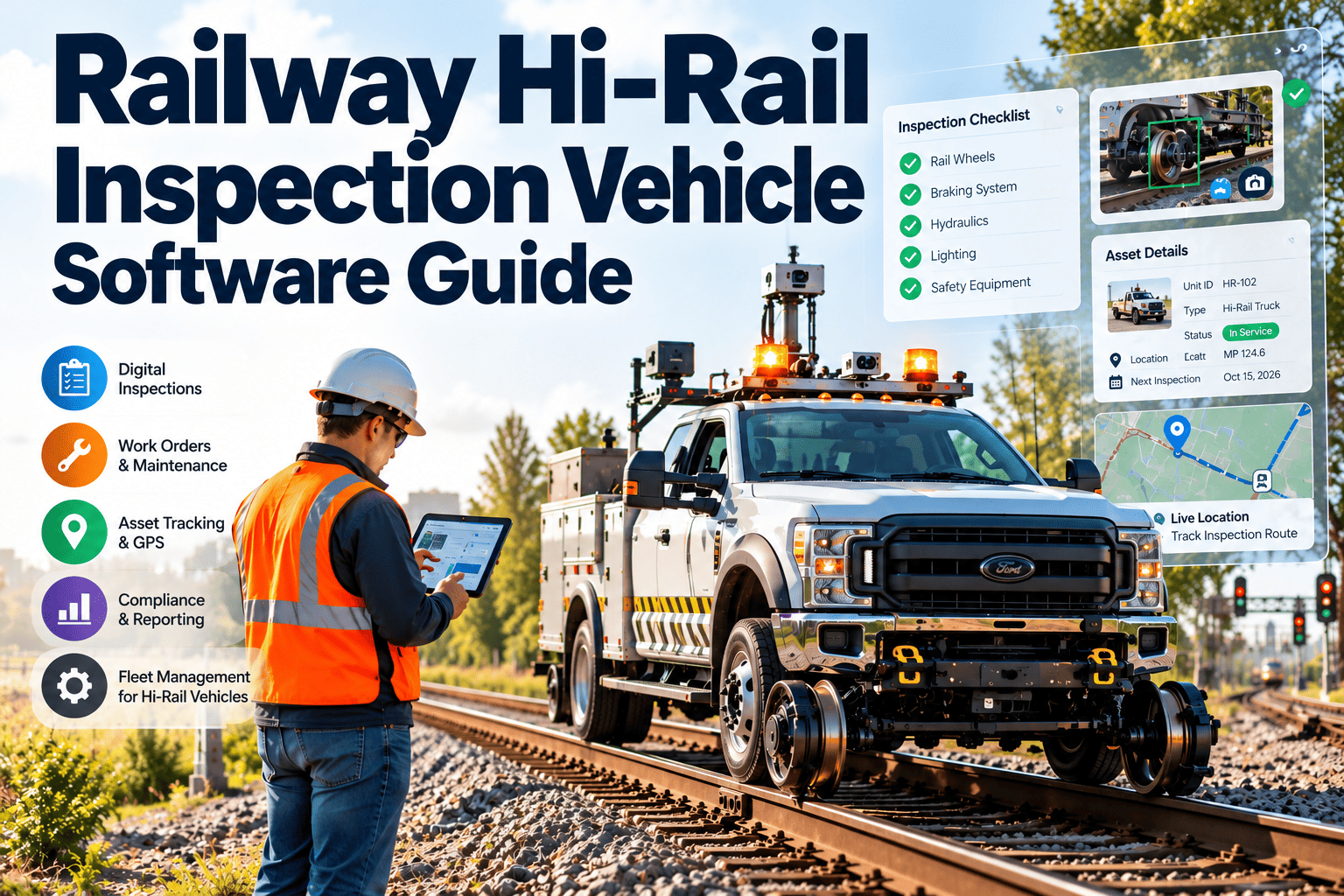
Hi-rail inspection vehicles do more than carry a track inspector from one milepost to the next. Many now carry geometry measurement systems, ultrasonic rail flaw detection equipment, cameras and positioning hardware, and each produces data that must be matched to a defect, a work order and a regulatory record. Railroads and transit agencies struggle when that data lands in separate files with different location references. This guide explains the data streams, the compliance context and how a railway CMMS can turn hi-rail findings into tracked maintenance from detection to repair.
Railway Hi-Rail Inspection Vehicle Software: Manage Geometry and Ultrasonic Data Streams
What a Hi-Rail Inspection Program Has to Manage
A hi-rail vehicle is a road vehicle fitted with retractable rail wheels. Track inspectors use them for visual inspections, and some are equipped for measurement and flaw detection. Each use creates records that must be accurate and retrievable.
The vehicle
The inspector
The track
The Regulatory Backdrop
In the United States, track safety standards are set in 49 CFR Part 213 and enforced by the Federal Railroad Administration. They cover track geometry, inspection, rail flaw testing and remedial actions by track class.
Always confirm current thresholds and intervals in the regulation and your railroad's internal standards. Transit and non-FRA systems may follow different rules.
Geometry Data: From Exceptions to Work
Geometry systems measure track shape as the vehicle travels. Typical parameters include gauge, alignment, profile, crosslevel, warp and surface. Output is usually a set of exceptions located by milepost or GPS.
Common challenges with geometry data
Ultrasonic Rail Test Data: Handling Flaw Indications
Ultrasonic testing detects internal rail flaws, such as transverse defects, that visual inspection cannot find. Rail test vehicles, including hi-rail units, record indications that must be verified, classified and acted on.
The time between detection and remedial action is the key operational control. A CMMS can timestamp each stage and escalate overdue steps.
Connect Hi-Rail Findings to the Crews Who Fix Them
Comparing Data Streams
| Data stream | What it detects | Typical output | Maintenance response |
|---|---|---|---|
| Geometry | Deviations in track shape | Exceptions by location | Surfacing, lining, gauge correction, tie work |
| Ultrasonic | Internal rail flaws | Indications, verified defects | Rail replacement, restrictions, planned removal |
| Visual inspection | Surface and component defects | Notes, photos, exceptions | Fastener, tie, joint and ballast repair |
| Vehicle condition | Hi-rail unit readiness | Inspection checklists, PM | Maintenance, sensor calibration, repair |
Maintaining the Hi-Rail Vehicle Itself
The measurement is only as good as the equipment. Poorly maintained rail wheels, brakes or sensors can create safety risks and unreliable data.
Often missed
- Rail wheel wear and gauge checks
- Warning light and horn functions
- Sensor and encoder calibration records
- Camera and GPS reliability
- Pre-trip inspection documentation
Tracked in a CMMS
- Pre-trip checklists on mobile devices
- Meter-based and calendar PM
- Calibration due dates with alerts
- Repair work orders and parts history
- Downtime by vehicle and component
A Workflow From Run to Repair
Plan the run
Pre-trip check
Collect data
Review and match
Create work
Repair and verify
Risk View: Prioritising Track Defects
Priorities should follow your regulations and engineering policy. The CMMS helps apply them consistently and keeps the evidence.
KPIs for Hi-Rail and Track Inspection
Oxmaint Capabilities for Railway Teams
- Asset management for track segments, switches, crossings, bridges and vehicles
- Inspection forms with required fields, photos and signatures
- Preventive maintenance for hi-rail vehicles and measurement equipment
- Corrective work orders linked to track defects and milepost location
- Mobile access for inspectors and maintenance-of-way crews
- Inventory for rail, joint bars, ties, fasteners and vehicle parts
- Reports for overdue items, defect aging and compliance records
Raw geometry and ultrasonic files are normally processed in dedicated tools. Oxmaint manages the resulting actions and records, with data delivery set up to suit your systems.
Location Referencing: The Hidden Problem
Every data stream describes the same track, yet each may use a different location reference. Without a common key, a geometry exception and a flaw indication at the same spot look unrelated.
Milepost
GPS coordinates
Engineering station
Practices that reduce mismatches
- Define one primary location key per subdivision and track
- Store track identifiers, such as main, siding or yard, with every record
- Record the reference point and direction of travel for each run
- Group defects within a set distance into one location record
- Verify the location in the field before the repair crew is dispatched
Evidence Inspectors and Auditors Look For
Regulatory reviews rely on records that show inspections occurred, defects were found, and action was taken. Missing information weakens even sound field work.
Common Failure Points in Hi-Rail Programs
Condition Trends and Predictive Planning
Repeated runs create a history of geometry and flaw data. Trends make it possible to plan work before a defect reaches a limit that demands urgent action.
- Compare successive geometry runs to see how quickly a surface or alignment exception grows
- Track rail wear and defect frequency by rail section, curve and tonnage
- Combine inspection data with tie, ballast and drainage records to find the cause of repeated defects
- Prioritise tamping, tie renewal and rail replacement by trend and traffic exposure
- Use trend reports to support annual maintenance-of-way budgets
Advanced forecasting often uses specialist analytics. A CMMS provides the maintenance history those models need and records the planned work that results.
Implementation Checklist for Railway Teams
- Train inspectors and crews on the same forms and defect codes before go-live
- Review the first month of data with field staff and correct unclear fields
- Confirm each vehicle has a PM plan and calibration schedule before assigning runs
Start with one subdivision, prove the data flow from run to repair, then extend to other territories and vehicle types.
Safety and Operational Discipline Around Hi-Rail Use
Operating on live track is a high-risk activity. Maintenance records can support, but never replace, the railroad's operating rules and on-track safety procedures.
Before entering track
During the run
After the run
- Track vehicle defects reported by operators and time to repair
- Keep qualification and training records alongside inspection assignments where your policy requires
- Review incidents and near misses against vehicle condition and inspection practice
Transit, Short Line and Industrial Railways
Not every operator follows the same framework as a Class I railroad. Short lines, transit agencies and industrial railways have different budgets, rules and inspection tools, yet they share the same record-keeping need.
Smaller railroads
- Often rely on visual hi-rail inspection by a small team
- Use contract geometry or rail test services
- Need simple records that show what was found and fixed
- Benefit from mobile forms and basic scheduling
Transit and metro systems
- May follow state or agency safety oversight rules
- Inspect during limited overnight windows
- Manage third rail, signals and track on one schedule
- Need work order coordination across departments
In both cases, linking inspection results, defect work and vehicle maintenance reduces the chance that a finding is lost between teams.
Reporting Hi-Rail Programs to Management
Track maintenance leaders need a short list of measures that show whether inspection effort is turning into safe, timely repairs.
- Segments inspected on time versus overdue, by subdivision and track class
- Open defects by type, age and restriction status
- Average time from verified flaw to remedial action
- Locations with repeated defects over the last several inspection cycles
- Hi-rail vehicle availability, downtime causes and overdue calibrations
- Work orders completed per crew and materials consumed per repair
When these figures come from the same records that crews update daily, managers can answer regulator and executive questions without compiling separate reports.