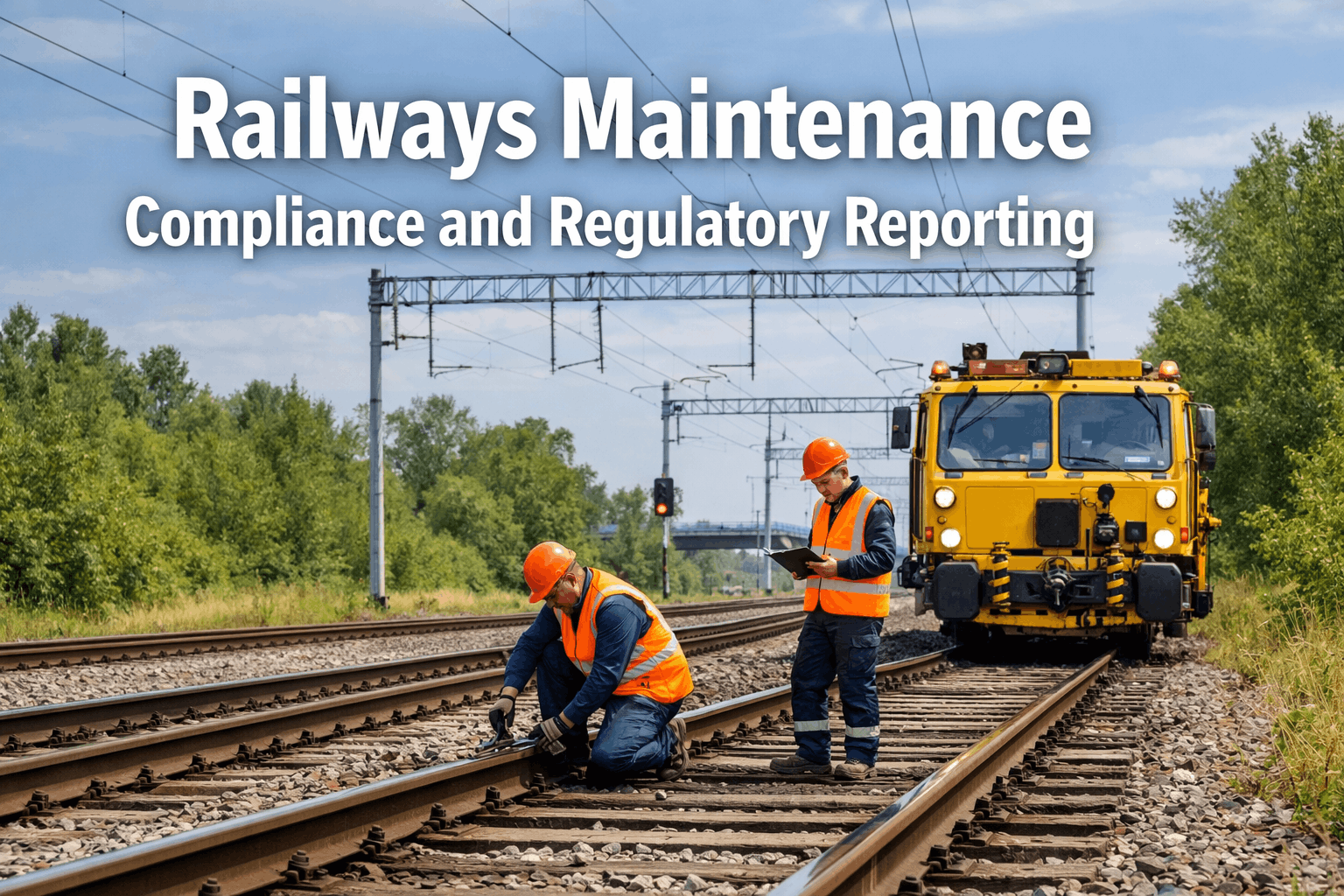
Railways Maintenance Compliance and Regulatory Reporting
By Taylor on March 13, 2026
Rail safety in public infrastructure is not self-certifying. Every track kilometre, every signal gantry, every bridge bearing, and every level crossing operated by a public rail authority carries with it a legally enforceable obligation to inspect, record, report, and demonstrate. The Office of Rail and Road does not accept intentions or assurances — it accepts documented evidence. The Rail Accident Investigation Branch does not work from estimates or reconstructions — it works from timestamped, signed, verifiable records. Network Rail's control period framework does not reward effort — it rewards measurable asset condition improvement backed by traceable data. Public rail authorities that cannot produce this evidence on demand are not simply inconvenienced by compliance obligations — they are exposed to enforcement action, reputational damage, and in serious cases, statutory intervention that removes operational authority entirely. The transformation from compliance vulnerability to compliance confidence is not a matter of working harder on paperwork. It is a matter of building a maintenance system that generates the required evidence automatically, as a natural output of every inspection completed and every work order raised. Oxmaint AI delivers exactly this: a compliance infrastructure that turns your maintenance programme into a continuous, self-documenting safety management system. Speak to our regulatory compliance specialists about your authority's specific obligations.
Your Compliance Calendar — Active Obligations
Q1
ORR Monthly
ISO Clause 9.1 Review
Q2 ← Now
NR CP7 Quarterly — 14 Apr
Internal Safety Audit — 28 Apr
ORR Monthly
Q3
ORR Monthly
NIS2 / CAF Review
Q4
ORR Annual SMS Report
ISO 55001 Cert Audit
NR CP7 Year-End
ORR Monthly
Major statutoryPeriodic regulatoryCybersecurityOngoing
With Oxmaint AI — every deadline above is met by automated evidence, generated continuously from live operations
Public Rail Authorities · Regulatory Evidence Platform
Automated ORR, RAIB, ISO 55001, and Network Rail compliance evidence — generated continuously from every inspection, work order, and sensor alert across your network. No manual data assembly. No compliance gaps. No deadline pressure.
THE REGULATORY RISK OF INADEQUATE EVIDENCE — WHAT IS AT STAKE
Enforcement Notice
ORR can issue improvement notices and prohibition notices where safety management evidence is insufficient — requiring immediate operational changes at the authority's cost
RAIB Investigation Exposure
Without a complete inspection history, any incident triggers prolonged RAIB investigation — including public reporting of systemic evidence failings that become permanent public record
ISO 55001 Certification Loss
Failure to demonstrate documented information requirements under ISO 55001 Clause 7.5 can result in certification suspension — impacting procurement eligibility and insurance terms
NIS2 Cyber Obligations
Rail authorities as Operators of Essential Services face NIS2 security reporting obligations — non-compliance with incident reporting and audit trail requirements carries significant financial and reputational risk
What Regulators Actually Inspect — And What Oxmaint AI Produces
Understanding compliance requirements in abstract terms is not enough. Every regulatory framework translates into a specific list of questions that inspectors, auditors, and investigators will ask — and a specific list of evidence items they will request to see. The mapping below shows exactly what each regulator examines when they visit your authority, and precisely how Oxmaint AI generates the evidence required to answer each challenge with verifiable, field-sourced documentation.
ORR
Office of Rail & Road Safety Management System
Inspector Will Ask / Request
Show me your inspection completion records for the past 12 months for all safety-critical assets
What is your process for identifying, recording, and escalating defects found during inspection?
Demonstrate that inspections are completed by competent, qualified engineers — with proof of sign-off
Show the link between inspection findings and maintenance action — closed defects only
How do you demonstrate continuous improvement in your safety management system performance?
Oxmaint AI Evidence Ready
Live inspection completion rate dashboard — asset-by-asset schedule adherence, overdue checks flagged, 12-month history with one-click export
Tamper-proof defect log with timestamp, GPS, photo, severity grade, and complete escalation chain to work order creation
Engineer digital signature on every completed record — identity verified, competency record linked, inspection assigned to specific individual
Finding-to-closeout traceability — every defect linked to its work order, intervention record, and sign-off. Zero unlinked open defects visible instantly
Predictive vs reactive ratio trending — documented improvement trajectory across consecutive reporting periods with statistical confidence
RAIB
Rail Accident Investigation Branch
Post-incident evidence — typically demanded within 72 hours
Critical — no time buffer
What RAIB Demands
Complete inspection history for the asset — every inspection, every finding, every sign-off, going back as far as available
Evidence of tamper-proofing — that records have not been altered since creation (chain-of-custody integrity)
All maintenance interventions on the asset — work orders, possession records, intervention outcomes
IoT and sensor data for the asset and adjacent infrastructure — structural, environmental, operational context around the incident time
Oxmaint AI Response Time
Under 5 min
Full inspection history for any asset — searchable by date, engineer, finding type, or severity. Exportable as signed PDF with evidence index
Instant
Cryptographic hash verification tool — independent integrity proof without access to internal systems, RAIB-ready
Under 5 min
Complete maintenance action history — work order chain, possession dates, contractor records, QA sign-off
On demand
IoT signal export for specified asset and time window — raw data with engineering units, anomaly detection flags overlaid
Defect trend analysis by asset class — improving/deteriorating trajectory
Work order close-out rates and intervention effectiveness scoring
Automated Compliance Platform
Every Regulatory Obligation. One Platform. Zero Manual Assembly.
Oxmaint AI generates ORR, RAIB, ISO 55001, CP7, and NIS2 compliance evidence continuously — from every field inspection, every work order, every sensor alert. When your regulator calls, your evidence is already complete.
avg annual hours saved on compliance report preparation
6 wks → 1hr
RAIB evidence pack assembly — before vs. after Oxmaint
100%
of inspection records cryptographically sealed and tamper-evident
The Old Way vs The Oxmaint Way — Compliance Activity Comparison
The difference between a vulnerable compliance programme and a robust one is not measured in the effort applied — most rail authorities apply considerable effort to compliance. It is measured in the architecture of the evidence generation process: whether evidence is a retrospective reconstruction or a continuous operational output. The comparison below shows how Oxmaint AI transforms each major compliance activity from a periodic burden into an automated background process.
Compliance Activity
Without Oxmaint AI
With Oxmaint AI
01
Annual ORR Safety Report
3 engineers, 6 weeks, 17 spreadsheets, retrospective data assembly with unresolvable gaps
One click. Live operational data formatted to ORR template. Ready any day of the year.
02
RAIB Evidence Pack
6–8 weeks of investigation, incomplete paper records, reconstructed maintenance history, legal exposure from gaps
Under 5 minutes. Complete, cryptographically verified, tamper-proof asset history. Instantly available 24/7.
03
ISO 55001 Cert Audit
Weeks preparing documented information index, manual extraction of asset condition records, risk register from multiple systems
Pre-built ISO 55001 evidence pack — Clause 7.5 documentation index populated from live asset register automatically.
04
NR CP7 Quarterly Report
Manual extraction from CMMS, spreadsheet calculations, inconsistent metric definitions across quarters, deadline stress
Auto-populated NR template with live CP7 KPIs. Quarterly reports generated the morning after each quarter closes.
05
ORR Inspector Visit
Frantic preparation in the days before. Risk of inspectors finding gaps that are known but not yet resolved. Defensive posture throughout.
Regulator View access provisioned in 2 minutes. Live, verified dashboard. Inspector reviews real-time data with confidence.
CAF evidence pack auto-generated from zero-trust access logs, OT anomaly records, and governance compliance status.
Audit Trail Architecture — From Field Action to Regulatory Evidence
The integrity of a compliance record is only as strong as the architecture that creates it. Oxmaint AI's audit trail is not a log that records activity — it is a cryptographic chain that mathematically proves the authenticity and completeness of every compliance record from the moment of creation. The architecture below shows exactly how each layer of the system contributes to building an evidence base that satisfies the most demanding regulatory and legal scrutiny.
L1
Field Capture
Mobile Inspection + IoT Sensor Data
Engineer completes structured checklist on mobile device. Photo, GPS coordinates, condition rating, and digital signature captured at the point of action. IoT sensor signals polled simultaneously from track, structure, and signals infrastructure. Every data point timestamped to millisecond precision at source.
Record transmitted → platform encrypted in transit (TLS 1.3)
L2
Cryptographic Seal
Tamper-Proof Hashing + Immutable Log
On receipt, every record is cryptographically hashed — a mathematical fingerprint of the record content, user identity, and server timestamp that changes detectably if any character of the record is altered. The hash is written to an append-only audit log using a linked-hash architecture: each new entry references the hash of the previous entry, creating a chain where any historical tampering breaks the entire sequence. No system administrator can alter or delete a signed record.
AI analysis triggered → anomaly detection and classification applied to live data
L3
AI Classification
Explainable AI Decision Logging
AI classification models assign defect severity, identify patterns, and generate predictive maintenance recommendations. Every AI decision is logged with full explainability output — the specific features of the record that drove the classification, the confidence score, and the model version applied. This explainability log satisfies ISO 42001 AI governance requirements and provides a verifiable basis for any work order generated by algorithmic recommendation rather than direct engineer judgement.
CMMS work order auto-created → bidirectional sync with SAP PM, Maximo, Infor
L4
CMMS Integration
Work Order Evidence Chain + CMMS Sync
Work orders created from compliance data carry full evidence linkage — inspection record, AI classification, defect photos, recommended possession window — all embedded in the work order record. CMMS sync is bidirectional: work order status changes in SAP/Maximo/Infor are reflected in the compliance dashboard in real time. Completion and sign-off records flow back to Oxmaint and are appended to the asset's compliance history, closing the evidence loop from defect identification to intervention verification.
SAP PM / MaximoBidirectional syncEvidence linkageLoop closed on completion
CMMS Linked
Regulatory report engine aggregates all layer data → framework-specific output generated on demand
L5
Regulatory Output
One-Click Regulatory Reports + Regulator Access
The report engine draws from all four underlying layers to generate framework-specific compliance reports on demand — ORR annual SMS, RAIB evidence packs, ISO 55001 documented information packs, NR CP7 quarterly, NIS2 CAF evidence indices. All reports are formatted for the target framework, cryptographically sealed at generation, and include an evidence index enabling regulators to drill to source records. A dedicated Regulator View access profile can be provisioned in under two minutes, giving inspectors direct read-only access without involving IT.
ORR SMSRAIB PackISO 55001NR CP7NIS2 CAF
Reports Live
Data Governance & Zero-Trust Cybersecurity
Compliance Evidence That Is Secure, Classified, and Retained for the Right Duration
Regulatory evidence is only valuable if its integrity is beyond dispute. Oxmaint AI governs every category of compliance data with defined retention periods, classification-based access controls, zero-trust authentication, and cryptographic sealing — automatically enforced, without reliance on manual records management or individual administrator judgement.
statutory inspection record retention enforced automatically
MFA + ZT
multi-factor + zero-trust on all compliance data access
NIS2
CAF evidence pack auto-generated from OT security logs
Data Retention & Governance by Compliance Category
Every category of compliance data that Oxmaint AI generates is subject to a defined governance policy — specifying the retention period required by the applicable regulatory framework, the data classification and access control tier, and the storage architecture that satisfies sovereignty and security requirements. Governance policies are enforced automatically by the platform; no manual records management or retention monitoring is required from the authority's compliance team.
Field Evidence: What Deployment Delivers in Practice
“
The compliance transformation at our authority did not begin with a technology decision — it began with an honest conversation about our regulatory vulnerability. We had seven hundred kilometres of managed infrastructure, a conscientious engineering team, and a genuinely strong maintenance programme. What we did not have was a compliance evidence base that reflected the quality of the work we were actually doing. Our paper inspection forms were completed thoroughly — but filing, retrieval, and verification was chaotic. When an ORR review was announced in late 2023, we spent four months preparing. Two senior engineers essentially stopped doing their core jobs to pull together the evidence pack. We passed the review, but the inspector noted that our evidence organisation was the weakest aspect of an otherwise strong SMS. When we deployed Oxmaint AI in early 2024, the first change we noticed was not in our maintenance outcomes — those were already good. What changed was that every action our engineers took in the field immediately became a permanent, verifiable, retrievable compliance record. By our next ORR engagement six months later, we provisioned regulator access in under three minutes during the inspector's visit. She reviewed our inspection completion data, defect closure rates, and work order history live, in real time, from the previous eighteen months. Her written finding was that our evidence base had moved from the weakest to the strongest aspect of our SMS in a single reporting period. That outcome — achieved by our existing engineering team doing exactly what they were already doing, just with a platform that captured their work properly — is what compliance transformation actually looks like.
Director of Infrastructure, Regional Rail Authority
700km managed network · 6-month deployment · ORR SMS evidence graded strongest aspect at next review
4 mo
Manual preparation time for pre-Oxmaint ORR review — 2 senior engineers diverted from core duties
3 min
Regulator access provisioned during live ORR inspector visit — no IT involvement required
6 months
From deployment to strongest-aspect ORR SMS rating — no change to engineering team or maintenance programme
The case for automated regulatory compliance is not a technology case — it is a safety case and a governance case. Every railway authority that continues to rely on manual evidence assembly carries a compliance risk that is proportional to the complexity of its network and the thoroughness of the regulators that oversee it. The tools to eliminate that risk are available, proven, and deployable without disrupting live operations. Begin your compliance transformation today and give your engineers, your leadership, and your regulator the evidence base that your maintenance programme already deserves.
Transform Your Compliance Programme
Automated Regulatory Evidence From Every Inspection, Every Work Order, Every Day
Oxmaint AI turns your existing maintenance programme into a continuous, self-documenting compliance system. ORR-ready. RAIB-ready. ISO 55001–ready. NIS2-ready. From day one of deployment — without changing how your engineers work in the field.
Annual SMS reports formatted and ready any day of the year
Day 1
Tamper-proof audit trail active from your first digital inspection
Zero
Manual data entry required for any major regulatory submission
Frequently Asked Questions
How quickly can we provision access for an ORR inspector during an unannounced visit?
Oxmaint AI includes a dedicated Regulator View access profile that is provisioned via a mobile-accessible admin panel in under two minutes. The profile grants the inspector read-only access to specified evidence categories — inspection completion records, defect logs, work order histories — without providing access to operational IoT data, financial records, or system configuration. Access is time-limited (default 24–72 hours, configurable), fully logged in the audit trail, and automatically revoked at expiry. A compliance duty manager can provision this access from any mobile device without IT involvement. After the session concludes, a session summary showing every record the inspector accessed is provided to the authority's compliance team automatically.
Can Oxmaint AI generate reports in the exact formats required by ORR and Network Rail?
Yes. Oxmaint AI maintains updated templates for ORR annual safety performance submissions, Network Rail CP7 quarterly reports (in the standard NR Excel template format), ISO 55001 documented information evidence indices, and NIS2 CAF self-assessment evidence packs. Templates are maintained by Oxmaint's regulatory affairs team and updated when framework requirements change. For ORR submissions, the report maps to the standard SMS evidence categories used in ORR inspections. Custom report formats can be configured through the report builder without developer involvement. All generated reports are cryptographically sealed at the moment of generation, so the submission itself is tamper-evident — regulators can verify the report has not been altered between generation and submission.
What happens to our existing paper inspection records when we deploy Oxmaint AI?
Oxmaint provides a structured historical data import service as part of the onboarding programme. Paper inspection records can be digitised through a defined process — scanning, structured data extraction, and quality validation — and imported into the platform's asset history, providing continuity of evidence trail for frameworks that require historical trend data (ISO 55001 and NR CP7 in particular). The platform clearly marks imported historical records as "legacy import" to distinguish them from natively-captured digital records, which is important for integrity transparency. Authorities with an imminent ORR inspection or audit can request accelerated onboarding that prioritises compliance dashboard activation and ORR template configuration ahead of full historical import. For RAIB purposes, the tamper-proof audit trail applies to all records created on the platform from deployment onwards — historical paper records retain whatever evidentiary status they had before.
How does Oxmaint AI handle the NIS2 cybersecurity reporting obligations for rail authorities?
Rail authorities designated as Operators of Essential Services face specific NIS2 obligations including incident reporting, security audit trail maintenance, and CAF self-assessment evidence. Oxmaint AI addresses these through three platform capabilities. The zero-trust access log captures every session, query, and data access event across the entire platform — providing the security audit trail required for CAF Outcome C evidence. The OT cybersecurity dashboard provides real-time visibility of OT network connectivity, protocol anomalies, and integration health across SCADA and IoT connections. The NIS2 CAF evidence pack auto-generates a structured document mapped to the relevant CAF outcomes from the platform's security log data, access control records, and governance compliance status — substantially reducing the effort required for annual CAF self-assessment submissions to the competent authority.
How does the platform handle compliance evidence if network connectivity is lost at a remote rail site?
Oxmaint AI's mobile inspection application operates in full offline mode — engineers can complete structured inspections, capture photographs, apply condition ratings, and attach digital signatures without any network connection. All data is stored locally on the device and queued for synchronisation. When connectivity is restored (on returning to a connected area, or when site connectivity is re-established), all queued records synchronise automatically. Each record retains the GPS timestamp captured at the moment of the field inspection — not the time of synchronisation — ensuring that the evidence trail accurately reflects when the inspection was physically performed. This is important for regulatory purposes, as ORR and RAIB require evidence of when inspections were conducted, not when data was transmitted. Records synchronised from offline mode are clearly marked with offline capture status in the audit trail for complete transparency.