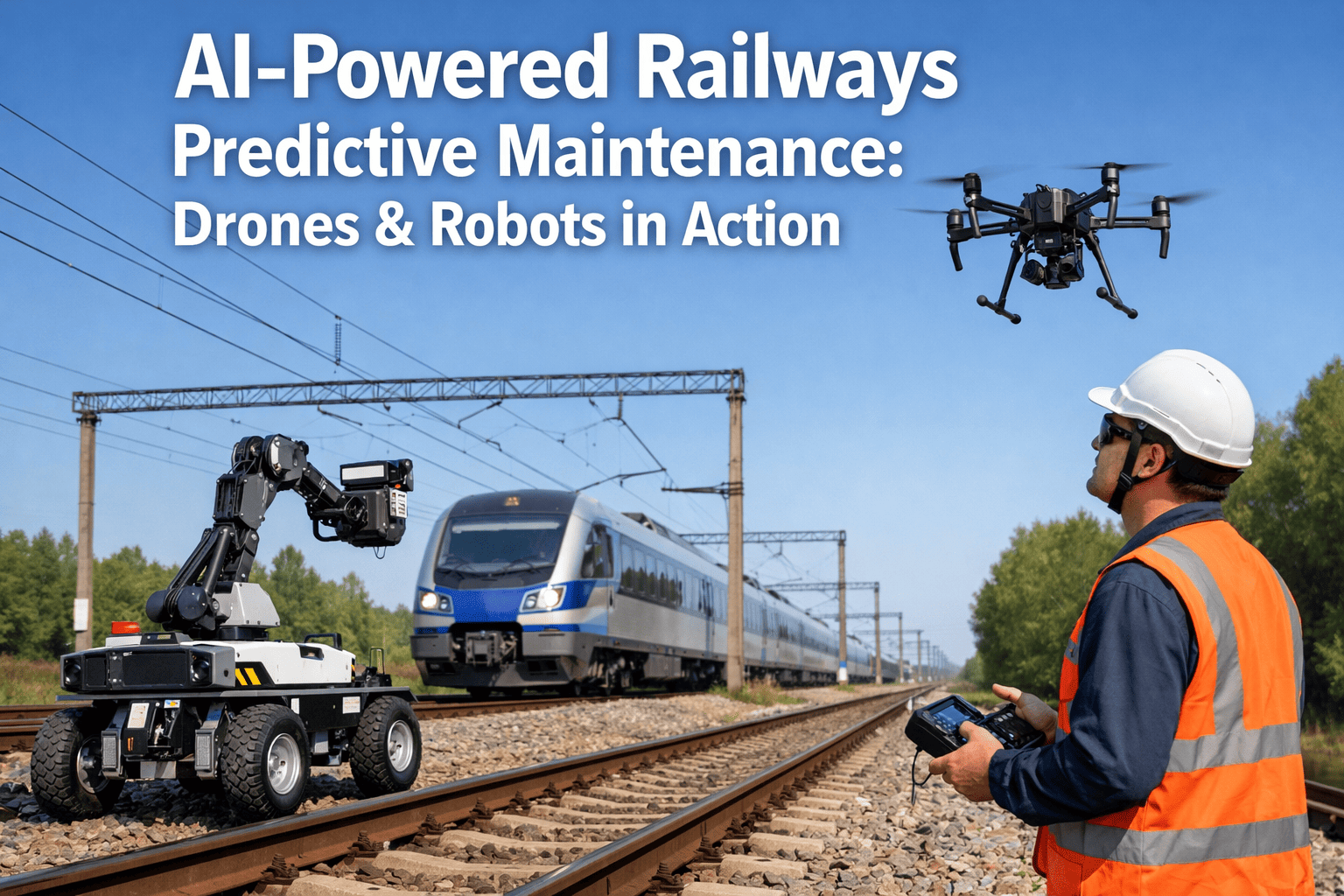
ROI Model for AI, Drones & Robots in Railways Maintenance
By Taylor on February 22, 2026
When a Class I railroad discovers that a $4.2 million bridge abutment failure could have been prevented by a $12,000 drone inspection six months earlier—the ROI question answers itself. But most railway agencies still cannot quantify the return because their drone flights, robot patrols, and AI defect data exist in disconnected silos with no unified cost model. The gap between "we fly drones" and "we prevented $X in failures" is the ROI integration gap—and it is where maintenance budgets are won or lost.
This guide provides railway maintenance directors, track engineers, and programme managers with a comprehensive ROI framework for AI, drone, and robotic inspection programmes in 2026. We cover the complete lifecycle from mission planning and AI defect detection through executive dashboards and cost-savings analytics. Agencies ready to quantify their inspection ROI can start their free trial today.
ROI Reality
The Financial Case for Integrated Inspection Technology
80%
of track defects detectable by AI vision before they trigger slow orders or service disruptions
70%
reduction in manual inspection labour hours when drone and robot patrols replace hi-rail walkdowns
8-12x
typical first-year return on investment for integrated drone, robot, and AI inspection programmes
Source: FRA Safety Data & Industry Benchmarks 2024-2025
Effective railway inspection ROI requires more than purchasing drones and robots. It demands unified mission planning, AI-powered defect classification, automated work order generation, and executive dashboards that translate inspection data into financial outcomes. By adopting an integrated CMMS-connected approach, railway agencies transform inspection technology from a cost centre into a measurable asset protection programme.
The Inspection ROI Lifecycle
Successful ROI delivery follows a structured lifecycle. Each phase—from mission planning through executive reporting—requires specific management activities, data integration, and financial tracking. Skipping steps or managing inspection technologies in silos prevents the organisation from quantifying the return that justifies continued investment and programme expansion.
Inspection ROI Delivery Framework
From technology investment to quantified financial return
Autonomous drone flights, robot patrols, LiDAR/RGB/thermal capture, and AI vision defect classification with severity scoring
03
Analyse & Action
CMMS work order generation, repair prioritisation, temporal change detection, and predictive degradation modelling
04
Measure & Report
Executive dashboards, cost avoidance quantification, programme ROI analytics, and FRA compliance documentation
Implementing a unified inspection management platform allows railway teams to track every mission, defect, and repair in a single system of record. Automated workflows connect drone findings to work orders, ensuring that critical defects drive maintenance action—not just data accumulation. Digital documentation provides the audit trail needed for FRA compliance and transparent capital planning. Book a Demo.
Inspection Strategies: Manual vs. AI-Integrated
Railway maintenance departments must select the appropriate inspection strategy for their network. While traditional hi-rail walkdowns and visual inspections remain necessary for certain tasks, AI-integrated drone and robot programmes offer dramatic advantages in coverage, consistency, and cost. Understanding the financial trade-offs is critical for building the business case that secures programme funding.
Inspection Strategy Financial Comparison
1
Manual / Traditional Inspection
2-5 track-miles inspected per crew per day
Subjective visual assessment, no data continuity
Requires track time and flagging protection
Paper/tablet forms with manual data entry
No temporal change detection between cycles
Defect severity based on inspector experience
$8,000-15,000 per mile fully loaded cost
Slow & Expensive
2
AI + Drone + Robot Integrated
30-50 track-miles surveyed per day per drone unit
Objective AI classification with 94% accuracy
Zero track time required for aerial surveys
Auto-generated CMMS work orders with GPS/photos
Multi-epoch temporal comparison and trending
AI severity scoring against safety thresholds
$800-2,500 per mile fully loaded cost
Fast & Cost-Effective
Choosing the right inspection mix is a strategic decision. Integrated CMMS platforms support hybrid programmes by tracking both manual and robotic inspections in a single system—ensuring consistent defect classification, unified reporting, and accurate ROI measurement regardless of the inspection method used.
AI-Integrated Inspection Impact
Measured improvements from CMMS-connected drone and robot programmes
94%
Defect Detection
AI Vision Accuracy
6x
Faster Coverage
vs. Manual Crews
85%
Cost Reduction
Per-Mile Inspection
100%
Audit Trail
FRA Compliance
Technology Stack: Drones, Robots & AI Analytics
Maximising inspection ROI requires the right technology deployed for the right task. Drones excel at corridor-level surveys, robots handle confined and hazardous environments, AI provides consistent defect classification, and CMMS integration converts data into maintenance action. Each layer multiplies the value of the others. Book a Demo.
Inspection Technology Stack for Maximum ROI
Drone Aerial Inspection
LiDAR, RGB, thermal, and multispectral sensors for track geometry, structure condition, vegetation, and clearance envelope surveys at 30-50 miles/day.
Autonomous Robot Patrols
Track-mounted and crawling robots for bridge under-deck, tunnel, and confined space inspection with CCTV, ultrasonic, and LiDAR sensor packages.
AI Vision & Analytics
Deep learning models for crack detection, ballast assessment, vegetation classification, and temporal change detection with 94% defect identification accuracy.
CMMS Integration & Dashboards
Automated work order generation, executive ROI dashboards, FRA compliance reporting, and predictive maintenance scheduling from unified inspection data.
The ROI Model: Quantifying Returns
Investing in integrated inspection technology delivers substantial, measurable returns. It prevents the catastrophic failures that drain capital budgets, eliminates unnecessary track time that disrupts operations, and provides the condition data that strengthens federal funding applications. The numbers tell a clear story when all cost avoidance is tracked in a unified system.
ROI Model: 500-Mile Railway Corridor
Annual cost comparison — manual inspection vs. integrated AI/drone/robot programme
Manual Inspection Programme
Crew Labour (12 inspectors)$1,440,000
Track Time & Flagging$620,000
Missed Defect Failures (avg.)$3,200,000
Slow Orders / Service Delays$850,000
Annual Cost: $6,110,000
VS
Integrated AI / Drone / Robot
Drone & Robot Fleet Operations$380,000
AI Platform & CMMS Integration$120,000
Reduced Crew (4 operators)$480,000
Prevented Failures (tracked)($2,800,000)
Annual Cost: $980,000
Railways that implement integrated inspection programmes see immediate financial impact: fewer emergency interventions, reduced slow orders, lower insurance exposure, and stronger capital funding applications. The data generated provides the evidence base for long-term asset management strategies that regulators and funders demand.
Quantify Your Inspection ROI
Stop guessing whether your drone and robot investments are paying off. Oxmaint delivers the unified inspection management platform that connects every flight, every patrol, and every AI defect to a tracked financial outcome. See the numbers for your railway.
Building inspection ROI maturity is a journey. It starts with deploying technology and capturing baseline data. From there, agencies advance to AI-automated defect classification, predictive maintenance models, and executive dashboards that quantify every dollar of cost avoidance with auditable evidence chains.
AI Defect ClassificationAuto Work OrdersTemporal Change DetectionCost Avoidance Tracking
Phase 3
Predict & Scale (Month 10+)
Predictive ModelsExecutive ROI DashboardsCapital Plan IntegrationProgramme Expansion
Start by establishing unified mission logs and cost tracking for all inspection activities. Standardise defect classification using AI to eliminate subjective variation. As confidence in the data grows, introduce predictive degradation models and executive dashboards that translate inspection activity into financial outcomes decision-makers can act on.
ROI Across Railway Asset Classes
Railway inspection ROI spans diverse asset types—from track geometry and rail defects to bridges, tunnels, signals, and right-of-way vegetation. A unified ROI framework ensures consistent measurement across all domains, enabling portfolio-level capital planning and accurate programme justification.
Unified ROI Tracking Across Railway Assets
Consistent cost avoidance measurement for every infrastructure type
Track & Rail
Bridges & Structures
Tunnels & Culverts
Signals & Crossings
Vegetation & ROW
Ballast & Subgrade
Retaining Walls
Yards & Terminals
Executive ROI Dashboards
Real-time cost avoidance tracking, programme spend vs. savings, and asset-class-level ROI breakdowns for board and regulator reporting.
Implementation Roadmap
Phased deployment plans with milestone tracking, risk registers, and go/no-go gates for controlled programme expansion across the network.
Cost Savings Analytics
Prevented failure valuation, labour hour reduction, track time elimination, and insurance premium impact—all auditable to individual inspections.
Start measuring your inspection programme ROIGet Started →
By standardising ROI measurement across asset classes, railway agencies gain portfolio-level visibility into where inspection technology delivers the greatest return. This enables smarter resource allocation, evidence-based capital requests, and the ability to demonstrate programme value to boards, regulators, and funding agencies. Book a Demo.
Transform Your Railway Inspection Programme
Join the forward-thinking railways using Oxmaint to connect every drone flight, every robot patrol, and every AI defect to a quantified financial outcome. Build the business case that expands your programme and protects your infrastructure.
How is ROI calculated for railway drone and robot inspection programmes?
ROI is calculated by comparing the total programme cost (equipment, operators, AI platform, CMMS integration) against quantified cost avoidance across five categories: prevented emergency repairs (valued at estimated failure cost minus planned intervention cost), eliminated track time and flagging charges, reduced manual labour hours, avoided slow orders and service delays, and strengthened grant/funding competitiveness. Oxmaint tracks each prevented failure back to the specific inspection that identified the defect, creating an auditable chain from drone flight to financial outcome. Most railways achieve 5-12x first-year ROI when all cost avoidance categories are properly tracked.
What role does AI play in the inspection ROI model?
AI serves three critical ROI functions: First, AI vision models classify defects with 94% accuracy across crack detection, ballast assessment, vegetation encroachment, and structural displacement—eliminating the subjective variation that causes manual inspectors to miss 20-30% of developing defects. Second, AI temporal comparison detects progressive degradation between survey epochs, identifying assets that are actively deteriorating before they reach failure thresholds. Third, AI severity scoring prioritises defects against safety standards and traffic volumes, ensuring that maintenance resources are directed to the highest-value interventions first. Each function directly reduces failure costs and improves the programme's financial return.
How do drone inspections reduce railway operational costs?
Drones reduce costs across four dimensions: coverage speed (30-50 miles/day vs. 2-5 miles/day for manual crews, reducing labour by 70%), zero track time requirement (aerial surveys need no flagging protection or track possession, eliminating $1,000-3,000/day in operational disruption), data completeness (LiDAR and RGB capture creates a digital twin of the entire corridor rather than spot-check samples), and temporal continuity (quarterly drone surveys enable change detection that manual annual inspections cannot provide). For a 500-mile corridor, the shift from manual to drone-primary inspection typically saves $4-6M annually in combined labour, track time, and prevented failure costs.
What types of railway robots are included in the ROI model?
The ROI model includes four robot categories: Track-mounted inspection robots that patrol rail corridors with ultrasonic, vision, and LiDAR sensors for rail defect and geometry assessment. Bridge under-deck crawlers that inspect steel and concrete elements in confined spaces inaccessible to drones. Tunnel inspection robots with CCTV, thermal, and LiDAR for lining condition, water ingress, and clearance verification. Teleoperated ROVs for underwater pier and scour assessment. Each robot type eliminates specific hazardous manual inspection tasks, reducing worker safety exposure while providing more consistent, data-rich condition assessments. CMMS tracks robot maintenance alongside infrastructure inspection data for complete fleet and asset management.
How does the programme integrate with FRA compliance requirements?
FRA track safety standards (49 CFR Part 213) and bridge management standards (49 CFR Part 237) require documented inspection evidence at prescribed frequencies. Integrated drone and robot programmes generate GPS-stamped, timestamped, AI-classified inspection records that exceed minimum FRA documentation requirements. Oxmaint archives every mission log, defect image, severity score, work order, and repair verification in a single compliance repository—providing auditors with complete inspection-to-remediation chains. This digital evidence trail not only satisfies FRA requirements but strengthens Safety Assurance Compliance Program (SACP) submissions and supports positive train control (PTC) asset condition reporting.