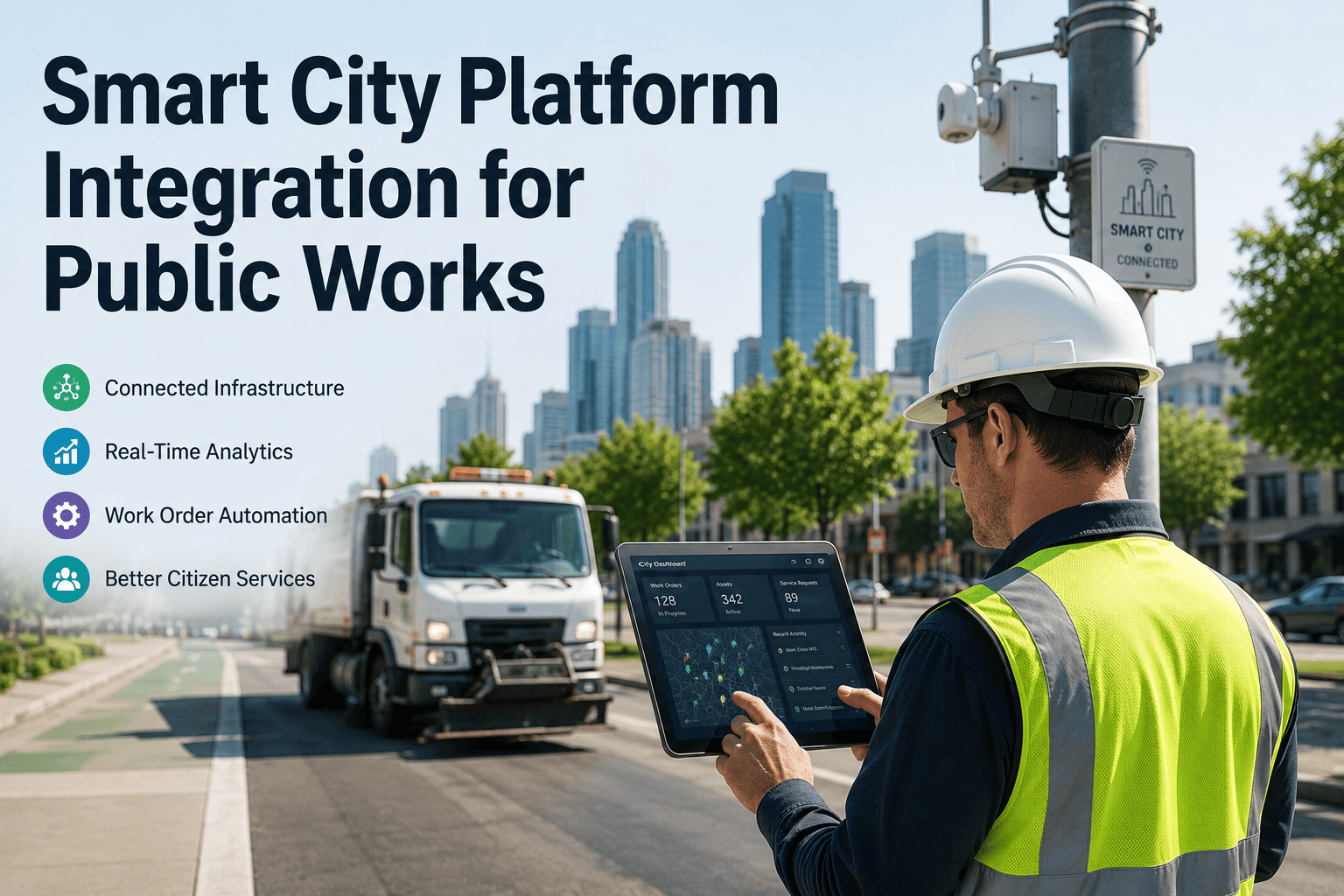
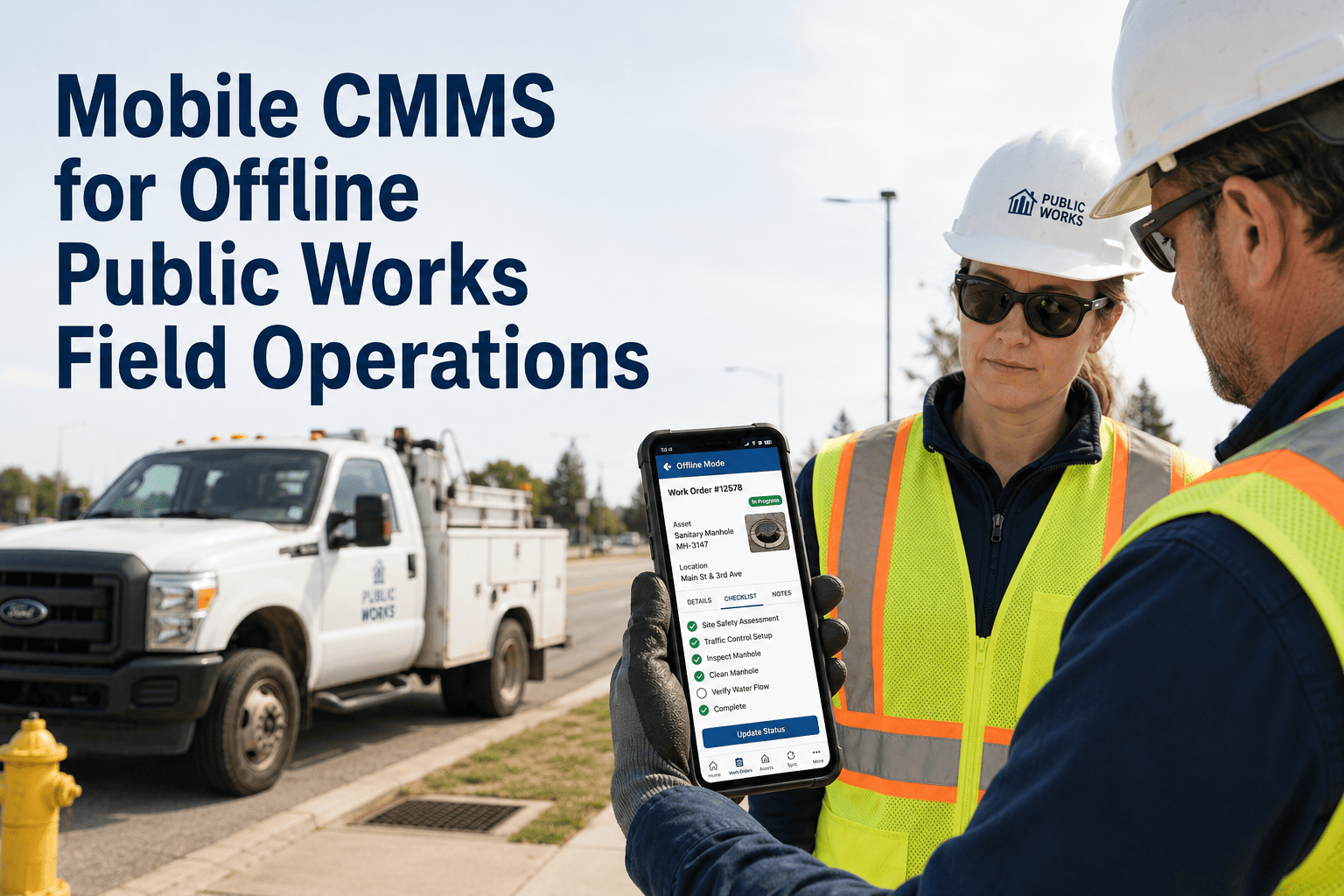
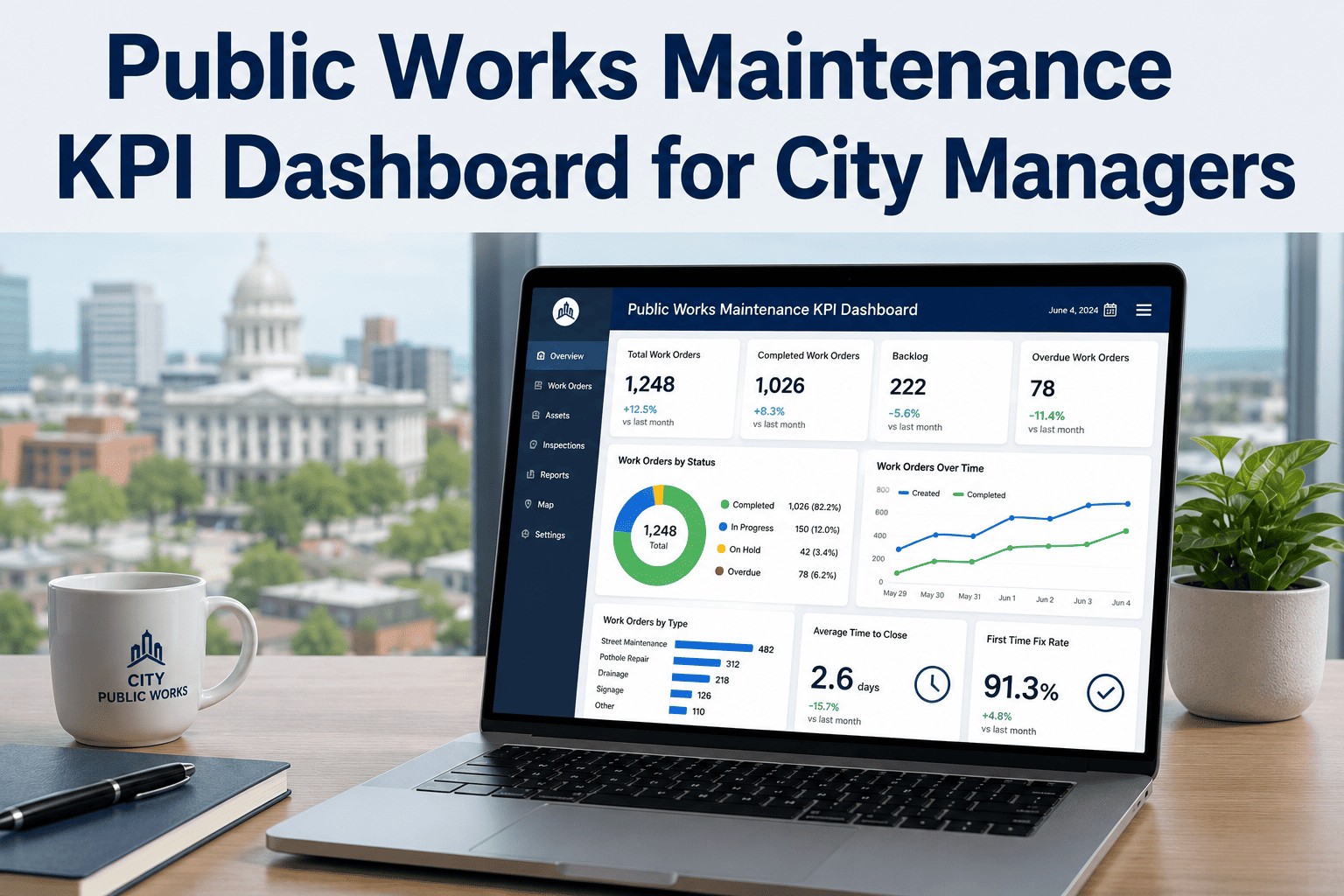
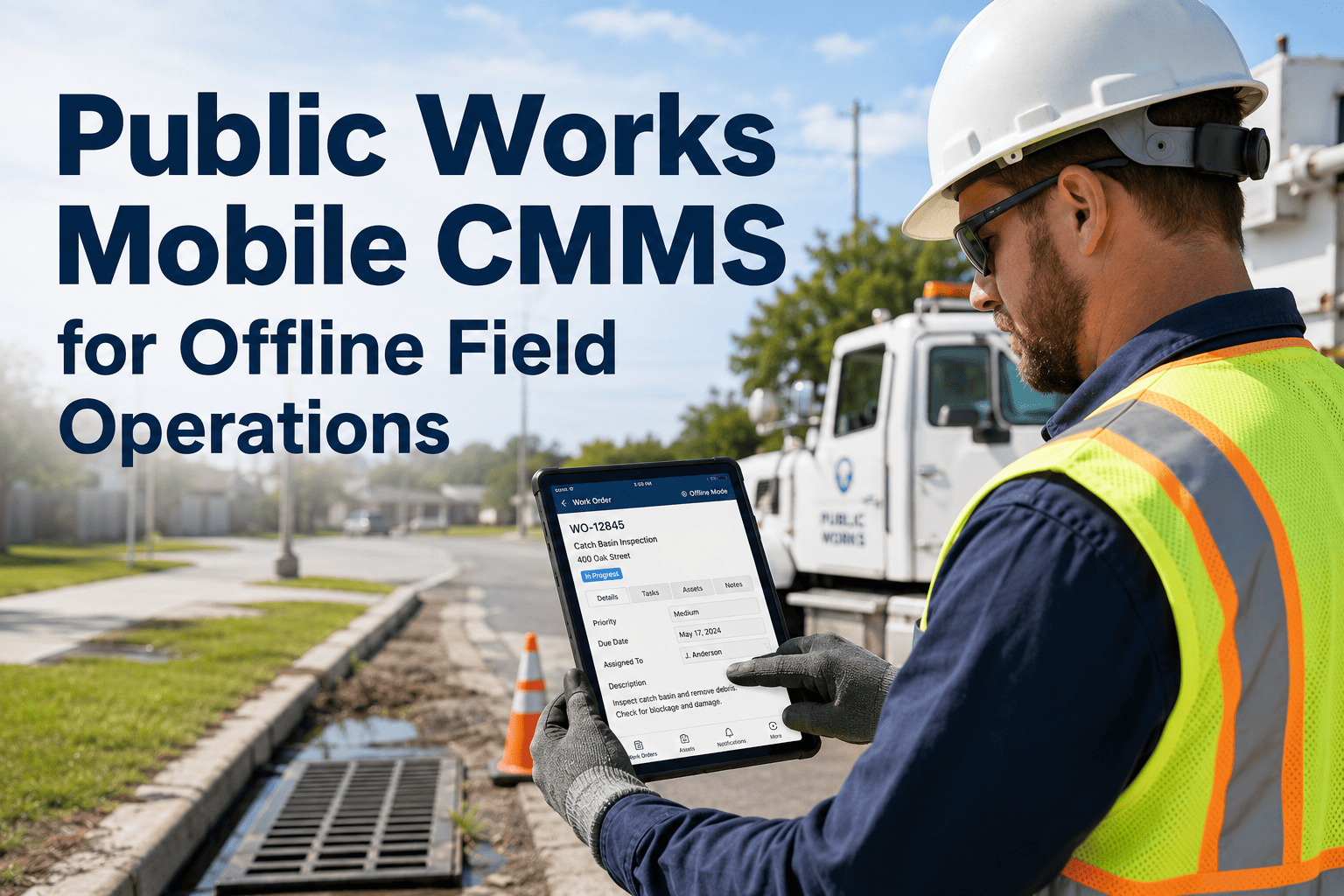
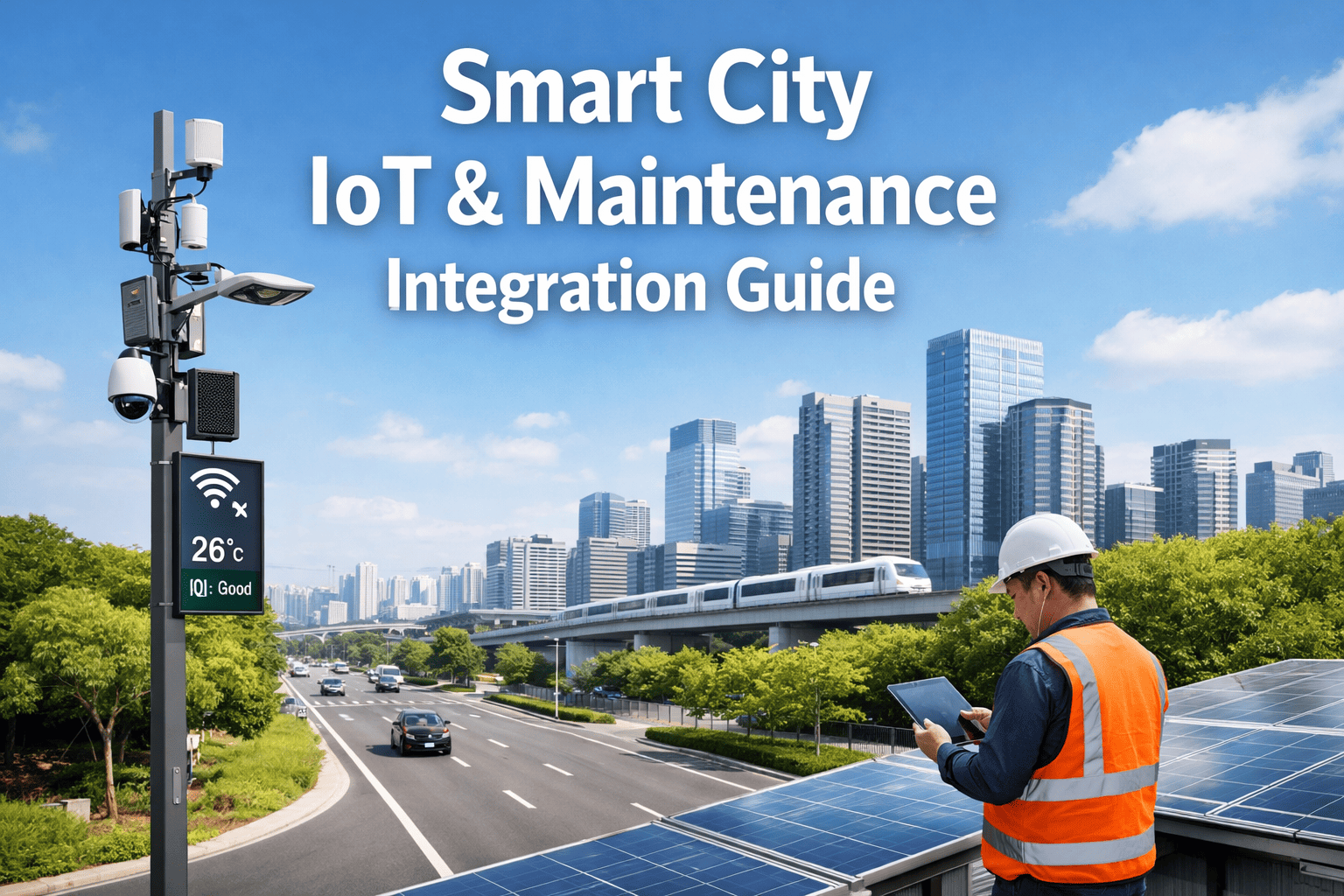
Smart city investment goes wrong the same way in almost every municipality — a traffic dashboard here, a water platform there, a 311 portal somewhere else, and none of it talking to public works. Research on US public-sector IT finds that 53% of officials cannot pinpoint problems inside their own data because it lives in departmental silos. The fix is not another dashboard. It is a deliberate integration strategy that connects smart city platforms with the operational systems public works crews actually run — GIS, CMMS, ERP, SCADA, 311, and the IoT sensor fabric — so data flows into work orders, not just charts. Book a demo to see how OxMaint connects smart city platforms with public works operations end-to-end.
Government · Public Works · Smart City Integration
Smart City Platform Integration for Public Works Operations
Platform architecture, integration approach, data governance, and the deployment strategy that turns smart city investment into measurable public works operational value — not another dashboard nobody logs into.
The Silo Problem
Why Most Smart City Investments Never Reach Public Works
53%
of US public-sector IT officials say they cannot pinpoint problems inside their own operational data — because it lives in disconnected departmental silos that no smart city dashboard has bridged.
Pain 01
Data collected, decisions unchanged
Traffic counts, air quality, water pressure — all measured, none of it triggering a work order, a route change, or a preventive action in the CMMS.
Pain 02
Field crews swivel between tools
Public works technicians open GIS to find the asset, CMMS to see the history, ERP to book parts, and 311 to update the citizen. Four logins per repair.
Pain 03
Vendor sprawl and lock-in
Every smart city vendor ships its own dashboard. Without an integration strategy, the municipality ends up with 8 login screens and zero cross-domain insight.
Pain 04
311 complaints outrun the work order
Citizens report a pothole three times before a crew is dispatched, because 311, GIS, and the maintenance work-order queue do not share a common record.
Integration Maturity Model
The Five Stages of Smart City Integration Maturity
Where a municipality sits on this ladder is the single best predictor of whether its smart city investment will deliver operational value. Most cities are stuck between stages 2 and 3.
Level 1
Isolated
Each department runs its own tools. No cross-system data flow. Reports built by hand from CSV exports.
Level 2
Connected
Point-to-point integrations link 2 or 3 systems. GIS to CMMS. 311 to email. Still no unified view.
Level 3
Integrated
Common integration layer (ESB or iPaaS). All operational systems publish and consume through shared APIs.
Level 4
Orchestrated
Cross-domain workflows. A sensor reading triggers a routed work order, an ERP purchase, and a citizen update — automatically.
Level 5
Autonomous
Predictive models act on integrated data. The system pre-schedules maintenance, pre-routes crews, and pre-orders parts.
Integration Architecture
The Six Systems Every Smart City Program Must Connect
Smart City
Integration Layer
Common APIs · Event Bus · Identity
GIS
Esri ArcGIS & Open Standards
Every asset gets a geographic coordinate. Work orders route to the crew closest to the pin. OGC-compliant WFS / WMS endpoints keep data bidirectional.
CMMS
Public Works Maintenance
The operational heart. Every sensor alert, citizen complaint, and inspection finding lands as a routed, documented work order in one queue.
ERP
Tyler, Oracle, SAP, Workday
Work orders trigger POs. Vendor invoices post to the right fund code automatically. Cost centers reconcile without spreadsheets.
SCADA
Utility & Traffic Telemetry
Read-only OT taps via OPC-UA, MQTT, Modbus, and NTCIP surface anomaly signals into the integration layer without touching the control network.
311
Citizen Request Portal
Every citizen call, app submission, and email routes to a work order automatically. Status flows back to the citizen without human retyping.
IoT
Sensor & Device Fabric
Environmental, structural, traffic, and utility sensors publish through a single ingestion layer with device management, edge processing, and identity.
Turn Six Silos Into One Operational Picture
OxMaint pre-integrates with the systems public works depends on — GIS, ERP, SCADA, 311, IoT gateways — so field crews work from one screen and every alert becomes an assignable action.
Data Flow Architecture
How Data Actually Moves — Three-Tier Reference Model
Tier 1
Data Sources
IoT sensors, SCADA taps, GIS layers, ERP tables, 311 submissions, work-order events. Every producer publishes in its native format — the integration layer handles translation, not the source.
OPC-UAMQTTModbusNTCIPRESTGeoJSON
↓
Tier 2
Integration Layer
Common schema, event bus, identity, and governance. Data is validated, enriched with location and asset context, and routed to whichever operational system needs to act on it.
Event BusCommon APIsSSO / IdentityGovernance
↓
Tier 3
Consumers & Actions
Work orders in the CMMS, purchase orders in the ERP, status updates back to the citizen 311 portal, dashboards for the city manager, and reports for the elected body. Data lands as a decision, not a chart.
CMMS ActionsERP POsCitizen UpdatesDashboards
Cross-Department Value
What Integration Actually Unlocks — By Use Case
| Use Case |
Systems Connected |
Operational Outcome |
| Pothole reported by resident |
311 → GIS → CMMS → Citizen Portal |
Routed work order in minutes — status back to reporter without staff retyping |
| Water pressure anomaly on SCADA |
SCADA → Integration Layer → CMMS → ERP |
Automated work order with pre-selected parts and vendor PO ready to approve |
| Air-quality spike near a school |
IoT → GIS → 311 Broadcast → Public Portal |
Geo-targeted resident notification and preemptive traffic diversion |
| Streetlight outage cluster |
IoT → GIS → CMMS → Route Optimizer |
Batched work order — one truck roll replaces five separate visits |
| Structural sensor on an aging bridge |
IoT → CMMS → ERP → CIP Report |
Condition data feeds the capital plan directly — defensible funding requests |
| Snowplow route completion |
Telematics → GIS → 311 → Citizen Portal |
Residents see which streets are plowed in real time — call volume drops sharply |
“
The cities that get the most operational value from smart city investments are the ones that treat integration as a first-class program — not an afterthought once the dashboards go live. If you buy a traffic platform, a water platform, and an air-quality platform without an integration strategy, all you have bought is three more silos. The rule I give every public works director is simple: no smart city procurement passes review unless it publishes to a common event bus and reads from the shared identity layer. That single rule keeps you on the maturity ladder instead of sliding back down it.”
Chief Data Officer, Mid-Size US Municipality
18 Years Municipal IT · Led Smart City Integration for a Top-50 US City · Public Sector Data Governance Advisor
Frequently Asked Questions
Do we have to rip and replace our existing systems to integrate them?
No. Modern integration layers connect to existing GIS, CMMS, ERP, and SCADA through standard APIs and OT-safe read-only protocols. Most municipalities keep every existing platform and add an integration layer on top.
Book a demo to walk through the non-disruptive integration pattern.
How long does a first meaningful integration typically take to go live?
A 311-to-CMMS integration typically ships in 10 to 14 days. GIS-to-CMMS asset sync in 2 to 4 weeks. ERP integrations like Tyler or Oracle in 6 to 12 weeks depending on IT resource availability. Full IoT sensor onboarding in 30 to 45 days.
How do we avoid smart city vendor lock-in during the buying process?
Make a simple procurement rule: every vendor must publish and consume through open APIs and standard data schemas. Reject proprietary-only platforms. Require an event-bus adapter as a contractual deliverable.
Start a free trial to see reference RFP language.
What data governance is required before we start integrating?
Three things at minimum: a shared master asset register, a single identity provider (SSO), and a documented data-owner matrix per domain. Without these, integrations technically work but no department trusts the resulting data.
Can a mid-size city realistically reach the Orchestrated maturity level?
Yes — and often faster than large ones because there are fewer legacy systems and shorter approval chains. Cities with 50K to 500K residents routinely reach Level 4 within 24 months of program launch.
Book a demo to map a realistic path for your size and system landscape.
OxMaint · Smart City Integration · Public Works
Make Your Smart City Investment Show Up in the Work Order Queue
OxMaint connects the smart city platforms your city already owns — GIS, ERP, SCADA, 311, IoT — with the public works operations that move the needle. So every dashboard turns into a dispatched crew and every citizen report closes with a documented action.