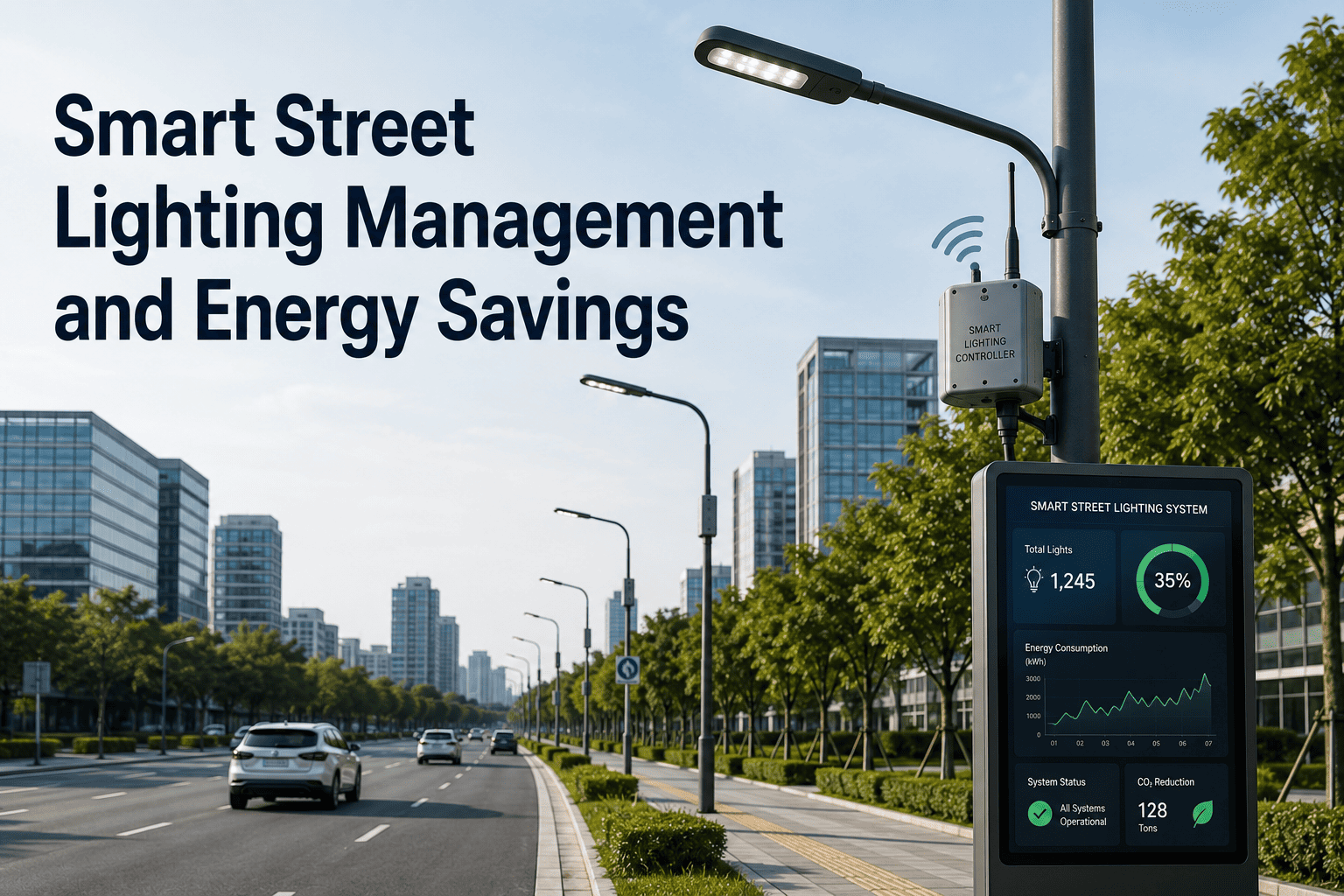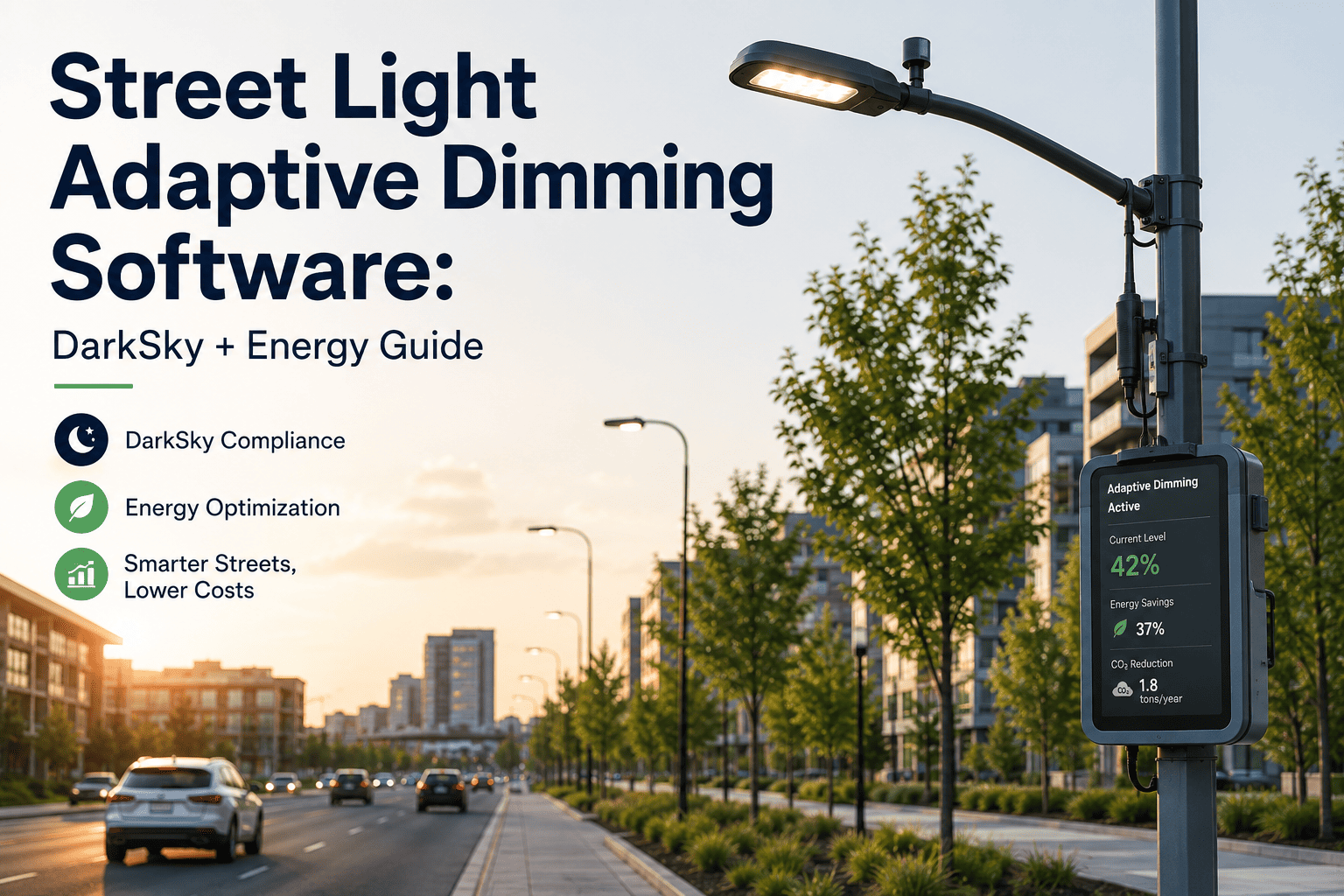
Street light adaptive dimming is the practice of scheduling luminaire output to match actual demand across the night — full brightness during evening pedestrian and vehicle peaks, stepped-down output through low-traffic overnight hours, back up before dawn. Done properly, it cuts municipal lighting energy 20–40% on top of the savings already captured by the sodium-to-LED conversion, extends luminaire lifespan by reducing thermal stress, and satisfies the adaptive-control criteria in the DarkSky Approved Luminaires program. The catch is that adaptive dimming only works when a CMMS is orchestrating it — when every fixture's schedule, override history, fault status, and energy consumption sit in one platform that maintenance, sustainability, and public works can all read. Explore how OxMaint's asset platform handles adaptive street light dimming for DarkSky-compliant municipalities.
Street Light Adaptive Dimming Software: The DarkSky & Energy Playbook
How CMMS-orchestrated dimming schedules cut municipal lighting energy 20–40% while meeting DarkSky Approved criteria — the operational discipline behind every credible smart-city lighting program.
The Night, Divided — A Typical Adaptive Dimming Schedule
A well-tuned dimming schedule is not a single dim step at midnight. It is a set of programmed output levels tied to the demand curve of each street, road class, or zone — commercial arterials, residential collectors, parking areas, and low-traffic side streets each running their own schedule. The visualization below shows the anatomy of a typical adaptive schedule for a residential collector road, running from dusk through dawn. The energy savings come from the shaded area — the difference between constant full output and the demand-matched curve.
DarkSky Compliance — What the Approved Program Actually Requires
The DarkSky Approved Luminaires program (v3.1) sets specific technical criteria for outdoor fixtures. Adaptive dimming is one of them — not optional guidance, but a hard requirement for any luminaire above 500 lumens to qualify. A municipality that has already invested in DarkSky-certified fixtures then needs a control platform that actually exercises the dimming capability the certification requires. Otherwise the certification becomes a specification stamp with no operational meaning: the fixture ships with dimmable drivers that never see a dimming command, and the community pays for controls that sit inert.
The four criteria below sit at the center of every DarkSky-compliant street lighting program. CCT and uplight are properties of the fixture itself and are fixed at procurement. Dimming and adaptive controls are ongoing operational disciplines — and where a CMMS earns its place in the lighting stack. Meeting the criteria on paper is straightforward; keeping them met across thousands of fixtures, override events, and driver replacements over a ten-year fleet life is the actual work.
Turn DarkSky Fixtures Into DarkSky Programs
A DarkSky-approved luminaire only delivers its full value when a control platform actually runs the adaptive schedules. OxMaint orchestrates dimming, faults, and energy reporting across every fixture in your network.
Five Dimming Strategies — Ranked by Energy Return
Adaptive dimming is not a single technique. Municipalities layer strategies based on their road inventory, available controls, and community input. Time-based schedules are the foundational layer — the one that captures the largest share of the addressable savings and works with any dimmable driver. Motion sensors, ambient light response, and traffic-responsive control add incremental savings on top, but each one adds hardware, calibration effort, and complaint-handling complexity. The comparison below shows typical energy savings and implementation complexity for each strategy, so lighting managers can sequence deployment based on where the return justifies the investment.
The sequencing matters more than the individual technology choice. A municipality that jumps straight to motion-triggered fixtures on residential streets without first proving out time-based dimming often generates a wave of community complaints about flickering, ramp-up delay, and perceived inconsistency — and the entire program stalls. Starting with the schedule layer, publishing the numbers, and then adding sensor-based refinements against a validated baseline is the pattern that survives contact with public comment.
The Financial Case — A 5,000-Fixture Network
The numbers below model a mid-size municipality operating 5,000 street light fixtures, already converted to LED at an average draw of 80 watts per fixture. The table shows the incremental annual savings unlocked by adding time-based adaptive dimming on top of the existing LED baseline — before adding any sensor-based layers. Actual results vary with electricity rate, road class mix, and schedule aggressiveness; the framework is the same. The line worth attention is the fixture lifespan extension: driving LEDs at reduced output cuts junction temperature, which is the primary driver of LED lumen depreciation and driver failure. Deferred replacements compound with the electricity savings over the ten-year fleet life.
| Metric | LED Baseline | + Adaptive Dimming | Delta |
|---|---|---|---|
| Average nightly output | 100% | 68% | −32% |
| Annual kWh consumption | ~1.75M kWh | ~1.19M kWh | −560,000 kWh |
| Annual electricity spend at $0.12/kWh | ~$210,000 | ~$142,800 | −$67,200 |
| Estimated CO₂ reduction | Baseline | — | ~220 metric tons/year |
| Fixture lifespan extension (thermal) | Rated hours | +15–20% | Deferred replacements |
| Typical control system payback | — | 1–3 years | Ongoing savings |
What a CMMS Actually Does in the Dimming Loop
Adaptive dimming spans three organizational functions inside a typical municipality: sustainability owns the energy target and the council-facing reporting, public works owns the safety and complaint response, and the maintenance team owns the fixture health and outage response. Without a shared platform, each function optimizes locally — sustainability pushes for deeper dimming, public works pushes back on any perceived brightness reduction, and maintenance ends up manually reconciling schedules against fault reports on a spreadsheet. The schedule drifts, overrides never expire, and the reported energy savings diverge from the actual meter reads.
A CMMS is the connective tissue that stops the drift. It is the place where the schedule lives, where overrides are logged with reasons and expiry dates, where controller fault codes automatically trigger work orders with GPS coordinates and access notes, and where the monthly energy report gets generated for the sustainability office and the council meeting without anyone hand-assembling numbers. Six functions do that work in practice — the loop below shows how they connect.
Frequently Asked Questions
Run Every Fixture, Every Schedule, Every Report From One Platform
OxMaint manages adaptive dimming schedules, override history, fault-driven work orders, and energy reporting for municipal street light networks. Purpose-built for DarkSky-compliant lighting programs and the sustainability offices that report on them. Free to start, no hardware lock-in, integrates with standard networked controllers.