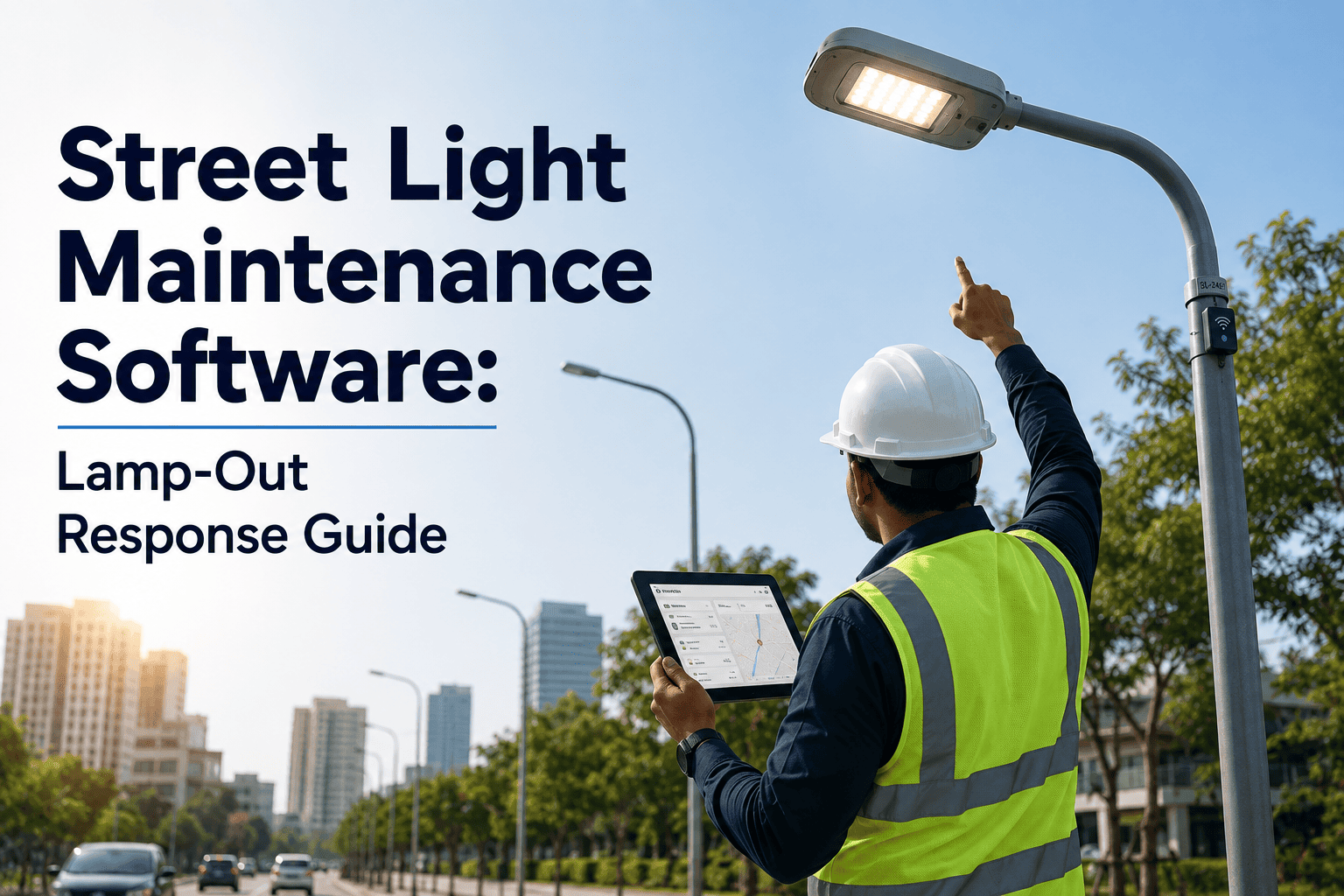
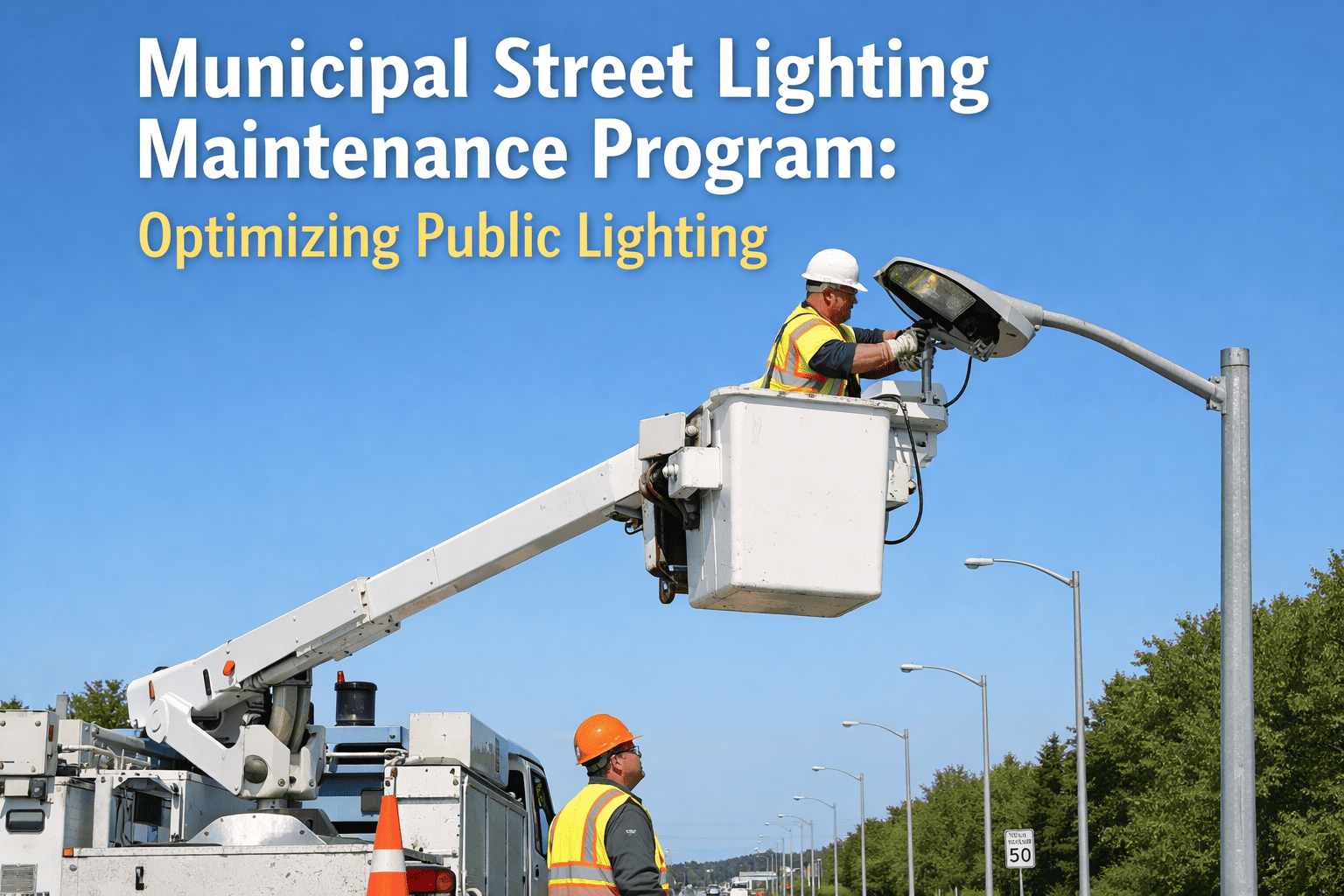
A resident calls 311 to report a dark street light. In some cities that light gets fixed in 3 business days. In others, the same report sits for months — one department has documented average repairs stretching past 180 days when copper theft and vandalism cases pile into the same queue as routine bulb failures. The difference usually isn't crew size. It's whether the report, the pole ID, and the work order are connected well enough for a crew to arrive at the right pole once and fix it, instead of driving out on a guess. This guide walks through what a street light maintenance software deployment needs to get right to turn lamp-out response from a weeks-long guessing game into a tracked, closeable workflow.
Municipal Lighting · Lamp-Out Response · 311 & GIS
Street Light Maintenance Software: Closing the Gap Between a 311 Call and a Fixed Light
Every dark street light starts the same way — a report comes in. What happens next determines whether that light is fixed in days or joins a backlog that never seems to shrink. This guide breaks down the pipeline from intake to close-out and where most cities lose weeks they don't have to lose.
3 daysBest-case reported response, normal call volume
7–14 daysTypical inspect-and-repair window once logged
180+ daysReported average where theft and vandalism cases dominate the queue
Where the Time Actually Goes
Lamp-Out Response Isn't Slow Because Crews Are Slow
Public works departments rarely lack the crews to fix a burned-out bulb — that's usually a couple hours of work once someone is standing at the right pole. The delay lives upstream, in how a resident's report becomes a located, prioritized, dispatchable work order.
Vague location descriptions
"The light near the park on Main Street" isn't a work order — it's a starting point. Without a pole ID or coordinates, a crew has to find the asset before they can fix it, and that search sometimes happens more than once for the same report.
Duplicate reports, no dedup
Multiple residents often report the same outage independently. Without a system that recognizes the pole was already flagged, staff can spend time processing the same complaint three or four times before a crew is ever dispatched.
No first-in-first-out visibility
Cities that manage repairs strictly by order received have no way to see how long a given report has actually been waiting unless someone manually checks the queue — so aging requests can drift for months without anyone noticing.
Theft and vandalism cases clog routine queues
One major city's lighting bureau saw theft-related service requests jump more than tenfold across four fiscal years, and copper theft repairs that once took hours now take weeks or even months because they require full rewiring rather than a bulb swap — all competing for the same crew time and the same tracking system as routine outages that should close in days.
The Response Pipeline
Six Stages Between "Light's Out" and "Ticket Closed"
A street light maintenance system's real job is making each of these six stages hand off cleanly to the next one, without a person having to manually re-key data or guess at a location. Break any single handoff and the whole chain slows down, even if every individual person along the way is doing their job well.
1
Report
Resident submits via 311 call, app, or web portal
2
Locate
Report matched to a specific pole via GIS coordinates or pole ID
3
Dedupe
System checks for an existing open ticket on the same asset
4
Prioritize
Work order ranked by safety factors and age in queue, not just order received
5
Dispatch
Work order routed to internal crew or contractor with pole location attached
6
Close
Repair confirmed, ticket closed, resident notified automatically
See the Pipeline in Action
Every Broken Handoff in That Pipeline Adds Days to the Repair
A report that can't be matched to a pole, a duplicate that isn't caught, a work order that never gets prioritized against how long it's been waiting — each of these turns a two-hour bulb swap into a weeks-long backlog item.
Prioritization Logic
Not Every Dark Light Waits in the Same Line
First-in-first-out sounds fair, but it treats a burned-out bulb on a quiet cul-de-sac the same as a dark stretch outside a school crossing or a blind intersection with a collision history. A prioritization layer lets a lamp-out queue reflect actual risk instead of just arrival order, without abandoning fairness for routine requests — and it gives public works directors a defensible answer when a council member or resident asks why one repair jumped ahead of another.
Highest Priority
Safety-critical locations
School zones, crosswalks, transit stops, and intersections with a documented collision or crime history get flagged for expedited response regardless of queue position.
Elevated Priority
Multiple adjacent outages
Several consecutive dark poles on the same block point to a circuit-level fault rather than a single bulb, and usually warrant a faster, coordinated response.
Standard Priority
Single routine outage
A lone bulb failure on a low-traffic residential street follows the standard queue, handled in the order it was logged once higher-risk tickets are addressed.
Extended Timeline
Theft or vandalism repairs
Cases requiring full rewiring get tagged with a realistic, separate timeline so they don't distort the aging metrics for routine repairs sitting in the same system.
The Foundation Layer
Why GIS Accuracy Determines Everything Downstream
Every stage in the pipeline above depends on stage two — matching a resident's report to a specific, correctly located pole. Cities that still rely on paper maps, hand-drawn coordinates, or worker memory to locate assets carry that inaccuracy into every work order that follows, and the cost isn't just wasted drive time. Inventory audits of large municipal systems have found poles that were relocated or removed years earlier still sitting in the billing and maintenance records as active assets, which means crews get dispatched to fixtures that no longer physically exist while the actual outage down the block goes untouched.
Unique pole identifiers
A visible, unique ID tag on every pole lets a resident report the exact asset instead of a street corner description, and lets crews confirm they're standing at the right fixture before doing any work.
Coordinate-accurate inventory
Sub-meter GPS coordinates tied to each pole record mean a work order can be mapped directly for a crew, rather than described in text a driver has to interpret on the road.
Removed or relocated asset tracking
Poles get relocated, replaced, or removed over time. Without an inventory that reflects those changes, cities have been documented paying monthly charges on fixtures that no longer physically exist.
Photo-verified condition records
A photo attached to each pole record at the time of inventory or last service gives dispatchers and crews a visual reference before they ever leave the yard.
Old Way vs. New Way
Spreadsheet-and-Phone Tracking vs. a Connected CMMS
| Workflow Element | Manual / Spreadsheet Tracking | Street Light CMMS |
|---|
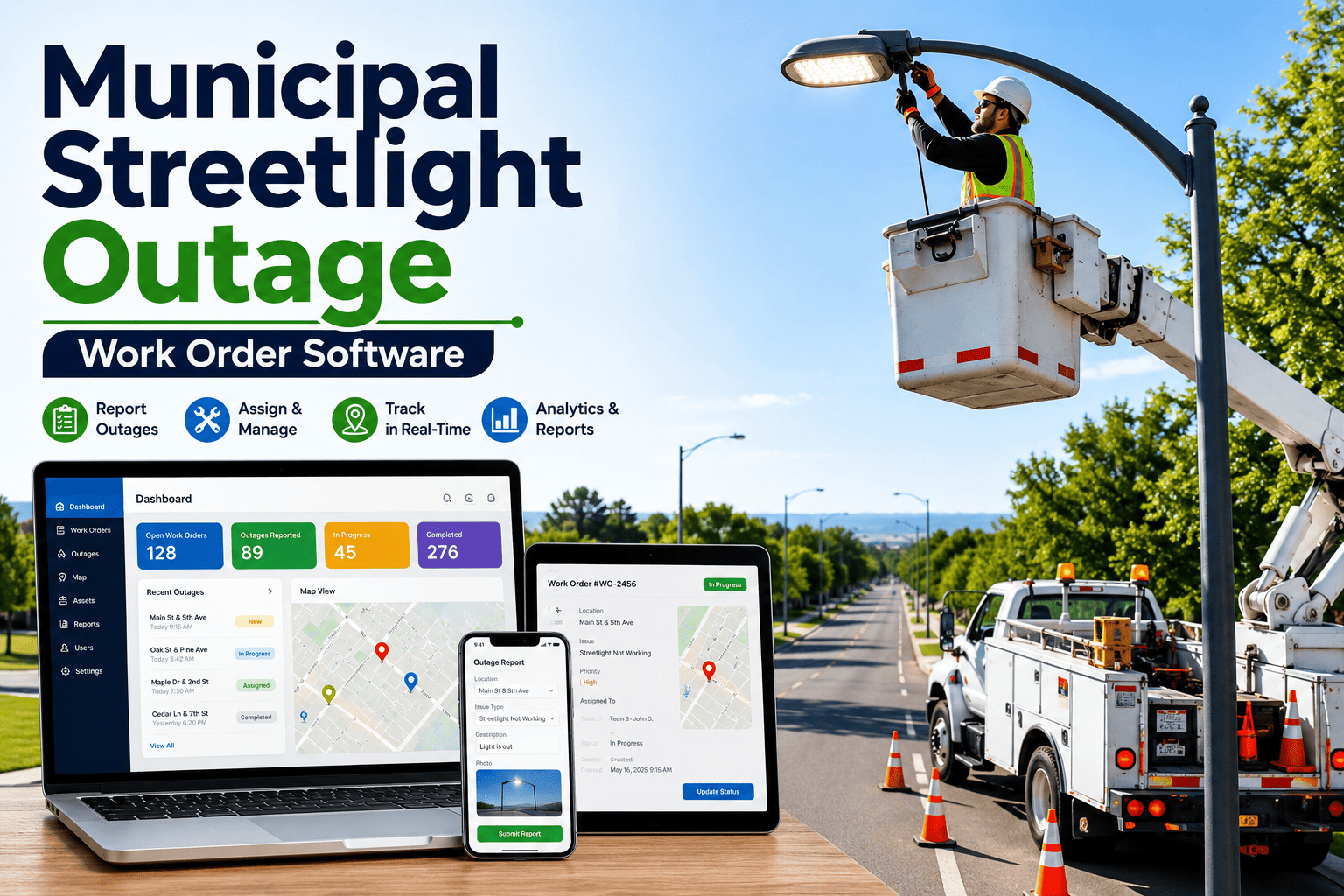
| Report intake | Phone call logged manually into a spreadsheet or ticket queue | 311, app, or web form auto-creates a structured work order |
| Location matching | Staff interpret a street description by hand | Report auto-matched to pole ID via GIS coordinates |
| Duplicate detection | Relies on staff remembering or manually searching prior entries | System flags existing open tickets on the same asset automatically |
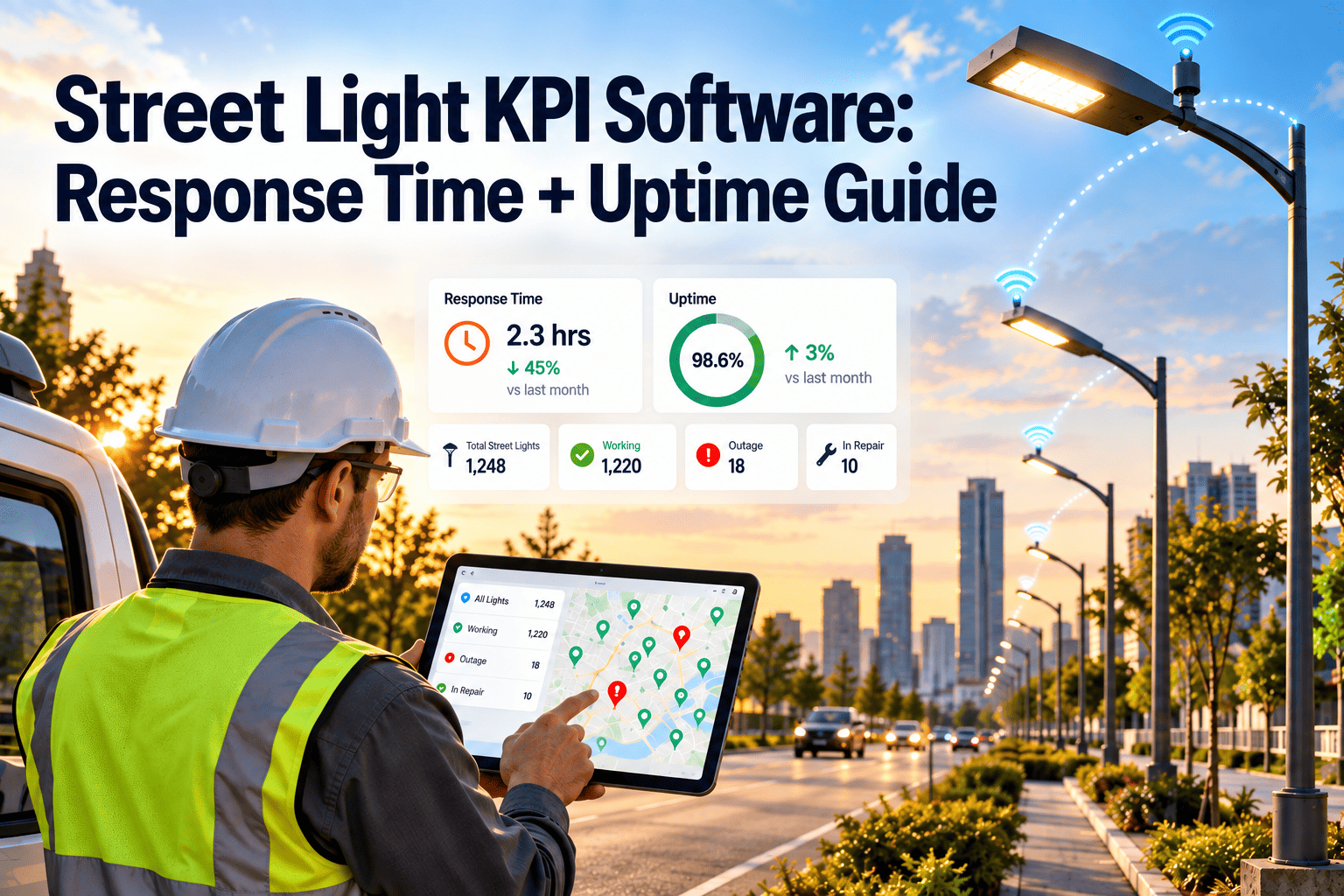
| Aging visibility | Requires a manual pull of the spreadsheet to see how old requests are | Live dashboard shows ticket age and flags anything past target response time |
| Contractor coordination | Separate emails or calls to confirm assignment and completion | Contractor sees assigned work orders and updates status directly in system |
| Resident notification | Manual callback or no follow-up at all | Automatic status update sent when ticket is closed |
Contractor Coordination
Most Cities Don't Fix Their Own Lights — They Coordinate the Crews Who Do
Many municipalities contract electrical repair work to outside crews, especially for anything beyond a routine bulb swap, or lean on the local utility for pole-mounted fixtures the city doesn't own outright. That handoff is exactly where visibility tends to break down, because the city's tracking system and the contractor's or utility's field operations often aren't talking to each other, which leaves residents calling back in weeks later just to ask whether anyone is actually working on their report.
A
Work order assigned with full context
Pole ID, GPS coordinates, fault type, and photo history travel with the ticket so the contractor doesn't need a separate phone call to understand the job.
B
Contractor updates status in real time
En route, on-site, repair complete, or parts needed — each status change is visible to city staff without a callback.
C
Completion photo and notes attached
Proof of repair closes the loop on the specific pole record, building a service history the city actually owns.
D
City closes the ticket and notifies the resident
The original 311 report is closed automatically, and the resident who reported it gets confirmation without staff having to track down who called.
Warning Signs
Signals That Lamp-Out Response Has Become a Backlog Problem
Most departments don't decide to modernize lamp-out response on a good day — they decide after a pattern of complaints, a council inquiry, or a preventable incident at a dark intersection makes the gap impossible to ignore. These are the signals worth watching for before that happens.
01Residents calling back multiple times about the same unresolved report
02Staff unable to answer how many outage tickets are currently open or how old the oldest one is
03Crews regularly returning from a dispatch unable to locate the reported pole
04No clear record of which contractor or utility is responsible for a given fixture
05Monthly billing for poles that field staff can no longer confirm exist
What Changes
What a Connected Lamp-Out Workflow Actually Delivers
None of this requires a bigger crew or a bigger budget in most cases — it requires the existing crew's time to stop being spent on searching, re-confirming, and manually tracking down status updates that a connected system handles automatically.
Fewer wasted truck rolls
Crews arrive at a confirmed pole with the right context, instead of searching a block for a fixture based on a vague description.
No report falls through the cracks
Every ticket has a visible age and status, so a request from three months ago can't quietly disappear into a spreadsheet no one is checking.
Duplicate reports don't duplicate work
Five residents reporting the same dark corner become one tracked ticket instead of five separate ones competing for attention.
A real service history per pole
Every repair, contractor visit, and outage becomes part of a permanent asset record instead of disappearing once the ticket closes.
Common Questions
Street Light Maintenance Software — Frequently Asked Questions
Can street light maintenance software integrate with our existing 311 system?
Yes. Reports submitted through 311 can flow directly into the CMMS as structured work orders instead of requiring manual re-entry.
Book a demo to see how your 311 platform connects.
What if our pole inventory and GIS data isn't accurate yet?
Most cities start with a phased inventory correction — matching poles to coordinates as reports come in — rather than a full re-survey before going live. Accuracy improves with every ticket closed.
How does the system handle theft and vandalism cases differently from routine outages?
These cases can be tagged separately so they don't silently consume the same queue as bulb replacements, and so staff can track their distinct, often longer repair timeline.
Can outside electrical contractors use the system directly?
Yes, contractors can be given access scoped to their assigned work orders so they can update status and attach completion photos without a separate phone-based process.
Does closing a ticket automatically notify the resident who reported it?
Yes, when the reporting channel supports it, status updates and closure notifications can be sent automatically rather than requiring a manual callback.
Ready to Close the Gap
Turn Every 311 Report Into a Trackable, Closeable Work Order
Oxmaint connects 311 intake, GIS pole matching, and contractor dispatch into one lamp-out response workflow, so outages get fixed in days instead of disappearing into a backlog.