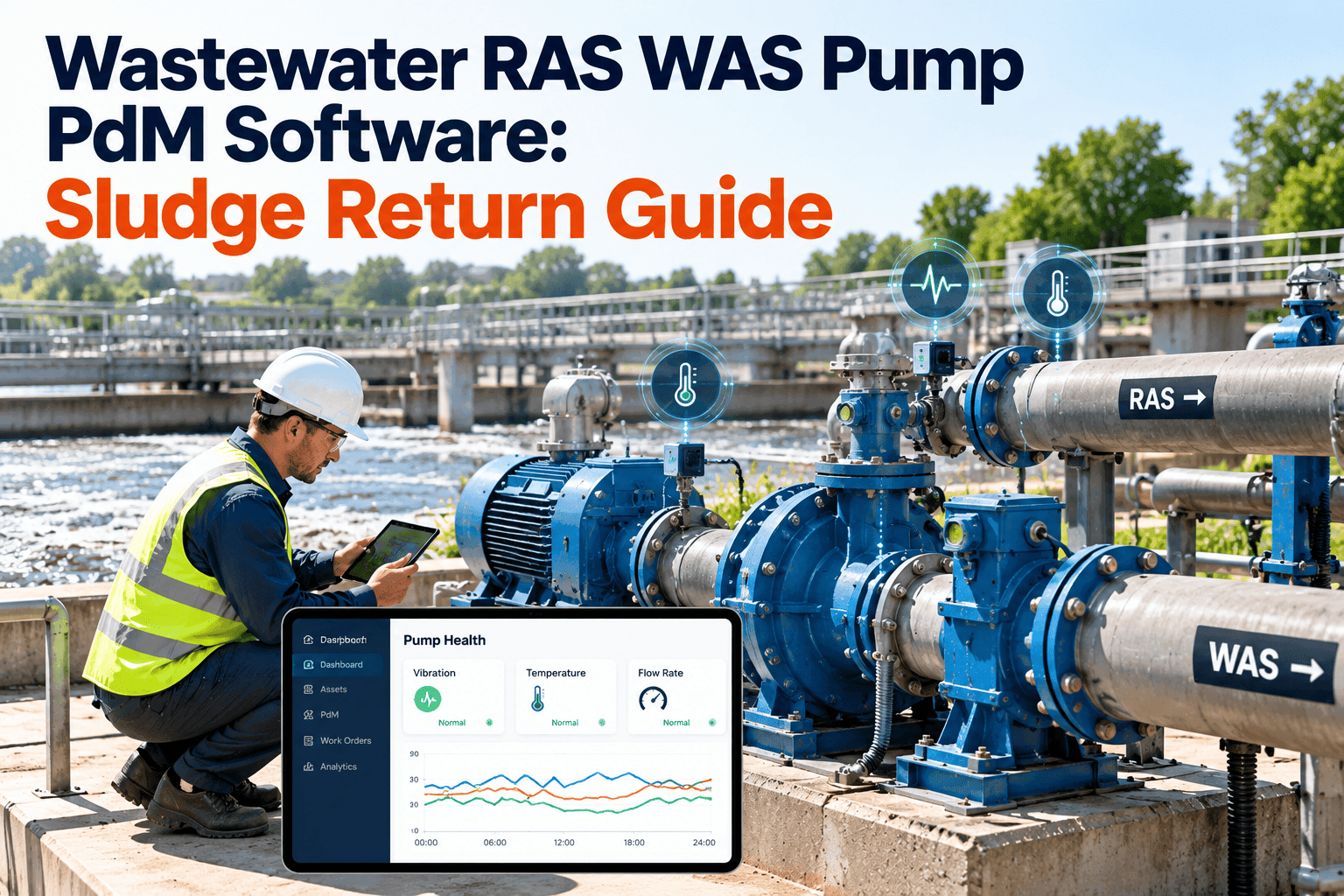
Return activated sludge (RAS) and waste activated sludge (WAS) pumps sit at the center of every biological treatment plant, yet they often get attention only after a clog or a failed seal. These pumps move thick, abrasive, rag-laden sludge around the clock, and their condition controls solids inventory, sludge age, and effluent quality. A predictive maintenance program built on vibration, motor current, flow, and inspection history lets crews act before a pump fails during a storm event. This guide explains how to structure that program and connect it to a work order system such as Oxmaint maintenance management software.
RAS and WAS Pump Predictive Maintenance for Biological Treatment Plants
Keep return and waste sludge pumps running at the rates your process needs. Detect wear, clogging, and seal problems early, then turn every finding into a tracked work order.
Why RAS and WAS Pumps Deserve Their Own Reliability Program
Wastewater plants tend to rank influent pumps and blowers as the critical assets. Sludge return pumps rarely make that list, but the biological process depends on them just as much.
What RAS Pumps Do
They return settled biomass from the secondary clarifier to the aeration basin, keeping enough active microorganisms in the system to treat incoming load.
What WAS Pumps Do
They remove excess biomass so the plant holds its target solids retention time (SRT) and sludge age instead of drifting out of balance.
When the Pumps Drift, the Process Drifts
- A partially clogged RAS pump lowers return flow, so the sludge blanket rises in the clarifier and solids can carry over into the effluent.
- A worn WAS pump that under-delivers lets mixed liquor solids climb, which pushes SRT higher than the operating plan intends.
- A pump that trips repeatedly forces operators into manual workarounds, adding labor and increasing the chance of a permit exceedance.
- Standby units that have not been exercised often fail to start when the duty pump goes down.
Before and After: Reactive Sludge Pump Maintenance vs a PdM Program
Most sludge pump problems announce themselves days or weeks early. The difference is whether anyone records the signals and acts on them.
| Situation | Reactive Approach | Predictive and Condition-Based Approach |
|---|---|---|
| Rising vibration on a RAS pump | Noticed during a walk-through, if at all | Trend crosses an alert level and a work order is created for bearing or alignment inspection |
| Rag buildup in the impeller | Discovered after flow drops and the blanket rises | Motor amperage and flow deviation flag partial clogging before process impact |
| Mechanical seal leakage | Repaired after sludge reaches the motor or floor | Seal inspection tasks and leak observations are logged and trended |
| Standby pump readiness | Assumed ready until needed | Scheduled run tests confirm the standby starts and delivers flow |
| Spare parts | Ordered after failure | Wear items such as seals, rotors, stators, and bearings are stocked based on repair history |
| Failure records | Held in operator memory or paper logs | Every repair is tied to the asset, cause, and cost |
Common Pump Types and What to Watch on Each
Plants use different technologies for return and waste duty, so condition monitoring should match the pump design rather than follow a single checklist.
Centrifugal and Non-Clog Pumps
Common on RAS lines because they move high volumes at low head.
- Vibration at the bearings
- Impeller wear and clearance
- Shaft seal condition
- Motor current versus flow
Progressive Cavity Pumps
Often used for WAS because they handle thicker sludge and give steady metering.
- Stator and rotor wear
- Dry-running protection
- Coupling and joint condition
- Discharge pressure trend
Screw Centrifugal and Rotary Lobe Pumps
Selected where gentle handling of sludge or solids passage is a priority.
- Rotor or lobe clearance
- Gearbox oil condition
- Seal flush supply
- Suction line blockage
Airlift Return Systems
Found in some smaller plants, with no rotating parts in the sludge itself.
- Air supply pressure
- Riser line fouling
- Control valve operation
- Return flow verification
Root Causes Behind Sludge Pump Failures
Understanding why sludge pumps fail helps you decide which signals are worth trending and which inspections belong on a schedule.
Rags and Fibrous Material
Wipes and debris that pass through headworks wrap around impellers and lodge in suction lines, raising amperage and cutting flow.
Abrasive Grit
Grit that escapes removal wears rotors, stators, casings, and wear rings, slowly eroding pump capacity.
Dry Running and Cavitation
Closed valves, low clarifier hoppers, or blocked suction lines starve the pump and damage seals, stators, and impellers.
Misalignment and Bearing Wear
Coupling and alignment issues raise vibration and shorten bearing and seal life, especially on frequently started units.
Deferred Inspection
When routine checks are skipped during staffing gaps, small leaks and noises turn into emergency repairs.
Failure Risk Matrix for Sludge Return and Waste Pumps
Use a simple matrix to decide which assets get condition monitoring first. Rate each pump on how likely a failure is and how much it would disrupt the process.
| Asset Condition | Low Process Impact | Moderate Process Impact | High Process Impact |
|---|---|---|---|
| Frequent past failures | Fix root cause at next outage | Add condition monitoring now | Priority monitoring and spare stocked |
| Occasional issues | Routine inspection | Trend key signals | Trend signals and exercise standby |
| Rare issues | Run to schedule | Routine inspection | Periodic vibration route |
Give Every Sludge Pump a Maintenance History
Set up RAS and WAS pumps as assets in Oxmaint, attach inspection routines, and keep repairs, readings, and parts usage in one record.
A Condition-Based Workflow for RAS and WAS Pumps
A predictive program does not need to begin with expensive sensors. It begins with a repeatable loop that connects observation, decision, and repair.
Register the Asset
Record pump type, duty or standby role, motor size, seal type, and the line it serves.
Define Baselines
Capture normal amperage, vibration, discharge pressure, and flow at typical operating speeds.
Collect Readings
Use rounds, handheld vibration tools, or SCADA values, and log them against the asset.
Set Thresholds
Choose alert levels based on manufacturer guidance and your own history, then review them yearly.
Trigger Work Orders
When a reading crosses a limit, create a corrective task with priority, parts, and instructions.
Close and Learn
Record the failure cause and repair action so future thresholds and spares improve.
Signals Worth Trending on Sludge Pumps
Not every signal carries equal value. These are practical starting points that plants can gather without a major capital project.
Motor Current
A slow rise with steady flow may indicate wear or partial blockage. A sudden drop can point to loss of prime or a dry-running event.
Flow Versus Speed
When a variable frequency drive runs faster to deliver the same return flow, pump capacity is likely declining.
Vibration
Rising overall levels or changing frequency patterns help identify bearing wear, imbalance, and misalignment.
Discharge Pressure
Unexpected pressure changes can indicate stator wear, plugged lines, or partially closed valves.
Seal and Leak Observations
Operators see leaks first. A simple structured observation record turns their notes into trend data.
Run Hours and Starts
Usage counts support component replacement planning and reveal duty rotation imbalance between pumps.
Inspection Checklist by Frequency
Adjust intervals to the pump model, sludge characteristics, and manufacturer recommendations. This layout gives crews a practical starting point.
Daily Rounds
- Confirm pump is running as scheduled
- Check for unusual noise or heat
- Look for seal leakage
- Compare return flow to setpoint
Weekly and Monthly
- Record amperage and pressure
- Run standby pump and verify flow
- Inspect suction and discharge valves
- Check seal flush and lubrication
Quarterly and Annual
- Vibration route and alignment check
- Rotor, stator, or impeller clearance review
- Gearbox and bearing oil analysis or change
- Review spare parts against repair history
KPIs That Show Whether the Program Works
Pick a small set of measures, define them clearly, and review them monthly with operations and maintenance together.
Compliance and Process Records
Sludge pump reliability connects directly to effluent quality, which is tracked under your discharge permit. Maintenance records help explain events and show due diligence.
- Document when pumps were out of service and how return or waste flow was maintained during the outage.
- Keep calibration records for flow meters that support RAS rate and wasting calculations.
- Link corrective work orders to process events such as blanket rise, foaming, or solids carryover.
- Retain inspection and repair histories so auditors and regulators can review them quickly.
- Track safety tasks such as lockout and tagout, confined space entry for wet wells, and pump room hazards.
Trends Shaping Sludge Pump Maintenance
Treatment plants are gradually moving from calendar-only maintenance toward data-informed decisions, and sludge handling is part of that shift.
Variable Frequency Drives
Drives improve control of RAS and WAS rates and expose speed, current, and torque data useful for condition analysis.
Wireless Vibration and Temperature Sensors
Battery-powered sensors reduce the cost of monitoring pumps in remote or hard-to-reach locations.
SCADA Data Reuse
Many plants already collect run status, flow, and current. Feeding that into maintenance planning adds value without new hardware.
Workforce Transitions
As experienced operators retire, written routines and recorded history preserve knowledge about how each pump behaves.
How Oxmaint Supports Wastewater Sludge Pump Maintenance
Oxmaint is a CMMS that helps water and wastewater teams organize pump maintenance around assets, schedules, and records instead of scattered notes.
Teams can begin with one clarifier train, prove the workflow, and then extend it across the plant. To explore the setup, talk with the Oxmaint team.
Frequently Asked Questions
What is the difference between RAS and WAS pumps?
Can predictive maintenance work without vibration sensors?
How often should standby RAS pumps be tested?
What parts should be stocked for progressive cavity WAS pumps?
Can Oxmaint be tried before a full rollout?
Keep Sludge Moving and Your Process in Balance
Bring RAS and WAS pump inspections, readings, and repairs into one maintenance system and reduce surprises in your biological treatment train.