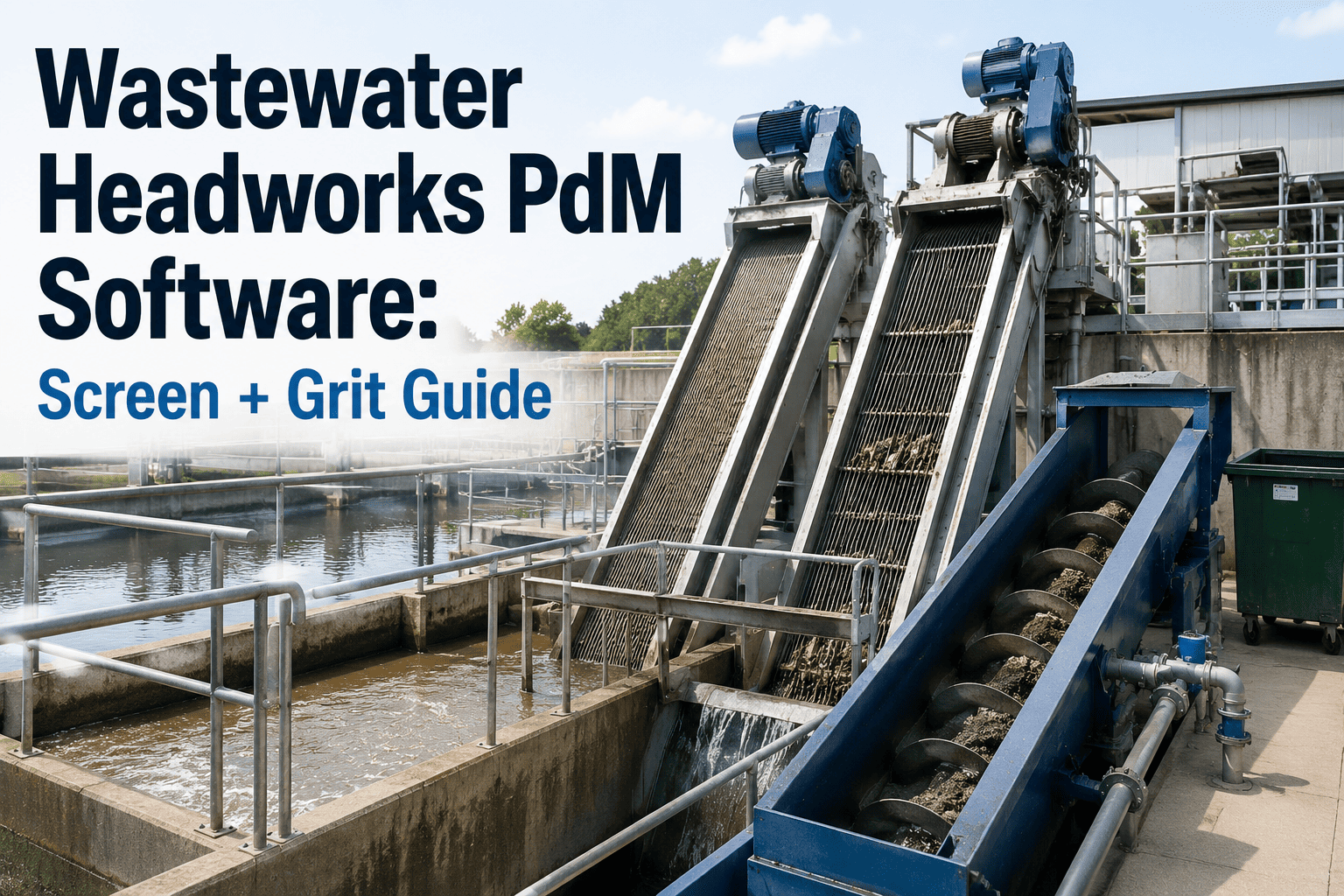
Headworks is the plant's first line of defense, and it is also the most overlooked corner of most preventive maintenance programs. The bar screen intercepts rags, wipes, and debris before they can wreck downstream pumps, the mechanical rake keeps that screen from blinding under load, and the grit chamber pulls sand and grit out of the flow before it abrades everything from the aeration blowers to the final clarifier mechanism. When any one of these three assets drifts out of calibration or slips into a reactive repair cycle, the damage rarely stays contained to headworks. It shows up weeks later as a clogged diffuser, a scored pump impeller, or a grit-choked clarifier drive that costs far more to fix than the original problem ever would have. Most utilities still run this area on paper logs, a wall calendar, and whatever the senior operator remembers from the last shift. Sign up to see what a connected headworks PdM program actually looks like for a plant your size.
Wastewater Headworks PdM Software Built for Screens, Rakes, and Grit Chambers
Oxmaint turns bar screen differential, rake motor torque, and grit classifier load into automated work orders inside your CMMS, so the equipment protecting your entire treatment train never runs blind again.
One Neglected Screen Can Take Down an Entire Process Train
Headworks equipment does not fail quietly. A blinded bar screen backs up the influent channel, a rake that stalls mid-cycle lets rags and wipes straight through to your pumps, and a grit classifier running past its duty cycle lets abrasive sand travel into aeration basins and clarifier mechanisms. Every one of those events starts as a small, measurable drift in motor current, torque, or differential level, long before it becomes an emergency call at two in the morning. Operators who rely on a fixed weekly walk-through often catch these problems only after the equipment has already begun compensating, which is exactly the stage where wear accelerates fastest and repair costs climb the most. A monitored headworks program instead flags the drift the moment it starts, giving maintenance teams days of lead time instead of minutes.
Headworks Equipment Every PdM Program Should Cover
Screening, raking, and grit removal work as a single system. Monitoring only one of the three still leaves the other two to fail without warning, so a proper headworks PdM plan tracks all three together and ties every reading back to a work order. Each asset below has its own wear pattern and its own set of early indicators, and a plan built around only one of them still leaves real exposure at the other two.
Connect Screen, Rake, and Grit Chamber Data to One CMMS
Oxmaint pulls readings from your existing sensors and PLCs, applies failure thresholds built for headworks equipment, and opens the work order automatically, before debris ever reaches a downstream pump.
Five Signals a Headworks Asset Is About to Fail
None of these signs show up overnight. Each one develops over days or weeks, which is exactly the window a PdM program is meant to catch, before a rake stall or a grit bypass becomes an emergency shutdown. Reviewing these five signals together, rather than in isolation, is usually what separates a routine work order from an after-hours callout.
PdM Parameters for Each Headworks Asset
Each asset in the headworks train has a small set of readings that reliably predict failure long before a visual inspection would catch it. Oxmaint maps these directly to alert thresholds and automated work order rules.
| Asset | Key PdM Parameters | Early Failure Signal |
|---|---|---|
| Bar Screen | Differential level, channel flow rate, screen cleaning frequency | Differential level trending upward across consecutive cycles |
| Mechanical Rake | Motor current draw, cycle time, chain or belt tension | Current and cycle time both drifting above baseline together |
| Rake Drive Motor | Bearing temperature, vibration, run-hours since lubrication | Temperature or vibration exceeding a rolling seven-day average |
| Grit Classifier | Screw torque, bearing temperature, duty-cycle frequency | Torque creep with no matching increase in grit loading |
| Grit Chamber | Removal efficiency, chamber level, downstream grit sampling | Grit detected in aeration or clarifier sampling points |
| Odor and H2S Sensors | H2S concentration, ventilation run status | Sustained H2S readings above the plant's safe operating band |
How One Headworks Failure Reaches Every Downstream Process
Headworks failures rarely stay where they start. The same debris or grit that a screen or classifier is meant to catch keeps moving through the plant, and every process it touches inherits the problem.
See Your Headworks Data Next to Every Downstream Asset
Oxmaint maps how a bar screen, rake, or grit chamber reading connects to the pumps, blowers, and clarifiers it protects, so your team fixes the root cause instead of chasing symptoms one work order at a time.
Measurable Gains From Headworks PdM
Wastewater Headworks PdM: Common Questions
A normal PM checklist tells a technician to inspect the screen or grit classifier on a fixed calendar date regardless of actual condition. Headworks PdM instead tracks live readings like differential level, rake motor current, and classifier torque, and opens a work order only when the equipment is actually trending toward failure. Sign up to see how Oxmaint builds this into your existing CMMS.
Most plants already have level sensors, motor current readings, and PLC data available at headworks; Oxmaint typically connects to that existing instrumentation rather than requiring a new hardware install. Where a gap exists, such as a rake without current monitoring, a targeted sensor addition is usually enough. Book a demo to review what your headworks setup already supports.
Screening and grit equipment generate meaningful trend data within the first few weeks of continuous monitoring, since cycle times, current draw, and differential readings update every shift. Most plants see their first predictive alert, and their first avoided emergency call, inside the first one to two months. Start a free trial to begin building that baseline now.
Yes, and this is where headworks PdM pays off the most. Because a screen or grit failure predictably stresses specific downstream assets, Oxmaint can link a headworks alert to preventive checks on the pumps, blowers, and clarifier drives most likely to be affected next. Book a demo to see the downstream linkage mapped for your process train.
Smaller plants often run with leaner staff and less redundancy, which makes an unplanned headworks failure more disruptive, not less. A focused PdM setup on just the bar screen, rake, and grit classifier is usually enough to catch the failures that would otherwise cascade through the rest of a smaller plant. Sign up to scope a plan sized for your plant.
Give Your Screen, Rake, and Grit Chamber the Same Attention You Give Aeration
Oxmaint connects headworks readings to your CMMS, turns drifting trends into automated work orders, and protects every process downstream from the plant's first mechanical barrier.