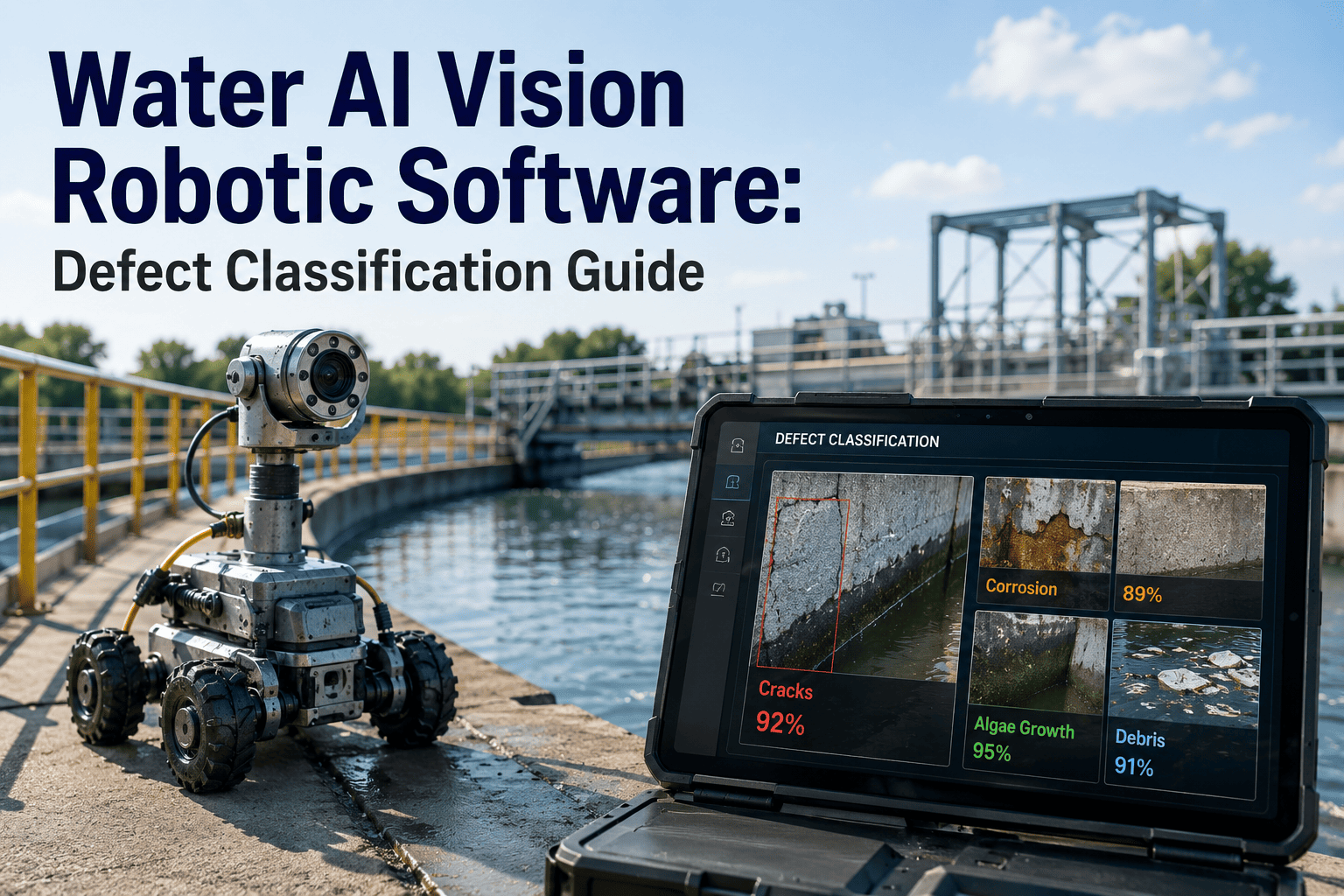
Every water and wastewater utility running a robotic inspection program eventually hits the same wall — not enough trained coders to keep up with the footage. A single CCTV crawler can capture more sewer mainline video in a week than a certified PACP coder can review in a month, and that gap only widens as utilities add more crawlers, more ROVs, and more inspection miles to meet consent decree and capital planning obligations. AI vision closes that gap by classifying defects directly from the video feed — structural cracks, root intrusion, corrosion, deformation — at a speed and consistency no human review queue can match. This guide covers how the AI vision layer actually works on top of robotic inspection hardware, what it classifies, and how it feeds directly into a maintenance and rehabilitation program. If your utility is still waiting weeks for coded inspection results, start a free trial with OxMaint to see AI-classified defects arrive the same day footage is captured.
Water AI Vision Robotic Software: The Defect Classification Layer That Scales PACP Coding Beyond Human Coders
Robotic crawlers and ROVs are capturing more pipe, tank, and treatment plant footage than certified coders can ever manually review. Here is how AI vision reads every frame, classifies every defect, and turns robotic inspection into a same-day maintenance workflow.
Why the Human Coder Became the Limiting Factor in Robotic Inspection
Robotic inspection hardware solved the access problem. Crawlers, pan-tilt-zoom cameras, and submersible ROVs now reach pipe and tank conditions no human could safely inspect directly, and they do it continuously, generating hours of HD footage per shift. What robotics did not solve is what happens after the footage comes back — a certified coder still has to watch every frame, apply the correct structural or operational code, assign a severity grade, and log the location. That review step moves at a fraction of the pace the cameras capture at, and it is where inspection programs quietly stall.
Industry studies on manual CCTV review consistently find that operators miss a significant share of defects during real-time or single-pass review, simply because sustained frame-by-frame attention over hours of footage is not something people do reliably. Coding also varies coder to coder — two trained reviewers watching the same clip do not always assign the same grade, which introduces inconsistency into a dataset that capital planning and rehabilitation prioritization depend on being accurate. AI vision does not get tired, does not lose attention on frame six thousand, and applies the same classification logic to every foot of pipe and every inch of tank wall it reviews.
The scale of the problem is growing faster than staffing can follow. Utilities are adding inspection miles every year to meet consent decree obligations, respond to aging infrastructure, and satisfy capital improvement planning requirements — but the number of certified PACP coders on staff or under contract has not grown at the same rate. The result is a widening backlog where completed footage sits waiting for review, delaying the very rehabilitation decisions the inspection program exists to support. AI vision does not replace the review discipline PACP certification represents — it applies that discipline at a volume and speed no review team, however well trained, can match on its own.
What the AI Vision Layer Actually Classifies From Robotic Footage
AI vision models trained on millions of labeled inspection frames recognize the same defect catalogue NASSCO-certified coders use, applied consistently across every inspection, every crawler, and every pipe material or tank surface. Each classification carries a confidence score, so results the model is certain about move straight to a work order while anything ambiguous routes to a human reviewer rather than being logged automatically.
How the AI Vision Layer Turns Footage Into a Work Order
AI vision is not a single step — it is a pipeline that runs between the camera and the maintenance system, and every stage feeds the next automatically.
How AI-Assigned Severity Grades Drive the Rehabilitation Schedule
Every classified defect lands on the same five-point scale used across the industry, and each grade maps directly to an action timeline instead of sitting in a report waiting for someone to interpret it.
Manual Coding Versus AI-Assisted Coding, Side by Side
The difference is not just speed. Consistency, cost, and how quickly results reach the capital planning process all shift once AI vision handles the first classification pass.
| Factor | Manual Coding Only | AI-Assisted Coding |
|---|---|---|
| Review Speed | Roughly real-time, one clip at a time | Full video processed in minutes |
| Defect Capture Rate | Misses a meaningful share of short-duration defects | Every frame reviewed, nothing skipped |
| Coding Consistency | Varies between coders and over a long shift | Same classification logic every time |
| Contractor Submittal Failures | Common cause of rejected inspection deliverables | Reduced sharply with standardized AI-verified coding |
| Time to Work Order | Days to weeks after inspection | Same day the inspection is completed |
The Same AI Vision Layer Works Inside the Treatment Plant
PACP coding gets the most attention because collection systems generate the most inspection volume, but the same underlying AI vision technology applies directly to treatment plant assets. Submersible ROVs now inspect clearwells, sedimentation basins, and elevated storage tanks without draining them, using HD cameras, sonar, and thickness-gauging sensors to survey walls, floors, and baffles while the asset stays in service.
AI vision reads that footage the same way it reads pipe video — identifying corrosion cells, coating breakdown, sediment depth, and structural anomalies, then scoring severity and attaching the finding to the asset's maintenance record. For above-ground equipment, a technician can capture a photo during a routine walk-through and get an instant defect classification instead of waiting on a scheduled inspection cycle. Research on visual inspection accuracy shows human inspectors miss a substantial share of early-stage defects during routine rounds simply because subtle corrosion and hairline cracking are hard to catch with the naked eye — the same detection gap AI vision closes on treatment plant equipment that it closes on buried pipe.
This matters most for assets that are expensive or disruptive to take offline for inspection. Draining a clearwell or elevated storage tank to send a person inside for a visual survey can take a facility out of service for days and carries its own safety risk. Submersible inspection removes that trade-off entirely — the tank stays full and in service while an ROV surveys every wall, floor, and baffle, and AI vision turns that survey into the same severity-scored, work-order-ready output a pipe inspection produces. The operational discipline is identical across the utility, whether the asset is buried underground or standing in the plant yard.