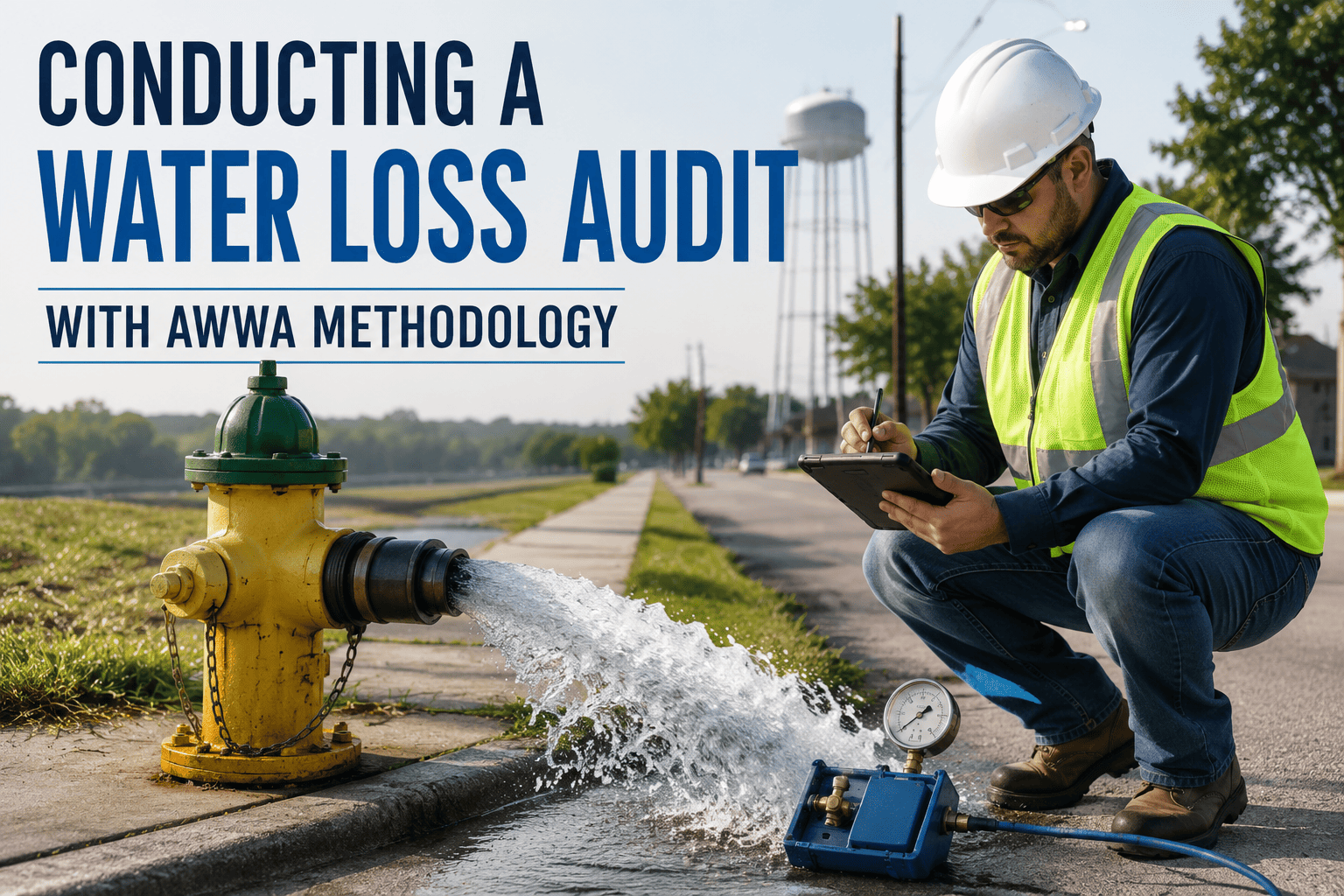
Conducting a Water Loss Audit With AWWA Methodology

By Corin Hale on July 9, 2026

water-loss-audit-awwa-methodology-utility

Every gallon your utility produces but never bills for is revenue quietly draining out of your budget, and most managers only discover the scale of it once a rate case or board meeting forces the question. An AWWA-standard water loss audit is the only way to actually put a number on that loss instead of guessing at it. Utilities that skip a formal audit typically run non-revenue water well above the 15-25% range regulators and industry bodies consider healthy, without knowing whether the cause is leaking mains, faulty meters, or unbilled consumption. The M36 methodology, developed jointly by AWWA and the International Water Association, gives you a defensible, standardized way to quantify exactly where every drop is going, and where the recovery dollars actually are: start tracking your water balance with Oxmaint.

AWWA M36 Methodology / Non-Revenue Water / Utility Management

Conducting a Water Loss Audit With AWWA Methodology

You cannot manage water loss you have not measured. The AWWA/IWA water audit methodology turns a vague sense of "we lose some water somewhere" into a validated, line-by-line water balance that tells you exactly how many gallons are lost to leakage versus meter error, and what recovering them is worth.

25%
non-revenue water level the World Bank considers the upper bound of acceptable
3.3
average Infrastructure Leakage Index reported across AWWA-validated audits
40%+
non-revenue water reported by utilities with the oldest buried infrastructure
2009
year AWWA's Water Loss Control Committee named annual audits standard practice
See Your Water Balance

Turn Audit Data Into a Live, Continuously Updated Water Balance

Oxmaint pulls production meter, billing, and consumption data into one AWWA-aligned water balance so your audit stays current between formal reporting cycles instead of going stale the day after you file it.

What the AWWA Water Balance Actually Tracks

The water balance is the backbone of the M36 method. It starts with every gallon your system produces and splits it, step by step, into water you billed for and water you lost — so nothing is unaccounted for and nothing hides in a rounding error. Building this out for your own system is exactly what a full audit walkthrough on Oxmaint's free trial will show you.

System Input Volume
Water produced or purchased, corrected for known measurement error
splits into
Authorized Consumption
Billed metered and unmetered use, plus unbilled water for fire flow, flushing, and utility operations
Non-Revenue Water
Everything produced but never converted to billed revenue
splits into
Apparent Losses
Unauthorized consumption, meter inaccuracy, billing and data handling errors
Real Losses
Physical leakage from transmission mains, storage tanks, distribution mains, and service connections

Apparent Losses vs. Real Losses: Why the Distinction Matters

Apparent Losses
Water that physically reaches a customer but is never correctly billed. Aging meters under-register at low flow, data handling errors drop consumption off a bill, and unauthorized connections tap the system without a meter at all. This is a paperwork and metering problem, not a pipe problem.
Fixed by: meter testing and replacement, billing system audits, theft detection
Real Losses
Water that leaves the system entirely through leaks, bursts, and storage overflows before it ever reaches a customer. This is the physical condition of your buried infrastructure showing up as lost production capacity and, eventually, main breaks.
Fixed by: active leak detection, pressure management, main rehabilitation

The Six Steps of an AWWA M36 Audit

The Free Water Audit Software gives you the spreadsheet, but the sequence below is what actually happens behind it. Utilities that assign clear ownership to each step consistently produce more defensible, higher-grade audit data.

01
Validate system input volume
Confirm production meter accuracy before anything else — every downstream number inherits this error.
02
Tally authorized consumption
Pull billed metered and unmetered use, plus unbilled operational water like flushing and firefighting.
03
Quantify apparent losses
Estimate meter under-registration, billing errors, and unauthorized consumption using sampled meter testing data.
04
Calculate real losses by difference
Subtract authorized consumption and apparent losses from system input volume to isolate physical leakage.
05
Compute performance indicators
Convert raw volumes into NRW percentage, gallons per connection per day, and the Infrastructure Leakage Index.
06
Grade data validity and prioritize action
Score each input's confidence level, then direct capital and labor toward the losses with the strongest data behind them.
Automate the Data Grading Step

Stop Re-Building Your Water Balance in a Spreadsheet Every Year

Oxmaint links directly to production meters, billing exports, and work order history so steps one through five of the audit update automatically instead of consuming a week of staff time every reporting cycle.

Reading Your Results: NRW% vs. Infrastructure Leakage Index

IndicatorWhat It MeasuresHealthy BenchmarkLimitation
NRW as % of system input Share of produced water never billed Below 25% per World Bank guidance Swings with seasonal demand, not just leakage
Infrastructure Leakage Index Current real losses against the unavoidable minimum for your system Below 2 is considered world-class Requires accurate pipe length and pressure data
Gallons lost per connection per day Real losses normalized by customer count Utility and density dependent Less useful for comparing rural to urban systems
Data validity score Confidence grade behind each audit input Higher band each reporting cycle Depends entirely on metering and record quality

A system with a high NRW percentage but newer infrastructure may still post a low ILI, meaning the loss is closer to unavoidable than it looks. That distinction is exactly why AWWA recommends reading the two indicators together rather than reacting to NRW percentage alone.

What Utilities Recover Once the Audit Points to Real Numbers

18-42 days
earlier warning on developing leaks when audit data feeds continuous monitoring instead of an annual snapshot
20-35%
typical reduction in avoidable real losses within the first two years of a targeted control program
6-12 mo
common timeframe for recovered revenue to offset the cost of the audit and follow-up leak detection work

Frequently Asked Questions

How often should a water loss audit be conducted?+
AWWA's Water Loss Control Committee has recommended annual audits as standard utility practice since 2009. Running the audit every year, using the same methodology, is what lets you trust year-over-year trend lines rather than one-off snapshots. See how continuous data collection keeps that annual audit accurate without a manual re-build each cycle.
What is the difference between NRW and the Infrastructure Leakage Index?+
NRW percentage measures lost water against total production and shifts with seasonal demand. The Infrastructure Leakage Index compares your actual real losses to the unavoidable minimum for a system your size and pressure, making it the more reliable figure for benchmarking against other utilities.
Do I need the AWWA Free Water Audit Software to follow this methodology?+
The free spreadsheet is the standard starting point and is what most regulators expect to see submitted. It works well for an annual snapshot, though most utilities eventually pair it with continuous monitoring so the underlying data does not go stale between audit cycles.
What data validity grade should a utility be targeting?+
AWWA grades each audit input from poor to excellent based on how the underlying data was collected. Utilities without formal metering programs commonly start in the lower bands and should prioritize production meter calibration first, since every other number in the audit depends on it.
Can a small utility complete this audit without dedicated staff?+
Yes. The M36 manual includes guidance specifically for small systems, and the core inputs — production totals, billing records, and known unbilled use — are usually already collected somewhere. Book a demo to see a small-fleet audit workflow walked through end to end.
Water Loss Intelligence — Oxmaint

Your Next Water Loss Audit Doesn't Have to Start From a Blank Spreadsheet

Oxmaint keeps your system input volume, billing data, and leak history connected year-round, so every AWWA audit cycle starts from a validated water balance instead of a week of manual data assembly.

1 platform
for production, billing, and leak data in one water balance
Continuous
tracking between formal audit reporting cycles
Audit-ready
exports aligned to AWWA M36 line items

Share This Story, Choose Your Platform!