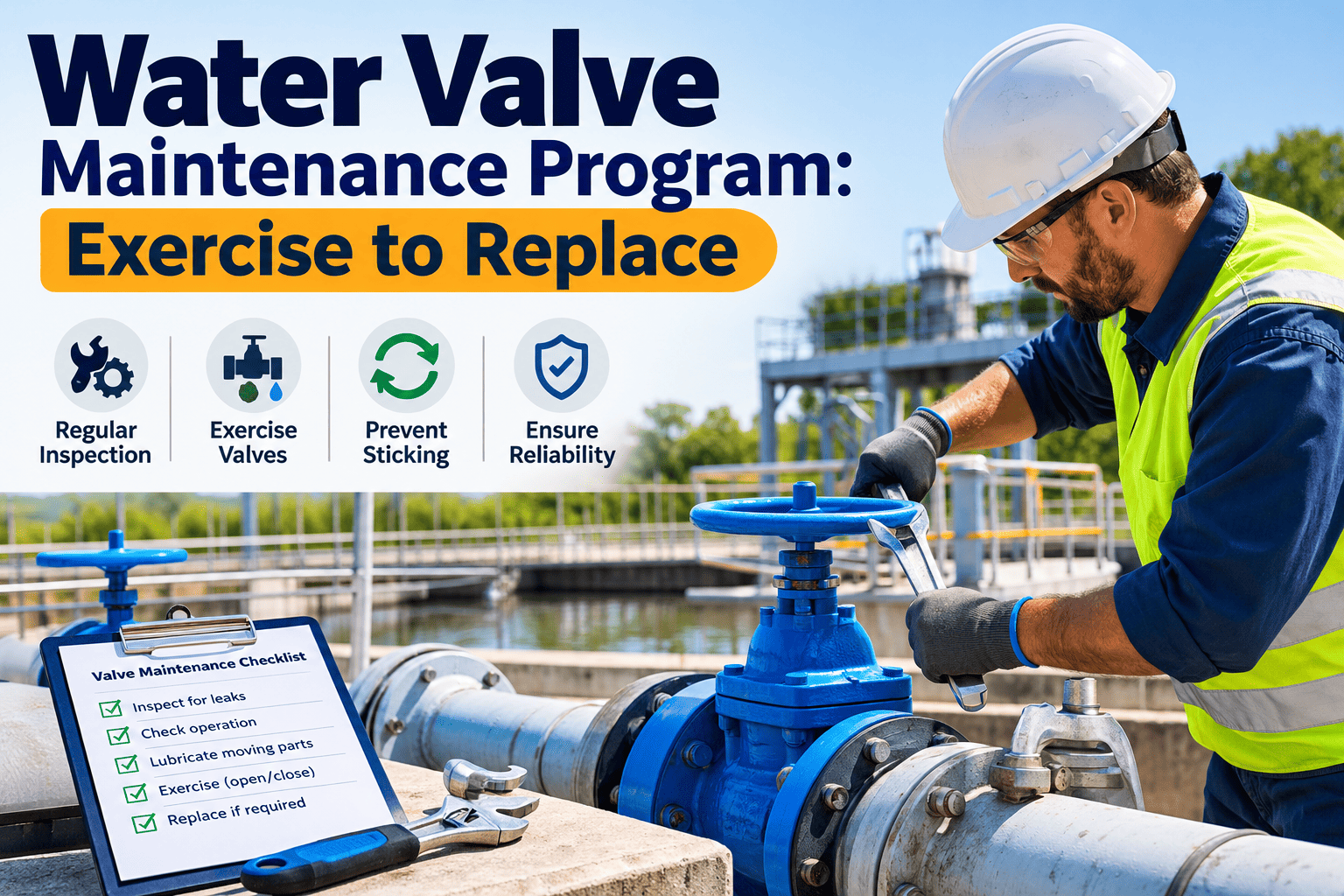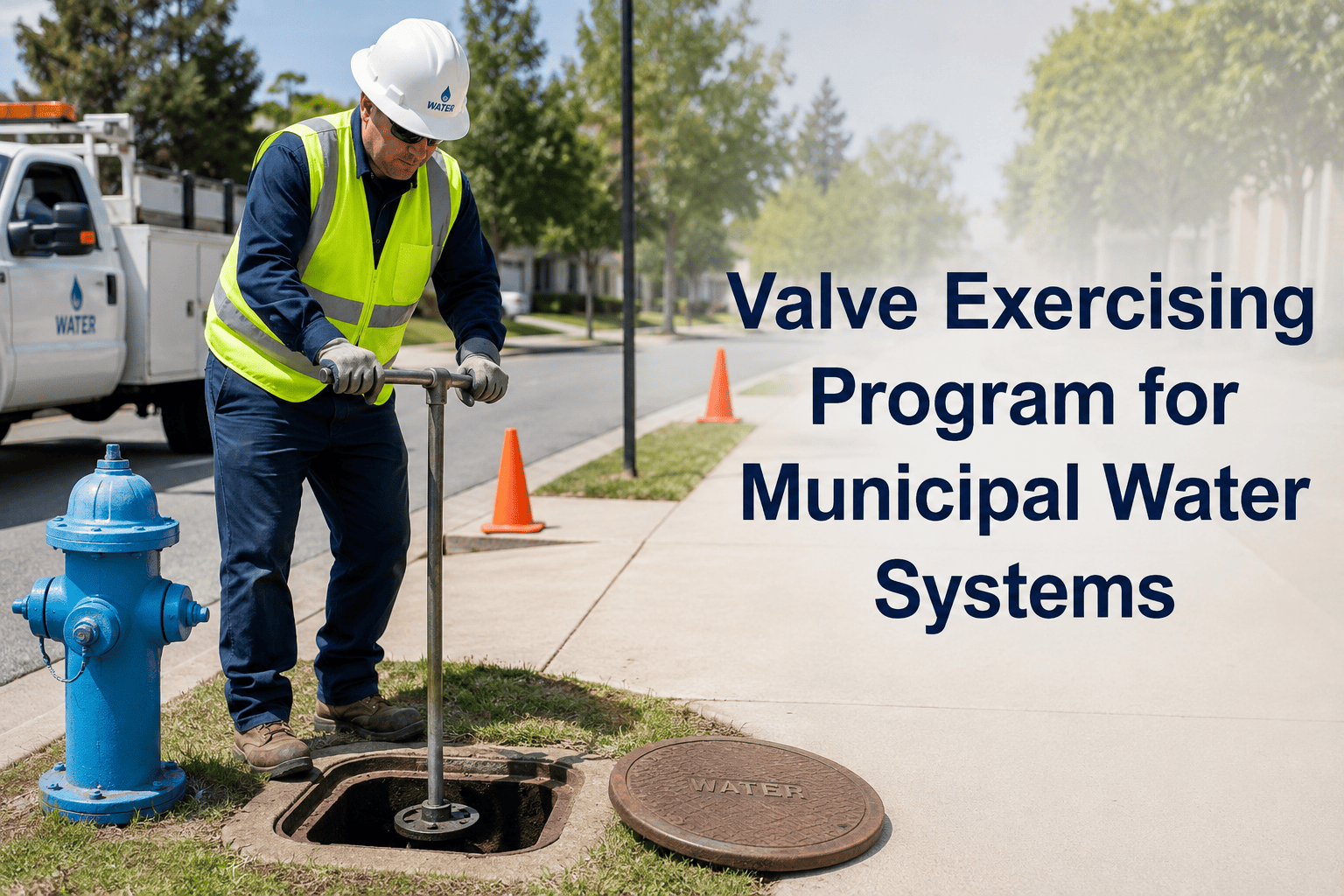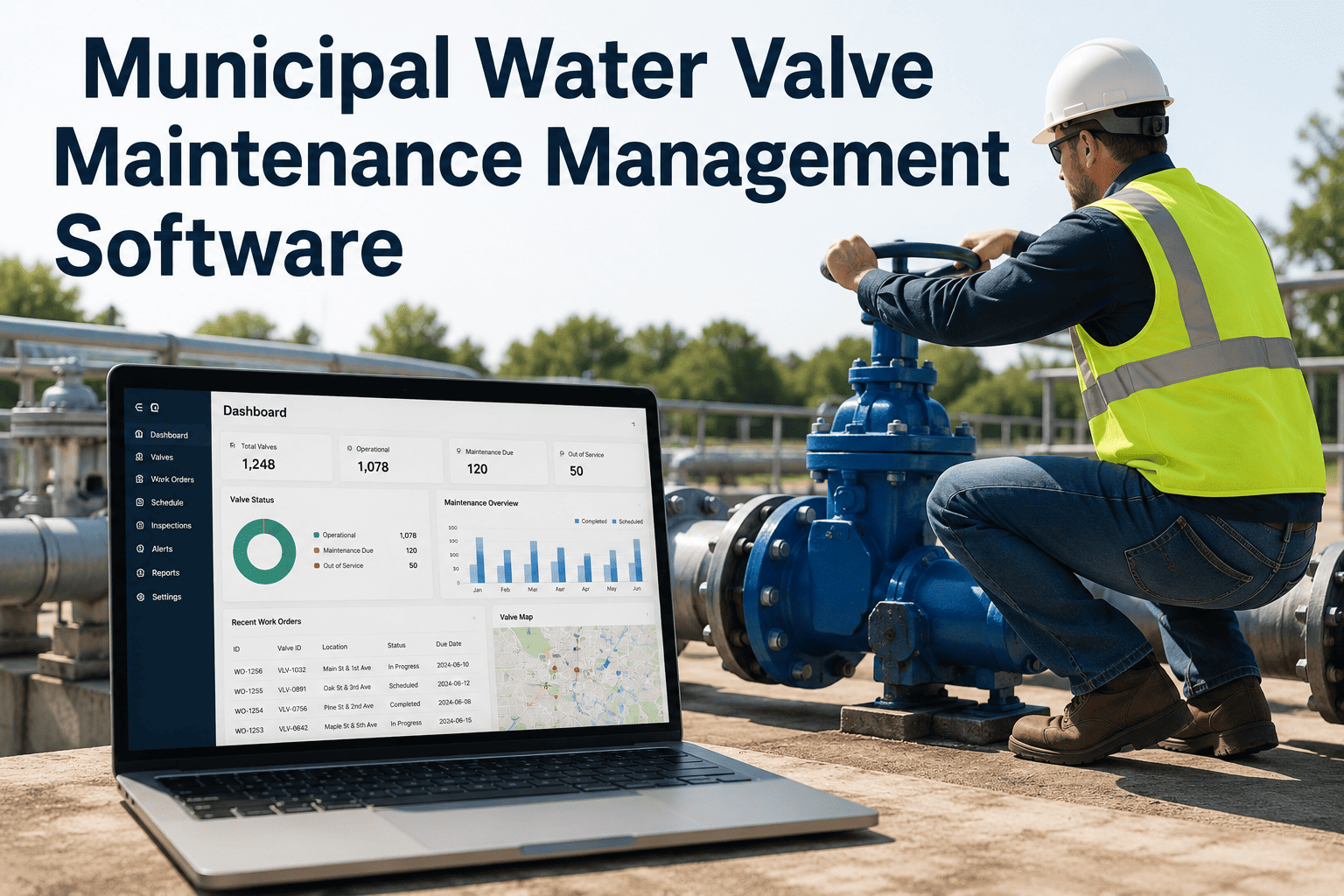
Valves and hydrants are the two assets water utilities defer most often — until a 3 a.m. main break or a four-alarm structure fire exposes years of inactivity. A disciplined valve exercising program and a structured hydrant flushing program are what keep your distribution system responsive, compliant and insurable, yet many utilities only touch valves when something fails and only flush hydrants when pressure complaints pile up. The reality is straightforward: a valve that hasn't been turned in 8-10 years has roughly a 50/50 chance of refusing to close, and a hydrant that hasn't been flowed in two years may deliver a fraction of its rated capacity. Building these programs around a CMMS — like Start Free Trial — transforms them from seasonal scrambles into scheduled, documented, defensible workflows.
Can your system close the right valve in the first 15 minutes of a main break?
Stuck valves add hours to isolation, hydrants that haven't been flowed in years fall short at structure fires, and both become audit liabilities when records go missing. This guide lays out the exercising and flushing cadences, crew math and documentation standards that keep every valve and hydrant ready when the call comes.
The cost of a deferred valve and a dead hydrant
Industry data is consistent: a valve exercised at least once every 4 years closes reliably over 95% of the time, while one left untouched for a decade fails to close or seal in nearly half of field tests. Hydrants tell a similar story — NFPA 291 recommends flowing every hydrant annually, yet most systems only reach a fraction of theirs each year.
A mid-sized utility running 6,200 valves on a 7-year cycle
Consider a utility with 6,200 system valves and 1,400 hydrants on a 7-year exercising cycle with no CMMS tracking. Field crews report roughly 1 in 6 valves won't close on the first attempt — meaning during a typical 8-inch main break, isolation takes 4-6 hours instead of the target 90 minutes, flooding basements and burning overtime. Moving to a 4-year cycle with mobile work orders dropped that failure rate to under 5% and cut average isolation time to 75 minutes within 18 months. The program paid for itself in avoided emergency repair costs inside the first year.
How often each valve and hydrant should be exercised
Frequency is not one-size-fits-all. Critical valves on large-diameter mains, transmission feeds and hospital or school service lines demand tighter cycles than residential branch lines. Use the table below as a starting baseline, then tighten cycles for high-consequence assets identified in your risk register.
| Asset Class | Exercising / Flushing Frequency | Cycle Rationale | Crew Time per Asset |
|---|---|---|---|
| Critical isolation valves (≥12-inch mains, transmission) | Every 12 months | High consequence of failure; supports system segmentation during breaks | 25-40 min |
| Distribution valves (4-10 inch mains) | Every 3-4 years | Industry benchmark balancing wear against operability | 15-25 min |
| Residential branch valves (≤2-inch) | Every 5-6 years | Lower risk; grouped with neighborhood flushing sweeps | 10-15 min |
| Fire hydrants (flow + inspection) | Annually (NFPA 291) | Flow testing, cap lubrication, drain-back check, painting | 20-35 min |
| Unidirectional flushing (UDF) zones | Every 2-3 years per zone | Targeted scouring velocity; tied to water quality complaints | 4-8 hrs per zone |
| Pressure reducing valves (PRVs) | Every 6 months | Pilot setting verification, strainer cleaning, diaphragm check | 45-90 min |
A 12-month valve and hydrant operating calendar
Spreading exercising and flushing across the year prevents the classic problem of crews doing nothing for nine months and then scrambling before freeze-up. A month-by-month cadence keeps the program visible, predictable and audit-ready.
Critical valve exercising, indoor assets
Exercise large-diameter and critical isolation valves while demand is low. Verify vaults, tag valves with GPS coordinates and confirm operability before spring break season.
Hydrant inspections begin
Open every hydrant, check caps and chains, lubricate threads, verify drain-back operation. Document static and residual pressures in the CMMS against the prior year's baseline.
Unidirectional flushing + flow testing
Run UDF zones in sequence to achieve 5+ ft/s scouring velocity. Pair flow tests with AWWA fire-flow documentation for the fire marshal and ISO rating submissions.
Distribution valve exercising sweep
Hit 25-30% of distribution valves on a rotating 4-year cycle. Record turns-to-close, direction, torque and any anomalies; flag trouble valves for replacement in the capital plan.
PRV and air-vac service, freeze prep
Service pressure reducing valves and air-release valves. Confirm all hydrants drain back properly before first hard freeze; mark any that hold water for priority repair.
Year-end review and capital planning
Reconcile CMMS records, calculate completion rate against target, identify the worst-performing 5% of assets for replacement, and set next year's crew schedule and budget.
How to estimate crew hours for exercising and flushing
A defensible program starts with honest crew math. Use this formula to right-size your annual labor budget so the cycle is actually achievable — not aspirational.
Efficiency factor typically runs 0.65-0.75 — the rest is travel, traffic control, weather delays and record-keeping. Planning at 100% efficiency is the most common reason programs fall behind.
Hydrants (annual): 1,400 × 28 min = 653 hrs
Total raw hours: 1,222 ÷ 0.70 efficiency = 1,746 crew hrs/yr
That's roughly one two-person crew working 220 days a year. If that feels tight, you've found the real reason your program slips — and the case for adding capacity or a CMMS to lift efficiency above 0.75.
Stop guessing which valves will close. Schedule the whole program in Oxmaint.
Auto-generate exercising routes, assign crews, capture torque and flow data on mobile, and export defensible audit records in one click.
What every exercising and flushing record must capture
An exercised valve with no record is the same as a deferred valve in an audit. Use these tiered checklists to standardize what every crew member captures on every visit — mobile-ready inside the CMMS.
Valve exercising record
- Valve ID, GPS location, size and type verified against GIS
- Turns to full close and direction of operation recorded
- Torque or operating effort logged (normal / elevated / seized)
- Condition of valve box, lid and surrounding pavement noted
- Photo of asset and any damage or obstruction captured
- Re-opened fully and confirmed — no partial close left behind
Hydrant flushing record
- Hydrant ID, manufacturer, year and nozzle size confirmed
- Static pressure, residual pressure and pitot reading captured
- Flow rate calculated and compared to previous year baseline
- Caps, chains, threads lubricated; operating nut condition noted
- Drain-back verified — hydrant must not hold water after close
- Dechlorination and runoff management documented where required
Compliance and audit trail
- AWWA / NFPA 291 standard reference attached to each record
- Crew member, date, time and duration auto-stamped by CMMS
- Deviations flagged for supervisor review and follow-up work order
- Annual completion rate reportable by zone, crew and asset class
- Capital candidates (repeat failures) pushed to replacement plan
- Records exportable for state primacy and ISO rating submissions
Reactive effort versus a CMMS-driven program
Most utilities are not doing nothing — they are doing unstructured work that doesn't compound. The gap between a paper-based reactive program and a CMMS-driven one is measurable in emergency hours, audit readiness and capital planning accuracy.
| Dimension | Reactive / Paper-Based | CMMS-Driven Program |
|---|---|---|
| Cycle visibility | "We think we hit most valves every 5-7 years" | Every asset's last-exercised date visible; next due auto-scheduled |
| Average isolation time | 4-6 hours; crews hunt for operable valves in the field | 60-90 minutes; critical valves pre-verified annually |
| Documentation | Clipboard sheets, partial data, lost in trucks | Mobile-captured torque, flow and photo records, cloud-stored |
| Audit readiness | Weeks of manual compilation; gaps and missing years | One-click report by zone, year or standard (AWWA / NFPA 291) |
| Capital planning | Replace what breaks; anecdotal prioritization | Repeat-failure data drives a ranked replacement queue |
| ISO fire-rating support | Partial flow data; fire marshal requests slow to fulfill | Hydrant flow history reportable per hydrant, on demand |
What changes when a utility commits to the cycle
"We moved 4,800 valves and 1,100 hydrants into Oxmaint on a 4-year rotating schedule. Within 14 months our average main-break isolation time dropped from just over 5 hours to 78 minutes, and we finally had the flow-test records our fire marshal had been requesting for three years."
"The crew-efficiency math was the wake-up call. We were planning at 100% and hitting maybe 55%. Once we staffed to the realistic 0.70 factor and let the CMMS auto-route exercising, our annual completion rate went from 62% to 94% in the first full year."
Valve exercising and hydrant flushing — answered
How often should water valves be exercised?
Critical isolation valves on large-diameter mains should be exercised annually. Standard distribution valves on 4-10 inch mains should follow a 3-4 year cycle, and residential branch valves can run on a 5-6 year cycle. The key is consistency — a valve exercised on a reliable 4-year cycle closes correctly over 95% of the time, while one left untouched for a decade seizes in roughly half of field tests. You can stand up the full rotating schedule in Oxmaint — Start Free Trial — and let the system auto-assign next-due dates.
What does a hydrant flushing program actually accomplish?
Flushing removes sediment and biofilm buildup that degrades water quality and reduces hydraulic capacity. It also verifies each hydrant's flow rate, static and residual pressure, drain-back function, and physical condition — all of which feed your ISO fire-protection rating and your compliance record under AWWA and NFPA 291. Without annual flushing, hydrants silently lose capacity and may fail outright when a fire crew connects and expects rated flow.
How long does it take to exercise a single valve?
A typical distribution valve takes 15-25 minutes including locating, operating through a full close-open cycle, recording torque and turns, and documenting condition. Critical large-diameter valves can take 25-40 minutes because of vault access, traffic control and slower operating speeds. Residential branch valves run 10-15 minutes. Multiply these by your asset count and divide by a realistic 0.65-0.75 crew efficiency factor to get true annual labor demand.
Why do valve exercising programs fall behind?
Three reasons: crews are pulled onto emergencies and the exercising schedule slips; the program is planned at 100% efficiency with no allowance for travel, weather or record-keeping; and there is no CMMS enforcing the next-due date, so exercised valves simply disappear into a spreadsheet until someone asks. A CMMS that auto-routes and auto-schedules is the single biggest fix. Book a walkthrough at Book a Demo to see the workflow.
What records do we need for an audit or ISO rating submission?
For each exercised valve: ID, GPS, date, turns-to-close, torque, direction and condition. For each flushed hydrant: ID, static and residual pressure, pitot reading, calculated flow rate, drain-back confirmation and crew. Both should be timestamped, crew-attributed and exportable by zone and year. Oxmaint stores all of this in a structured, audit-ready format that exports to the reports your state primacy agency and fire marshal expect.
Every valve exercised. Every hydrant flowed. Every record defensible.
Build the valve exercising and hydrant flushing program your system has been deferring — on a platform that schedules it, routes it, documents it and proves it.
Free 14-day trial · No credit card