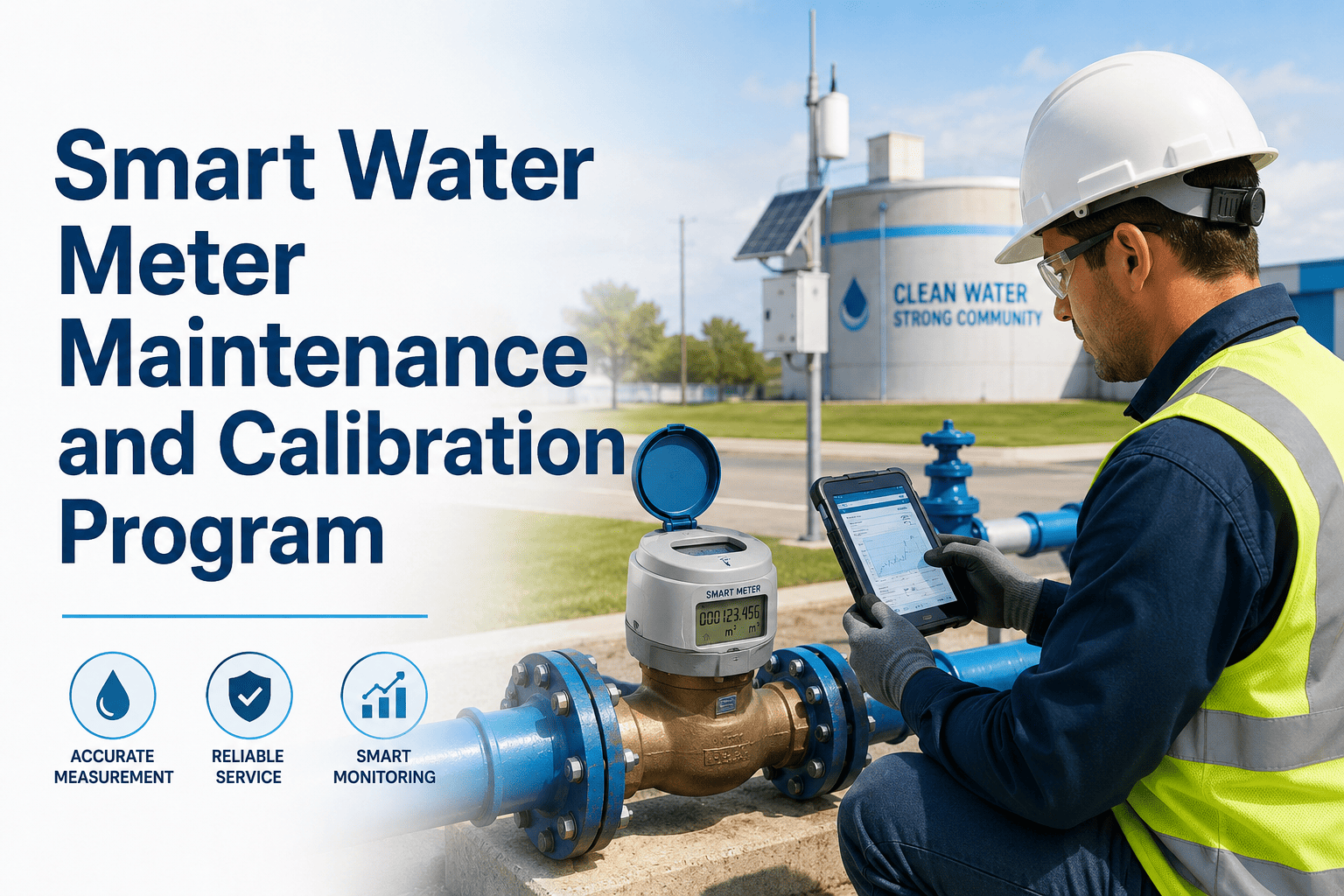
Advanced Metering Infrastructure (AMI) has transformed water utility operations — replacing manual meter reads with real-time consumption data, leak detection, and automated billing. But smart meters and the communication networks connecting them are physical assets that degrade, drift, and fail like any other infrastructure. Without structured maintenance, meter accuracy declines 1–3% annually, billing revenue leaks compound silently, and AMI network gaps leave entire service zones unmonitored. A CMMS like OxMaint brings meter lifecycle management, accuracy testing schedules, and network health monitoring into one operational platform.
Manage Your Entire Meter Fleet and AMI Network in OxMaint
Meter testing schedules, replacement planning, AMI communication monitoring, and data quality tracking — one CMMS for your entire metering infrastructure.
What Makes Smart Meter Infrastructure Different from Traditional Meters
Traditional meters are mechanical devices that require periodic manual reading and eventual replacement. AMI systems add layers of electronic and communication complexity — each smart meter contains a measurement register, an electronic encoder, a radio transceiver, a battery (for battery-powered endpoints), and firmware that must be managed across the fleet. The communication network itself — whether fixed-network RF, cellular, or hybrid — introduces additional infrastructure requiring its own maintenance program.
This complexity means AMI maintenance is not just "meter maintenance plus IT" — it is an integrated program spanning physical assets, electronic components, communication networks, and data management systems. Utilities that treat AMI as a set-and-forget deployment discover within 3–5 years that accuracy degradation, communication failures, and firmware obsolescence erode the ROI that justified the AMI investment. Book a demo to see how OxMaint manages all four dimensions.
AMI System Components: What Needs Maintenance
Meter Register
The measurement element — positive displacement, electromagnetic, or ultrasonic — that measures flow volume. Subject to accuracy drift from wear, sediment fouling, and age-related degradation.
Electronic Encoder
Converts mechanical register readings into digital data for transmission. Encoder failures cause data gaps, stuck reads, and billing discrepancies that may go undetected for months.
Radio Transceiver
Transmits meter data to collection infrastructure via RF, cellular, or LPWAN protocols. Signal degradation from antenna corrosion, environmental interference, or network congestion causes read failures.
Network Infrastructure
Collectors, repeaters, gateways, and backhaul connections that route meter data to the head-end system. Infrastructure failures can black out entire neighborhoods from the billing and monitoring system.
Head-End System
The central software that receives, validates, and stores all meter data before passing it to billing and analytics platforms. Data quality issues here cascade into every downstream system.
Battery & Power
Battery-powered endpoints have finite life spans — typically 10–20 years depending on transmission frequency. Low-battery meters transmit intermittently or stop entirely, creating silent billing gaps.
Meter Accuracy Testing: Protecting Billing Revenue
Meter accuracy is the foundation of utility revenue integrity. AWWA standards recommend testing meters on a statistical sampling basis, with full-fleet accuracy audits on defined cycles. OxMaint automates testing schedules, tracks results per meter, and flags meters exceeding accuracy tolerance thresholds for replacement.
| Meter Size | AWWA Test Interval | Low Flow Accuracy Target | Normal Flow Accuracy Target | Revenue Impact of 2% Drift |
|---|---|---|---|---|
| 5/8" – 3/4" Residential | 10–15 year cycle (sample-based) | 95% at 0.25 GPM | 98.5% – 101.5% | $15 – $40 per meter/year |
| 1" – 2" Commercial | 5–10 year cycle | 95% at rated low flow | 98.5% – 101.5% | $200 – $800 per meter/year |
| 3" – 6" Commercial/Industrial | 3–5 year cycle | 95% at rated low flow | 98.5% – 101.5% | $2,000 – $15,000 per meter/year |
| 8"+ Master/Wholesale | Annual testing | 95% at rated low flow | 98.5% – 101.5% | $25,000 – $100,000+ per meter/year |
The revenue impact compounds silently — a utility with 50,000 residential meters averaging 2% under-registration loses $750,000–$2,000,000 annually in unbilled water. A CMMS-managed testing program catches this drift before it compounds. Sign up free and start tracking meter accuracy across your fleet.
AMI Network Health: Maintaining Communication Reliability
A smart meter that cannot communicate is functionally identical to a dead meter — it produces no billing data, no leak alerts, and no consumption analytics. AMI network maintenance ensures that the communication infrastructure connecting meters to your head-end system operates at target read rates.
Read Success Rate
Target: 98%+ daily read success across the fleet. OxMaint tracks read rates per meter, per collector zone, and fleet-wide — flagging zones dropping below threshold for field investigation.
- Per-meter read rate tracking with trend analysis
- Automatic work orders for chronic non-read meters
Collector and Gateway Uptime
Fixed-network AMI depends on collectors and gateways that aggregate and relay meter data. A single collector failure can black out hundreds of meters. OxMaint schedules collector PM and tracks uptime per device.
- Uptime monitoring with downtime alerting
- Preventive maintenance for power, antenna, and enclosure
Signal Quality and Interference
RF signal degradation from new construction, vegetation growth, or interference sources causes gradual read rate decline. Periodic signal surveys and antenna inspections maintain communication quality across the coverage area.
- Signal strength baseline and trend tracking
- Interference investigation work orders
Maintenance Program by Frequency
Review fleet read success rates and flag non-read meters
Audit head-end exception reports for data quality anomalies
Check collector/gateway uptime logs and investigate outages
Process customer high-use and leak alerts from AMI data
Conduct field investigation on chronic non-read meters
Inspect and clean collector/repeater enclosures and antennas
Review battery life projections and stage proactive replacements
Validate firmware versions and schedule update campaigns
Statistical sample accuracy testing per AWWA M6 guidelines
Large meter testing (3"+ commercial/industrial, wholesale)
AMI network coverage survey and signal quality assessment
Meter replacement campaign for end-of-life and failed units
Full residential meter accuracy audit (statistical or full-fleet)
AMI endpoint technology refresh evaluation
Network infrastructure upgrade planning (collectors, backhaul)
Head-end system upgrade or migration planning
Performance Benchmarks: CMMS-Managed Metering Programs
Utilities with structured CMMS-managed metering maintenance consistently outperform those relying on reactive or calendar-only approaches across revenue integrity, network reliability, and data quality metrics.
| Performance Metric | Unmanaged Baseline | CMMS-Managed Program | Improvement |
|---|---|---|---|
| Fleet Read Success Rate | 88% – 94% | 97% – 99.5% | 5 – 8 point gain |
| Non-Revenue Water (metering component) | 8% – 15% apparent loss | 2% – 5% apparent loss | 60% – 70% reduction |
| Meter Accuracy (fleet average) | 94% – 97% | 98% – 100% | 2 – 4 point gain |
| Billing Exception Rate | 5% – 12% of accounts | 1% – 3% of accounts | 65% – 80% reduction |
| Collector/Gateway Uptime | 92% – 96% | 98% – 99.8% | 3 – 5 point gain |
| Customer Billing Complaints | 3% – 6% of accounts/year | 0.5% – 1.5% of accounts/year | 70% – 80% reduction |
How OxMaint Manages Metering Infrastructure
Meter Fleet Registry
Complete meter inventory with size, type, manufacturer, install date, location, AMI endpoint ID, and battery status — searchable and filterable across your entire service territory.
Automated Testing Schedules
AWWA-aligned accuracy testing schedules by meter size with auto-generated work orders, result tracking, pass/fail flagging, and replacement triggers for meters failing tolerance thresholds.
Network Health Dashboards
Real-time read success rates, collector uptime, and signal quality metrics displayed per zone and fleet-wide — with automatic work order generation for meters or infrastructure dropping below targets.
Battery Life Management
Track remaining battery life across the fleet, project replacement timelines, and generate proactive replacement campaigns before batteries reach end-of-life — preventing silent data gaps.
Firmware and Configuration Management
Track firmware versions fleet-wide, schedule update campaigns, and verify successful deployment — ensuring all endpoints run current software with the latest security and performance patches.
Revenue Impact Reporting
Quantify the revenue impact of meter accuracy drift, non-read meters, and billing exceptions — giving finance and operations teams the data to justify meter replacement and AMI maintenance investments.
Protect Meter Accuracy and AMI Network Reliability with OxMaint
Meter testing schedules, network health monitoring, battery life tracking, and revenue impact reporting — everything your metering program needs in one CMMS.
Frequently Asked Questions
How often should water meters be tested for accuracy?
AWWA recommends statistical sample testing on 10–15 year cycles for residential meters, 5–10 years for small commercial, 3–5 years for large commercial/industrial, and annually for master and wholesale meters. Large meters should be tested more frequently due to their outsized revenue impact.
What is a good AMI read success rate?
Industry best practice targets 98%+ daily read success rate fleet-wide. Utilities with structured CMMS-managed AMI maintenance routinely achieve 99–99.5%. Rates below 95% indicate systemic network or endpoint issues requiring investigation.
How does meter accuracy drift affect utility revenue?
Meters under-register as they age — typically 1–3% per decade for residential positive displacement meters. A 50,000-meter utility with 2% average under-registration loses $750,000–$2,000,000 annually in unbilled water. Proactive testing and replacement recovers this revenue.
What maintenance do AMI collectors and gateways need?
Quarterly inspection of enclosures, antennas, and power systems. Annual firmware updates and signal coverage surveys. Continuous uptime monitoring with automatic alerting on communication failures. Battery or solar panel maintenance for off-grid installations.
How does a CMMS improve AMI maintenance?
A CMMS automates testing schedules, tracks meter accuracy results, monitors network health KPIs, manages battery life projections, and generates work orders for meters and infrastructure requiring field attention — replacing spreadsheet-based tracking with a unified operational platform.
When should smart meters be replaced?
Replace meters that fail accuracy testing below AWWA tolerance, meters with depleted batteries that cannot be field-replaced, meters with obsolete firmware that can no longer receive updates, and meters exceeding manufacturer-rated service life — typically 15–20 years for residential AMI endpoints.