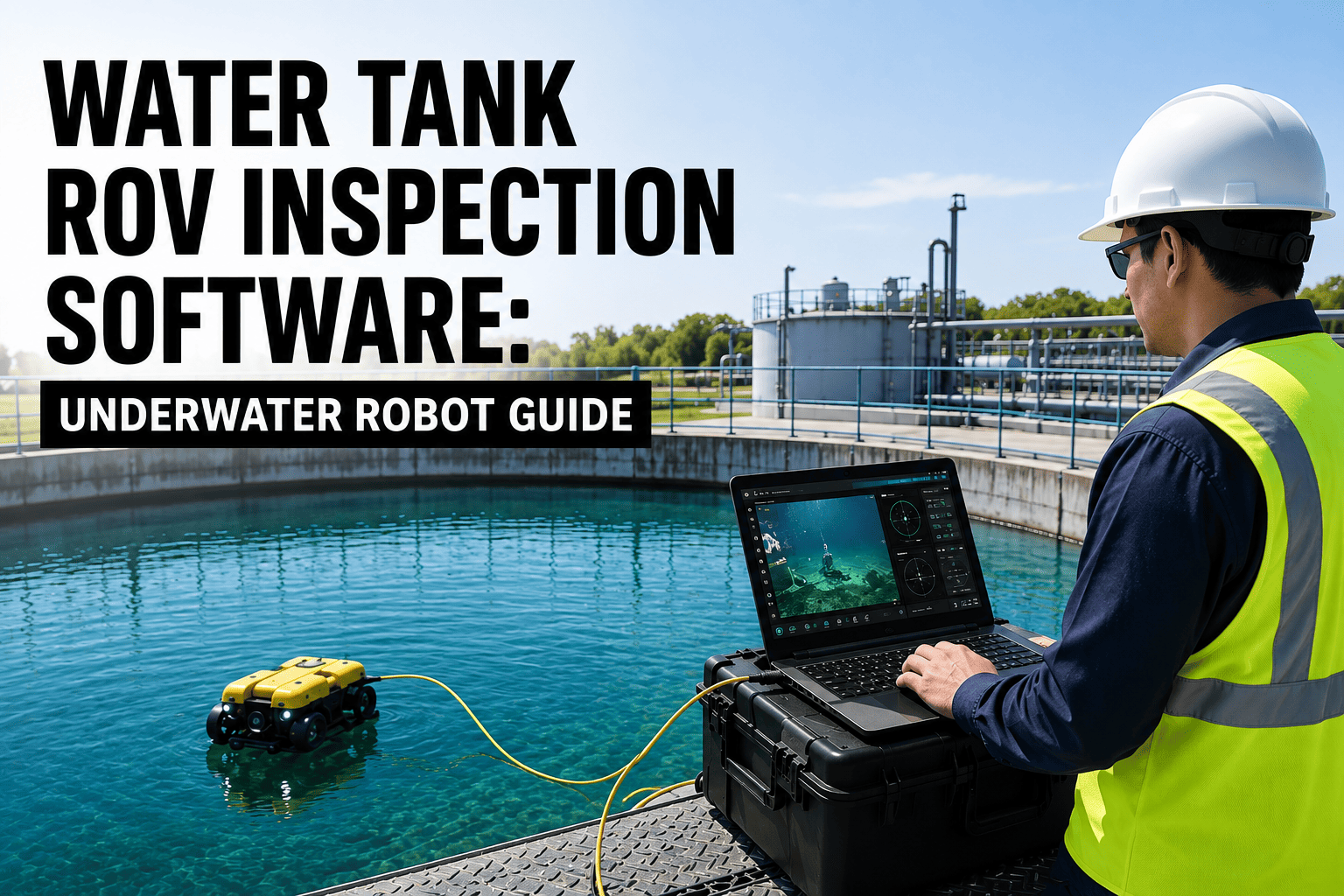
Every elevated tank, clearwell, and reservoir eventually needs its interior checked — and for decades that meant draining thousands of gallons, pulling confined space entry permits, and sending a diver or technician into a dark steel or concrete shell. Sediment mapping, coating checks, and corrosion surveys all depended on someone physically climbing in. A remotely operated vehicle changes that equation entirely: a pilot lowers a small submersible through the roof hatch, watches a live 4K feed from ground level, and documents the entire tank floor, wall, and riser condition without a single person entering the water or the space above it. This guide covers how water tank ROV inspection actually works, which tank types benefit most, and how to connect that footage directly into a working maintenance record inside OxMaint.
Underwater Robotics · Confined Space Elimination · Water & Wastewater CMMS
Water Tank ROV Inspection Software — Turn Underwater Robot Footage Into a Working Maintenance Record
See inside elevated tanks, clearwells, and reservoirs without draining them, without a confined space permit, and without a diver in the water. Here is how utilities are replacing entry inspections with a submersible robot and a CMMS that actually does something with the footage.
Zero
Confined space entries required for a standard ROV tank inspection
50%
Typical labor reduction versus a dive team for the same tank
1 Day
Time to mobilize, inspect, and demobilize a mid-size clearwell
10"
Typical ROV footprint — small enough for a standard roof manway
The Old Way
Why Confined Space Entry Has Been the Default — And Why It Shouldn't Be Anymore
Traditional water tank inspection follows the same pattern almost everywhere: the tank gets taken offline, drained or partially dewatered, ventilated, and tested for atmospheric hazards before anyone is permitted to climb down the ladder. A confined space entry permit has to be issued, an attendant has to stand by at the hatch, and rescue procedures have to be staged before work even starts. If a dive team is used instead, divers are limited by air supply and have to surface repeatedly, certification and insurance add cost, and cross-contamination of potable water becomes a real operational concern. None of that changes what actually gets found — sediment buildup, coating failure, corrosion at the waterline, or damage near inlet and outlet piping — it just makes finding it slower, riskier, and far more expensive than it needs to be.
A submersible ROV removes the human from that equation entirely. The vehicle goes through the same roof hatch a technician would have used, but the tank stays in service, no permit is required, and the pilot never leaves ground level. What used to take a full crew, a confined space plan, and a day of downtime now takes one operator, a controller, and a couple of hours.
How It Works
From Roof Hatch to Recorded Inspection — The ROV Workflow
A water tank ROV inspection follows a consistent sequence regardless of tank type. Understanding each stage makes it clear why the process is faster, safer, and more repeatable than sending a person inside.
01
Pre-Deployment Check and Disinfection
The ROV, tether, and thrusters are inspected and disinfected before entry, following the sanitation guidance in AWWA C652 for potable water storage facilities. Lights, cameras, and any wall-thickness or sampling attachments are tested on the surface first.
02
Lowered Through the Existing Roof Access
The vehicle is lowered through the roof manway or hatch already in place — no scaffolding, no cutting new access points, and no need to drain the tank to a workable level first.
03
Live-Piloted Systematic Sweep
The operator flies a grid pattern across the floor, walls, riser pipe, and roof underside, watching a live feed rather than relying on footage reviewed after the fact. Baffle walls, pump intakes, and ladder brackets get direct attention since they are where sediment and corrosion concentrate first.
04
Recorded, Timestamped, and Exported
Every pass is recorded in high definition with timestamps, giving asset owners a permanent visual baseline. That footage becomes the reference point every future inspection gets compared against — and it is what turns a one-off inspection into a real condition trend.
Underwater Footage, Above-Ground Action
Stop Letting ROV Footage Sit in a Folder
An inspection is only useful if what it finds turns into a work order. OxMaint connects your ROV findings — sediment depth, coating condition, corrosion location — directly to the asset record, so every clip becomes a scheduled action instead of an unwatched video file.
Tank Types
Where Water Tank ROVs Actually Go — Elevated Tanks, Clearwells, and Reservoirs
Not every storage structure presents the same inspection challenge. The vehicle stays the same, but what the pilot is looking for — and how the tank is accessed — changes with the asset.
Elevated Storage
Elevated Tanks
Access is through the roof hatch at height, so the ROV eliminates the fall-risk climb as well as the confined space entry. Inspectors focus on the bowl floor, riser pipe interior, and coating condition near the waterline where cyclic filling causes the fastest degradation.
Treatment Infrastructure
Clearwells
Clearwells are rarely simple rectangles — baffle walls, pump intakes, and piping runs make navigation complex. An ROV sweep maps where sediment has actually settled before any cleaning crew is mobilized, so cleaning is targeted instead of guessed at.
Bulk Storage
Reservoirs
Larger reservoirs need longer tether runs and more systematic flight patterns to cover the full floor area. The payoff scales with size — the larger the reservoir, the more a dive team would have cost, and the more time an ROV sweep saves.
From Footage to Action
What Happens to ROV Footage Once It Reaches OxMaint
A video file with no follow-up is just a record of a problem someone will eventually rediscover. The value of a water tank ROV inspection comes from what happens after the pilot surfaces — and that is where a connected CMMS changes the outcome.
Immediate Action
Sediment Findings Become Cleaning Work Orders
Depth and location of sediment observed during the sweep are logged against the specific tank asset, and a cleaning work order is generated automatically instead of waiting for the next scheduled review.
Immediate Action
Coating and Corrosion Flags Route to Technicians
Coating breakdown or corrosion spotted near the waterline or riser is tagged with a photo and assigned to the right technician, with the exact location noted so a repeat trip isn't needed to relocate the defect.
Long-Term Value
Every Inspection Builds the Asset History
Each ROV pass is stored against the tank's permanent record, so this year's footage can be compared directly against last year's — turning a single inspection into a visible condition trend over time.
Long-Term Value
Compliance Records Stay Ready for Audit
Inspection dates, disinfection records, and findings tied to AWWA and state drinking water requirements are stored in one place, ready to hand over the moment a regulator or auditor asks for them.
Method Comparison
ROV Inspection vs Diver Entry vs Drain-and-Enter
The three common approaches to internal tank inspection differ sharply in cost, downtime, and safety exposure. Laid out side by side, the gap becomes obvious.
Why It Adds Up
What Utilities Report After Switching to ROV Inspections
No Draining
Assets Stay in Service
Tanks are inspected while full, removing the cost and time of dewatering and refilling around every routine check.
Live Feed
Faster Decisions
Operators see the tank interior as it happens instead of waiting on footage handed over after a dive is complete.
Half the Crew
Lower Labor Cost
A single pilot and controller typically replace a multi-person dive crew and standby attendant for the same tank.
Permanent Record
Trend, Not a Snapshot
Timestamped footage stored against the asset lets every future inspection be compared to a real baseline.
Common Questions
Water Tank ROV Inspection — Questions Operations Teams Ask
Does a water tank ROV inspection still require any confined space entry?
+
No. The vehicle is lowered through the existing roof manway and piloted from ground level, so a person never enters the tank itself. Roof-level work at height may still need its own precautions, but the confined space entry permit tied to going inside the tank is eliminated entirely.
Can an ROV inspect a tank without draining or taking it offline?
+
Yes, and this is the main operational advantage over drain-and-enter methods. The tank stays full and in service throughout the inspection, which removes the outage window and the cost of refilling.
Start a free trial to see how findings from an in-service inspection get logged against the asset automatically.
What does an ROV actually find inside a clearwell or reservoir?
+
Most commonly sediment accumulation and its exact location, coating breakdown or corrosion near the waterline and riser, and any damage around baffle walls, pump intakes, or inlet and outlet piping that would otherwise go unnoticed until a bigger failure occurs.
How is water quality protected when a robot enters a potable tank?
+
The vehicle, tether, and any attachments are disinfected before entry following AWWA C652 guidance for water storage facilities. Because no fuel-powered equipment or external generator is used, the contamination risk is significantly lower than many traditional entry methods.
How does ROV footage turn into a maintenance action instead of just a report?
+
When footage is reviewed inside a connected CMMS, a flagged defect can be logged straight to the tank's asset record and assigned as a work order with the location and photo attached.
Book a demo to see that workflow end to end.
OxMaint · Underwater Inspection · Asset Ready
Every ROV Pass Should End With a Work Order, Not Just a Video File
OxMaint gives elevated tanks, clearwells, and reservoirs a permanent digital record — sediment findings, coating condition, and corrosion locations tied directly to the asset, timestamped, and ready the moment an auditor or engineer asks for the history.