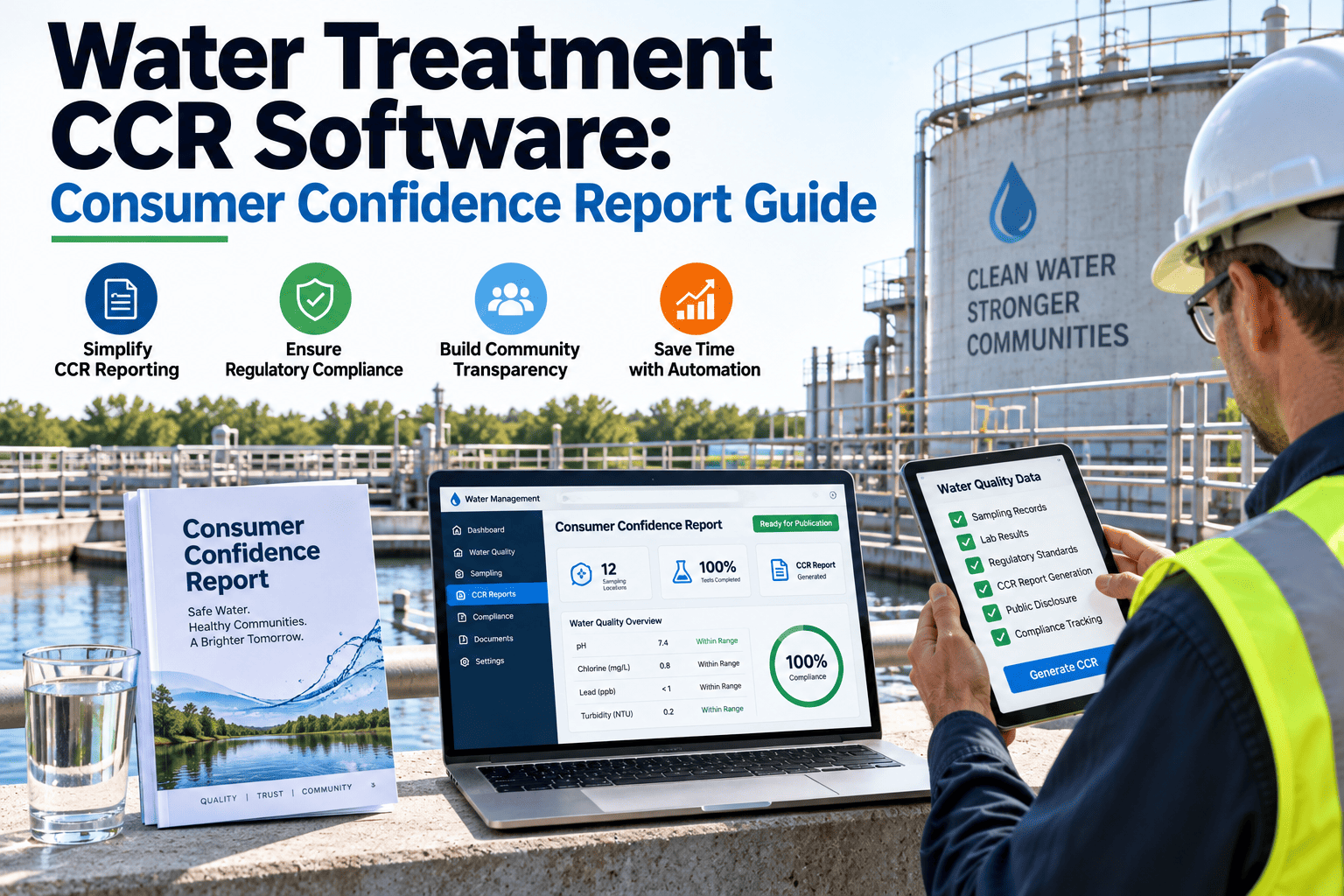
Every community water system in the United States owes its customers one document every year: the Consumer Confidence Report. It sounds like a simple mailer, but behind it sits twelve months of source water data, lab results, compliance monitoring records, and public education language that all has to land correctly by July 1. Miss a required element and the report can be rejected before it ever reaches a mailbox.
Water Treatment CCR Software: Building the Annual Consumer Confidence Report Without the Scramble
The CCR is due every July 1 under the Safe Drinking Water Act, and it has to reflect a full calendar year of monitoring data pulled together from labs, SCADA readings, and compliance logs. The teams that dread it most are the ones rebuilding it from scratch each spring instead of tracking that data as the year unfolds.
What the SDWA Actually Requires From Your CCR
The Consumer Confidence Report requirement came from a 1996 amendment to the Safe Drinking Water Act, and it applies to every community water system, from a small mobile home park utility to a metropolitan authority. A community water system is defined as a public water system serving at least fifteen service connections or at least twenty-five year-round residents.
The Annual Deadline That Doesn't Move
The report must be delivered to customers by July 1 of each year and cover the previous calendar year's data, and it must reflect the same monitoring information the utility already submitted to its state drinking water program. New systems get a slightly different clock: a system delivers its first CCR by July 1 of the year following its first full calendar year in operation.
This due date has stayed constant since the rule took effect, which means CCR season is entirely predictable on the calendar. The utilities that struggle with it aren't caught off guard by the date — they're caught off guard by how scattered their own monitoring data turns out to be when they finally sit down to compile it.
| System Type | First CCR Due | Ongoing Cadence |
|---|---|---|
| Existing community water system | Annually, by July 1 | Every July 1, covering the prior calendar year |
| New community water system | July 1 after first full year of operation | Every July 1 thereafter |
| Wholesale system selling to another CWS | Data delivered to buyer, typically by April 1 | Annually, per contract terms with the buyer system |
What Has to Be Inside the Report
A CCR isn't just a summary letter. It has defined content requirements, and state reviewers check for each one before the report goes to print.
Required Elements
- Source water description (surface water, groundwater, or purchased)
- Detected contaminants with levels found against MCLs
- Compliance status with applicable drinking water rules
- Cryptosporidium guidance for vulnerable populations
- Statements on nitrate, arsenic, and lead where applicable
- Utility contact information and public participation opportunities
Optional but Common
- Explanation of the water treatment process used
- Source water protection efforts and conservation tips
- Cost information tied to making the water safe to drink
- A statement from the general manager or utility director
- Notes on planned system improvements
Skip the Spring Scramble for Next Year's CCR
See how OxMaint keeps compliance monitoring data organized all year so the report builds itself when July gets close, instead of becoming a spring scramble.
How the CCR Fits Alongside Other Compliance Reporting
The CCR isn't the only report a community water system files each year, and it's worth understanding how it differs from the other obligations that draw on the same underlying monitoring data.
A Public-Facing Summary, Not a Regulatory Filing
Monthly operating reports and compliance monitoring submissions go to the state throughout the year as data is collected, often on a rolling basis tied to sample results. The CCR is different in that it's a single annual document aimed at customers rather than the regulator, built by summarizing that same year of submitted data into a public-facing format with required plain-language health education content.
Because the CCR draws from the same monitoring data already submitted to the state throughout the year, a system with clean, centralized compliance records rarely finds the CCR itself difficult to write. The difficulty almost always traces back to how that underlying data was tracked in January through June, not to the report format in July.
What Gets Reported and How It's Framed
Not every contaminant category is reported the same way in a CCR. The report has to show what was detected, the range found, the maximum contaminant level it's measured against, and the likely source category — language that state reviewers check closely before approving a draft. Getting this table right the first time is one of the fastest ways to avoid a revision cycle before the July deadline.
| Contaminant Category | Examples | What the CCR Must Show |
|---|---|---|
| Microbial | Total coliform, Cryptosporidium | Detection status and required health guidance for vulnerable populations |
| Disinfection Byproducts | Total trihalomethanes, haloacetic acids | Range detected against the maximum contaminant level |
| Inorganic Chemicals | Nitrate, arsenic, lead, copper | Level found, MCL comparison, and required statement language where applicable |
| Radiological | Radium, uranium (where monitored) | Detected levels against the applicable standard, when monitoring applies |
Where CCR Preparation Breaks Down
Most utilities don't struggle with knowing what the CCR needs. They struggle with pulling twelve months of scattered data together under a hard deadline.
Data Spread Across Systems
Lab results, SCADA readings, and compliance monitoring logs often live in separate spreadsheets, lab portals, and paper files that nobody merges until report season, and reconstructing a full calendar year from those sources takes far longer than gathering the same data as it comes in.
Manual Cross-Checking
Every detected contaminant has to be verified against its MCL and prior submissions to the state, a process that is slow and error-prone when done by hand each spring, especially when the underlying lab results were logged inconsistently across the year.
Turnover and Institutional Memory
When the person who built last year's report leaves, the next person often starts from a blank template instead of a repeatable process.
Distribution Recordkeeping
Utilities are expected to distribute the report to all billed customers by July 1 and make a good-faith effort to reach non-billed consumers, then document that effort.
Delivering the Report Isn't the Last Step
A completed report doesn't satisfy the rule on its own. Utilities are expected to distribute the report to all billed customers by July 1 and make a good-faith effort to reach non-billed consumers, then document how that effort was carried out for each delivery channel used. A report sitting finished on someone's desk after July 1 is still a compliance gap, regardless of how accurate its contents are.
Accepted Delivery Methods
- Direct mail to billed customers
- Electronic delivery where permitted by the state program
- Posting at a physical location for non-billed consumers
- Direct distribution to landlords for multi-unit properties
What to Keep on Record
- The date the report was delivered or posted
- Which delivery method was used for which customer segment
- A copy of the final report as submitted to the state
- Any translated versions provided for non-English speaking populations
Building the CCR as a Year-Round Process, Not a Spring Project
The utilities that stop dreading CCR season are the ones that stop treating it as a once-a-year event and start treating it as a report that assembles itself from data captured continuously.
Centralize Monitoring Data
Log lab results, source water data, and compliance monitoring records in a single system as they come in, rather than filing them for later reconciliation.
Validate Against MCLs
Compare every detected contaminant against its maximum contaminant level and flag any results that need additional review before drafting begins.
Draft and Route for Review
Generate the report draft from the consolidated data, add required health education language, and route it for internal and state-level review.
Distribute and Document
Deliver the CCR to customers, log the distribution method for each channel used, and retain records in case a state reviewer asks for proof.
How OxMaint Supports CCR Preparation
OxMaint doesn't replace your state's CCR template or your lab reporting obligations. It gives your team a single place to capture the compliance monitoring data, inspection records, and asset history that the report is built from, so nobody is hunting through a year of spreadsheets in June.
Data That's Already Organized When the Deadline Arrives
Work orders tied to treatment assets, scheduled compliance inspections, and recorded readings from rounds all stay searchable by date and asset, making it straightforward to pull the exact data range a CCR draft needs and cross-check it before submission.
Utilities that centralize this data year-round tend to spend CCR season reviewing a draft rather than assembling one from scratch, since the underlying source water, treatment, and monitoring records were already logged as the year happened rather than reconstructed retroactively.
Centralized Compliance Records
Store lab results, inspection outcomes, and monitoring readings in one system instead of scattered spreadsheets and shared drives.
Scheduled Compliance Inspections
Recurring preventive maintenance and inspection schedules keep source water and treatment monitoring on track throughout the year, not just before the deadline.
Searchable History by Asset and Date
Pull the exact calendar-year data range needed for the CCR without digging through disconnected files or asking former staff where records were kept.
Audit-Ready Reporting
Generate reports that document what was monitored and when, giving your team a clear paper trail if a state reviewer requests supporting data.
Mistakes That Send a Draft Back for Revision
State reviewers see the same handful of errors year after year, and most of them come from rushed data assembly rather than a misunderstanding of the rule itself. Each of these is avoidable with better source data, not a better writer.
Missing a Detected Contaminant
A result that was correctly reported to the state during the year gets left out of the CCR because it wasn't carried over from the lab report into the draft.
Outdated Source Water Description
A system that added a new well or changed its purchased water supplier during the year forgets to update the source water section to match.
Incomplete Required Language
Standard health education language for nitrate, arsenic, lead, or Cryptosporidium gets dropped from a template update and isn't caught before submission.
No Distribution Record
The report goes out on time, but nobody logs how or when it was delivered, leaving the utility unable to prove distribution if it's ever questioned.
Why Small Utilities Feel the CCR Deadline the Most
A large metropolitan utility often has a dedicated compliance team whose entire job is preparing the CCR. A small community water system serving a few hundred connections usually has one operator wearing that hat alongside plant operations, sampling, and everything else on the job.
The Same Requirements, Far Fewer Hands
The reporting requirements under the Safe Drinking Water Act don't scale down for smaller systems. A fifteen-connection mobile home park system has to meet the same content standard as a city utility, which is why keeping monitoring data organized throughout the year matters even more when there's no dedicated compliance staff to catch gaps in April.
This is also where turnover hits hardest. A small utility that loses its one compliance-savvy operator often loses the informal system that operator built to track the year's data, leaving the next person to rebuild that process from nothing right as a deadline approaches.
Frequently Asked Questions
Who has to send a Consumer Confidence Report?
Every community water system is required to deliver a CCR to its customers, whether it is a municipal utility, a mobile home park system, or an apartment complex water system meeting the connection threshold.
When exactly is the CCR due?
By July 1 of each year, covering monitoring data from the previous calendar year. New systems deliver their first report by July 1 of the year after their first full calendar year in operation.
Does CMMS software actually write the CCR for us?
No system writes the final regulatory language for you. What OxMaint provides is the organized, year-round compliance data your team drafts the report from, which removes most of the manual data-hunting that makes CCR season stressful.
What happens if we detect a contaminant close to its MCL?
That detection must be reported in the CCR along with the level found relative to the maximum contaminant level, regardless of whether it triggered a violation. Keeping monitoring data centralized makes this cross-check faster to verify.
How can we make next year's CCR easier than this year's?
Start logging monitoring data, lab results, and inspection records in one system now rather than in April. Book a demo to see how OxMaint keeps that data ready year-round.
Make Next Year's CCR the Easy One
Centralize your compliance monitoring data now with OxMaint, and let next July's Consumer Confidence Report build from records you already trust.
Free 14-day trial · No credit card