A valve that will not close is usually discovered at the worst moment, during a main break or an emergency shutdown when the neighborhood is already losing service. Valves seize from disuse, corrosion and debris, so the only defense is a program that exercises them, scores their condition and plans replacement before they fail. This guide covers exercising frequencies, scoring and replacement planning, and how asset management software keeps the service history in one place.
Water and Wastewater / Distribution
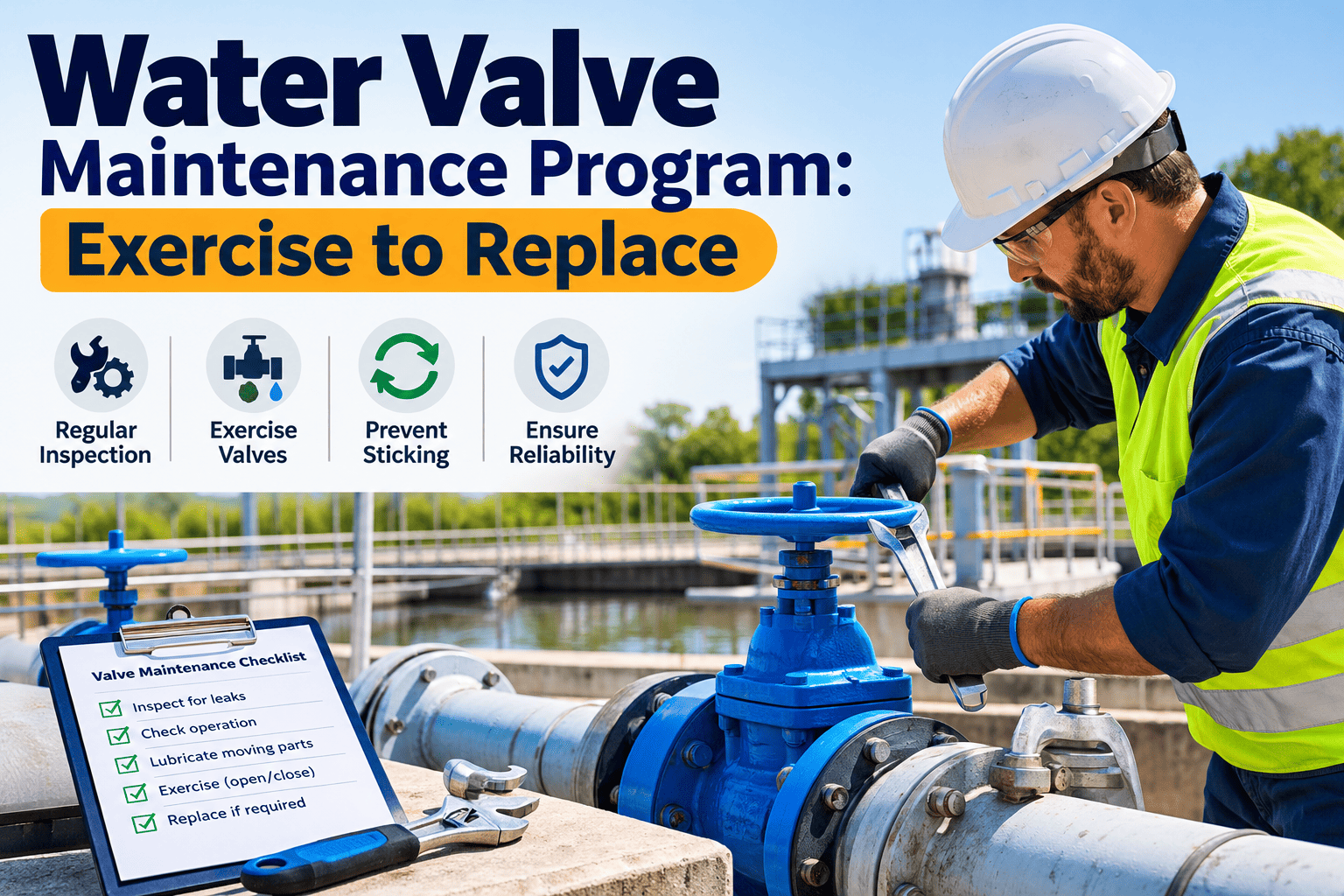
Water Valve Maintenance Program: From Exercise to Replacement
Exercise valves on a risk-based schedule, score their condition and use service history to decide what to repair, replace or defer.
1Operates freely
2Minor stiffness
3Leaks or hard to turn
4Partial operation
5Inoperable
Set Exercise Frequency by Risk
Consequence of failure / valve size
Large transmission valves
Distribution valves
Service and dead-end valves
Critical or isolation for hospitals and major users
Most frequent
Frequent
Regular
Typical network valves
Regular
Regular
Planned cycle
Low consequence valves
Planned cycle
Planned cycle
Planned cycle
A Repeatable Exercising Procedure
- Confirm the valve location, size, type and direction to close from the record
- Operate the valve fully, counting turns and noting torque or effort
- Compare turns with the expected count to spot debris or partial closure
- Open fully, then back off if the manufacturer procedure calls for it
- Record condition, access problems and any leak at the stem or packing
- Create a repair order for any valve that will not operate or is buried
Condition Score and Action
| Score | What crews find | Planned action |
|---|---|---|
| 1 | Operates freely, accessible | Keep on regular exercise cycle |
| 2 | Minor stiffness or extra turns | Shorten interval, monitor |
| 3 | Leaking packing, hard to operate, box damaged | Repair and re-test |
| 4 | Operates partially or valve will not seal | Plan replacement, add to risk list |
| 5 | Inoperable or inaccessible | Prioritize repair or replacement |
Give Your Crews a Valve Program They Can Follow in the Field
Load valve assets, create exercise routes and record turns, torque and condition from a phone or tablet.
Planning Replacement With Evidence
Without service history
- Replacement driven by failures
- No view of how many valves are at risk
- Budget requests rely on age alone
- Crews rediscover the same problems
With scored service history
- Replacement ranked by condition and consequence
- Clear count of poor-condition valves
- Budget requests supported by findings and repair cost
- Crews see past issues before arriving
What to Capture on Every Visit
Valve ID and location
Turns to close and open
Torque or effort
Condition score
Photos of box and surface
Repairs performed
Customers affected if closed
Next exercise date
KPIs for the Valve Program
Valves exercisedagainst plan
Inoperable valvesfound and fixed
Repair backlogby age
Critical valve coverageexercised within target
Build the Valve Inventory First
- Valve ID, size, type and manufacturer where known
- Location, street intersection and map reference
- Direction to close and number of turns expected
- Pipe material, installation year and pressure zone
- Customers or areas isolated when the valve is closed
- Condition score and date of last exercise
Crew and Equipment Setup
Field equipment
- Valve exerciser or manual operator suited to valve size
- Torque and turn counting method
- Tools to clean and open valve boxes
- Tablet or phone for records and photos
Crew practices
- Plan routes by zone to cut travel time
- Work with traffic control rules where required
- Stop if torque suggests the valve may break
- Record any valve box in need of repair
Common Valve Problems and What They Suggest
| Finding | Possible cause | Likely action |
|---|---|---|
| Valve box full of soil or debris | Settled or damaged box | Clean, repair or replace the box |
| Higher effort than normal | Corrosion or sediment buildup | Exercise again, shorten interval, monitor |
| Fewer turns than expected | Debris, partial closure or damage | Investigate and plan repair |
| Leak at stem or packing | Worn seals | Repair packing or replace the valve |
| Valve will not move | Seized or broken internals | Priority repair or replacement |
| Valve not found | Paved over or missing record | Search, correct the map and raise a work order |
Decide Between Repair and Replacement
| Situation | Typical lean | Why |
|---|---|---|
| Low consequence valve with minor stem leak | Repair | Cost is low and function remains |
| Critical isolation valve that no longer seals | Replace | Reliability matters more than a temporary fix |
| Several repairs in a short period | Replace | Repeat cost suggests end of useful life |
| Valve scheduled in an upcoming main replacement | Defer or coordinate | Avoid duplicate work |
| Inaccessible valve with unknown condition | Investigate first | Locate and assess before committing budget |
Plan Shutdowns So Customers Are Not Surprised
- Notify affected customers and critical users before planned closures
- Avoid peak demand periods where possible
- Confirm which valves must be operated and in what order
- Keep a record of any customers affected and how long
- Restore service gradually to reduce pressure surges
Review the Program Each Year
- Compare planned and completed exercises by zone
- List valves that moved to a worse condition score
- Review repair backlog age and critical valves affected
- Adjust exercise frequency based on findings
- Update replacement forecasts and budget requests
Why Valves Fail When You Need Them
Valves are unusual assets because they may sit untouched for years and then be required to work instantly. That long idle period is the main reason they fail.- Corrosion and mineral buildup lock moving parts in place
- Sediment collects in the seat and prevents full closure
- Operating nuts and stems wear or break under high torque
- Valve boxes fill with soil, shift or get paved over
- Records are wrong, so crews cannot find the valve quickly
- Packing and seals leak after long service
Valve Types and Maintenance Notes
| Valve type | Typical use | Maintenance notes |
|---|---|---|
| Gate valve | Mainline and branch isolation | Count turns carefully, watch for broken stems and sediment |
| Butterfly valve | Large mains and plant piping | Check operator condition, seat leakage and torque |
| Plug or ball valve | Service connections and smaller lines | Inspect for leaks and difficulty turning |
| Check valve | Prevents reverse flow | Test for sticking and slamming noise |
| Pressure reducing valve | Controls zone pressure | Verify settings, strainer and pilot condition |
| Air release valve | Releases trapped air at high points | Clean, inspect and confirm vent function |
Valve Records Worth Keeping
- Original installation date and manufacturer when known
- Every exercise date, turns counted and effort recorded
- Photos of the valve box before and after repair
- Repairs, parts replaced and cost
- Any customer outages or shutdowns linked to the valve
- Notes on access issues, traffic control and nearby utilities
Connect Maps, GIS and Work Orders
- Use the same valve ID in GIS, field maps and maintenance records
- Update coordinates when crews find a valve in a different place
- Show valves due for exercise by zone and priority
- Link replacement candidates to the planned main or paving projects
- Report areas where many valves are missing, buried or inoperable
Staffing and Budgeting Approaches
| Approach | Best fit | Consideration |
|---|---|---|
| Dedicated valve crew | Large systems with many valves | Highest throughput and consistent records |
| Shared crew in slow season | Smaller utilities | Needs scheduling discipline |
| Contracted exercising | Backlog or limited equipment | Require records in your format |
| Zone-by-zone campaign | Systems starting from scratch | Builds data and condition scores steadily |
Safety and Pressure Considerations
- Follow traffic control and excavation safety practices at every valve box
- Do not force a valve past the torque recommended for its size and type
- Operate valves slowly to limit pressure surges
- Confirm the closing direction before turning
- Be prepared for discolored water after operation and inform customers where needed
Emergency Isolation Readiness
When a main breaks, crews need to know which valves isolate the break and how many customers are affected. Prepare isolation plans for critical areas, keep valve maps accessible on mobile devices and confirm that key valves have been exercised recently. After each event, record which valves worked, which did not and what changes are needed. This turns every emergency into data for the next maintenance cycle.Common Mistakes to Avoid
- Exercising only easy valves and skipping hard-to-reach ones
- Recording only that a valve was exercised, not its condition
- Ignoring valves that repeatedly need extra effort
- Replacing valves by age alone
- Treating missing valves as a mapping issue instead of a maintenance task
- Waiting for a main break to learn which valves do not work
How Oxmaint Supports a Valve Program
Oxmaint can store each valve as an asset with location, size, type and condition score, schedule recurring exercise routes and record turns, torque, photos and repairs from a mobile device. Reports highlight valves that have not been exercised, valves scoring 4 or 5 and repair backlogs, giving planners the evidence needed for replacement budgets.- Exercise work orders grouped by zone or route
- Condition score history for every valve
- Repair work orders linked to the original finding
- Dashboards for coverage, backlog and critical valves
Operational Impact of a Reliable Valve Program
- Faster isolation during main breaks, with fewer customers affected
- Fewer surprises when a valve is needed in an emergency
- More accurate maps and valve records
- Replacement budgets supported by condition data
- Less rework because crews can see previous findings
Roll the Program Out in Phases
| Phase | Focus | Outcome |
|---|---|---|
| Phase 1 | Critical isolation valves and large mains | Highest risk valves are exercised and scored |
| Phase 2 | Distribution valves by zone | Accurate records and condition scores across the network |
| Phase 3 | Service and low-consequence valves | Planned cycle covering the remaining system |
Keep Valve Data Reliable
- Require turns and condition score before closing an exercise work order
- Use consistent condition definitions across crews
- Review unusual entries each week
- Correct location errors as soon as they are found
- Audit a sample of records against field visits each year
Turning Findings Into a Replacement Forecast
Each exercise visit adds one more data point. After a full cycle, group valves by condition score, size and consequence of failure, then estimate how many will need replacement each year. Combine that list with paving, main replacement and development plans so valve work is coordinated with other projects instead of opening the same street twice. Share the forecast with finance early, with condition photos and repair history attached, so the budget request rests on field evidence.Frequently Asked Questions
How often should water valves be exercised?
Frequency should reflect valve size, criticality and past findings. Most utilities start with critical valves and extend outward.What is a good way to prioritize valve replacement?
Combine condition score with consequence of failure. Service history in Oxmaint makes that ranking repeatable.Should every valve be scored?
Yes, whenever it is operated. Even a simple one-to-five score builds a trend over time.What if a valve cannot be found?
Log it as a work order, note the last known location and update records once located or confirmed lost.Can we see a valve exercising workflow?
You can book a demo to review exercise routes and condition scoring.Know Which Valves Will Work Before the Emergency
Exercise, score and plan replacement with a program backed by complete service history.