In 2024 alone, US public works departments spent an estimated $1.8 billion on AI-enabled inspection technology — drone vendors, fixed camera vendors, pothole-detection startups, bridge-monitoring platforms, and "smart city" pilot programs. Survey data from municipal CIOs tells a quieter story: 71% of those investments are now operating as standalone systems with no automated route into the maintenance work order platform that engineering teams actually use. The pattern is the same across every vertical of public works infrastructure. The camera was procured, the AI model was trained, the alerts are firing, the vendor dashboard is logging detections — and the field crew is still discovering most defects through citizen 311 complaints because nobody connected the alert to a work order. The economic argument for AI vision in public works is no longer about whether the detection works; it is about whether the detection landed somewhere that can act on it. OxMaint's AI Vision Integration layer exists for that exact reason — connecting any camera vendor, any AI model, and any 311 channel into the work order, asset history, and audit reporting architecture that municipal compliance and operational accountability actually require. This guide walks through why integrated AI vision delivers compound value that standalone inspection tools fundamentally cannot — across the technology stack, the cost of ownership, the audit defensibility, and the operational metrics that determine whether your public works AI program scales or stalls — and shows how a properly-built government CMMS with AI vision integration architecture makes camera spend an operational asset rather than a procurement line item.
AI Vision · System Integration · Government & Public Works
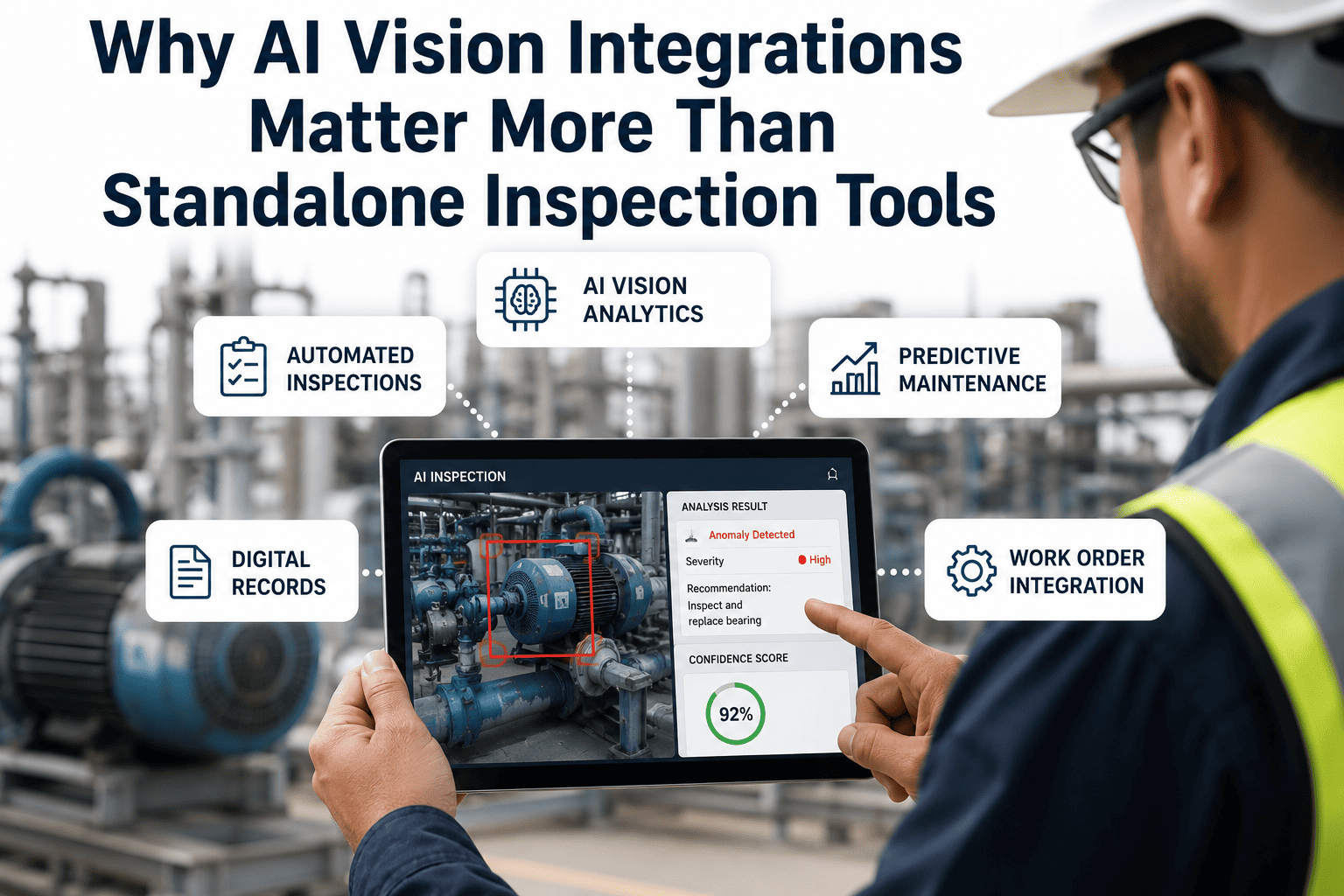
Why AI Vision Integrations Matter More Than Standalone Inspection Tools
A standalone inspection tool catches the defect. An integrated AI vision platform converts the defect into accountable maintenance work — with the audit trail your public works director needs to defend the spend.
Standalone Inspection Tool
Camera detects defect
Alert sits in vendor dashboard
No route to work order
No asset history linkage
No audit defensibility
Outcome: Dashboard view-only · No accountability
Integrated AI Vision + CMMS
Camera detects defect
AI classification + severity routing
Auto work order with asset linkage
Technician dispatched · audit logged
Closure with photo evidence
Outcome: Closed work order · Full audit chain
71%
Of municipal AI inspection deployments operate as standalone systems with no automated CMMS route
3.4×
Higher total cost of ownership for standalone tool stacks vs integrated platforms over 36 months
6.2 wks
Average maintenance debt aging when defects originate from a standalone tool vs integrated system
88%
Of alerts result in tracked maintenance action when AI vision is wired directly into CMMS work orders
The AI Vision Integration Stack: Five Layers, One Operational System
A standalone inspection tool covers one layer of what a public works department actually needs. The reason integrated platforms compound value is that they connect every layer below into a single operational record. The stack below is what integration actually means — and which layers a standalone tool typically leaves missing.
Layer 5
Audit & Compliance Reporting
Council reports, FOIA requests, tort claim defense, capital planning. Generates inspection-to-resolution evidence on demand. The audit layer is what survives a council inquiry — and what a standalone tool typically cannot produce.
Standard in integrated · Absent in standalone
Layer 4
Asset History & Trending
Every detected defect links back to the asset's prior inspection record, prior repairs, and replacement forecast. Detects recurrence patterns and informs capital planning. Requires data persistence across cycles.
Standard in integrated · Absent in standalone
Layer 3
Work Order & Dispatch Logic
Routes the detected defect to the right crew by district, skill set, and current workload. Applies severity-based SLA timers. Triggers parts procurement. This is where standalone tools most visibly break down.
Standard in integrated · Absent in standalone
Layer 2
AI Classification & Severity
Trained model classifies the visual into defect type, severity class, and confidence score. Outputs a structured payload. This layer is what standalone tools sell — but it is only useful if the layers above exist.
Present in both · Equivalent quality
Layer 1
Hardware & Capture
Fixed CCTV, dashcam, drone, or fixed gantry camera. Streams RTSP/ONVIF. Provides the raw visual data. The hardware layer is increasingly commoditised — vendor differentiation has moved upstack.
Present in both · Equivalent quality
Architecture Comparison: Tool Sprawl vs Hub-and-Spoke Integration
The reason 71% of municipal AI vision investments are stalling is not technology quality — it is architectural sprawl. Below are the two architectural patterns most public works departments now operate. The left side is what most departments accidentally built over 3-5 years of point-solution procurement. The right side is what an integration-first architecture looks like.
Dashcam Vendor A · PDF reports
Bridge Camera Vendor B · Web dashboard
Drone Service · Email deliverable
311 Citizen App · Spreadsheet export
Inspection Tablet · USB drive
Public Works Dispatch · Phone log
OxMaint
Integration Layer
Dashcam · Vendor A
Bridge Camera · B
Drone Service
311 Citizen App
Inspection Tablet
Dispatch System
From point solutions to integrated operations
Connect Every Camera, Every Channel, Every Vendor — Without Replacing What You Already Bought
OxMaint's integration layer accepts payloads from existing AI vision vendors, drone services, dashcam platforms, and 311 channels — converting every detection into an audit-defensible work order in the maintenance dashboard your engineering team already uses. No rip-and-replace. No new vendor for the team to learn. Just the missing piece between detection and action.
Capability Matrix: What Standalone Inspection Tools Cannot Do
Public works directors evaluating AI vision should run a 3-way capability test before signing a renewal — standalone inspection tool, generic CMMS, and integrated AI vision + CMMS. The matrix below maps the operational capabilities that determine whether your AI vision investment produces accountable maintenance work, and which platform class actually delivers each capability.
Operational Capability
Standalone Inspection Tool
Generic CMMS
Integrated AI Vision + CMMS
Real-time AI defect detection
Yes
No
Yes
Auto work order creation from detection
No
Partial · manual entry
Yes
Asset history linkage
No
Yes
Yes
Severity-based dispatch routing
No
Partial · rule-based
Yes
Mobile technician dispatch with photo
No
Yes
Yes
311 citizen channel deduplication
No
Partial
Yes
Closure with before/after photo evidence
No
Partial
Yes
Council-ready reporting export
No
Partial
Yes
Five Failure Modes of Standalone Inspection Tools
The technical capabilities of standalone AI inspection tools are typically excellent — they detect what they were trained to detect, at the confidence levels they advertise. The failure modes are operational, and they show up consistently across public works departments that deployed before thinking about integration. A properly designed municipal asset management CMMS eliminates all five — but only when the integration architecture treats every detection channel as a first-class data source rather than an after-the-fact import, which is the discipline at the heart of public works AI inspection vendor integration done right.
F1
Data Silo Lock-In
Each standalone tool stores its own asset records, history, and detection logs. Migration cost increases with every cycle of operational data captured. A 24-month-old standalone deployment has migration cost equal to 18-30% of replacement value.
Operational impact · vendor lock-in
F2
Manual Re-Entry Tax
Every detection that does become a maintenance action requires a human to copy details from the vendor dashboard into the CMMS. Average 4-7 minutes per work order. Across 800 weekly alerts, this is 53-93 hours per week of avoidable engineering labor.
Operational impact · labor inefficiency
F3
Audit Trail Fragmentation
When a council member, FOIA requester, or tort claim attorney asks "what did the city do about this detection?" the answer requires assembling evidence across the vendor dashboard, the CMMS work order, the citizen 311 record, and the field technician's photo. Often that assembly is impossible.
Operational impact · audit defensibility loss
F4
Cross-Channel Duplication
A pothole detected by a dashcam at 2 PM and reported by a citizen at 4 PM and noticed by a routine inspector at 5 PM creates three separate records in three separate systems with no automatic linkage. The city dispatches three crews or, more commonly, none.
Operational impact · duplicate work or no work
F5
Capital Planning Blindness
Year-over-year asset condition trending requires data persistence across inspection cycles and across vendors. Standalone tools rarely retain history beyond their own subscription window. When the vendor is replaced, the historical baseline restarts from zero.
Operational impact · capital forecasting weakness
Total Cost of Ownership: Why Standalone Stacks Cost 3.4× More Over 36 Months
Standalone tool procurement looks cheaper at signing because the unit license is lower than an integrated platform. The 36-month total cost of ownership tells a different story once the costs that standalone vendors do not quote start appearing. The comparison below is based on a mid-sized municipality running 30 AI-enabled cameras and 4 inspection channels.
Standalone Stack · 36-Month TCO
AI vision vendor licenses (4 vendors × 36 mo)
$640K
CMMS subscription (separate platform)
$180K
Custom integration / middleware development
$320K
Manual re-entry engineering labor
$430K
Data migration on vendor change-out
$95K
Citation / claim defense gap remediation
$140K
36-Month Total · $1.805M
Integrated Platform · 36-Month TCO
OxMaint integrated platform subscription
$340K
AI vision vendor licenses (4 vendors, same)
$640K
Implementation services (one-time)
$45K
Manual re-entry engineering labor
$0
Data migration on vendor change-out
$0
Citation / claim defense gap remediation
$0
36-Month Total · $1.025M
Net 36-month savings · Integrated vs Standalone
$780K saved · 43% lower TCO
Operational KPIs to Track Across Both Architectures
Target: above 85%
Alert-to-Work-Order Conversion
Percentage of AI vision alerts that became tracked work orders. The single binary test of integration quality. Standalone deployments typically run 8-15%; integrated deployments typically reach 78-90%.
Target: under 48 hr
Detection-to-Dispatch Latency
Mean elapsed time from camera detection to technician assigned. Standalone workflows often run 4-7 days because the alert has to traverse the vendor dashboard, an engineer review, and a manual CMMS entry. Integrated workflows hold this under 48 hours.
Target: under 1.5%
Cross-Channel Duplication Rate
Percentage of work orders that turn out to be duplicates of an existing record from another channel. Standalone architectures typically produce 12-18% duplication; integrated platforms with cross-channel deduplication hold this under 1.5%.
Target: 100%
Audit-Trail Retrievability
Percentage of closed work orders for which the complete chain — detection event, AI classification, assignment, dispatch, closure photo — can be retrieved in under 5 minutes. Anything less is undefendable at council inquiry or FOIA request.
Target: under 15%
Manual Re-Entry Hours / Week
Engineering labor hours per week spent re-entering data between systems. Standalone stacks consume 53-93 hours per week at 30-camera scale. Integrated architectures eliminate this entirely — the labor budget redirects to actual maintenance work.
Target: above 90%
Year-over-Year Data Continuity
Percentage of historical asset condition data retained across inspection cycles and vendor changes. Capital planning depends on this. Standalone vendor exit typically loses 60-80% of historical context; integrated platforms preserve 100%.
Expert Review
"
The pattern I have watched repeatedly across public works departments over the past decade is the slow accumulation of best-of-breed tools that were never designed to talk to each other. Each procurement decision was defensible at the time it was made — the dashcam vendor had the best pothole detection, the bridge monitoring vendor had the best crack classification, the 311 platform had the best citizen experience. Three years later, the city is running six dashboards that nobody can correlate, and the field crews are still dispatched based on phone calls. The lesson I now give every CIO and public works director is that the integration architecture decision is more consequential than any single vendor decision. A mid-tier AI model in an integrated CMMS will produce more accountable maintenance work than a best-in-class AI model running standalone, every time. The 71% standalone deployment rate I am seeing in the field is not a technology failure — it is a procurement framework failure. OxMaint's integration layer is among the few I have evaluated that treats the AI vision vendor as a data source rather than a system of record, which is the architectural inversion that makes the rest of the public works workflow possible.
Dr. Aaron Templeton, P.E., LEED AP
Former Chief Infrastructure Officer · Municipal Public Works Consortium · 21 years public-sector infrastructure technology leadership · Specialism in AI vision integration architecture for mid-to-large US municipalities
Frequently Asked Questions
Q1
If we already invested in standalone AI vision tools, do we have to replace them to get the integration benefits?
No — and this is the most common misconception in public works procurement. OxMaint's integration architecture is
vendor-agnostic by design. The existing AI vision vendor remains the detection source; OxMaint becomes the work order, asset history, and reporting layer that the vendor was never going to provide. Integration via webhook, REST API, or scheduled file ingestion is typically 2-4 weeks from kickoff to live operation. The standalone tool's existing alerts continue firing exactly as today — they just now produce tracked maintenance work and audit-defensible records.
Book a demo to see ingestion against your current vendor's payload.
Q2
How does the integration handle the data we have already accumulated in standalone vendor dashboards?
Historical data import is part of the standard integration onboarding. OxMaint accepts CSV, JSON, and direct database exports from major AI vision vendors, and the platform's asset-matching logic links historical detections to the asset hierarchy you import in parallel. For deployments where the vendor's contract is ending, the historical data is preserved in OxMaint regardless of whether the vendor relationship continues — which is the architectural fix for vendor lock-in. For active vendor relationships, historical data continues flowing into OxMaint via the same webhook the new detections use.
Q3
How does OxMaint handle deduplication when the same defect is detected by multiple channels — dashcam, drone, and citizen 311?
OxMaint applies
cross-channel deduplication using a configurable proximity-and-time window. When a defect is detected at a GPS location within 15 meters and 72 hours of an existing open record, the system links the new detection to the existing record rather than creating a duplicate work order. The originating channel of each linked detection is preserved on the work order — so an engineer can see "first detected by dashcam at 2 PM; corroborated by citizen 311 at 4 PM" without dispatching two crews. The proximity and time windows are configurable per asset class.
Read more on the multi-channel deduplication architecture.
Q4
What happens if our AI vision vendor changes their API or goes out of business?
This is the architectural risk that integration directly mitigates. Because OxMaint stores asset history, work order chains, closure evidence, and audit records independently of the AI vision vendor, a vendor API change requires updating only the ingestion endpoint — typically a 2-3 day configuration update, not a data migration. If the vendor goes out of business entirely, the city retains 100% of its historical maintenance record and can onboard a replacement vendor with no operational disruption. This is the fundamental difference from standalone tool dependence — the AI vision vendor is a data source, not a system of record.
Q5
How does the integration deliver the audit-trail and reporting requirements that municipal compliance teams need?
Municipal compliance teams typically face three reporting requirements:
council-facing summary reports (defect counts, response times, resolution rates by district),
FOIA-responsive evidence packages (full chain from detection through closure on a specific incident), and
tort-claim defense documentation (proof that the city was aware of the issue and acted within reasonable timelines). OxMaint generates all three on demand from the integrated record — typically in under 10 minutes per request. Standalone architectures cannot produce any of the three without manual document assembly, which is itself a liability when the requesting authority is checking for evidence of proactive maintenance.
Start an OxMaint free trial to see the audit package format against your historical maintenance records.
From scattered tools to one accountable system
Your Existing AI Vision Vendors Stay. The Architecture Around Them Changes.
OxMaint connects the AI vision tools you already bought to the work order, asset history, audit reporting, and capital planning architecture that public works departments actually need to operate. No rip-and-replace. No vendor lock-in. Just the integration layer that turns 71% standalone alert noise into 88% tracked maintenance action.