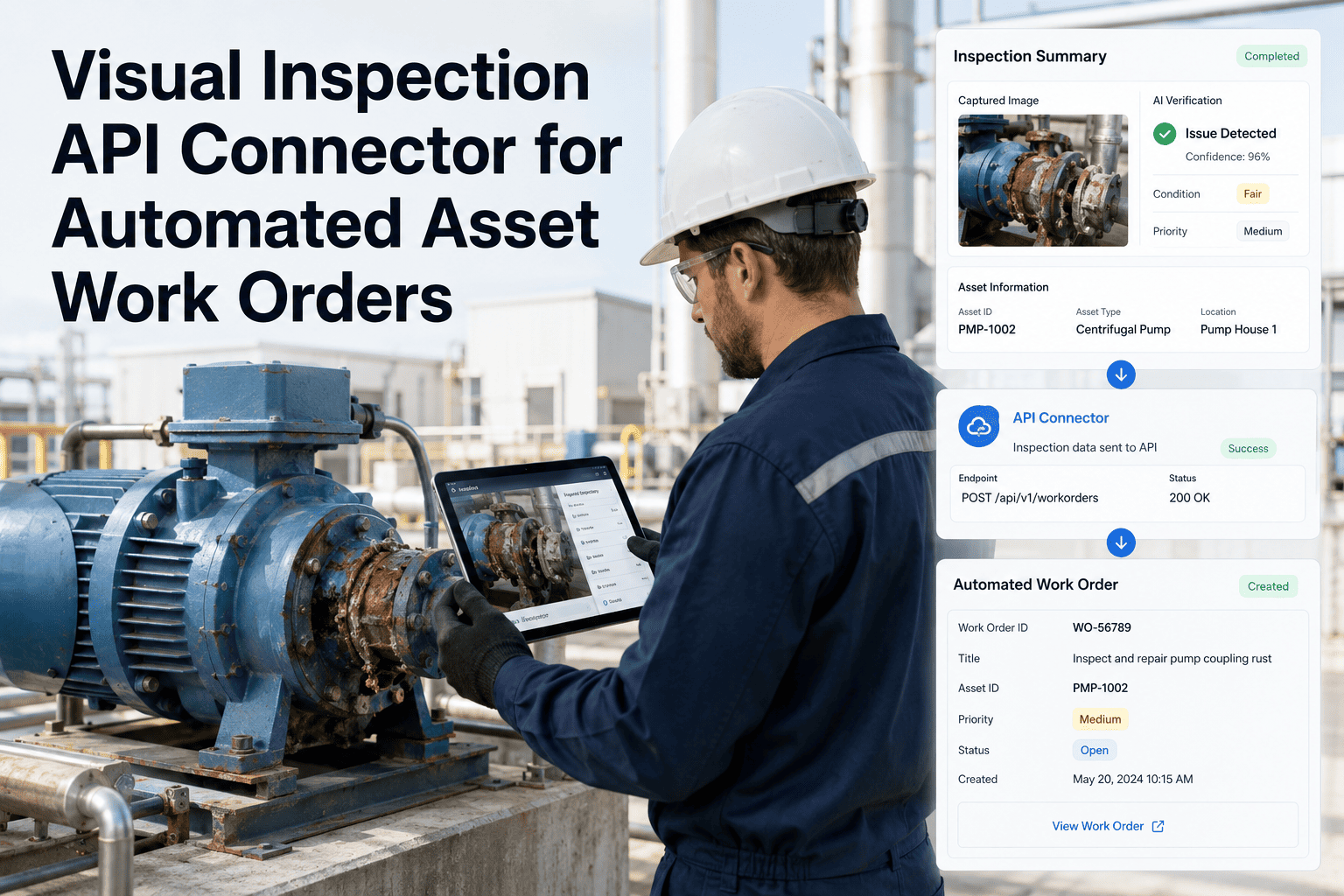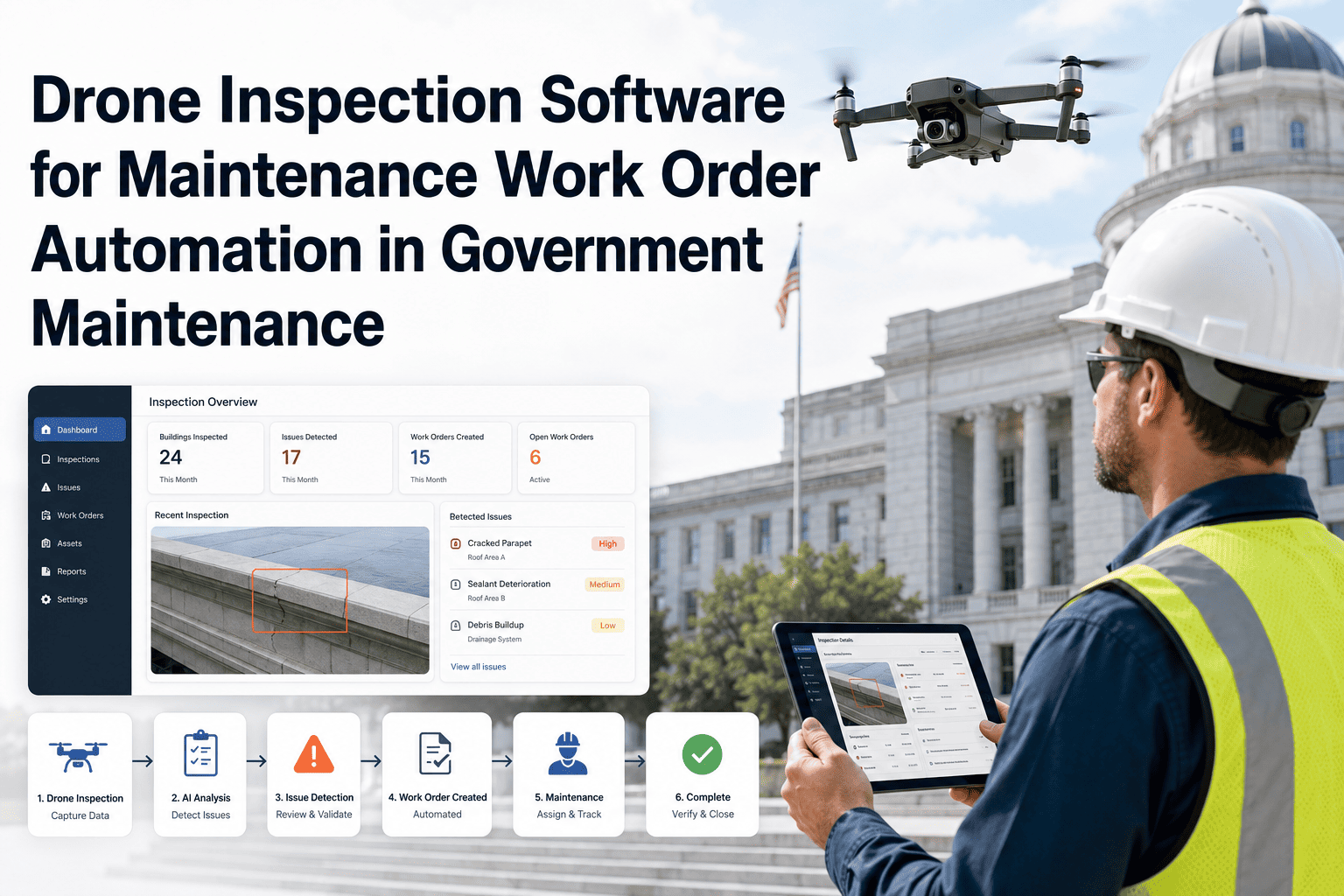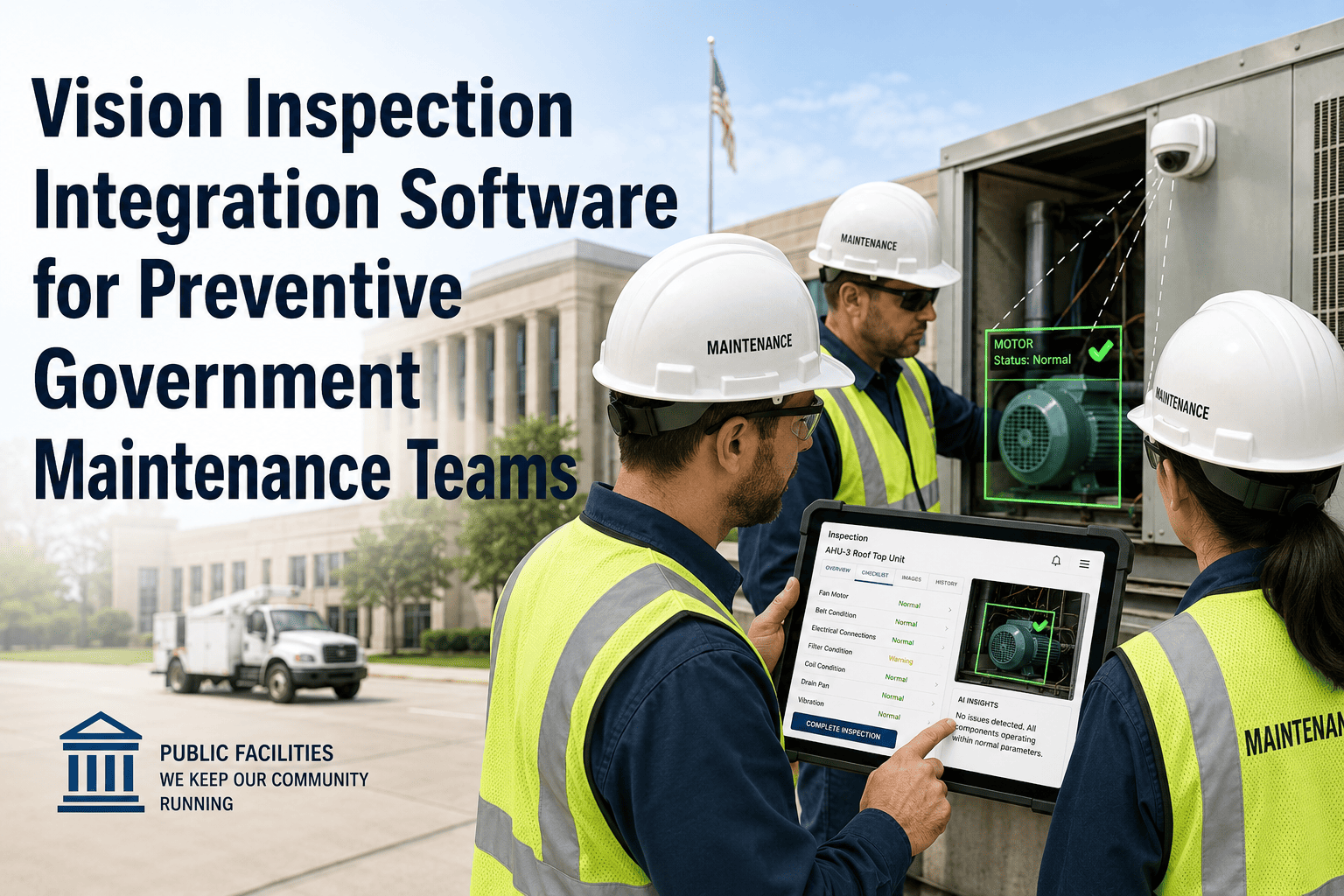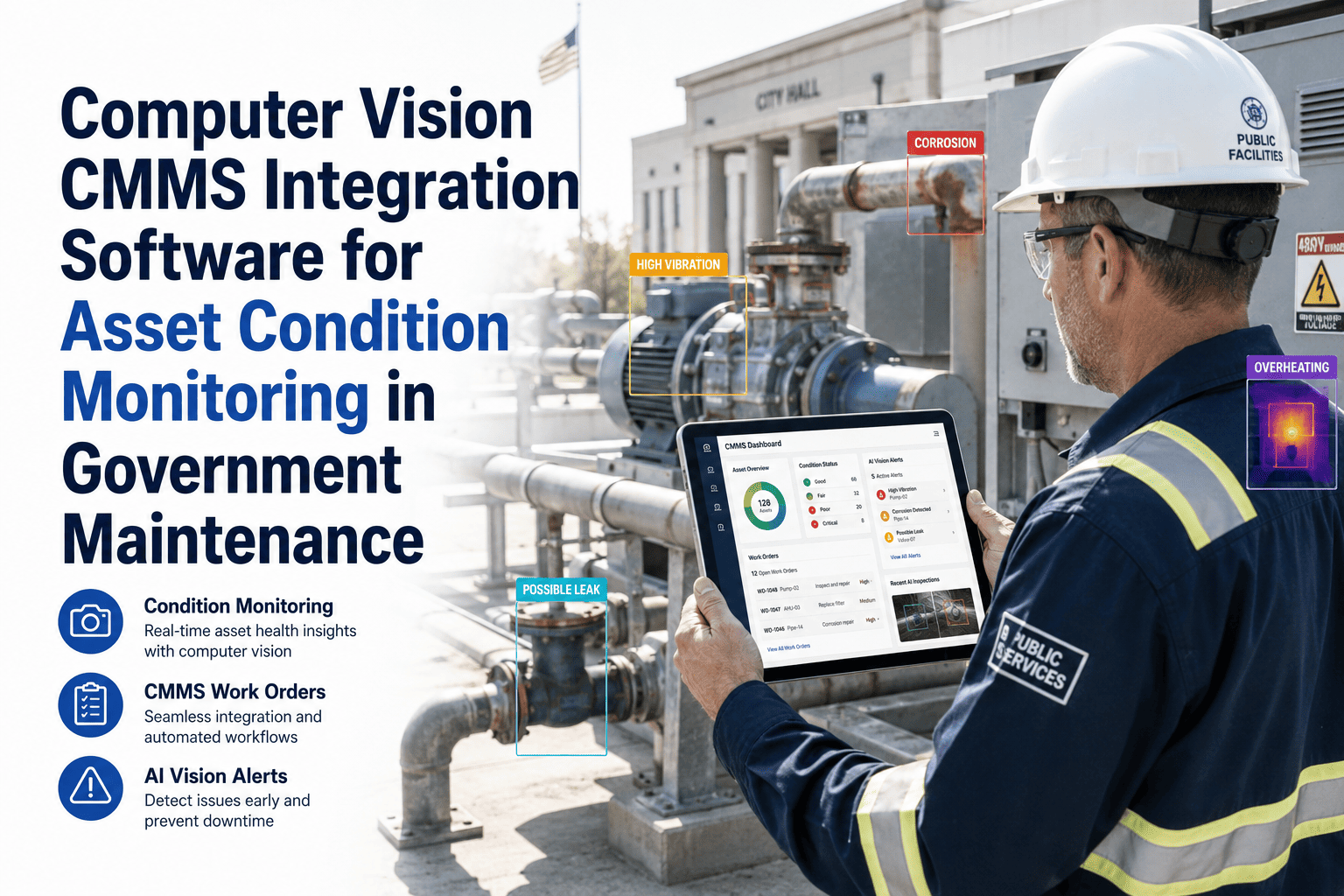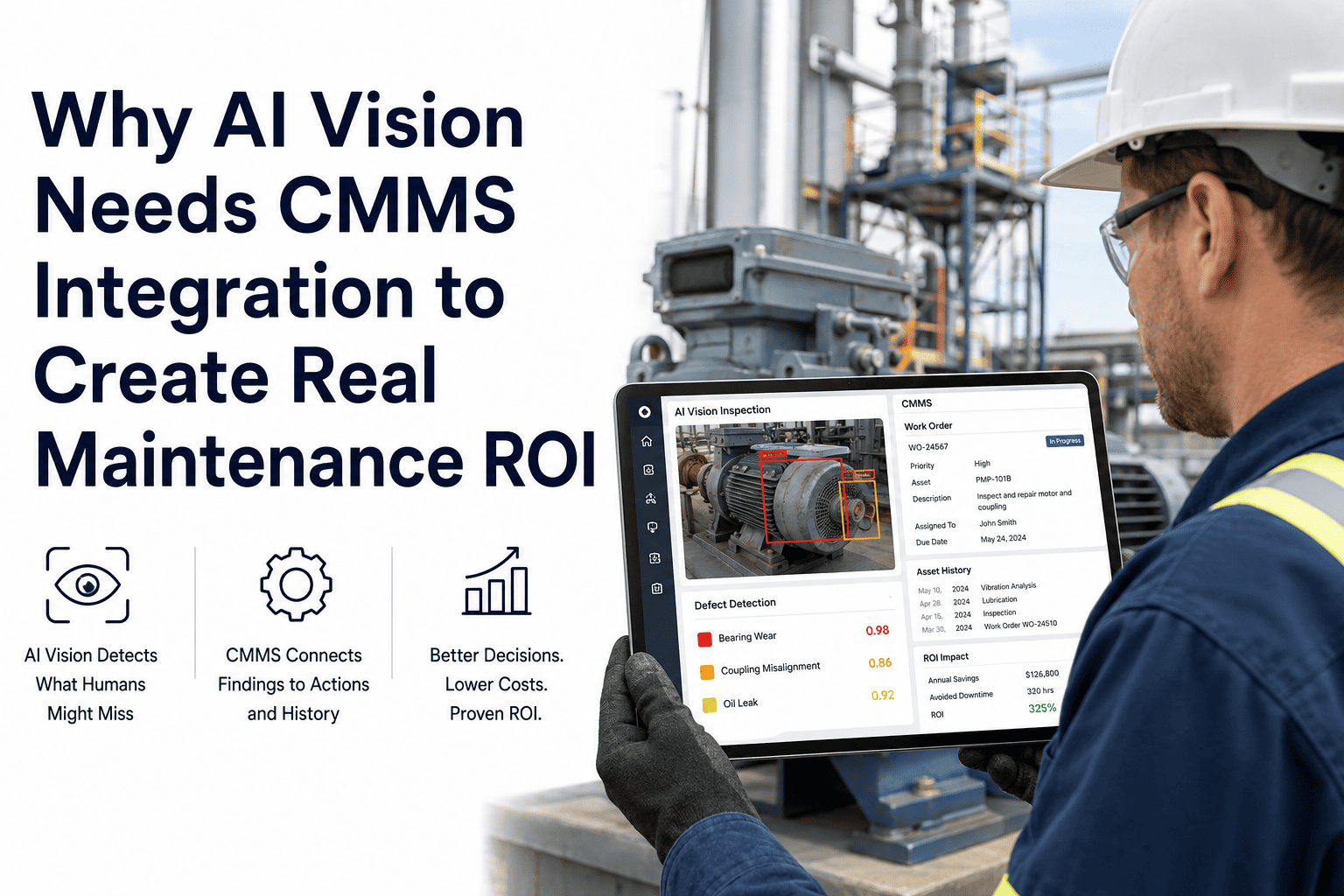
A government water utility deployed 47 AI-vision cameras across pump stations to detect leaks, vibration anomalies, and equipment overheating. Within six months, the cameras had generated 12,400 detection events. Field crews had closed out 312 of them. The other 12,088 sat in a cloud bucket nobody had time to triage — because the AI was detecting problems faster than humans could read emails. This is the silent failure mode of AI vision in the public sector: the detection works, but without CMMS integration for government infrastructure, the alerts never become work orders, the work orders never become fixes, and the fixes never become compliance records. Oxmaint's AI vision and work order automation engine closes the loop — turning every camera detection into a routed work order, every fix into an audit-ready record, and every dollar of vision spend into measurable ROI a city council can defend at budget time.
Why AI Vision Needs CMMS Integration to Create Real Maintenance ROI
A camera that detects a problem nobody acts on is just expensive data. Government agencies are deploying AI inspection at record pace — and discovering that without a CMMS routing layer, 70–80% of detections never reach a technician.
The Hidden Failure Mode of Government AI Vision Programs
Public sector agencies have moved fast on AI vision — bridge inspection drones, traffic camera analytics, pump station monitoring, and substation thermal imaging are now routine procurement line items. The technology works. Detection accuracy on cracks, corrosion, leaks, and structural fatigue routinely exceeds 95%. The hidden failure is on the back end: an alert that doesn't become a routed, prioritised work order assigned to a named technician with a deadline doesn't generate value. It generates liability — a documented detection that an agency knew about and didn't act on.
The Five-Layer Integration That Closes the Loop
Real ROI from AI vision in government maintenance requires a five-layer integration architecture — not just a vision platform and not just a CMMS, but an explicit chain connecting detection to documented resolution. This is the architecture OxMaint's work order automation for public works operates on every government deployment.
Government Application Areas Where the Loop Matters Most
AI vision in public works covers wildly different asset classes — but the integration logic is universal. Wherever a camera generates a detection, a CMMS must route it, a technician must close it, and a record must survive an audit. Predictive maintenance for municipal assets only works when these four pillars are present.
Your AI Vision Investment Pays Back Only When Every Detection Becomes a Closed Work Order
OxMaint connects directly to the major AI vision platforms used in government — turning detection events into routed, prioritised, asset-linked work orders within seconds of the alert. No manual re-entry, no spreadsheet triage, no compliance gaps.
Live AI Detection Feed — Integrated With OxMaint Work Orders
This is what a closed-loop AI vision deployment actually looks like in production: every detection arrives with a confidence score, an asset link, and an auto-created work order number. The supervisor sees outcomes, not raw camera feeds.
The Compliance Audit Trail: Why Government Maintenance Needs the Loop Sealed
In private sector maintenance, a missed work order is a cost issue. In government maintenance, it is a public records issue. A complete CMMS audit trail for government maintenance means every AI detection produces a sealed evidence chain — from the moment the camera saw the issue through to the final closure photo, every step is timestamped, named, and exportable.
The ROI Math for an Integrated Government AI Vision Program
Public sector procurement runs on documented payback. The integration math is straightforward: vision spend without CMMS routing returns nothing on most detections; the same vision spend with CMMS routing returns value on nearly every detection. The computer vision inspection ROI math below uses real government deployment benchmarks.
KPIs That Prove the Integration Is Working
A government agency cannot defend a vision program at budget time with detection counts alone. The KPIs that prove the loop is closed are operational and financial — and OxMaint surfaces all six on a single dashboard.
Detection-to-Work-Order Conversion
Percentage of AI vision detections that auto-generate a routed work order within 60 seconds of the alert. Below 75% means the integration layer is broken or threshold tuning needs review.
Closure Within SLA
Percentage of vision-triggered work orders closed within their priority-defined SLA window. The single most important compliance metric — and the hardest to fake in an audit.
False Positive Rate
Percentage of AI detections marked "no action required" after field inspection. High false-positive rates burn out crews and erode trust in the system — OxMaint feeds this back to vision model tuning.
Mean Time to Acknowledgement
Average time from detection to named technician acknowledgement of the work order. Below 15 minutes for P1 alerts is the public-sector benchmark for credible response posture.
Audit Chain Completeness
Percentage of closed work orders with complete digital evidence chain — detection image, GPS, technician signature, closure photo. Anything below 100% is a compliance exposure.
Avoided Cost to Platform Cost
Ratio of documented avoided expenditure (deferred replacements, prevented incidents, reduced overtime) to combined AI vision + CMMS platform cost. The number that defends the program at budget hearings.
Expert Review — A Voice From Public Works AI Deployment
After deploying AI vision across 60 pump stations in our utility district, I learned the most important lesson in public sector technology procurement: the camera is the cheapest part of the system. The expensive part — the part that determines whether the program succeeds or quietly dies in a council meeting — is the work order layer underneath. Vision platforms generate alerts at a rate no human team can triage manually. Without an integrated CMMS auto-creating routed, asset-linked work orders the second the detection fires, you are paying for a very expensive observation system that nobody reads. We saw our detection-to-resolution ratio jump from 19% to 91% the month we connected the vision stack to OxMaint. The ROI was real — but more importantly, the audit trail finally existed. That alone justified the entire integration cost.
Frequently Asked Questions
How does OxMaint integrate with existing AI vision platforms a government agency has already deployed?
OxMaint connects through standard API patterns — REST webhooks, MQTT message streams, and direct integrations with the major industrial vision platforms used in public works procurement. When a detection event fires, the vision platform pushes a payload containing the confidence score, image, GPS coordinates, and detection class into OxMaint, which then auto-creates a work order tagged to the correct asset hierarchy and routed to the right craft. No vision platform replacement is required. Agencies can book a demo to walk through the specific integration path for their existing vision stack.
What happens to the AI vision alerts that don't warrant a work order — do they get lost?
No detection is ever discarded. OxMaint logs every incoming vision event, whether it triggers a work order or not. Low-confidence or low-severity detections are recorded as observation events against the asset record with timestamp and image — visible in the asset history but not assigned to a technician. This protects the agency on two fronts: (1) the audit chain is complete, showing the AI system was operating and logging events, and (2) the data feeds back into vision model tuning to reduce false positives over time. Sign in to OxMaint to see the observation event log on a live asset.
How does an integrated AI vision + CMMS system satisfy a FOIA or state DOT audit request?
A public records request typically asks for "all detections of issue X at asset Y between dates A and B, and the agency's response to each." In a vision-only deployment, this requires hunting across the camera platform's archive, manually cross-referencing the work order spreadsheet, and producing a narrative explanation of gaps — a process that can take weeks. In an integrated OxMaint deployment, the entire chain is one filtered export: detection event, work order, dispatch record, completion evidence, and closure timestamp. The audit response goes from weeks of legal exposure to a single PDF export. Book a demo to see the audit export workflow.
What is the typical implementation timeline for a government agency adding CMMS integration to existing AI vision?
For an agency with AI vision already deployed and asset data available, integration typically completes in 4–8 weeks. Weeks 1–2 cover OxMaint asset hierarchy build and vision platform API connection. Weeks 3–4 cover work order routing rules, priority thresholds, and SLA configuration per asset class. Weeks 5–8 cover pilot deployment, false-positive tuning, and field crew onboarding. Most agencies see their first auto-created work orders flowing within Week 2, with full SLA reporting active by Week 6. Start free in OxMaint to begin the asset hierarchy build today.
How do I justify the integration spend at a public budget hearing when the AI vision platform is already approved?
The budget argument is straightforward: the agency has already spent on AI vision; without CMMS integration, roughly 78% of that spend produces no field response and therefore no avoided cost. The integration layer is what converts vision spend from a documentation system into a maintenance system. Council members understand this framing immediately — they have already paid for the cameras, and the integration is what makes the cameras useful. The typical narrative includes the detection-to-resolution ratio before and after, the documented audit response time improvement, and one or two avoided-incident examples. Book a demo to receive a budget hearing template.
Every AI Detection Without a Work Order Is a Liability Waiting to Be Audited.
OxMaint turns AI vision detections into routed, asset-linked, SLA-tracked work orders with sealed audit trails — making your government vision investment finally pay back the way the procurement deck promised it would.